
Goth Capsule Wardrobe: An All-Black Base With Real Range
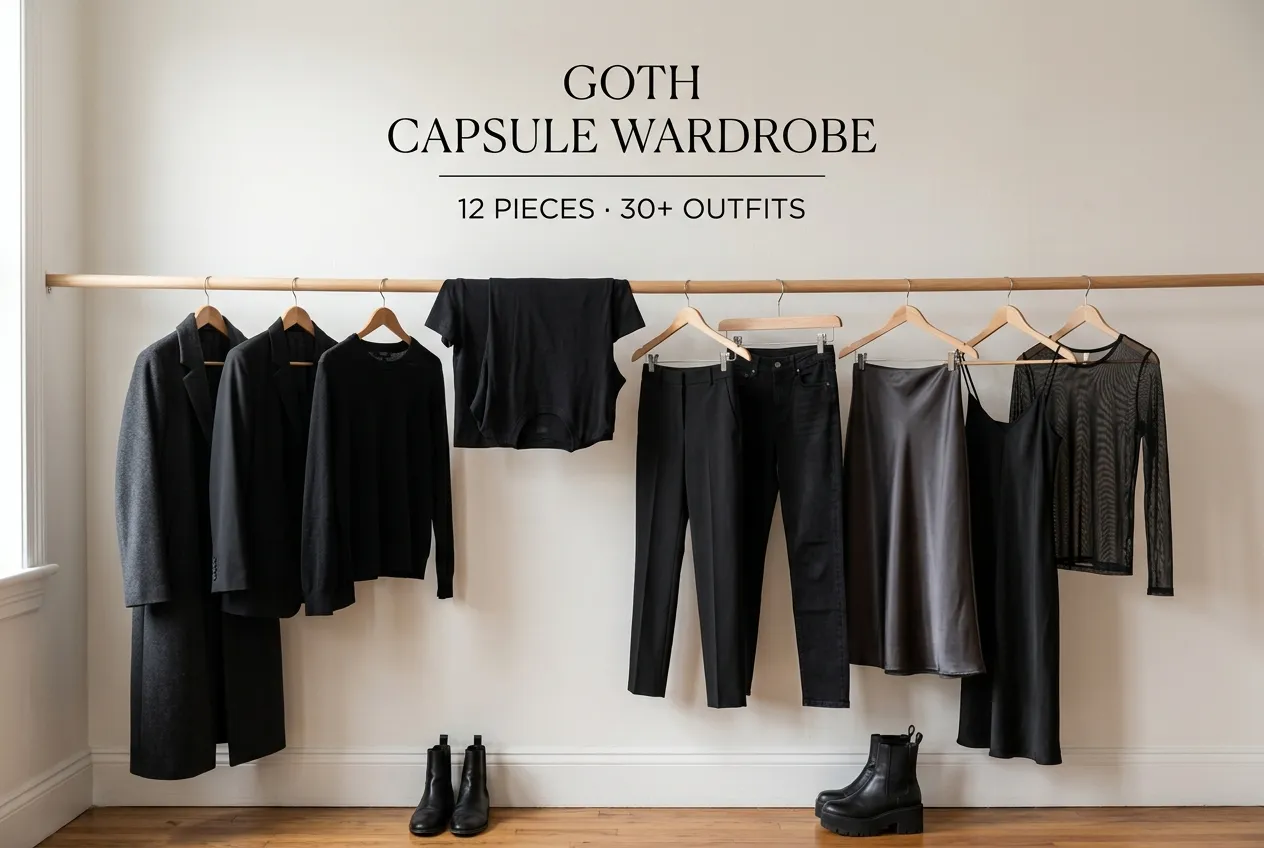
A goth capsule wardrobe fails for one reason, and it usually is not the clothes. It’s that fourteen black pieces bought at fourteen different moments never quite agree with each other. One reads blue in daylight. One has gone soft and gray at the shoulders. One is a heavier weave than everything it sits next to. You end up with a closet that is technically all black and still impossible to dress from.
Here’s what actually fixes it: twelve pieces chosen to a shared standard, two boot options, and a small set of accessories that swing the whole look from Tuesday errand to Friday night. That’s it. Below is the exact build, the outfit grid, and the one matching trick almost nobody mentions.

What a Goth Capsule Wardrobe Actually Fixes
A capsule is a small set of clothes chosen so every piece works with most of the others. The goth version applies that logic to a dark palette, which sounds easier and is genuinely harder. Neutrals like oat and camel forgive a lot. Black doesn’t. It shows every mismatch in undertone, sheen, and wear.
So the payoff is bigger. When a dark capsule is built correctly, you stop styling and start assembling. Grab a bottom, grab a top, grab a layer, and it works, because it was designed to work before you ever opened the closet.
This is also the moment to name what this article is not doing. It’s not asking you to soften the aesthetic into something more palatable. Plenty of “wearable goth” advice is really just asking you to wear gray. The pieces below stay dark. They’re simply built to hold up across a real week, the same way building a vintage-inspired capsule wardrobe with retro soul keeps the romance and drops the costume.
Worth knowing: Pinterest named a romantic goth revival one of its 2026 trends, describing an after-dark aesthetic that leans elegant rather than theatrical. If your feed has felt more velvet and less spikes lately, that’s why.
The 12-Piece Dark Base
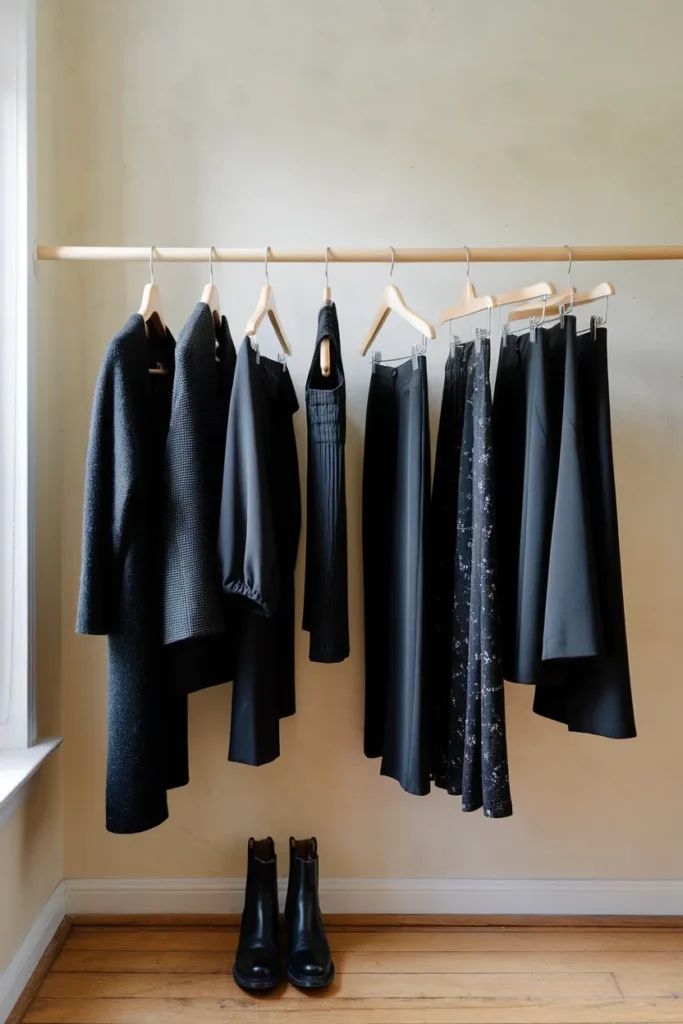
Twelve is the number I keep landing on. It’s enough to avoid outfit repeats inside a week, small enough that every piece stays in rotation, and it leaves room for two or three items that exist purely because you love them.
Front-load your budget on the first item in this list. It does more work than anything else you own.
1. A long dark coat. Charcoal or true black, mid-calf or longer, wool or a wool blend. This is the piece people see. A coat with clean shoulders and a bit of weight to the hem reads expensive at any price point, and it turns a plain tee-and-trousers combination into a complete look from across the street. Massimo Dutti and COS both cut this silhouette well, generally in the $200 to $400 range, and Quince has undercut it recently in wool blends closer to $100 to $180. If you want a fuller breakdown, choosing a wool coat that earns its hanger space covers fabric weight and fit in more detail.
2 and 3. Two black tees, different weights. One heavier and opaque with a slightly boxy cut for layering under everything. One finer and closer to the body for wearing under a blazer or on its own. Uniqlo and Everlane both do this in the $20 to $50 band. Buy the same two again when they fade, and don’t overthink it.
4. A fine-gauge black knit. Crewneck or mock neck, thin enough to sit under a coat without bulk. Merino if you can, cotton if not. This is your November through March default.
5. Black tailored trousers. Wide-leg or straight, full length, in a fabric with drape rather than stiffness. Banana Republic and J.Crew sit around $90 to $150. These carry you into offices, dinners, and anywhere a boot needs a long line above it.
6. Black jeans. Rigid or lightly stretched, in the darkest wash you can find. Madewell’s typically run $98 to $138. Everything here rests on whether they’re actually black rather than very dark gray, which brings us to the next section.
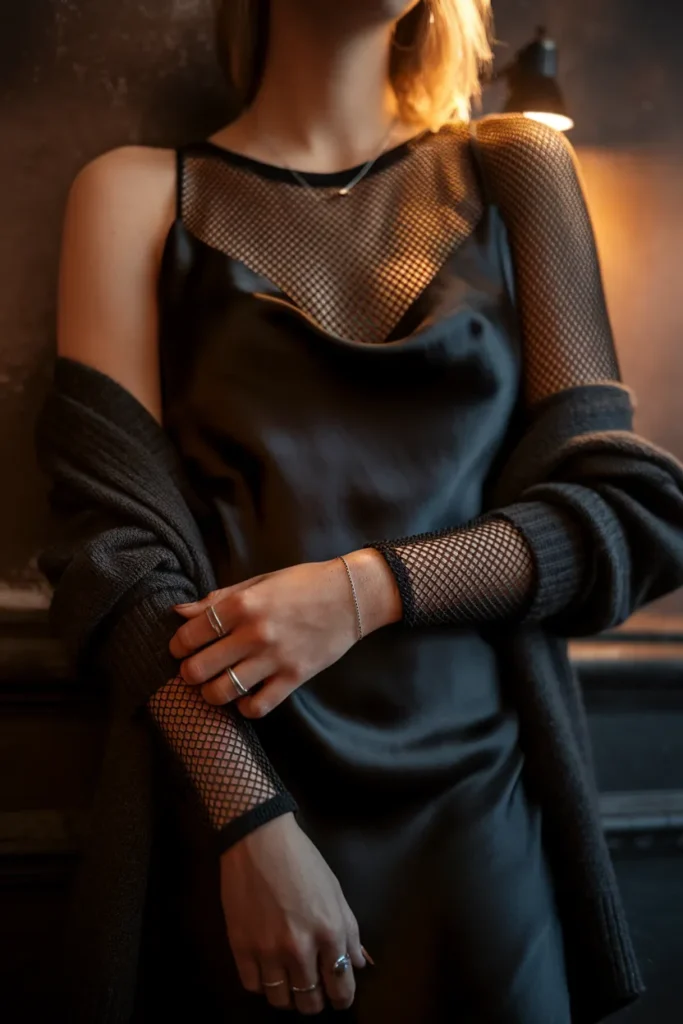
7. A black midi skirt. Bias-cut satin, heavy jersey, or a pleated crepe. The satin option is the most versatile piece in the whole capsule because it changes character completely depending on what’s above it: a chunky knit makes it casual, a sheer top makes it evening.
8. A slip dress. Black, midi length, adjustable straps. Wears alone in summer, layers over a long-sleeve tee in fall, layers under an oversized cardigan in winter.
9. A black blazer. Slightly oversized, single-breasted, no shine. Structure is the entire point. It’s what turns a slip dress into something you can wear to dinner with your partner’s parents.
10. A leather or leather-look jacket. Cropped or hip-length, silver hardware rather than gold. Gold warms the palette and fights everything else.
11. A textured layer. Velvet blazer, mesh long-sleeve, lace-trim cardigan, whatever version of texture speaks to your particular corner of the aesthetic. One is enough. Two is a wardrobe theme.
12. Your one loud piece. A corset top, a floor-length duster, a sheer paneled shirt, a pair of platform boots. Every capsule needs one item that exists for joy rather than logic. Mine changes about once a year.
Accessories sit outside the twelve. They repeat constantly, so counting them distorts the math.
Why Your All-Black Outfits Look Flat (the Black Families Method)
This is the part no other guide will tell you, and it’s the single highest-value thing on this page.
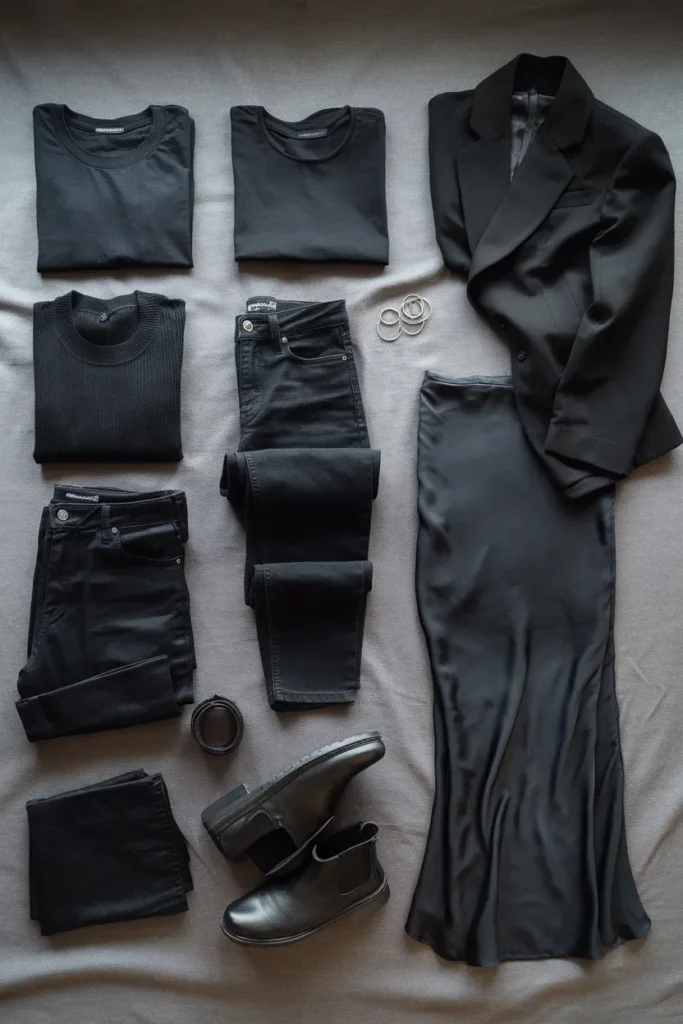
Black is not one color. Dyes and fibers push it in different directions, and once you see it you can’t unsee it. There are four families:
- Blue-black. Cool, slightly inky. Common in cotton, denim, and most synthetics.
- Brown-black. Warm, faintly soft. Common in wool, suede, and a lot of leather.
- True black. Deep, neutral, no cast. Common in silk, satin, high-quality wool crepe, and good dyeing generally.
- Faded black. Washed toward charcoal or dusty gray. Every black garment ends up here eventually.
Mixing families randomly is why an all-black outfit sometimes looks pulled-together and sometimes looks like laundry. A blue-black cotton tee against a brown-black wool trouser is a visible clash in daylight, even though your brain files both as “black.”
The method, in three steps:
- Sort in daylight, not closet light. Carry every black piece you own to a window. Lay them on white if you have it. The families separate immediately.
- Pick one family as your anchor. Whichever you own the most of. For most people it’s blue-black, because cotton dominates.
- Break the difference on purpose. When you do want to combine families, put a hard visual break between them. A belt, an untucked layer, a jacket that separates the top from the bottom. Difference reads as deliberate when there’s a boundary, and as a mistake when there isn’t.
There’s a fourth move, which is to stop pretending everything is black. A brown-black wool trouser worn with an espresso knit is a tonal outfit, and tonal outfits are more expensive-looking than flat ones. Faded black is likewise a color in its own right if you commit to it as charcoal rather than fighting it. The logic is identical to how to add color without losing cohesion, just compressed into a narrower range.
Texture Does the Job Color Usually Does
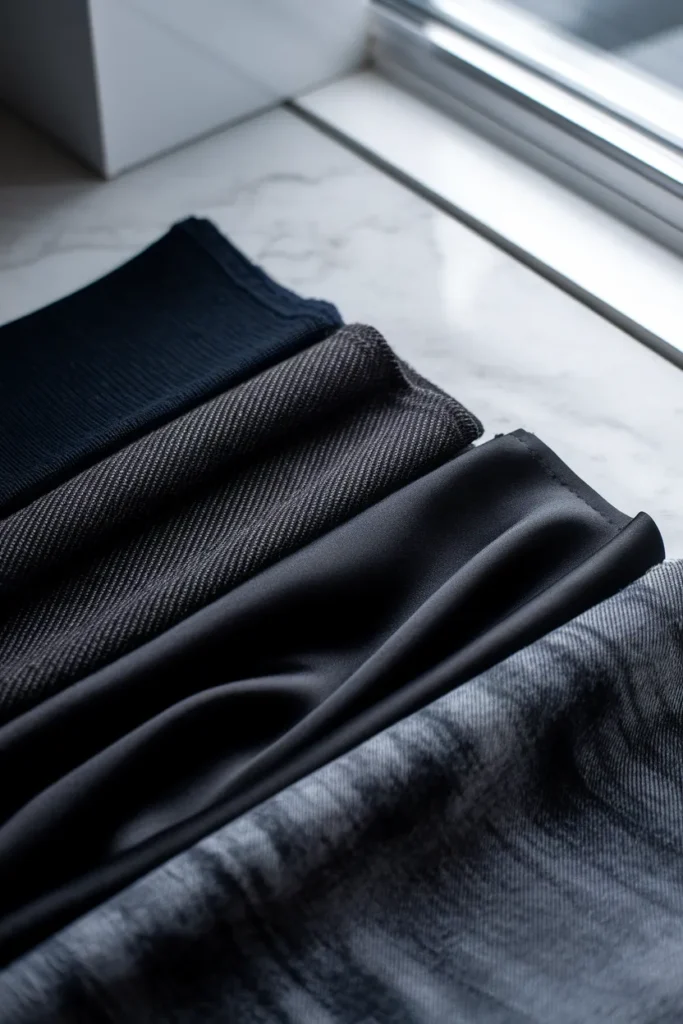
In a normal capsule, variety comes from color. Remove color and texture has to carry the entire load, which is why goth outfits built on flat cotton look thin and goth outfits built on mixed surfaces look rich.
Think of it as three surface types, and try to get at least two into every outfit:
- Matte. Cotton jersey, wool, crepe, suede, brushed knits. Absorbs light.
- Lustrous. Satin, silk, leather, patent, sequin. Reflects light.
- Open. Mesh, lace, sheer chiffon, loose knit, fishnet. Lets light through.
A black tee with black jeans and black boots is three matte surfaces, and it reads flat no matter how well it fits. Swap the tee for satin and the same outfit lifts instantly. Add a mesh sleeve underneath and it lifts again.
Sheen has one rule attached: keep it below shoulder height or above the waist, rarely both. Head-to-toe reflective surfaces stop reading as clothing and start reading as costume, and there’s a real difference between the two when you’re standing in a grocery store on a Tuesday.
Boots, and the Two Pairs That Cover Everything
Footwear is where a dark capsule usually overspends. You need two pairs.
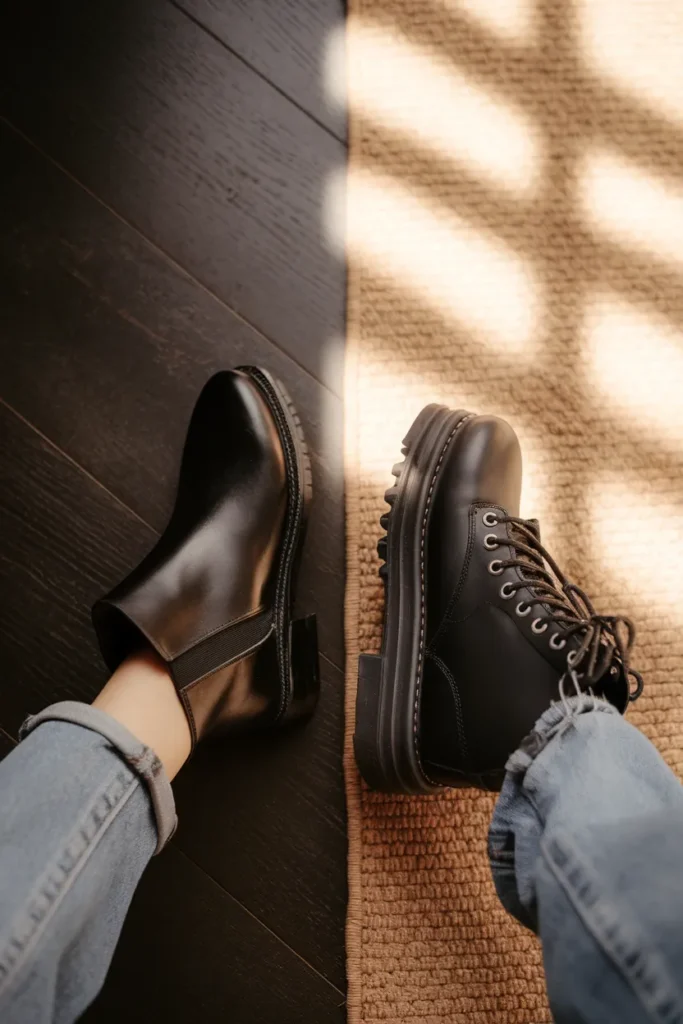
Pair one: a flat black leather ankle boot. Almost no hardware, a low block heel or none, a clean toe. This is the boot that goes to work, to dinner, and under trousers without announcing anything. It’s the highest-mileage shoe in the capsule and worth the largest share of your footwear budget. The best ankle boots for a capsule wardrobe walks through shaft height and toe shape in more detail, and the same fit rules apply here.
Pair two: your statement boot. Combat, platform, tall shaft, buckle-heavy, whatever version of loud you actually want. It exists to change the register of an outfit that’s otherwise quiet.
That’s the whole system. A knee boot is a nice third if you wear a lot of skirts. Most people don’t need one.
One fit note that matters more with dark clothing: check where the boot shaft ends against your leg. A shaft that stops mid-calf visually cuts the leg at its widest point, which changes the proportion of every skirt and dress in your capsule. If you’re petite, a shorter shaft that sits just above the ankle bone keeps the line unbroken. If you’re tall, you have more room to play with a mid-shaft height. It’s about how the line works with your proportions, not about hiding anything.
Corporate Goth: Dark Dressing Inside a Dress Code
Search “professional goth” and “gothic business casual” on Pinterest and you’ll find enormous demand and almost no practical guidance. So here’s the practical guidance.
Most dress codes don’t actually prohibit black. What they flag is a short list of specific signals, and once you know the list you can navigate around it while keeping the palette entirely intact.
| The signal | What triggers it | The dark swap that reads fine |
|---|---|---|
| Visible hardware | Buckles, studs, chains, D-rings | Silver jewelry instead, kept small |
| Sheer skin | Mesh or lace showing skin directly | Sheer over an opaque base layer |
| Aggressive footwear | Heavy lug soles, tall platforms | Flat leather ankle boot, clean toe |
| Graphic imagery | Band tees, printed symbols | Solid textures: velvet, satin, ribbed knit |
| Restrictive silhouettes | Corsetry worn as a top | Structured blazer over a fitted knit |
The pattern underneath: structure passes, hardware doesn’t. A black wool blazer over a black mock-neck knit with black tailored trousers is a fully monochrome outfit that no HR handbook in the country has an opinion about. Add the flat ankle boot and you’re done. Add one silver ring and a matte oxblood lip and the aesthetic is fully present without a single item that could be flagged.
Nine of the twelve base pieces above clear a business-casual code as written. If you’re building the work half of your closet with more intention, a business professional wardrobe that actually mixes and matches covers the structural pieces in depth, and every recommendation in it works in black.

Accessories: the Fastest Outfit Multiplier You Own
Same twelve pieces, four completely different moods, and the clothes never changed. Accessories are how a small capsule stops feeling small.
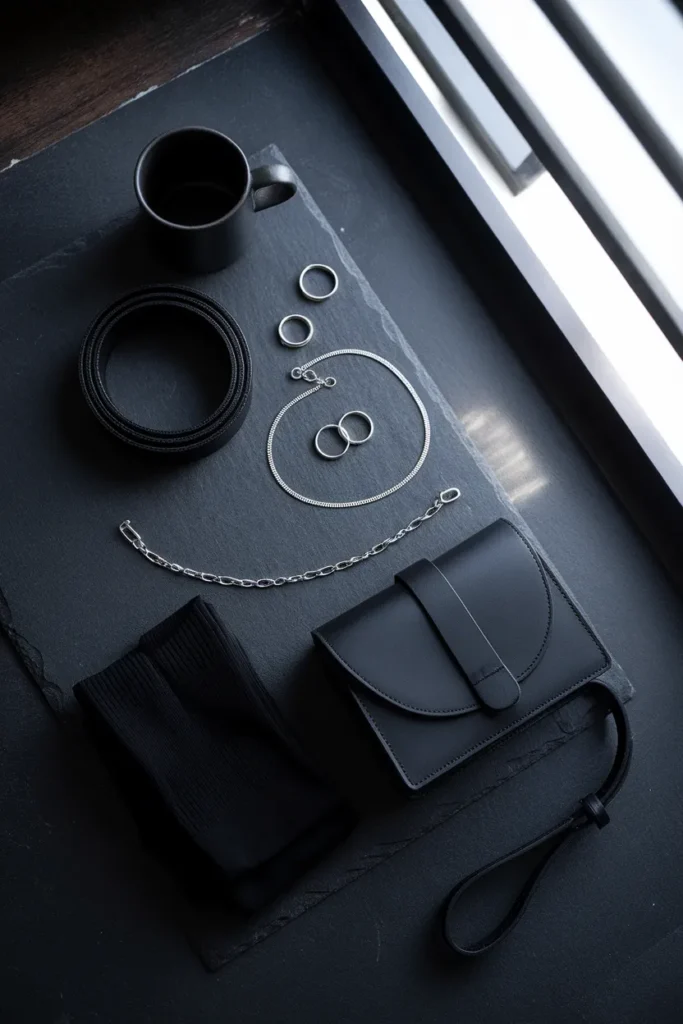
Keep the metal consistent. Silver, pewter, gunmetal, oxidized: pick one direction and stay there. Mixed metals against black look accidental in a way they don’t against neutrals.
The working set:
- Silver rings, stacked. The single highest-impact accessory in dark dressing. Two on one hand, one on the other, and every gesture carries the aesthetic.
- A black leather belt with a plain silver buckle. Reshapes a slip dress, defines a coat, tucks a shirt into meaning something.
- A structured black crossbody. Structure over slouch. A soft bag against soft clothing collapses the whole silhouette.
- Opaque black tights, 60 to 80 denier. They turn every summer skirt and dress into a fall and winter piece, and they’re the cheapest range-extender you will ever buy.
- One neck piece. A thin choker, a heavy chain, a small pendant. It sets the register of the whole outfit before anyone looks lower.
Skip the tempting fifth and sixth version of each. An accessory drawer with forty things in it produces fewer outfits than one with eight, because you stop being able to see any of them.
Summer Goth Without Overheating
Black absorbs heat, so the July version of this wardrobe is a fabric problem rather than a color problem.
Three adjustments do most of the work:
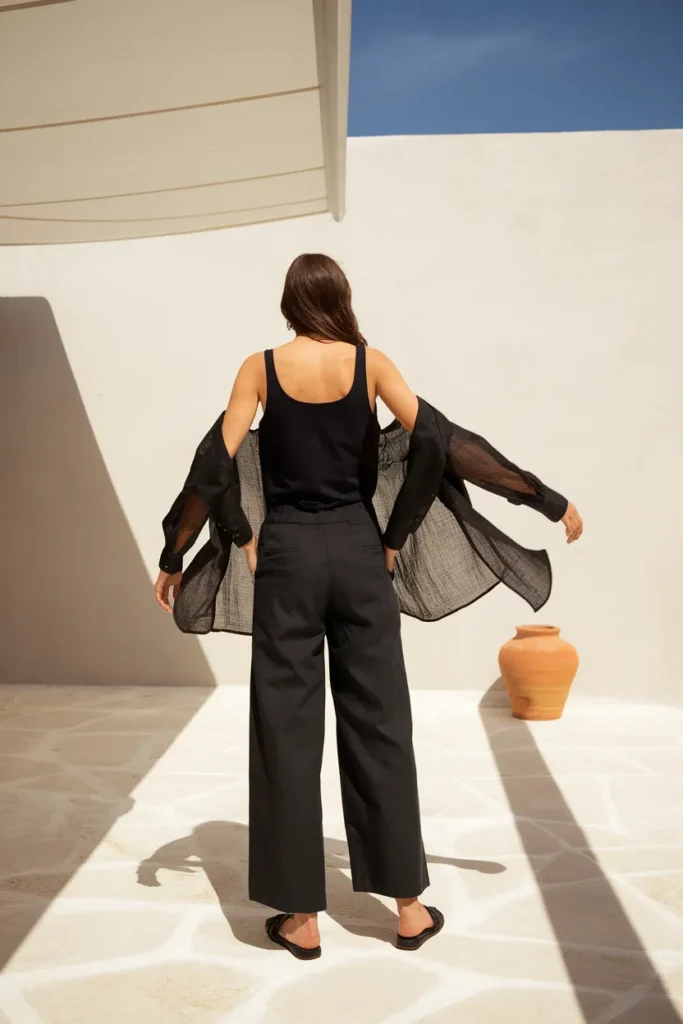
Change the fiber, keep the color. Black linen, black cotton voile, black rayon challis, and black silk all sit far cooler than black jersey or black synthetic knit. Linen in particular wrinkles into something that looks intentional and moves air constantly.
Change the fit. Loose beats fitted in heat, and a wide black linen trouser with a black tank is cooler than black shorts in a dense cotton. Air moving under fabric matters more than how much skin is showing.
Change the layer count, not the layer idea. A sheer black overshirt worn open gives you the silhouette of a layered outfit while functioning as shade. Mesh does the same and dries fast.
Two pieces from the twelve carry summer almost single-handed: the slip dress, worn alone with the flat boot or with flat sandals, and the satin midi skirt with a plain black tank. Both are one-decision outfits on the mornings when it’s already 88F at nine.
If you’d rather build one closet that handles all four seasons instead of splitting into seasonal capsules, a 30-piece year round capsule that works in every season lays out the swap logic, and the same structure holds if you run the whole thing in black.
Keeping Black Black
A dark capsule has one maintenance problem that a neutral capsule doesn’t. Black fades, and faded black is the fastest way to make a careful wardrobe look tired.
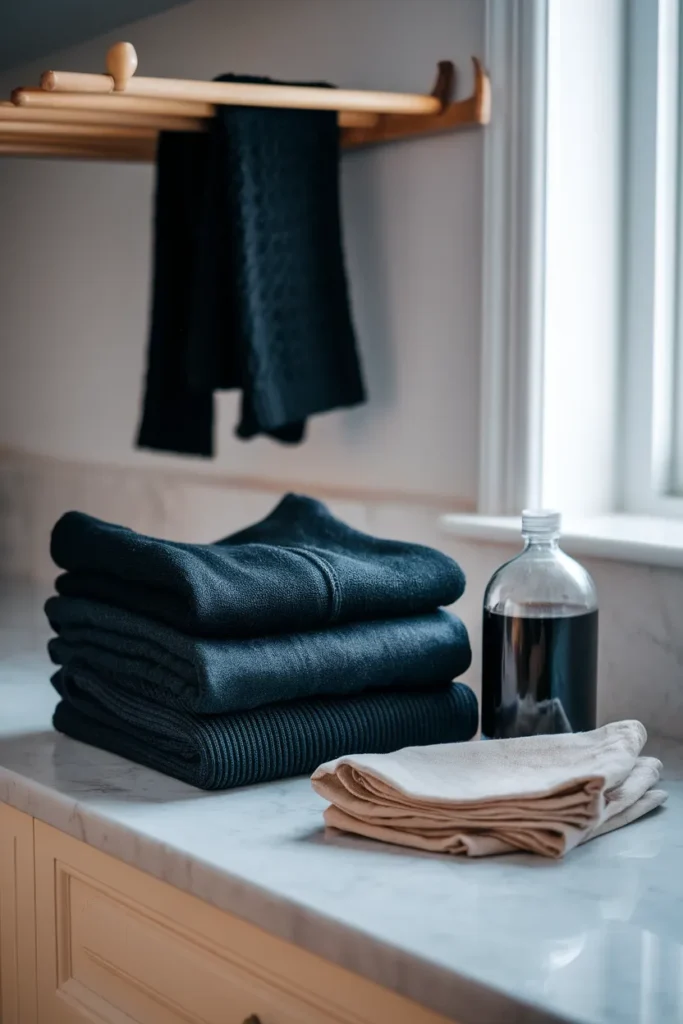
What actually causes it: hot water, agitation, sun-drying, and detergent with optical brighteners. Not time. Time is only the thing you blame.
The routine, which takes no extra effort once it’s habit:
- Wash cold. Always. Warm water opens fibers and releases dye.
- Turn everything inside out. Fading happens mostly through surface abrasion against the drum.
- Use a detergent without brighteners, and use less than the cap suggests. Residue is what dulls dark fabric to gray.
- Dry away from direct sun. UV bleaches black faster than washing does.
- Skip the dryer on anything you care about. Heat plus tumbling is the worst combination for dye retention.
- Wash black cotton less often than instinct says. Air it out overnight and wear it again.
Fiber matters as much as routine. Wool, silk, and good polyester hold black for years. Cotton jersey is the fastest fader in any closet, which is exactly why the two black tees in the base are the pieces you plan to replace rather than protect.
One practical note on shopping: the fiber content and care instructions on a garment label are regulated, and the FTC’s apparel labeling rules require manufacturers to provide care instructions on textile apparel sold in the US. So the label is a real data point rather than a suggestion. Reading it before you buy tells you whether a black piece will still be black in two years.
The Outfit Grid: 12 Pieces, 30 Outfits
Screenshot this one. Every row is a real combination from the base twelve.
| # | The formula | Reads as |
|---|---|---|
| 1 | Heavy tee + black jeans + flat boot | Weekend errands |
| 2 | Heavy tee + tailored trousers + blazer + flat boot | Business casual |
| 3 | Fine tee + satin midi + flat boot | Dinner |
| 4 | Fine tee + satin midi + leather jacket + statement boot | Night out |
| 5 | Knit + tailored trousers + long coat + flat boot | Cold weather work |
| 6 | Knit + black jeans + statement boot | Casual fall |
| 7 | Knit tucked into satin midi + belt + flat boot | Elevated everyday |
| 8 | Slip dress alone + flat boot | Summer default |
| 9 | Slip dress + heavy tee underneath + statement boot | Transitional |
| 10 | Slip dress + blazer + flat boot | Dressy work |
| 11 | Slip dress + knit over top, worn as a skirt + boot | Layered fall |
| 12 | Slip dress + tights + leather jacket + statement boot | Winter evening |
| 13 | Textured layer + tailored trousers + flat boot | Quiet drama |
| 14 | Textured layer + black jeans + long coat | Everyday with edge |
| 15 | Blazer + fine tee + black jeans + flat boot | The universal outfit |
Fifteen formulas, and each one shifts again with tights, a belt, a different neck piece, or the coat added on top. That’s how twelve pieces clears thirty outfits without repeating in any way anyone notices.
Frequently Asked Questions
What is a goth capsule wardrobe? It’s a small, deliberately chosen set of dark clothing where every piece coordinates with most of the others. The color palette is anchored in black and dark neutrals, silhouettes repeat rather than compete, and layering and accessories do the work that color does in a conventional capsule.
How many pieces do you need? Twelve clothing pieces plus two pairs of boots covers a full week without repeating, which is the version laid out above. Fifteen to twenty is more comfortable if your week spans an office, a gym, and a social life. Accessories aren’t counted, because they repeat constantly by design.
What are the essential pieces in a gothic wardrobe? A long dark coat, two black tees at different weights, a fine-gauge knit, black tailored trousers, black jeans, a black midi skirt, a slip dress, a black blazer, a leather jacket, one textured piece, and one item chosen purely because you love it.
Can you dress goth for work or a corporate office? Yes, and more easily than most people expect. Dress codes generally flag visible hardware, sheer skin, heavy footwear, and graphic prints rather than the color black. Swap in structure, keep jewelry small and silver, wear a flat leather boot, and a head-to-toe black outfit reads as polished.
How do you build a goth wardrobe on a budget? Buy the coat and the flat boot properly, since they’re seen most and worn hardest. Fill the middle from Uniqlo, Target, Old Navy, and H&M, where black basics run roughly $15 to $50 and the fabric trade-off is real but acceptable on pieces you’ll replace anyway. Thrift the outerwear and the loud piece, which are the two categories where secondhand consistently beats retail. Accessories last, because they’re the cheapest way to change how everything else looks.
What colors go with black in a goth capsule? Charcoal and pewter for tonal depth. Oxblood, plum, and deep espresso for warmth. Silver and gunmetal for hardware. One accent is plenty. Adding a second usually costs you more cohesion than it buys you variety.
How do you dress goth in summer without overheating? Keep the color, change the fiber. Black linen, voile, rayon, and silk stay dramatically cooler than jersey or synthetic knit. Go looser rather than shorter, since airflow matters more than skin exposure. A sheer overshirt worn open gives you a layered silhouette while working as shade.
Where to Start This Week
Don’t buy anything yet. Pull every black piece you own to a window and sort it into the four families. You’ll learn more about why your closet has been fighting you in twenty minutes than in a season of shopping.
Then pick your anchor family, note the two or three gaps in the twelve-piece list you genuinely don’t have, and let the rest wait. A dark capsule is one of the few wardrobes that gets better the slower you build it, because black is easy to buy and hard to match. Take the time. The version you assemble over six months will outlast anything you could put together this weekend.
Keep reading
Winter 2026 Fashion Trends Worth Your Closet Space
Every winter fashion trends 2026 roundup you have read so far has handed you a shopping list. Five trends here, twenty-three there....

Fall 2026 Fashion Trends: The Looks Worth Adding to Your Capsule
Every fall fashion trends 2026 roundup you’ve read this month has the same problem. It tells you satin is back, hands you...
Whimsigoth Outfits: Witchy, Romantic Style You Can Build From Your Fall Capsule
The first time whimsigoth outfits showed up in your feed, you probably saved four of them and then wore none. That is...