
Denim Jacket Layering: What to Wear Underneath From 40 to 70 Degrees
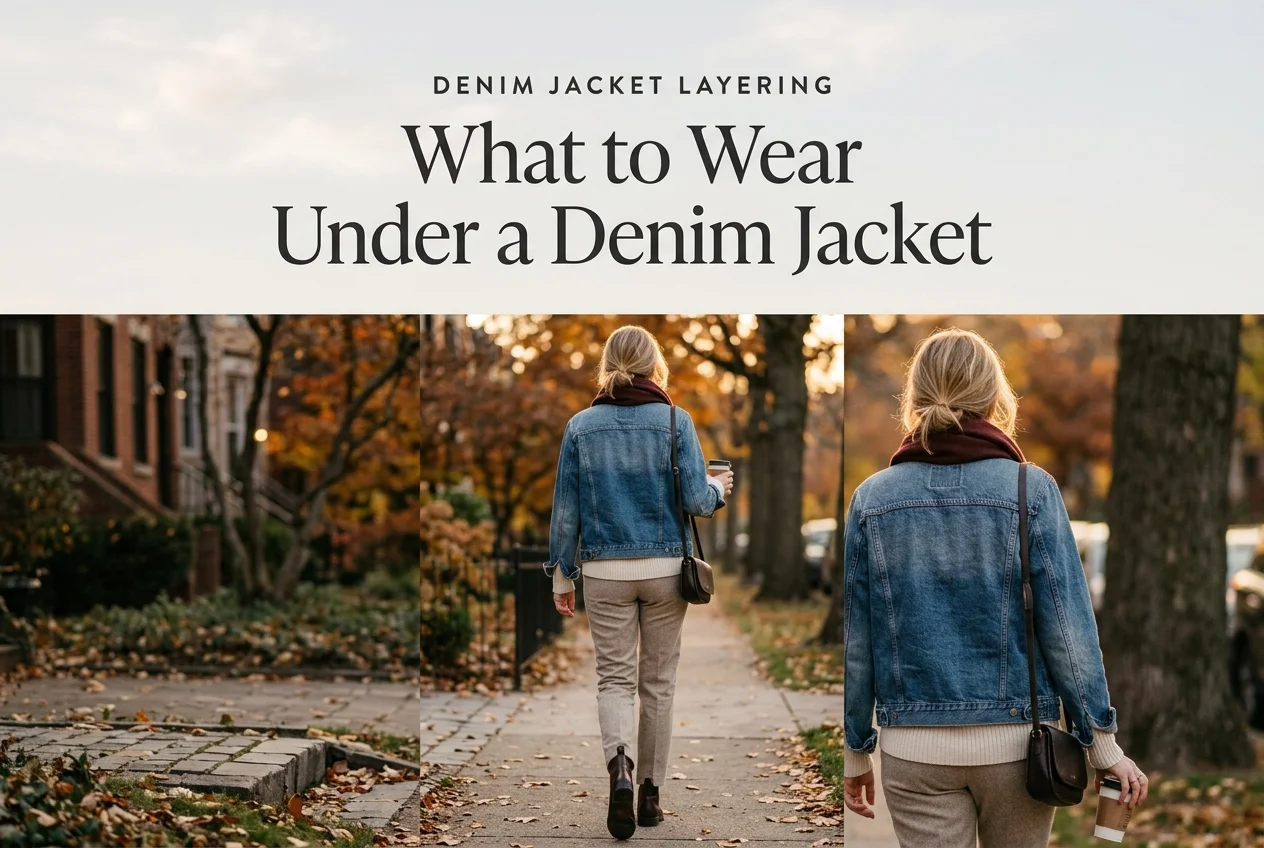
Denim jacket layering is where most good outfits quietly fall apart. You own the jacket. You like the jacket. Then it’s 52 degrees on a Tuesday, you throw it over whatever’s clean, and by 10am you’re either sweating through a sweater or standing outside with goosebumps wondering why this thing never seems to work when you need it to.
The problem isn’t the jacket. It’s that nobody ever tells you what goes underneath at a given temperature, so every morning turns into a small experiment. Below is the layering system I’d hand a friend who texted me from her closet: what to wear under a jean jacket from 40 all the way to 75 degrees, where the bulk actually comes from, and the two fixes that make a cheap jacket look considered.
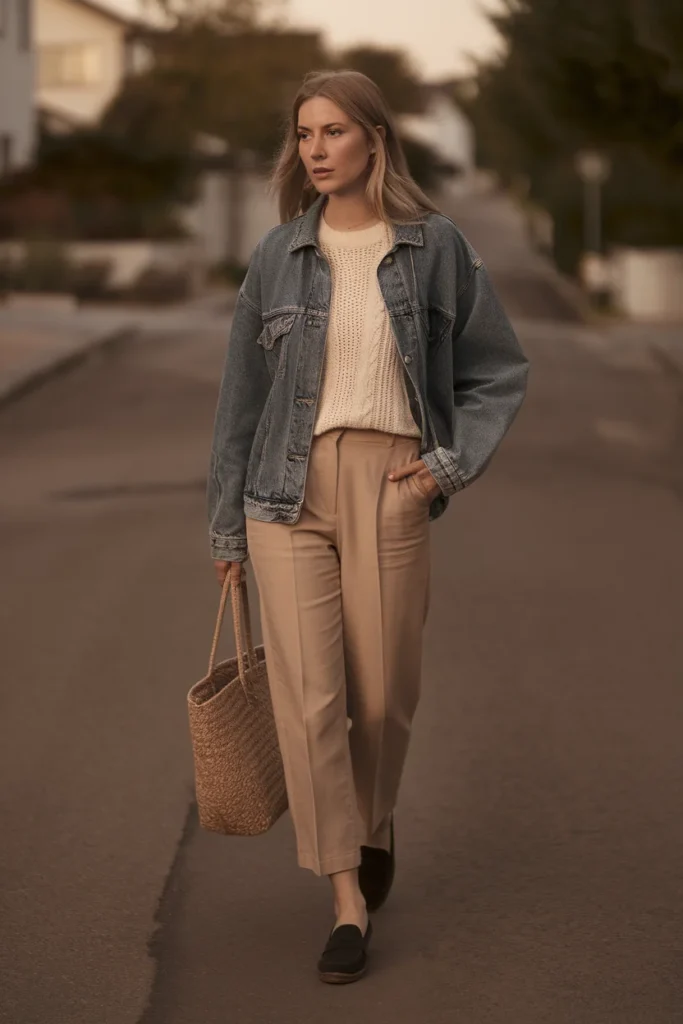
Your Jean Jacket Has a Narrower Temperature Range Than You Think
Here’s the thing nobody says out loud: a standard cotton trucker gives you roughly 8 to 10 degrees of warmth. That’s it. It blocks wind well, it holds almost no heat, and it has no insulation whatsoever.
So when you reach for it at 45 degrees expecting it to behave like a coat, it fails, and you decide the jacket is the problem. It isn’t. You just asked a windbreaker to do a parka’s job.
Once you accept that 8 to 10 degree budget, the whole thing gets easy. The jacket isn’t your warmth. Your base layer is your warmth. The denim is structure, shape, and wind protection sitting on top. If you want the pairing side of this covered in depth, the full denim jacket styling guide works through what to wear it with. This piece handles what goes under.
The Denim Ladder: Layering by Temperature
Screenshot this one. It’s the whole article in a box, and it turns a five-minute closet stare into a ten-second decision.
| Outside temp | Under the jacket | Over the jacket | Best bottom |
|---|---|---|---|
| 65 to 75°F | Tee, tank, or a thin cotton shirt | Nothing | Anything, including shorts and dresses |
| 55 to 65°F | Long-sleeve tee or fine-gauge knit | Nothing | Full-length denim or trousers |
| 45 to 55°F | Fine knit plus a scarf | Optional vest | Denim, lined trousers, midi skirt with tights |
| 40 to 45°F | Fine knit, jacket buttoned | Wool coat or trench over the top | Denim with tights underneath |
| Under 40°F | Jacket demoted to mid-layer only | Insulated coat, always | Whatever’s warmest |
Two rules make the table work. First, warmth comes from the layer touching your skin, never from the denim. Second, the moment you need a scarf and a sweater and the jacket buttoned, you’ve passed the jacket’s ceiling and it’s time to put a coat over it.
That last row surprises people. A denim jacket under a wool coat is one of the warmest, best-looking things you can do in January, and it’s why the jacket earns its hanger space twelve months a year instead of four. It also tracks with what’s actually being saved right now: Pinterest’s 2026 trend reporting shows denim holding steady as a year-round layer rather than a spring-only piece.
65 to 75 Degrees: One Layer, Nothing Else
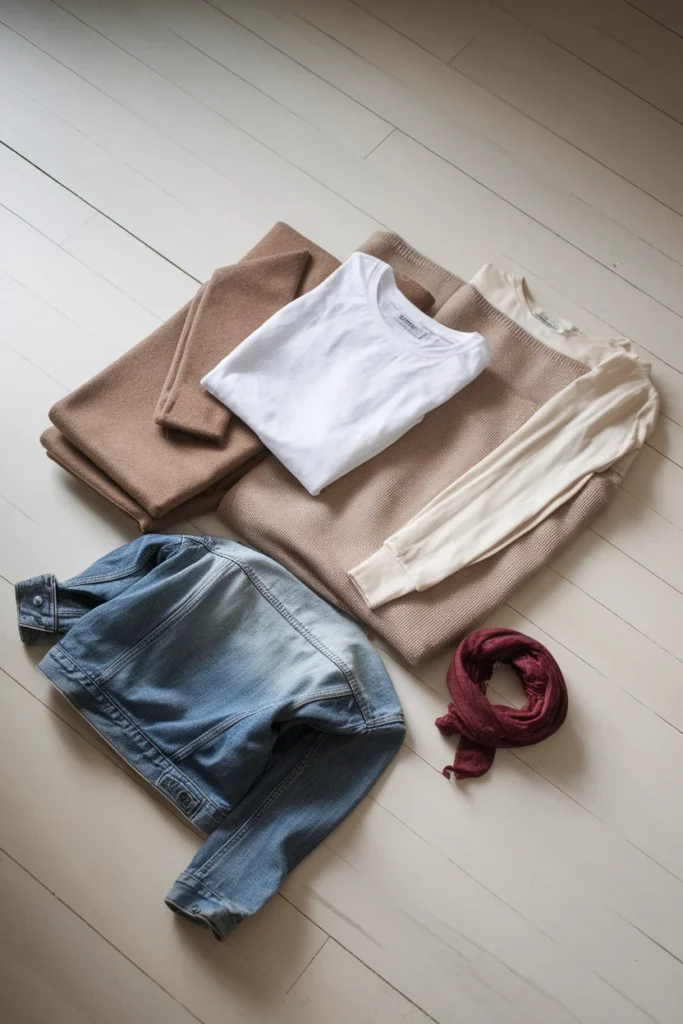
This is the range the jacket was built for. A tee underneath, sleeves pushed to the forearm, jacket left open. Done.
The mistake here is overthinking it. At 70 degrees the jacket is doing a styling job, not a warmth job, so the base layer should be as thin as you can stand. A ribbed tank, a boxy white tee, a thin cotton camisole under an unbuttoned jacket at golden hour.
Fabric matters more than you’d expect at this temperature. Cotton and linen breathe. Polyester traps heat against your skin and turns a pleasant 72 into a clammy afternoon, which is exactly why the capsule wardrobe tops that anchor every outfit you own lean natural fiber almost across the board.
One small thing that reads expensive: push the sleeves up to just below the elbow and leave them there. It shortens the jacket visually, shows wrist, and stops the boxy top half from swallowing you.
55 to 65 Degrees: Where the Jacket Earns Its Hanger Space
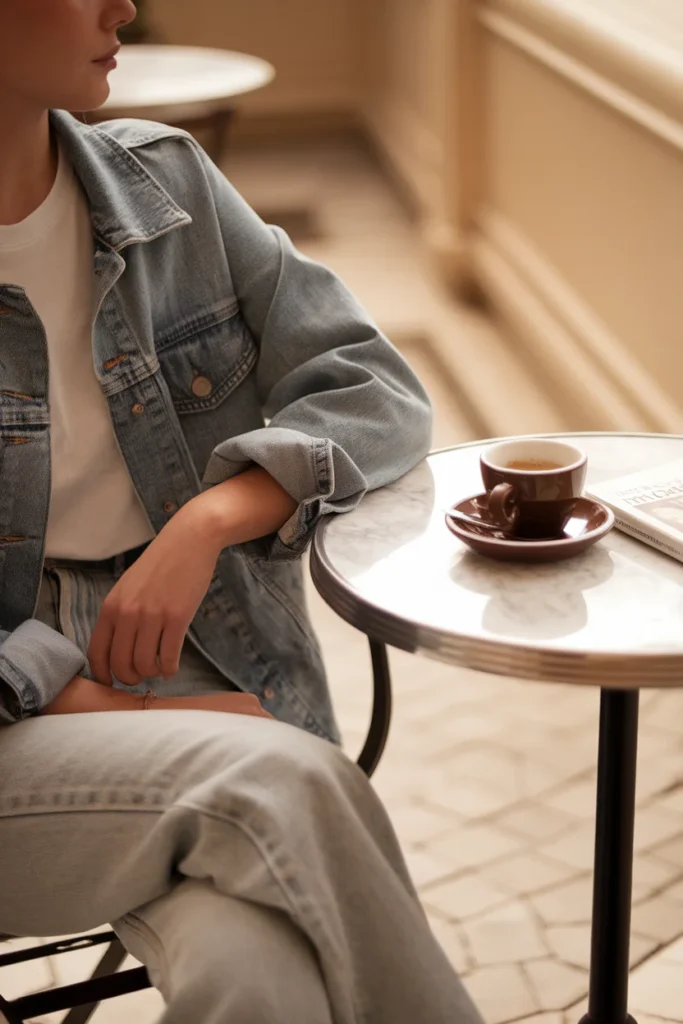
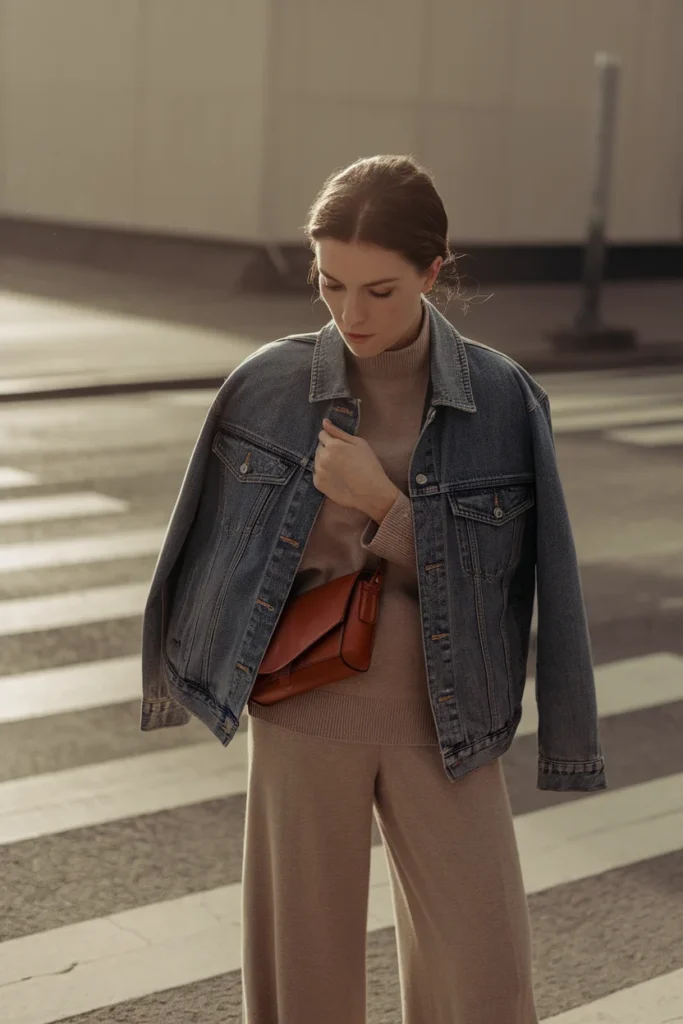
This is the sweet spot, and it’s most of September, October, April, and May in the US. Long-sleeve tee or a fine-gauge knit underneath, jacket open or buttoned depending on wind.
Fine-gauge is the operative phrase. A thin merino or cotton knit slides under denim without fighting it. A chunky cable sweater does not, and that’s where the marshmallow effect comes from that makes people quit on the jacket entirely.
Because the top half is already boxy, the bottom half is doing the balancing. Straight or wide legs give you a vertical line that offsets the square shoulders, and wide-leg jeans balance a boxy top half better than almost anything else in a capsule. Skinny jeans can work, but you’ll want the jacket cropped or the top tucked so the proportions don’t go top-heavy.
A cotton or wool blend that’s thin enough to see the shape of your shoulder through it is the test. If the knit has its own structure, it’ll compete with the denim and both will lose.
45 to 55 Degrees: Weight Without Bulk
Now you need actual insulation, and the temptation is to reach for something thick. Resist it. Two thin layers beat one thick one every single time, because the trapped air between them is what keeps you warm.
The combination that works: a thin base, a fine knit, then the jacket. Add a scarf and you’ve gained about five degrees for almost no visual bulk, because a scarf seals the gap at your neck where most heat escapes.
If you want more warmth without more sleeve volume, a vest is the quietest way to add warmth under a denim jacket. It insulates your core, leaves your arms clean, and slides under the jacket without the cuff pile-up that sinks most layering attempts.
Buttoning the jacket at this temperature makes a real difference too. An open jacket at 48 degrees is decorative. A buttoned one actually blocks wind.
Under 45 Degrees: Demote the Jacket to a Mid-Layer
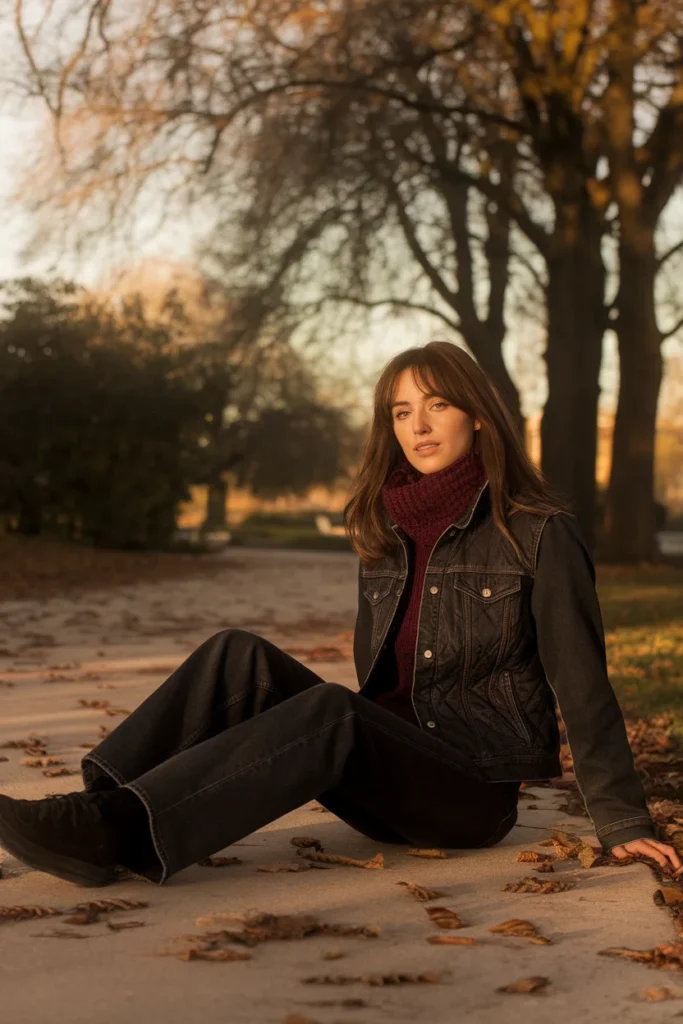
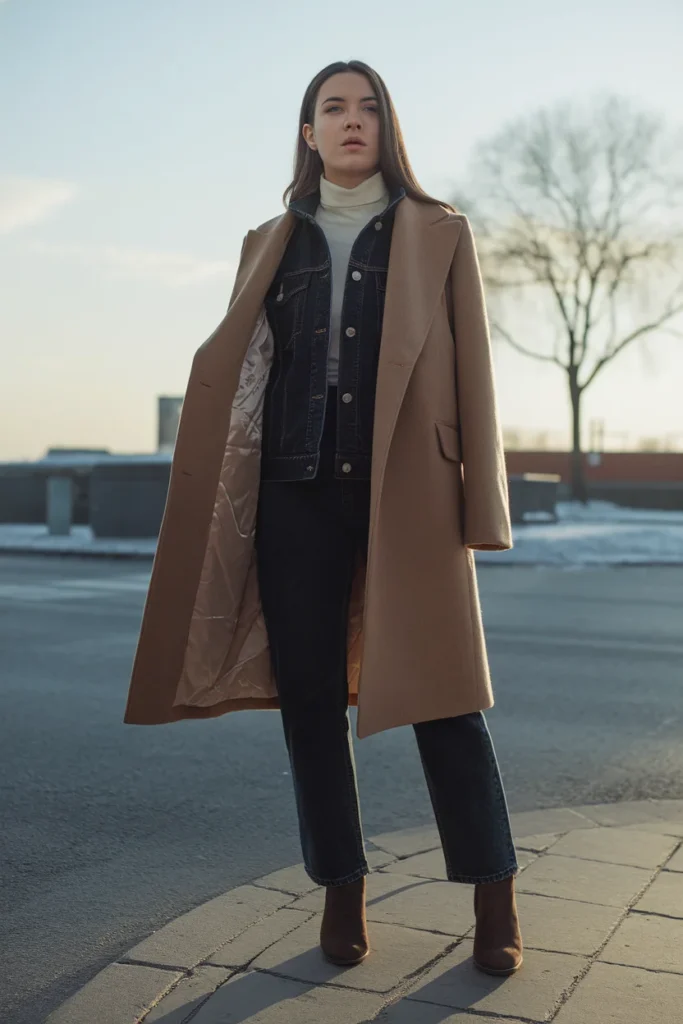
Below about 45, stop asking the denim to be your outer layer. Put a coat over it.
A denim jacket under an oversized wool coat or a roomy trench is genuinely one of the best cold-weather layering moves there is. The denim adds a structured second collar, the coat handles the actual warmth, and you get visible texture at the neckline that a coat alone never gives you. Size matters here: your coat needs about two inches of extra room through the shoulders or the whole thing binds.
Footwear carries more of the warmth load than people expect once you’re under 45, and ankle boots that hold up past November will do more for how long you can stay outside than another sweater will.
The other winter move: a denim jacket over a hoodie, under a coat. It looks intentional, it’s warm, and it costs you nothing you don’t already own.
The Sleeve and Hem Collision Nobody Warns You About
Here’s the failure almost every layering guide skips, and it’s the reason a good outfit reads sloppy in photos.
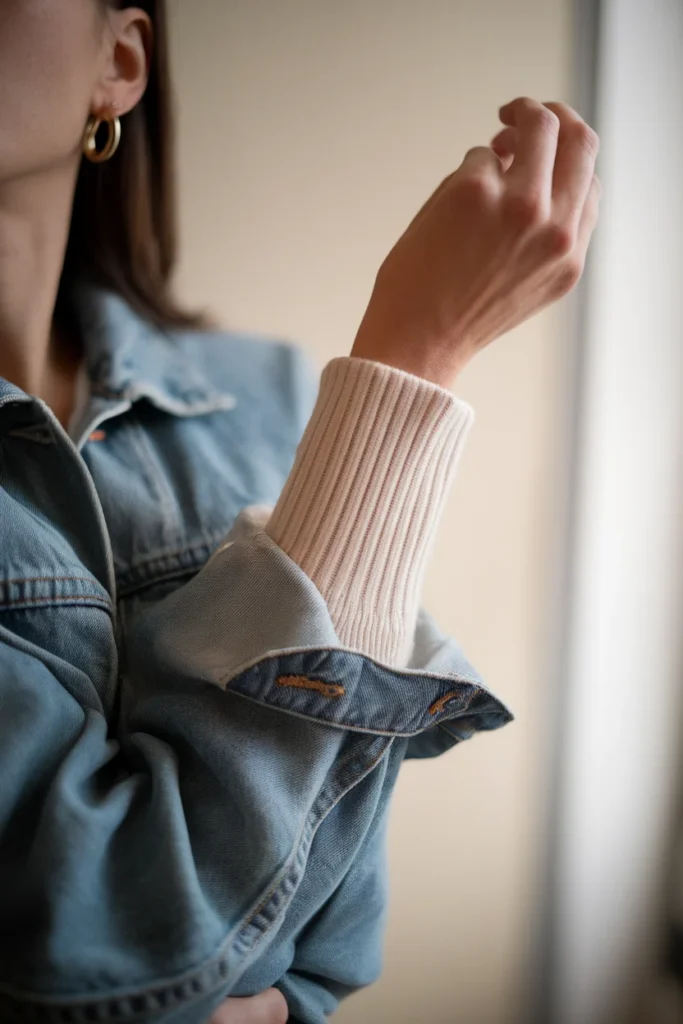
When you put a long-sleeve knit under a denim jacket, two things collide. The knit cuff bunches inside the jacket cuff, creating a lumpy ring at your wrist. And if the knit is longer than the jacket, you get a second hem hanging below the first, which visually chops you in half at the widest point of your hip.
The fixes take about four seconds each:
- For the cuff: push both sleeves up together to just below the elbow. One clean line, no bunching. If you need the length, fold the knit cuff back over the outside of the jacket cuff on purpose so it reads as a deliberate detail.
- For the hem: either tuck the knit fully, or French tuck the front only, or choose a base layer that ends above the jacket hem. Never let an untucked knit hang two inches below a cropped jacket.
- For the collar: if you’re wearing a collared shirt underneath, pull the collar fully out over the denim. Half in, half out is the single fastest way to look like you got dressed in the dark.
That third one is small and it changes everything.
Fabric Weight Beats Layer Count Every Time
Two women can wear the same three layers and get completely different results, and the variable is almost always fabric weight rather than the number of pieces.
Denim is measured in ounces per square yard. Lighter denim in the 8 to 10 ounce range drapes softly, layers easily, and suits spring and early fall. Heavier denim from 12 ounces up holds a crisp structured shape, blocks more wind, and takes a season to properly break in. If your jacket feels stiff and boxy in a way you don’t love, the weight is why, and time will fix it.
Care affects how it wears more than most people realize. Levi’s own denim care guide recommends washing denim roughly every ten wears unless it’s visibly dirty, washing inside out on cold, and skipping the dryer entirely because heat both shrinks and damages the fibers. Air-dry it and the jacket keeps its shape and color for years instead of seasons.
On price, checked in early August 2026: a classic Old Navy jean jacket lists around $45 and drops to about $30 on sale, while Levi’s women’s Original Trucker lists at $110 with common markdowns into the $46 to $83 range. The mass-market version gets you the silhouette at a fraction of the cost, but the trade-off is real, thinner cotton, lighter hardware, and seams that soften faster. If you’re wearing it two or three times a week, the mid-tier version usually wins on cost per wear within about a year. If it’s an occasional layer, the $30 one is plenty.
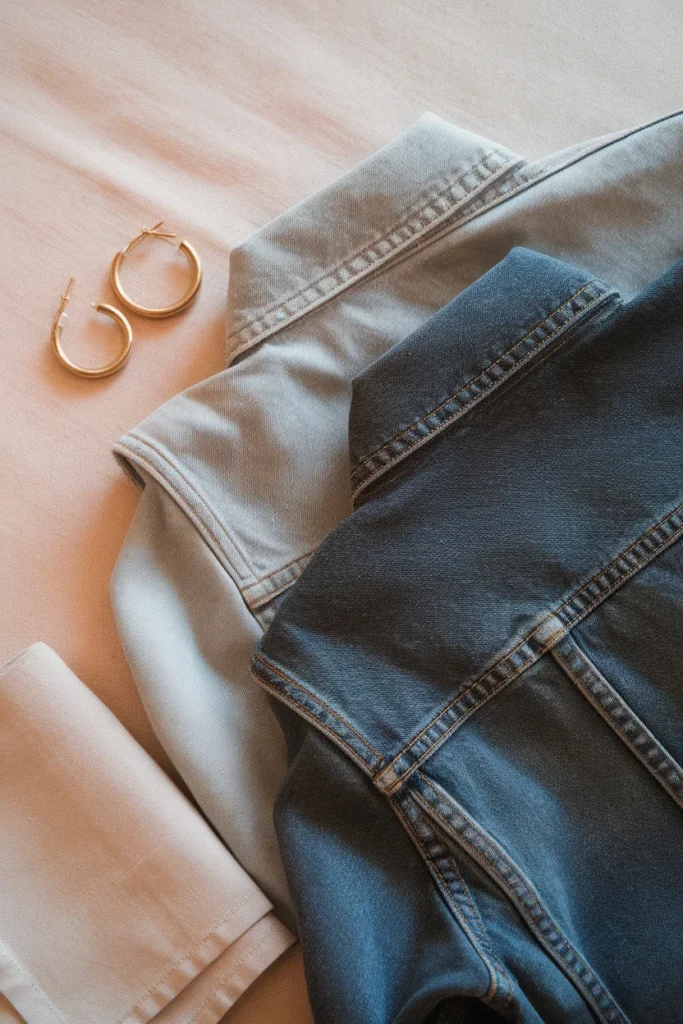
Layering by Proportion: Petite, Tall, Curvy, Midsize, Over 40
Layering changes what a jacket does to your proportions, so the same combination reads differently depending on your frame.
Petite (5’4″ and under). A cropped or waist-length jacket keeps your leg line long. Thin base layers only, since bulk underneath adds visual width you can’t spare. Tuck the base layer fully so the hem line stays high and clean.
Tall (5’9″ and over). You can carry a longer or oversized jacket that would swallow a shorter frame. Longer base layers work here too, so an untucked knit peeking below the hem reads intentional rather than accidental.
Curvy and hourglass. Buttoning the jacket at the narrowest point of your waist keeps the shape defined. If the jacket pulls across the bust, size up and treat the extra room through the shoulders as the layering allowance rather than sizing down and fighting it.
Midsize and plus-size. Structure works with your proportions here. A slightly boxy jacket that skims rather than clings gives you a clean vertical line, and a longer base layer underneath stops the hem from cutting at the widest point.
Over 40 and over 50. Wash choice does most of the work. Mid to dark indigo with minimal distressing reads polished at any age, and pairing it with a fine knit rather than a graphic tee shifts the whole outfit from casual to considered.
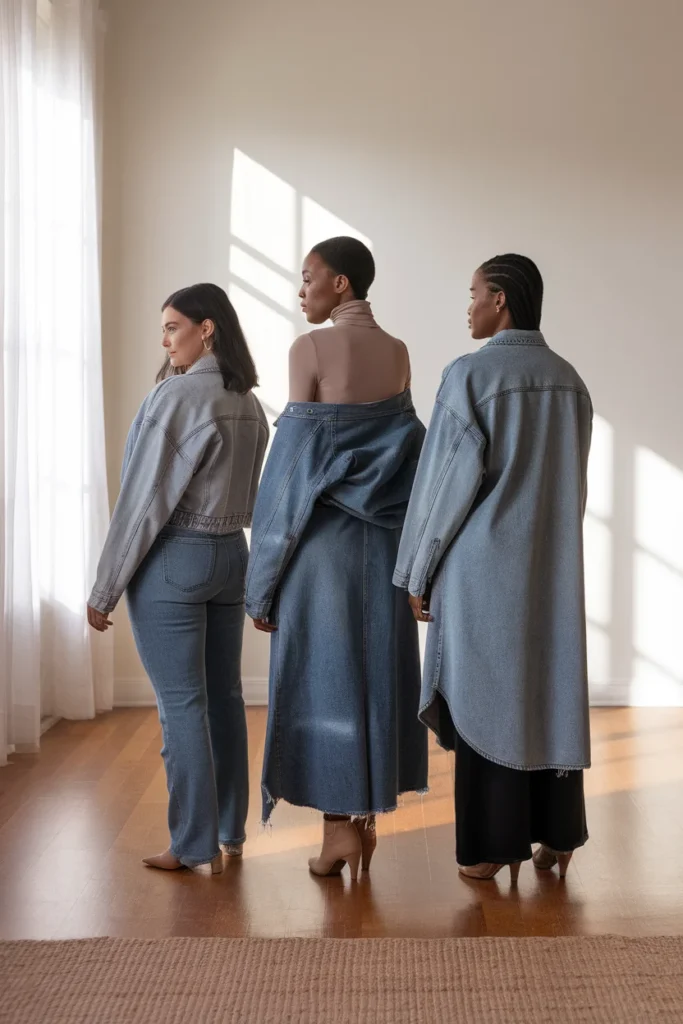
Five Layering Combos That Read Bulky
Every one of these is fixable in under a minute.
- Chunky cable knit under a fitted jacket. The knit has nowhere to go, so it bunches at the armhole. Swap to fine-gauge, or wear the chunky knit over an open jacket instead.
- Hoodie under a slim trucker. The hood mounds up behind your neck and shortens it. Either size up the jacket or move to a crewneck sweatshirt.
- Long untucked shirt under a cropped jacket. Two competing hems at hip level. Tuck it, or switch to a shorter base.
- Puffer vest over the jacket. Doubles the volume at your torso exactly where you don’t want it. Put the vest underneath instead.
- Three thick layers with the jacket buttoned. You’ve passed the jacket’s ceiling. Demote it to a mid-layer and put a real coat on top.
The pattern behind all five: bulk lives at the shoulders and the hip line. Keep those two zones clean and you can layer almost anything.
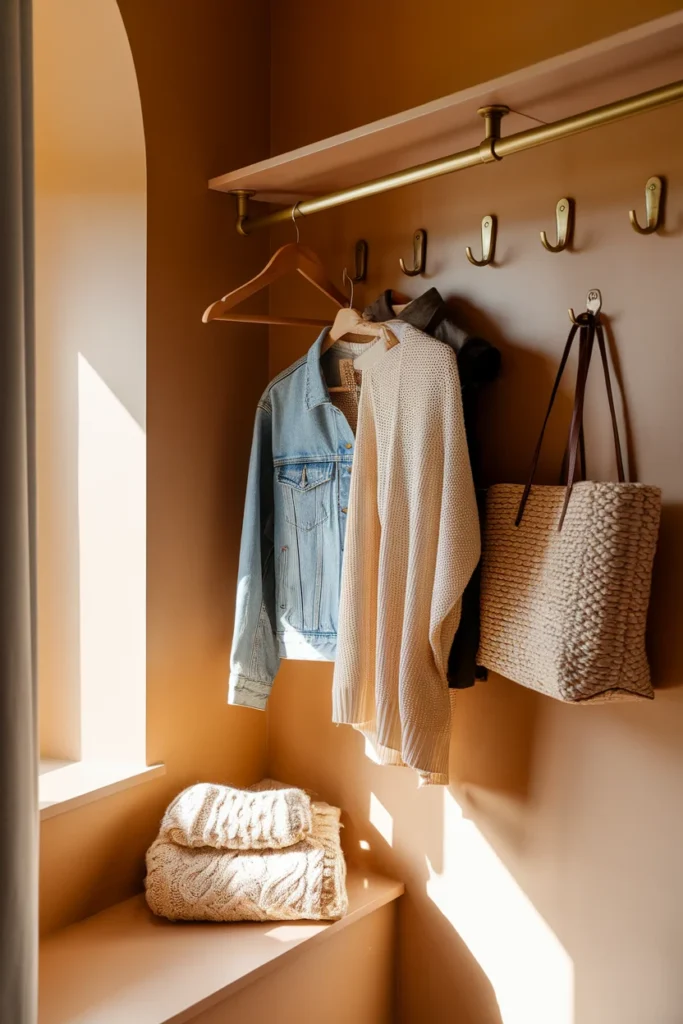
What to Layer Under It for Work
A denim jacket reads office-appropriate in most business-casual settings, but only when the layers underneath do the lifting.
Dark indigo with no distressing is the baseline. Under it, a silk or silk-blend shell, a fine merino turtleneck, or a crisp button-down with the collar pulled fully out over the denim. Below, tailored trousers or a midi skirt with real structure. The formula is straightforward: one relaxed piece, everything else polished.
What tips it casual is distressing, light washes, and a graphic tee underneath. What tips it polished is a tucked base layer, a defined waist, and a leather shoe rather than a sneaker. If you’re building a wardrobe where the same jacket covers Saturday and Wednesday, a year-round capsule wardrobe built on one neutral base is what makes that stretch possible without buying a second jacket.
Frequently Asked Questions
What should I wear under a denim jacket in the fall? For 55 to 65 degrees, a long-sleeve tee or fine-gauge knit. For 45 to 55, add a scarf or a thin vest underneath. Below 45, keep the fine knit and put a coat over the jacket instead of asking the denim to be your outer layer.
Can you wear a jean jacket with jeans without it looking like a costume? Yes, and the rule is contrast. Keep at least two shades between your jacket and your jeans, so a light-wash jacket over dark indigo or a dark jacket over ecru. Matching washes exactly is what creates the one-piece look people are trying to avoid. Breaking up the middle with a contrasting top or a belt helps too.
What size should a denim jacket be if I plan to layer under it? Size up one from your usual if you’ll wear knits underneath regularly. You want roughly two fingers of room through the shoulder seam and enough sleeve width that a fine knit doesn’t bind at the bicep. Check by raising both arms in the fitting room. If the whole jacket lifts with you, it’s too small for layering.
What color top goes under a blue denim jacket? White, cream, and oat are the most reliable. Soft black and navy both work and read more polished. If you want an accent, burgundy and butter yellow sit beautifully against mid-wash indigo without fighting it.
How often should you wash a denim jacket? Far less than you’d think. Levi’s suggests roughly every ten wears unless it’s visibly dirty or starting to smell, and spot-cleaning between washes. Wash inside out on cold and skip the dryer, since heat is what shrinks and weakens the fibers.
Is a $110 jean jacket worth it over a $30 one? It depends entirely on frequency. At two or three wears a week, the heavier cotton and better hardware on a mid-tier jacket usually win on cost per wear inside a year. As an occasional layer, the $30 version does the same styling job. Buy the cheaper one first and upgrade only if you find yourself reaching for it constantly.
Are denim jackets still in style in 2026? Denim jackets have been in continuous rotation for decades, which puts them well outside trend cycles. What shifts is the fit, and right now both classic waist-length and relaxed oversized cuts are widely worn. Wash and fit date a jacket far more than the category ever will.
Start With Tomorrow’s Forecast
Pull up the weather on your phone, find your number on The Denim Ladder, and pick the base layer it points to. That’s the whole system. No experimenting, no standing in front of the closet at 7:40am.
Try it for one week and you’ll notice the shift: the jacket stops being the thing you grab when you can’t decide and starts being the thing you plan around. Which combination are you starting with tomorrow?
Keep reading

How to Style a Jacket for Plus-Size Women: 10 Outfits That Work
A lot of jacket advice for bigger bodies is still written around hiding. Hide the hips, hide the arms, hide under something...

How to Style a Jacket for Women Over 50: 12 Outfits That Work
Your closet probably holds more jackets than you wear. There’s the blazer from an old job, the denim jacket you’re unsure about...

How to Style a Jacket: 10 Cozy Jacket Outfits for Fall and Winter
Your jacket is the first thing people see between October and March. It’s also the piece most of us grab last and...