
The 8 Capsule Wardrobe Tops That Anchor Every Outfit You Own
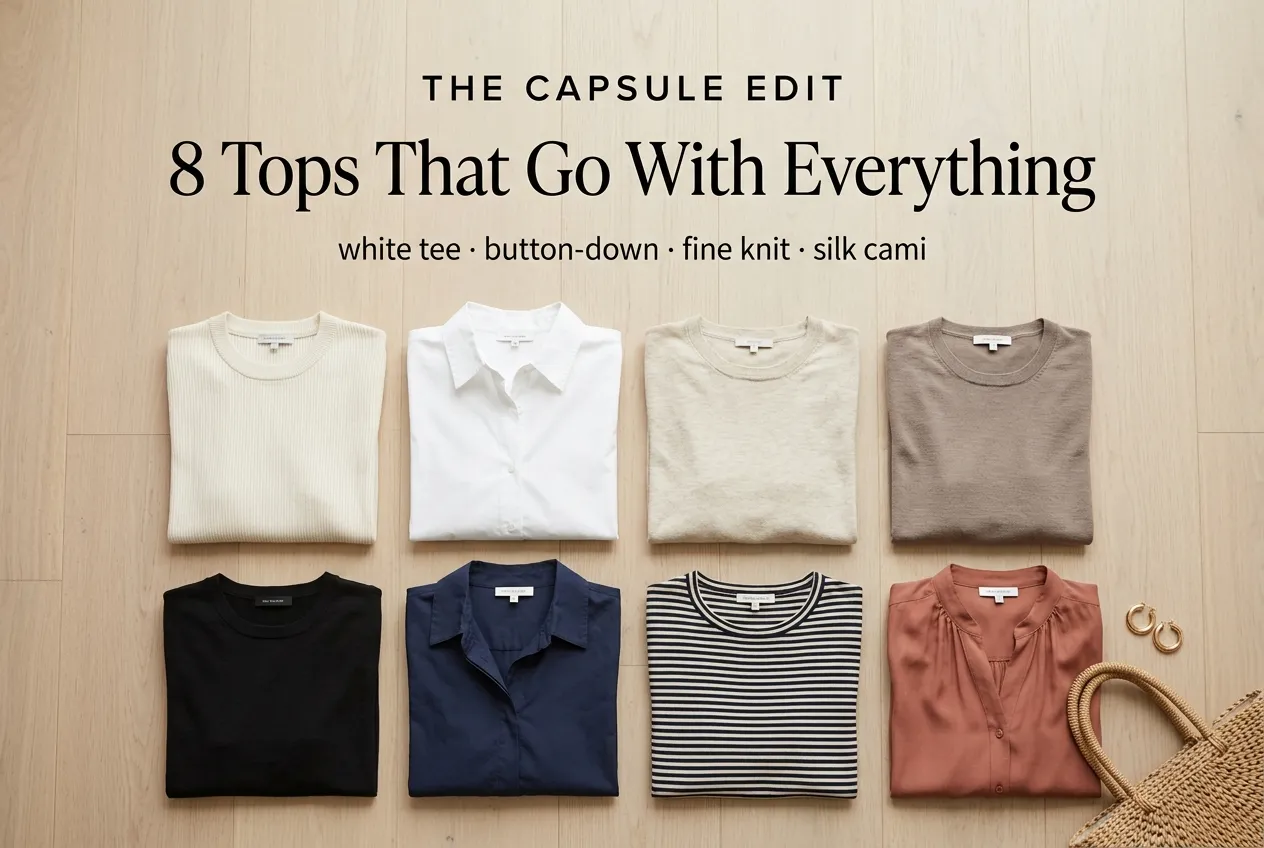
You have more tops than anything else in your closet. You also have the least to wear. That contradiction is what sends most women looking for capsule wardrobe tops in the first place, and the usual answer, a list of eight neutral shirts, quietly skips the part that matters. Which eight. Chosen how. This guide gives you the eight, plus the two buying rules that decide whether they mix or just hang there in coordinated beige.
Here is the short version. Tops carry the heaviest load in a capsule because they sit closest to your face, they show in every mirror and every photo, and they are the piece people register first. Get eight right and the rest of the closet gets easier overnight.
Why Your Tops Decide Whether the Whole Capsule Works
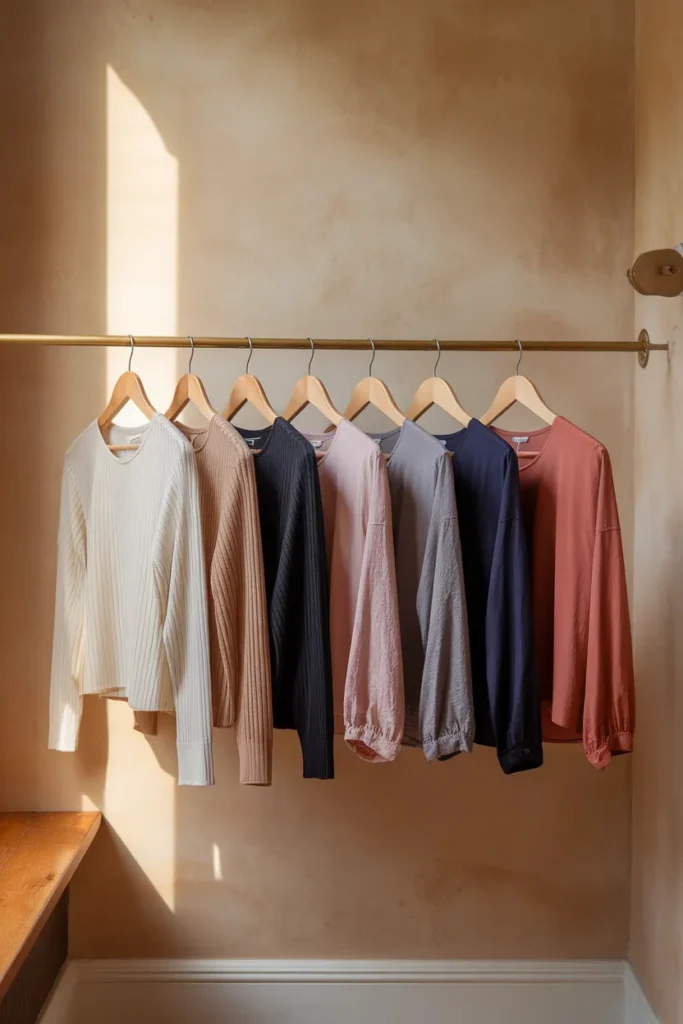
Bottoms are forgiving. You can wear the same dark straight-leg jeans on Monday, Wednesday, and Friday and nobody notices, including you. Tops do not get that grace. They sit in the frame of every photo, every video call, every glance in the bathroom mirror at 7:40 in the morning.
That asymmetry is why tops usually make up around a third of a well-built capsule. It is also why the wrong eight tops feel so much worse than the wrong two pairs of trousers.
Most capsules fail here for a boring reason. You buy tops you already own. Slightly different crewneck, slightly different shade of oatmeal, same everything else. Three months later you have eleven tops that produce four outfits, and the same guide that tells you how a printable capsule wardrobe checklist keeps your closet honest is the one you need to pull back out.
The fix is not buying fewer tops. It is buying tops that differ from each other in ways you can actually name.
The Neckline Rule Nobody Mentions
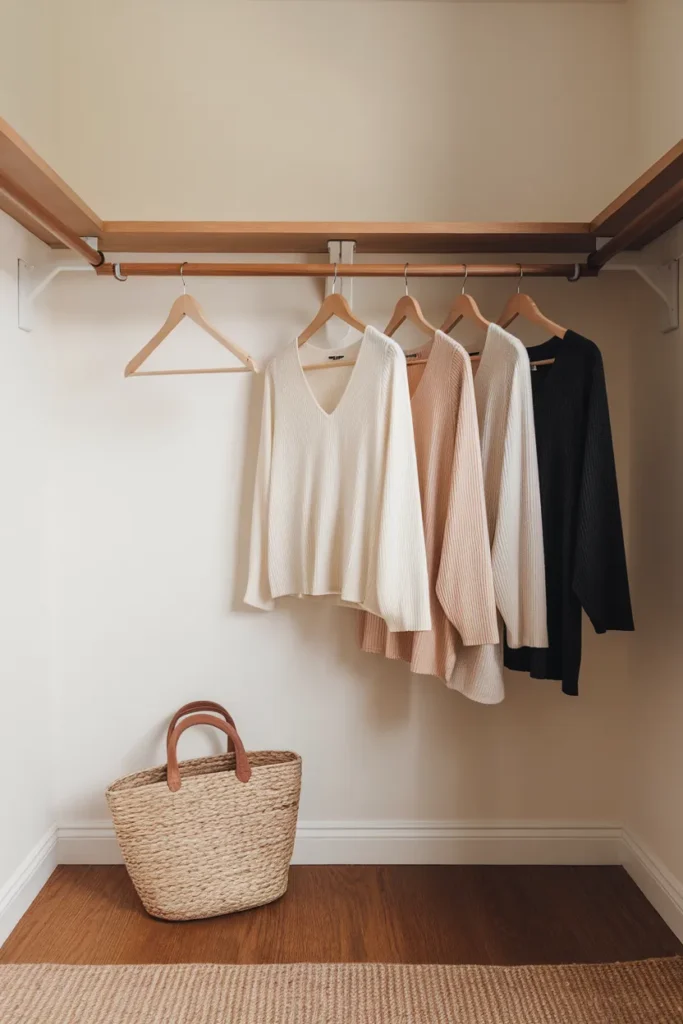
Here is the rule that changed how I edit a closet: across your eight tops, you need at least three different neckline heights.
Not three necklines total. Three heights. High (mock neck, high crew, buttoned collar), mid (standard crew, boatneck, open collar), and low (scoop, square, V, camisole).
Why height and not shape? Because neckline height is what changes the visible proportion between your jaw and your collarbone, and that stretch of skin is the single most visible thing about an outfit from the chest up. Two tops in different colors with identical crew necklines read as the same outfit in a photo. Two tops in the same color with a mock neck and a square neck read as two completely different looks.
Count yours right now. Most closets that feel repetitive have six or seven crewnecks and nothing else.
There is a second benefit, and it is practical. Different neckline heights layer without fighting. A square-neck tank disappears cleanly under a buttoned shirt. Two crewnecks stacked look like a mistake.
The Eight Capsule Wardrobe Tops, and the Job Each One Does
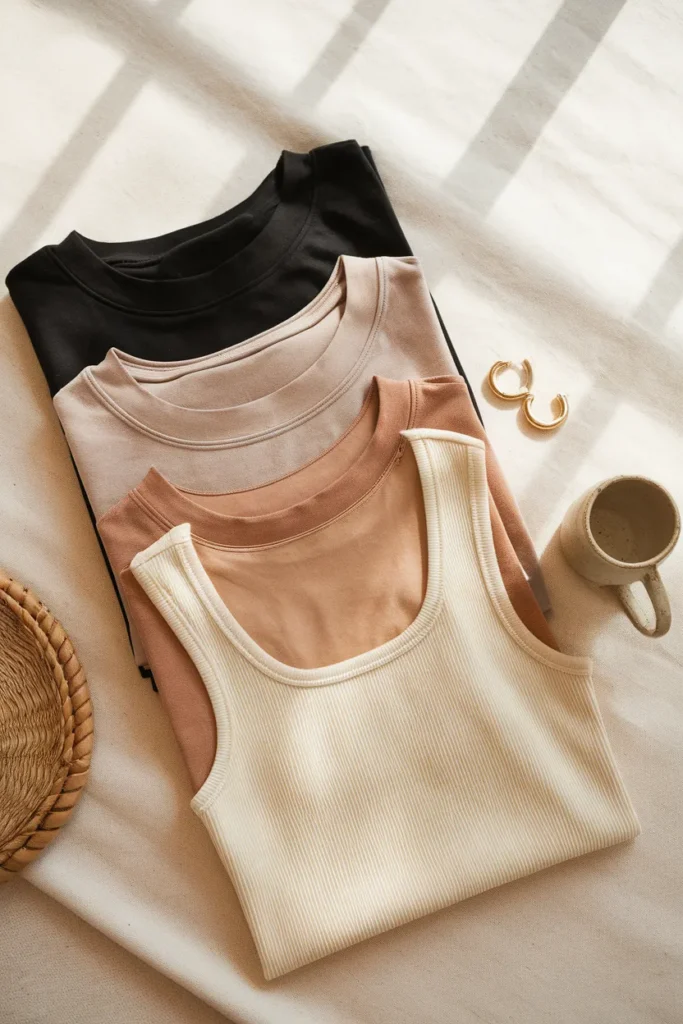
Each piece below earns its hanger space by doing something the others cannot. Read the job first, then the piece.
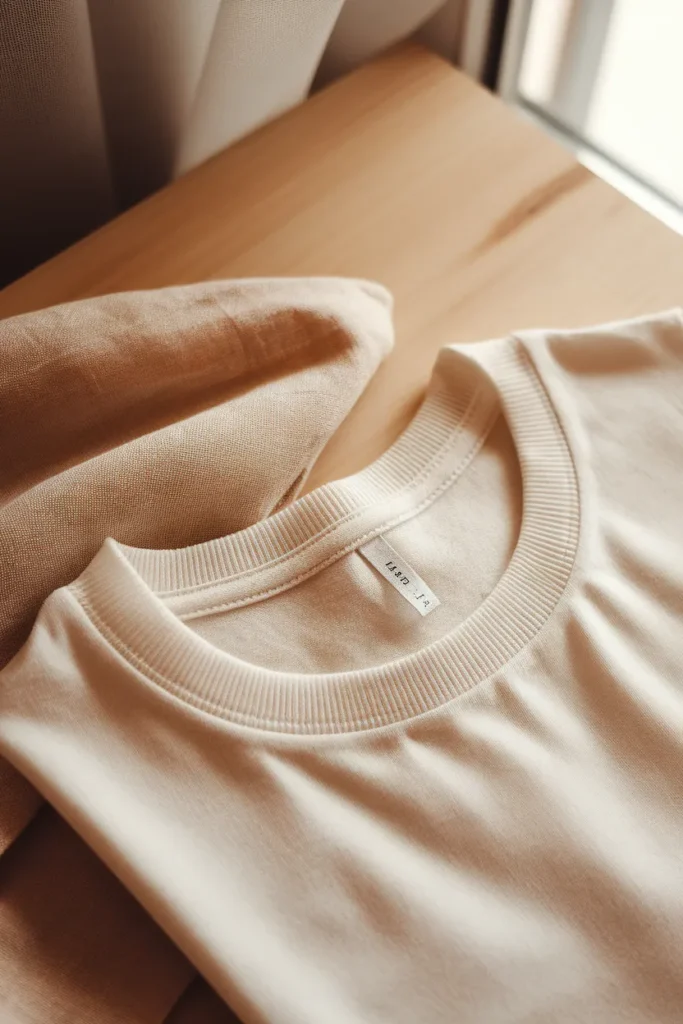
1. The mid-weight white crewneck tee
The one everyone owns and almost nobody owns correctly. The failure point is weight. A thin jersey goes translucent, clings at the waistband, and stretches out at the neck after four washes, which is why you keep rebuying it.
Look for a mid-weight cotton with a ribbed neckband that snaps back when you tug it. Combed or ring-spun cotton holds shape noticeably better than open-end spun, because the shorter fibers are removed before spinning.
Job: the base layer everything else sits on. Neckline: mid crew. Tucks fully.
Price reality: Uniqlo and Target sit in the low tier around $15 to $25, Everlane and Quince land roughly $30 to $50, and Madewell and J.Crew typically run $40 to $70. The jump from $20 to $45 buys opacity and shape retention. The jump from $45 to $120 mostly buys a label.
2. The ivory button-down with a shirttail hem
The hardest working top in the eight, and the one where hem shape matters most. A curved shirttail hem can be tucked, half-tucked, knotted, or worn loose over a tank. A straight hem can really only be tucked or worn out.
Ivory over stark white if you want it to read expensive. Stark white is unforgiving next to warm skin and next to every other cream piece in your closet.
Job: the third piece that turns two items into an outfit. Neckline: open collar, reads as a soft V. Tucks every way there is.
3. The fine-gauge boatneck knit
Polish without a blazer. A fine-gauge knit in merino, cotton-cashmere, or a good cotton blend drapes close to the body instead of adding bulk, which is what separates it from the chunky sweater you already own.
Boatneck is the deliberate choice here. It widens the shoulder line, balances a hip-heavier frame, and gives you a mid-height neckline in a closet that is probably drowning in crewnecks.
Job: instant polish, layers under a coat without bunching. Neckline: mid, wide. Front tuck only.
4. The silk or satin camisole
The dress-up piece, and the layering piece, and the one most capsule guides list without explaining. Under a knit it adds a smooth line and a sliver of shine at the neckline. On its own with tailored trousers it reads evening.
Washable silk exists now at the mid tier, which removes the dry-cleaning objection that used to make this piece impractical.
Job: evening, and a smooth layer under everything. Neckline: low square or V. Tucks fully.

5. The striped long-sleeve
A print that behaves like a neutral. A narrow navy-and-cream or black-and-cream stripe pairs with denim, camel, olive, and every solid in your palette, which almost no other pattern manages.
Keep the stripe narrow. Wide stripes read costume and date fast.
Job: pattern without palette risk. Neckline: mid crew. Untucked or front tuck.
6. The ribbed tank
Your most-worn piece by a distance, and the one you will replace most often. Ribbed cotton or a cotton-modal blend holds its shape through layering better than a flat jersey.
Buy two. In cream and soft black. This is the one place doubling up is worth the hanger space.
Job: base layer in cool weather, standalone in heat. Neckline: scoop or square, low. Tucks fully.
7. The fitted long-sleeve in soft black
The evening top, the contrast top, and the one that creates a long unbroken column when you pair it with dark trousers. A mock or high neck here gives you the high end of your neckline spread.
Soft black over harsh black. It sits better next to camel, oat, and espresso.
Job: evening, contrast, vertical line. Neckline: high. Tucks fully.
8. The one personality top
The piece that keeps seven neutrals from reading as a uniform. Print, texture, color, your call. A dusty terracotta blouse, a butter-yellow knit, a subtle jacquard, a single well-cut polo.
One rule: it has to work with at least three bottoms you already own. If it works with one, it is not a capsule piece, it is a purchase you will regret in six weeks.
Job: personality, and the accent in a 60-30-10 split. Neckline: your choice, ideally one you do not already have.
The Eight-Top Grid
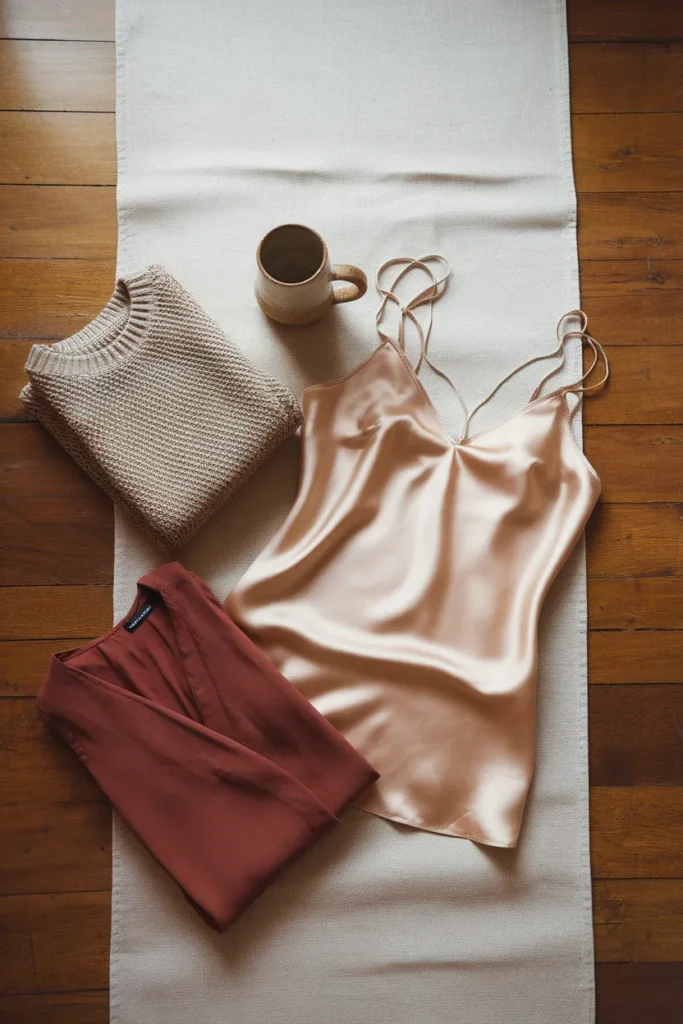
Screenshot this. It is the whole article in one table, and it doubles as a shopping filter: if a top you are about to buy duplicates a row you already have, put it back.
| # | Piece | Weight | Neckline height | Tuck behavior | The job |
|---|---|---|---|---|---|
| 1 | White crewneck tee | Mid | Mid | Full tuck, French tuck | Base layer |
| 2 | Ivory button-down | Light, structured | Mid (open collar) | Every tuck, plus worn open | Third piece |
| 3 | Fine-gauge boatneck knit | Light-mid | Mid, wide | Front tuck | Polish, no blazer |
| 4 | Silk camisole | Light, fluid | Low | Full tuck | Evening, smooth layer |
| 5 | Striped long-sleeve | Mid | Mid | Untucked, front tuck | Pattern as neutral |
| 6 | Ribbed tank (x2) | Light | Low | Full tuck | Layering workhorse |
| 7 | Fitted black long-sleeve | Mid | High | Full tuck | Contrast, vertical line |
| 8 | Personality top | Varies | Fill your gap | Varies | Accent, anti-uniform |
Check the neckline column. Three heights, covered. That is the test.
Hem Architecture: Why Some Tops Tuck and Some Never Will
Tuck flexibility is the real multiplier behind the “one piece, three outfits” promise, and hem shape decides it before you ever get dressed.
Curved shirttail hem. Longer at front and back, shorter at the sides. Tucks, half-tucks, knots, or hangs loose. Most flexible hem there is.
Straight hem, hip length. Tucks cleanly, wears out cleanly, does not half-tuck well because there is no natural fold point.
Straight hem, cropped. Wears out only. Sits at the high hip and does the visual work of a tuck without the bulk, which makes it genuinely useful with wide-leg trousers.
Curved hem, cropped. The awkward one. Too short to tuck, too curved to sit flat. Skip it.
Then there is bulk. A full tuck on a thick ribbed knit creates a ridge under fitted trousers. Fine-gauge and woven fabrics tuck flat. Heavy ribs do not. If a piece only looks right untucked, that is fine, just know it before you count it as a versatile buy.
How to Read a Top Before You Buy It
Four checks, sixty seconds, in the fitting room or before you click buy.
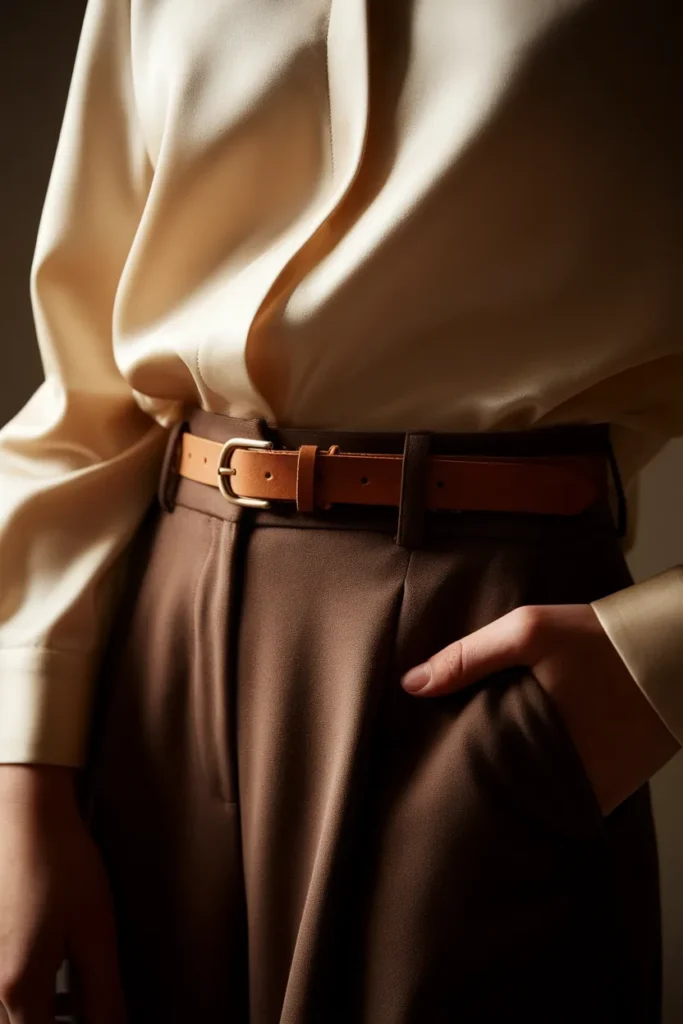
One: hold it to the light. If you can see your hand through a white or cream top, it will be see-through in daylight. No amount of layering fixes it.
Two: read the tag. In the US, federal rules require a fiber content label on nearly every garment sold, so the information is always there. Higher natural fiber content usually means better drape and breathability. A small percentage of elastane, roughly two to five, helps recovery. More than eight in a woven top and it will bag out at the elbows.
Three: pull the neckband. Stretch it gently and let go. If it stays stretched, the top will look tired by week three.
Four: check the shoulder seam. It should land on the corner of your shoulder, or deliberately past it on an oversized cut. Halfway down your upper arm on a fitted piece means the fit is wrong regardless of what the size label says.
Where you buy matters less than what you check, though it helps to know the brands whose fabric quality actually holds up before you start.
Outfit Math: What Eight Tops Actually Gets You
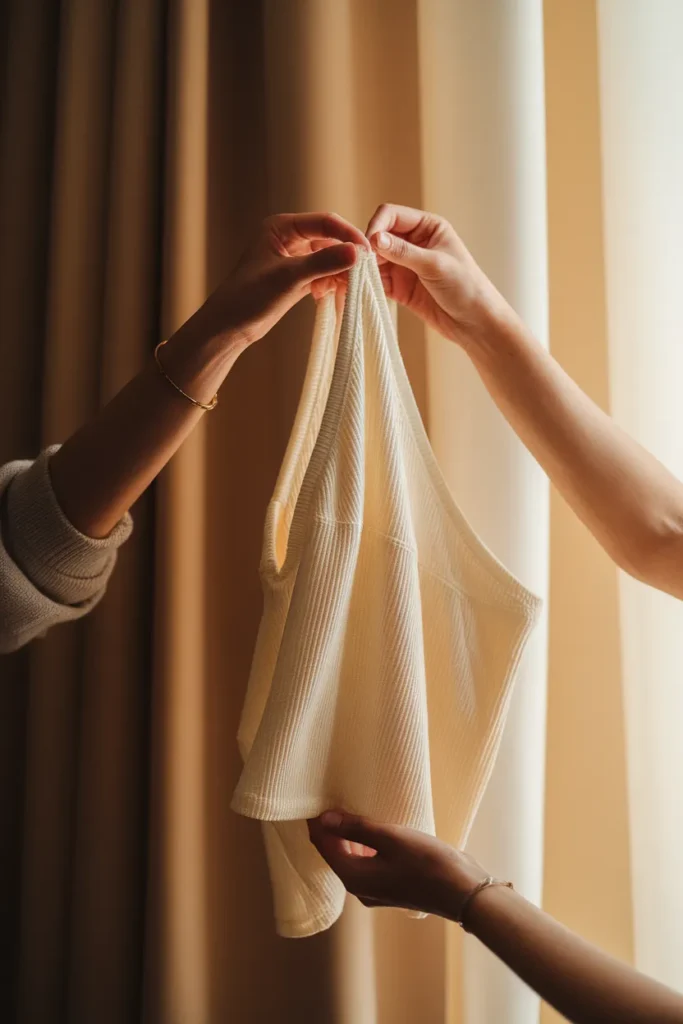
Eight tops against four bottoms is thirty-two base combinations. Add a third piece and a shoe change and the arithmetic gets silly fast.
The number is not the point. Thirty-two combinations where twenty-six look wrong is worse than twelve that all work.
What makes them all work is the palette. Keep your eight inside one family, warm neutrals or cool neutrals, and stop crossing the line. Cream, oat, camel, and espresso live together. Cream, oat, camel, and cool gray do not, and that single mismatch is why some closets refuse to cohere no matter how carefully they are edited.
Then anchor a few formulas so mornings run on autopilot:
- Ribbed tank + button-down worn open + straight jeans + loafers
- Fine-gauge knit, front tucked + wide-leg trousers + ballet flats
- Silk camisole + blazer + dark denim + ankle boots
- Striped long-sleeve + midi skirt + sneakers
- Fitted black long-sleeve + black trousers + one gold necklace
That third formula is the backbone of most business casual outfit ideas built from the same eight tops, which is exactly the point of a capsule. The pieces do not change. The context does.
Fit Notes by Proportion
Necklines and hems land differently depending on your frame, and the fixes are small.
Petite, 5’4″ and under. A shorter hem keeps your leg line long. Front-tuck rather than full-tuck to avoid bunching at the waistband. Scoop and V necklines open up the space between jaw and collarbone, which reads longer through the neck.
Tall, 5’9″ and over. You can carry an untucked hip-length hem that would overwhelm a shorter frame. Look for tops with a genuinely longer body so the hem does not ride up to an odd midpoint.
Curvy and hourglass. Wrap and V necklines follow your natural line. Fine-gauge knits skim where chunky ones add width. A shirttail hem worn loose gives you shape without clinging.
Rectangle. Boatnecks and square necks build width at the shoulder, which creates the illusion of a waist below. This is one of the clearest cases where how proportions change which necklines work on you does more for an outfit than any styling trick.
Over 40 and over 50. Slightly more structure in the fabric holds a cleaner line. Mid and high necklines tend to feel better through the day, and a fine knit reads more polished than a soft jersey with almost no extra effort.
None of this is about hiding anything. It is about working with the proportions you have.
Making Eight Tops Stretch Across Seasons
The eight barely change. What changes is what goes over and under them.
Fall, roughly 45 to 70F. Button-down under the knit, collar out. Tank under the striped long-sleeve. This is the peak layering window and the reason these eight are worth buying in July rather than October.
Winter, roughly 20 to 45F. Silk camisole becomes a base layer under the fitted black long-sleeve. The fine-gauge knit goes under a wool coat without bulk, which is exactly what a chunky sweater cannot do.
Spring, roughly 50 to 70F. Button-down worn open over the tank. Trench on top. The most reliable transitional formula there is.
Summer, roughly 75 to 95F. Tank and camisole carry the season. Button-down becomes sun cover.
Eight tops that run all four seasons is the whole argument for a 30-piece year round capsule that never needs rebuilding instead of four seasonal closets you replace on a loop.

What to Buy First if You’re Starting From Zero
Do not buy all eight at once. You will get three of them wrong.
Buy in this order, wearing each one for two weeks before the next:
- Ribbed tank, two of them. Cheapest, most worn, teaches you your neckline preference fastest.
- Mid-weight white tee. Now you know whether you want crew or scoop.
- Ivory button-down. The biggest jump in outfit count from a single purchase.
- Fine-gauge knit. Buy this one in fall when the selection is best.
- Silk camisole.
- Striped long-sleeve.
- Fitted black long-sleeve.
- Personality top. Last, deliberately. By now you know what your closet is actually missing.
Spread across a season this is a manageable spend, and it is meaningfully less than the cost of rebuying the same wrong tee four times. There is a wider argument too: Americans generated about 17 million tons of textile waste in a single year, and buying eight tops carefully rather than twenty carelessly is a small, real dent in that.
If you want to see where these land in a full seasonal build, the summer capsule these tops slot straight into shows the same logic applied across an entire closet.
Frequently Asked Questions
How many tops should be in a capsule wardrobe? Usually eight to twelve per season, depending on how often you do laundry and whether you dress for an office. Tops tend to run about a third of a capsule’s total pieces because they carry more visual weight than bottoms. Eight is the working minimum. Twelve starts to blur.
What tops go with everything? A mid-weight white tee, an ivory button-down with a curved shirttail hem, and a fine-gauge knit in a warm neutral. All three sit inside almost any palette, tuck at least two ways, and layer under outerwear without bulk.
How many outfits can you make from a capsule wardrobe? Eight tops against four bottoms gives you thirty-two base combinations before you add a third piece or change shoes. The realistic number is lower, because only combinations inside one color family will actually look right. Cohesion beats arithmetic every time.
Can a capsule wardrobe include trendy items? Yes, in the personality slot. One trend-leaning top out of eight keeps the closet current without destabilizing it. The test is whether it works with three bottoms you already own. If it works with one, it belongs in the regret pile.
What is the 3-3-3 capsule wardrobe rule? Three tops, three bottoms, three pairs of shoes, worn for a set stretch of time. It is a useful exercise rather than a real wardrobe. Run it for two weeks and you will learn which necklines and hems you reach for, which makes the eight-top build much more accurate.
How do I stop my capsule wardrobe from looking boring? Vary neckline height, fabric texture, and hem shape rather than adding more color. Eight neutral tops in three neckline heights and four textures look varied. Eight tops in eight colors with the same crewneck look like a uniform in a paint chart.
Are expensive tops worth it for a capsule wardrobe? Sometimes. The jump from a $20 tee to a $45 one buys real opacity and shape retention, which you will notice. The jump from $45 to $150 mostly buys a name. Spend on knits and the button-down, where construction shows. Save on tanks and tees, which you replace anyway.
Start With Two
You do not need a shopping list. You need two ribbed tanks and a fortnight.
Wear them on repeat, notice which neckline you keep reaching for, and let that answer choose the next six. That is how a capsule actually gets built: one confirmed piece at a time, not one hopeful order of eight.
Save this guide, screenshot the Eight-Top Grid, and count your necklines tonight. Most closets are one square-neck away from feeling twice as big.
Keep reading

Capsule Wardrobe Shoes: The 7 Pairs That Cover Everything
Capsule wardrobe shoes are the part of the closet edit almost everyone skips. You can get the tops right, get the trousers...

The 6 Capsule Wardrobe Jackets That Actually Earn Their Hanger Space
You own more jackets than you wear. Most of us do. The denim one from three summers ago, the blazer that fits...

Capsule Wardrobe Accessories: The Small Pieces That Change Everything
You built the capsule. Thirty pieces, mostly neutral, all of them things you actually like. And getting dressed is faster now, which...