
How to Style a Vest: The Layering Piece Nobody Uses Enough
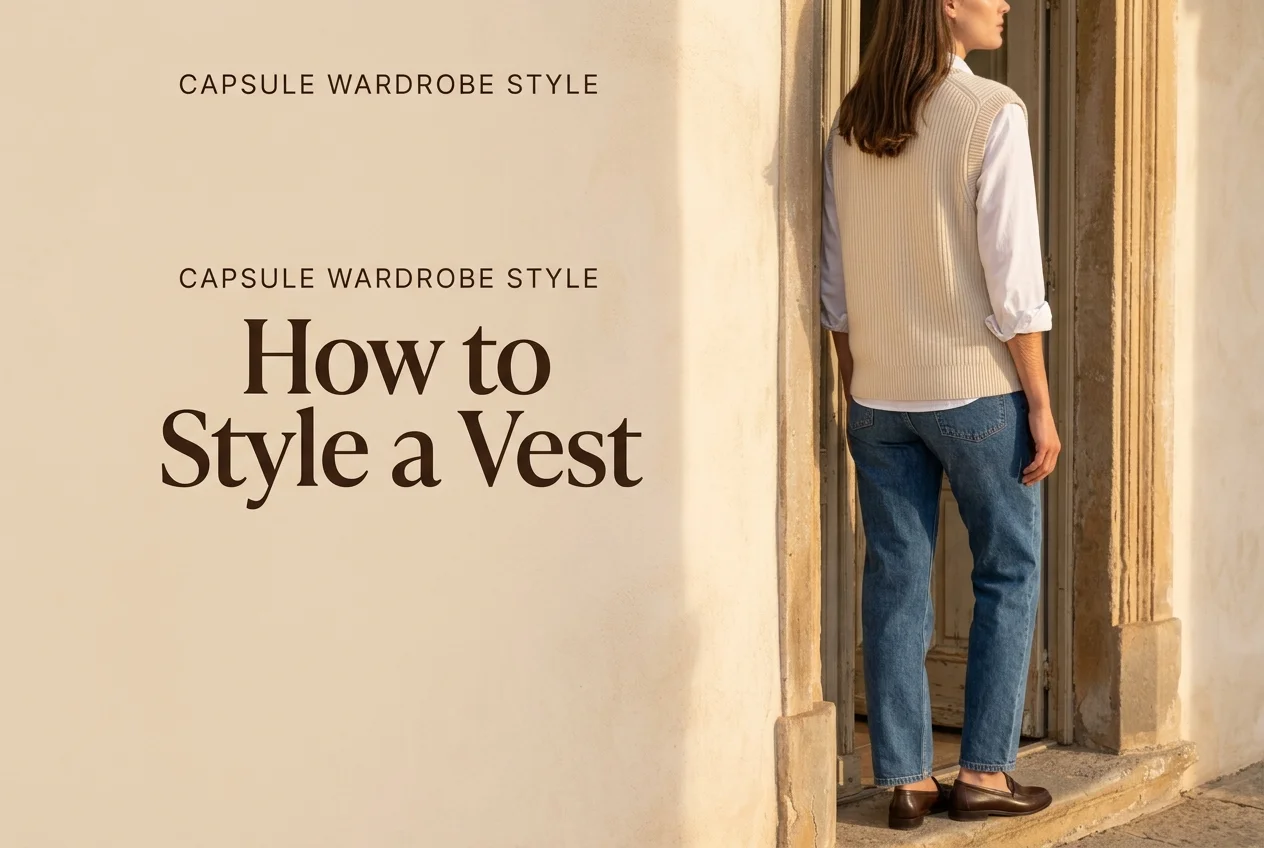
There is probably a vest in your closet right now. It came home with you because it looked sharp on the hanger, you wore it twice, and then it slid to the far end of the rail where the maybe-someday clothes live. Learning how to style a vest is less about finding new outfits and more about fixing the two or three small things that made it feel wrong the first time. Fit, hem line, and what sits underneath. Get those right and one vest quietly adds a dozen outfits to a closet you already own.

I am going to walk through the six vests worth owning, a four-point fit check you can run in any fitting room, eight outfit formulas, and the fabric and care details that decide whether this piece lasts one season or eight. No styling advice here depends on buying something new.
Why a Vest Earns Its Hanger Space
A vest does something no other layer does. It adds a full second color and texture to an outfit without adding a single degree of warmth to your arms, which is exactly the problem most of the year. September mornings sit around 50F and September afternoons hit 75F. A cardigan is too much by ten in the morning. A blazer reads too formal for the grocery store. A vest splits that difference and holds it.
Think about the outfit math. One plain white tee plus one pair of jeans is a single outfit. Add a vest and it becomes three: vest open and relaxed, vest closed and tailored, vest over the shoulders of a button-down for a different neckline entirely. You did not buy three things. You bought one.
The piece also has a longer history than its current trend cycle suggests. The Met’s Costume Institute holds an early 18th century British waistcoat in the Met’s Costume Institute worked in linen, silk, and metallic thread. Three hundred years is a reasonable run for something people keep calling a passing trend.
Here is the practical case. A vest is the only layer that works over a tee, a button-down, a turtleneck, a slip dress, and a long-sleeve knit without any of them fighting it. Compare that to a moto jacket, which really only works over two of the five. When you are choosing which layers deserve rail space, versatility per piece is the whole calculation, and it is the same logic behind the six capsule wardrobe jackets that earn their hanger space.
One more thing that gets missed. A vest keeps your core warm while leaving your hands and arms completely free, which is why it beats a cardigan for driving, cooking, carrying a toddler, and typing.
The Six Vest Types Worth Knowing
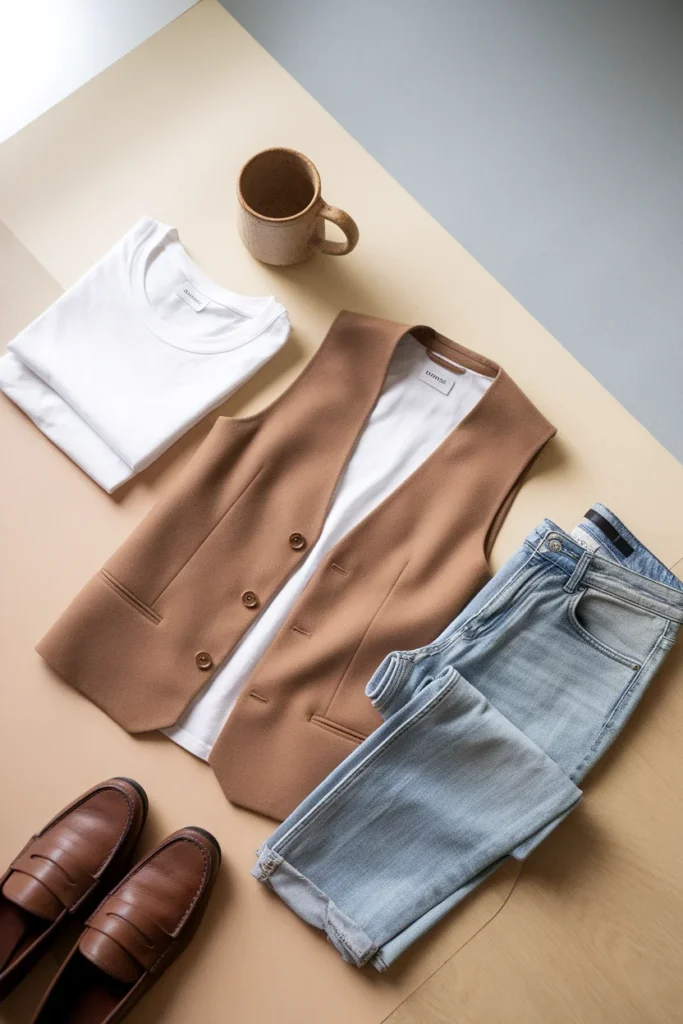
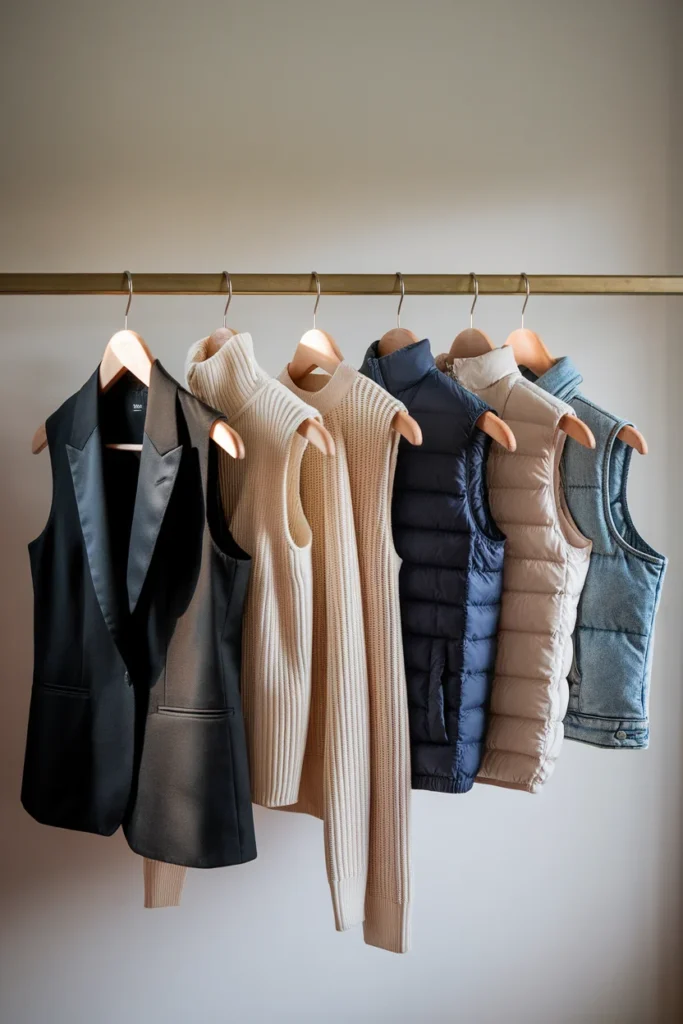
Vest is one word covering six pretty different garments. Buying the wrong one for your life is the most common reason it goes unworn, so start here.
The tailored suiting vest
Structured, usually with a V neck, buttons, and a satin or lining back. It reads sharpest and dresses up fastest. Best if you want office wear or evening looks. Least forgiving on fit.
The sweater vest
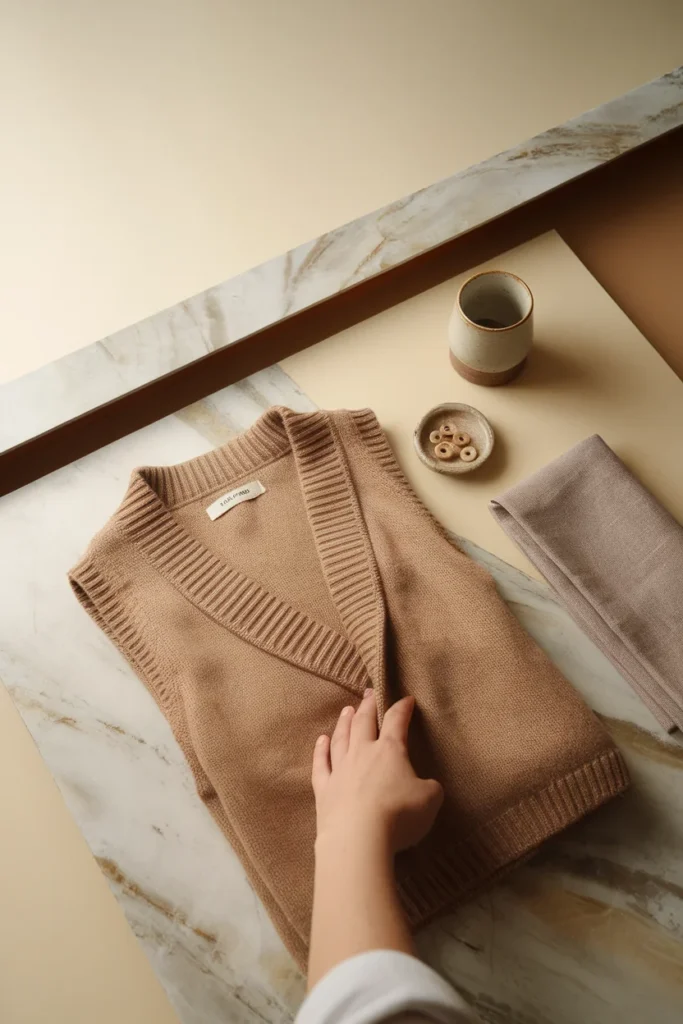
Knit, often ribbed, sometimes cropped. Softest of the group and the easiest entry point. Works over a button-down for the collar-and-cuff look, or on bare skin as a top. Watch the armhole, since knit stretches and a sagging armhole is what makes these look sloppy.
The longline knit vest
Hits mid-thigh or lower, hangs open, no closure. Quietly the most useful of the six because it adds a vertical line to almost anything. This is the one I would buy first if you only buy one.
The quilted vest
Lightweight, usually diamond-stitched, often in navy, olive, or black. Reads preppy and practical. Best for walking the dog, school pickup, and weekend errands in 45F to 60F weather.
The puffer vest
Warmer, sportier, and the one most likely to look like gym gear if you get the proportions wrong. Keep it fitted and short, or skip it.
The denim vest
Sleeveless denim, either purpose-made or made by cutting the sleeves off a jacket. Casual, seasonal, and worth owning only if you already wear denim as a layer. If you do, the styling logic runs parallel to styling a denim jacket as your everyday layer.
If you want one vest to do the most work, buy the longline knit in a neutral. If you want one vest for the office, buy the tailored suiting vest and have the shoulders checked. Those two cover about 80 percent of real use.
Temperature is the other half of the decision, and it is the part that determines whether a vest lives in rotation or in storage. Here is roughly where each one earns its place across a US year.
| Vest type | Works best | Season |
|---|---|---|
| Tailored suiting | 55F to 75F, indoors year round | Spring, fall, office all year |
| Sweater vest | 50F to 68F | Fall, early spring |
| Longline knit | 45F to 70F | Fall through spring, widest range of the six |
| Quilted | 45F to 60F | Fall, winter layering |
| Puffer | 30F to 50F | Winter |
| Denim | 60F to 75F | Late spring, summer evenings |
Read that table and you can see why the longline knit wins. It covers a 25 degree spread, which in most of the country means roughly seven months of wear. A puffer vest covers 20 degrees and gets maybe ten weeks.
How a Vest Should Fit, the Four-Point Check
Most vests that get returned or abandoned are not the wrong style. They are the wrong fit in one specific place, and the wearer cannot name which. Run these four checks in the fitting room, in order. It takes about forty seconds.
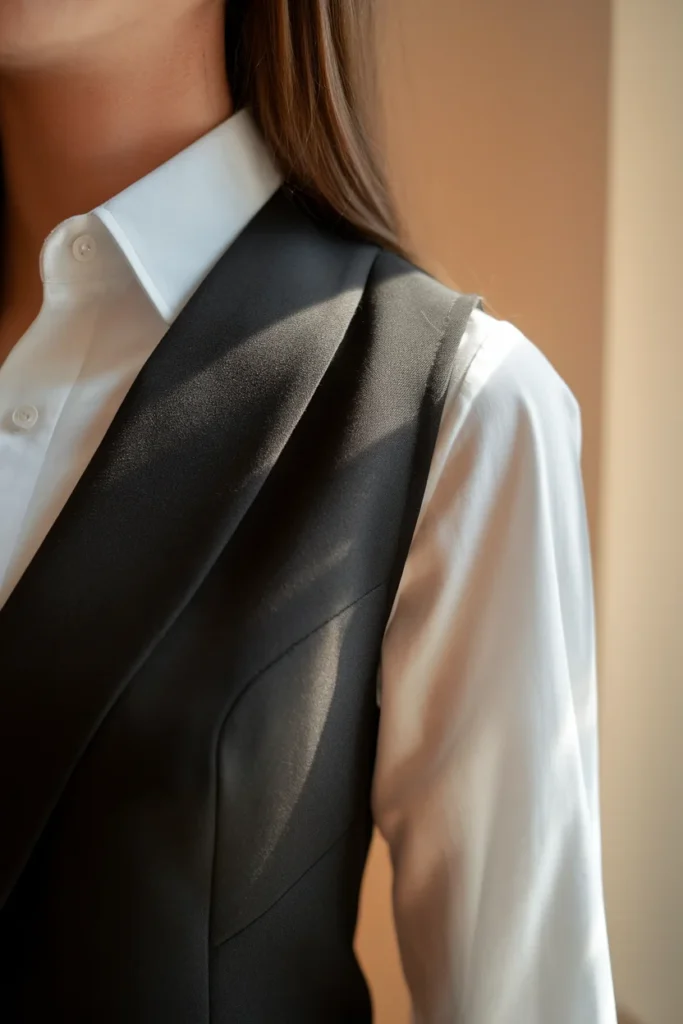
1. The armhole. Raise both arms straight out to the sides. The armhole should sit close to your underarm without cutting in, and you should see no more than an inch or two of your side body or bra when your arms are down. A gaping armhole is the single biggest tell of a badly fitting vest, and it is also the hardest thing to alter later.
2. The shoulder seam. It should land on the bony point where your shoulder ends and your arm begins. If it hangs onto your upper arm, the whole vest reads borrowed. This one is worth sizing down for even if the body feels snug, because a tailor can let out a side seam and cannot rebuild a shoulder.
3. The closure. Button or zip it fully. If the fabric pulls into an X across your bust, size up. If you can fit a full flat hand between the closure and your body, size down. Somewhere between those two is correct, and the vest should still close comfortably over a long-sleeve layer.
4. The hem line. Look at where the bottom edge lands relative to your hip. Move on to the next section, because this one deserves its own explanation.
If a vest passes three of four, buy it and tailor the fourth, unless the failure is the shoulder or the armhole. Those two are structural. Everything else is a modest fix at a local alterations shop.
It helps to know what a tailor can actually do, since this is where people either waste money or throw away a good piece. Taking in the side seams to slim the body is routine and cheap. Shortening a hem is routine on a woven vest and harder on a knit, where the finished edge is often part of the knitting. Moving buttons to adjust the closure is the cheapest fix of all. Rebuilding a shoulder means dismantling the whole upper garment, which usually costs more than the vest. Reducing a gaping armhole is possible on a lined suiting vest and close to impossible on a knit.
So the rule is worth stating plainly. Buy for the shoulder and the armhole, tailor everything else.
Save that four-point check to your phone. It works on secondhand vests, online returns, and anything a friend tries to hand down to you.
The Hem Line Rule That Sets Your Whole Silhouette
Where a vest ends changes your proportions more than its color, fabric, or price. Almost nobody talks about this, and it is the reason two women in the same vest can get completely different results.
The rule is simple. A vest hem creates a horizontal line across your body, and your eye reads that line as the end of your torso. Put it in the wrong place and you visually shorten whichever half of your body you did not intend to shorten.
| Where the hem lands | What it does | Pair it with |
|---|---|---|
| Above the natural waist (cropped) | Lengthens the leg line, shortens the torso | High-rise trousers, midi skirts, wide-leg jeans |
| At the hip bone | Neutral, the safest default | Almost anything, straight or bootcut jeans |
| Mid-thigh | Adds a long vertical, breaks up the leg | Slim or straight bottoms, never wide plus long |
| Below the knee | Strong column effect, needs a fitted base | Fitted trousers or leggings, close-cut top |
Two working principles come out of that table. Long vest, slim bottom. Short vest, wide or high-rise bottom. Break the pairing and the outfit will feel off even when you cannot say why.
The other half of the rule is what happens when the vest stays open. An open longline vest creates two vertical lines running down your front, which is the most reliably elongating shape in the whole category. Closing it swaps those verticals for one horizontal at the hem. Neither is better. They just do opposite jobs, and knowing which one you want before you leave the house is the whole trick.

Eight Vest Outfit Formulas You Can Build Tonight
Every one of these uses pieces most capsule closets already hold. I have put the highest-value formula first, because if you only try one, try that.
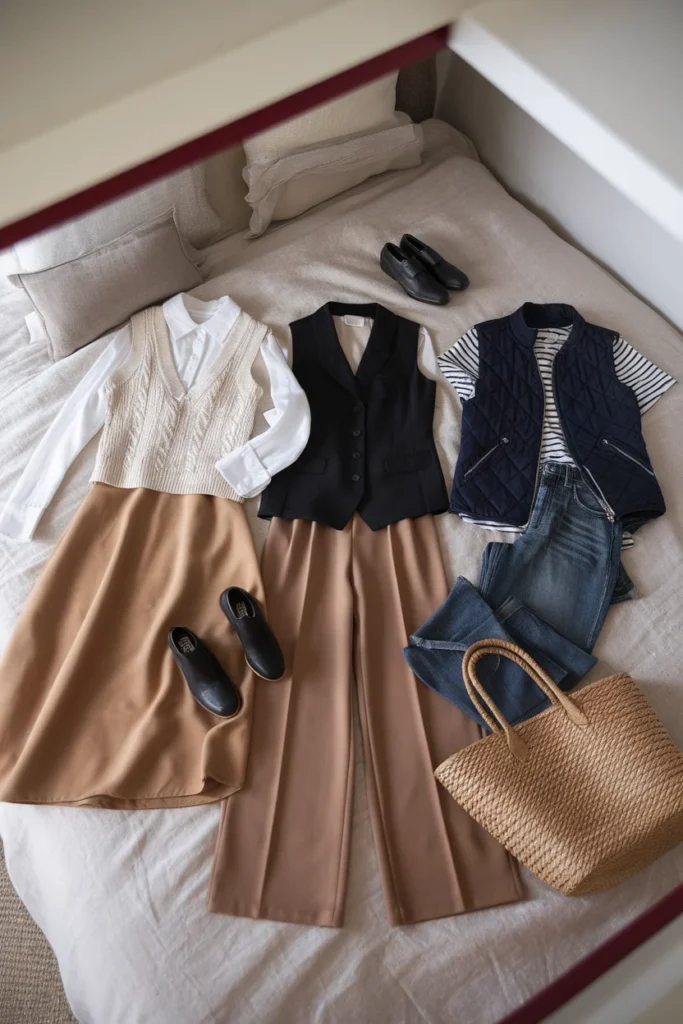
1. Longline vest, white tee, straight jeans, loafers. The workhorse. It reads polished in about four seconds of effort and works from March through November. Swap the loafers for ankle boots when it drops below 55F. If your loafer situation needs help, start with the best loafers for women chosen the capsule way.
2. Tailored vest, wide-leg trousers, same color family. Tonal dressing, and the fastest way to look expensive without spending it. Camel on cream, navy on navy, espresso on oat. The trick is matching the depth of the two colors, not the exact shade.
3. Sweater vest over a white button-down, midi skirt. Collar and cuffs peeking out from a knit vest is the single most reliable fall formula there is. Add tights and boots in November.
4. Vest as the top, high-rise trousers, gold hoops. Skip the underlayer entirely. Works with a tailored or knit vest that closes fully, and it turns a daytime piece into an evening one with no other changes.
5. Quilted vest, striped long-sleeve tee, jeans, sneakers. The weekend errand uniform. Adds structure to an outfit that would otherwise read as pajamas with shoes.
6. Vest over a slip dress. A tailored vest over a bias-cut midi slip is the most underrated combination on this list. The structure on top and the fluid drape below do all the work.
7. Vest, turtleneck, wool trousers, ankle boots. The cold weather answer, good down to about 35F with a coat over it. Keep all four pieces in the same three-color range.
8. Denim vest, black tee, black trousers. Denim as a layer instead of a bottom. Reads intentional rather than casual because the base is monochrome.
Notice what is not on this list. No formula asks you to buy a matching set, and none of them depend on a trend that expires. Each one is built from a base you can rearrange.
How to Style a Vest for Your Proportions
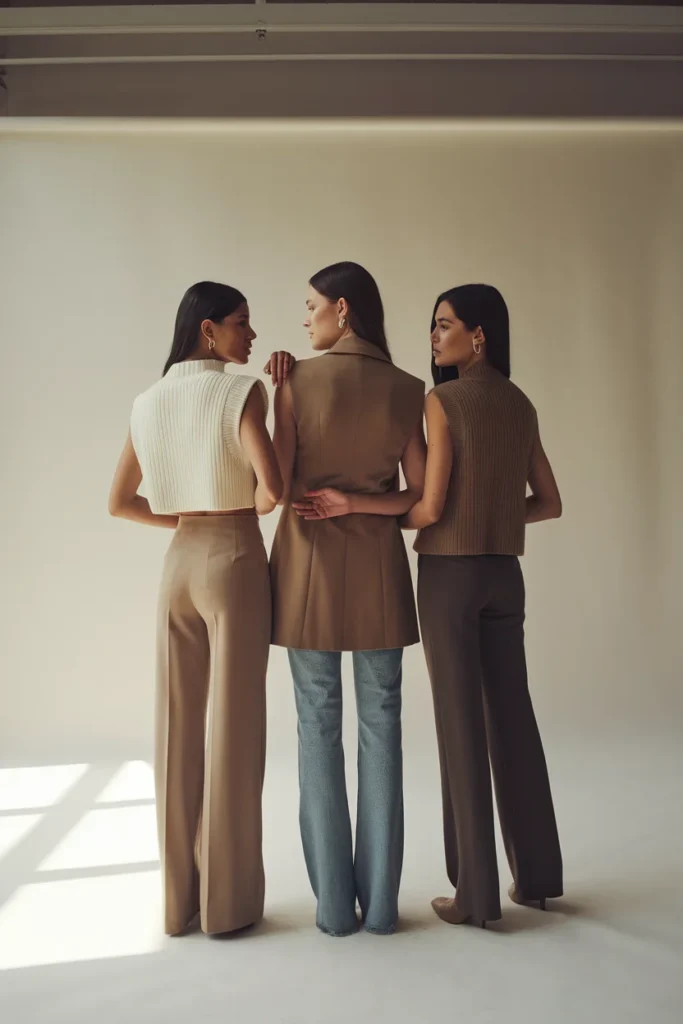
Fixed vocabulary here, because vague advice about what is flattering helps nobody. What follows is about proportion, meaning where lines land on your particular frame, and not about hiding anything.
If you are petite (5’4″ and under): Cropped and hip-bone hems keep your leg line long. A mid-thigh vest can work, but it needs a high-rise bottom underneath so the waist still reads high. Keep the vest slim through the body so the fabric does not add visual width you did not ask for.
If you are tall (5’9″ and over): You have room for the longline and below-knee hems that shorten everyone else. Take it. Mid-thigh and longer vests are genuinely easier on a longer frame, and you can carry a wide-leg bottom with them where a petite frame usually cannot.
If you are curvy or hourglass: The closure check matters most for you. A vest that pulls at the bust will undo the whole outfit, so size to your widest point and have the waist taken in. An open longline vest is reliable because it creates verticals without needing to close over anything.
If you are pear shaped: A vest that ends above or well below the widest part of your hip works better than one that ends right at it, since that hem line draws the eye exactly where it lands. Structure through the shoulder balances the proportion nicely.
If you are apple shaped or midsize: Open vests over a column of one color are the strongest play. Skip anything that closes tightly at the natural waist and look for a straight cut through the body.
If you are rectangle or inverted triangle: A vest that nips slightly at the waist creates a shape that a straight cut will not. For inverted triangle, keep the shoulder clean and unpadded, and let the volume live in the bottom half instead. Pairing with a wider leg helps, and there is more on that in how to style wide-leg jeans for your proportions.
If you are over 40 or over 50: Fabric weight starts to matter more than cut. A vest in a substantial wool or a dense knit hangs cleanly and holds its shape all day, where a thin acrylic will cling and ride up by lunchtime.
What to Wear Under a Vest
This is the question that stalls most people at the mirror, and the honest answer is that four options cover nearly every situation.
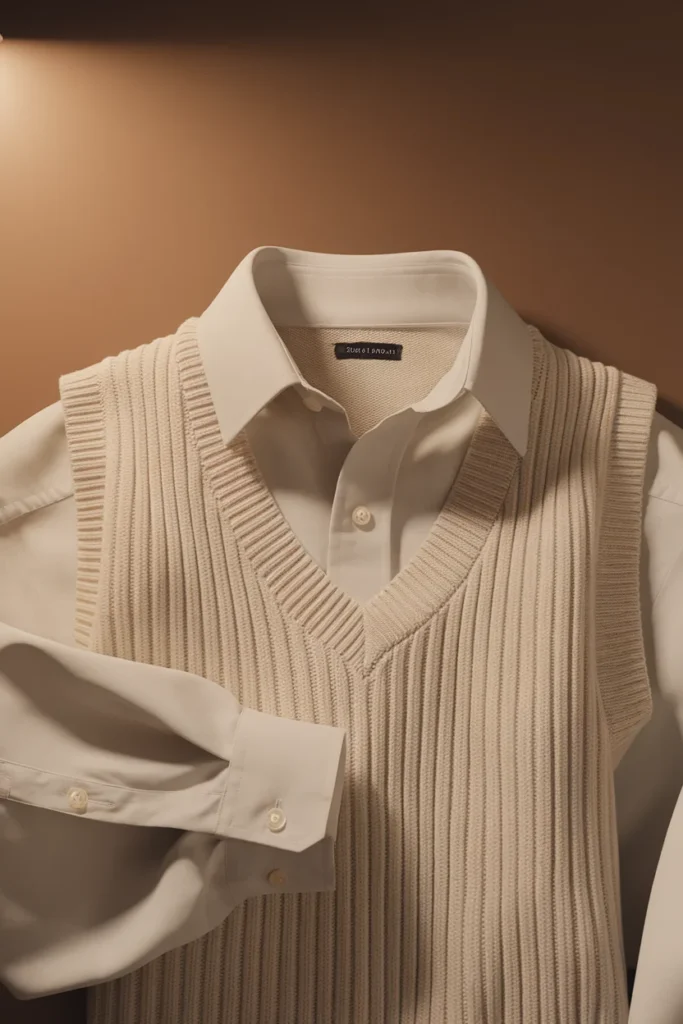
A fitted tee. White, cream, black, or gray. The default, and the reason a good tee is worth more than most people spend on one. Look for a close sleeve and a neckline that sits higher than the vest’s V, so the layering reads deliberate.
A button-down. Collar out, cuffs rolled over the vest’s armhole edge or left long. Instantly more formal. A crisp cotton poplin holds its collar under a knit vest where a soft flannel will collapse.
A turtleneck or mockneck. The cold weather answer. Fine gauge merino under a wool vest is warmer than most people expect and adds almost no bulk.
Nothing at all. A fully closed tailored or knit vest can work as a top on its own. Check the armhole depth first, since a deep armhole that was designed for layering will show more than you want when worn bare. Sticky gel cups solve most of that.
What does not work under a vest, in my experience: anything with a bulky shoulder seam, puff sleeves, or a chunky cowl. Volume at the top of the arm fights the vest’s armhole and creates a bunched line right where the eye lands. Save those tops for days the vest stays on the hanger.
Fabric weight is the quiet variable. A thin base under a thick vest looks intentional. A thick base under a thin vest looks like you got cold and improvised. Build your base layers first, since they decide what the rest of the closet can do, and the capsule wardrobe tops that anchor every outfit you own is the place to start.
How to Style a Vest for Work Without the Waiter Look
Here is the thing nobody writing about vests will say out loud. A black tailored vest over a white button-down with black trousers is a server’s uniform in most American restaurants, and a lot of women can feel that resemblance without being able to name it. That association is the real reason the office vest stays home.
It is also completely fixable. Three adjustments break the pattern.
Break the black and white. The uniform reads as uniform because of the high contrast. Move to camel over ivory, navy over pale blue, or espresso over oat and the entire association disappears. Tonal is your friend at work.
Change one silhouette. The uniform is fitted vest, fitted shirt, fitted trouser. Swap in a wide-leg trouser or a midi skirt and the proportion no longer matches. One change is enough.
Add something a uniform would never include. Gold hoops, a leather belt in a contrasting brown, a structured tote, loafers with a visible sole. Uniforms are deliberately plain, so a single considered accessory signals that this was a choice.
For business casual specifically, a knit vest over a button-down clears nearly every dress code while looking more considered than a cardigan. For a client meeting or an interview, the tailored vest with matching trousers reads as sharp as a blazer and stays comfortable in a warm conference room, which a blazer does not. Pair the vest logic with the rest of your office rotation using these business casual work outfit ideas from a capsule wardrobe.
One note on fabric at work. A vest in a wool or wool blend suiting holds a press through a full day of sitting. Polyester suiting creases at the hip by mid-afternoon and shows every wrinkle under fluorescent light.

Fabric, Care, and Cost Per Wear
The part every vest article skips, and the part that decides whether you own this piece in five years.
Fabric, ranked by how well it ages. Wool and wool blends hold shape, resist wrinkles, and get better with wear. Cotton is breathable and washes easily but wrinkles and can stretch at the armhole. Linen blends work for summer vests and will crease, which is the point. Acrylic is the cheapest and pills fastest, usually within a season at the underarm and side seam. Polyester suiting holds color but traps heat and creases at stress points.
Weight matters as much as fiber. A midweight knit vest hangs. A featherweight one clings and rides up. If you can see your hand clearly through the fabric when you hold it to the light, it will not hold its shape over a tee.
Care. For anything wool, Woolmark’s wool care guidelines are the reference worth following. Their guidance is to wash inside out with a mild wool detergent, dry flat at room temperature away from direct sunlight or heat, and store clean in an airtight container. The tip most people have never heard: rest a wool garment for 24 hours between wearings so the fiber’s natural spring can recover. That one habit does more for the life of a knit vest than anything you buy.
Price tiers in the US market. A vest at the mass tier generally runs $10 to $50 at places like Old Navy, Target, Uniqlo, or H&M, and at that price you are usually getting acrylic or a poly blend. Mid tier sits around $50 to $150 at Madewell, J.Crew, Quince, Everlane, or Banana Republic, which is where wool blends and better armhole construction start. Contemporary runs roughly $150 to $400 at COS, Sezane, or Reformation. Prices move, so treat these as tiers rather than quotes and check current numbers before you buy.
Cost per wear. Take the price and divide it by how many times you will realistically wear it in a year. A $40 acrylic vest worn six times before it pills is about $6.67 a wear. A $120 wool vest worn thirty times a year for four years is about $1 a wear. The cheap one costs more. If you are buying at the mass tier, buy cotton or a wool blend over acrylic even when the acrylic looks identical on the rack, because the difference shows up at the armhole after about ten washes.
Frequently Asked Questions
Should a vest be tight or loose?
Neither, and the answer changes by zone. Your shoulder seam should be exact, sitting right at your shoulder point. The armhole needs to sit close without cutting in. Through the body you have real freedom, relaxed or fitted depending on the look, as long as the closure neither pulls into an X across your bust nor leaves room for a full flat hand. Structural fit up top, personal preference below.
What do you wear under a vest?
A fitted tee, a button-down with the collar out, a fine-gauge turtleneck, or nothing at all if the vest closes fully and the armhole is not cut deep for layering. Avoid puff sleeves, chunky cowls, and anything with a bulky shoulder, since volume there fights the armhole and bunches.
Do vests work if you are petite?
Yes, with attention to the hem. Cropped and hip-bone lengths keep your leg line long. If you want a longer vest, pair it with a high-rise bottom so your waist still reads high, and keep the vest slim through the body. Below-knee vests are the one length that genuinely fights a shorter frame.
Can you wear a vest to the office?
Absolutely, and a knit vest over a button-down clears almost every business casual dress code. Move away from the black vest, white shirt, black trouser combination if the server-uniform resemblance bothers you. Tonal colors and one silhouette change fix it completely.
Can you machine wash a sweater vest?
It depends on the fiber. Cotton and acrylic usually handle a cold gentle cycle. For wool, follow the care label, wash inside out with a mild wool detergent, and dry flat at room temperature rather than tumbling. Woolmark also recommends resting wool 24 hours between wears so the fiber recovers, which prevents most of the stretching people blame on washing.
How much should you spend on a vest?
Aim for the $50 to $150 mid tier if you plan to wear it weekly, because that is where wool blends and properly finished armholes begin. Under $50 works if you buy cotton or a wool blend and skip acrylic. Run the cost per wear before you decide, since a cheap vest that pills in one season usually costs more per wear than a good one.
Can you wear a vest in summer?
Yes, in linen or a light cotton, and worn as the top rather than as a layer. A closed linen vest with wide-leg trousers works in 75F to 85F weather. Skip wool, quilted, and puffer styles entirely until temperatures drop back under 65F.
Start With What You Already Own
Before you buy anything, go pull the vest that is already hanging in your closet. Run the four-point check on it: shoulder seam, armhole, closure, hem. You will know in under a minute whether the piece was ever going to work, and if it fails on the shoulder or armhole, you can finally let it go without guilt.
If it passes, build formula one tonight. Longline or hip-length vest, white tee, straight jeans, loafers. Wear it out for coffee tomorrow and notice how differently it feels when the fit is right.
The vest is the layer that quietly does the most and gets the least credit. Give yours one honest week in rotation and see where it lands.
Which vest is sitting unworn in your closet? Tell me in the comments what is stopping you from reaching for it, and I will help you troubleshoot the fit.
Keep reading

How to Style a Jacket for Plus-Size Women: 10 Outfits That Work
A lot of jacket advice for bigger bodies is still written around hiding. Hide the hips, hide the arms, hide under something...

How to Style a Jacket for Women Over 50: 12 Outfits That Work
Your closet probably holds more jackets than you wear. There’s the blazer from an old job, the denim jacket you’re unsure about...

How to Style a Jacket: 10 Cozy Jacket Outfits for Fall and Winter
Your jacket is the first thing people see between October and March. It’s also the piece most of us grab last and...
One Comment