
How to Style a Denim Jacket: The Layer That Goes With Everything
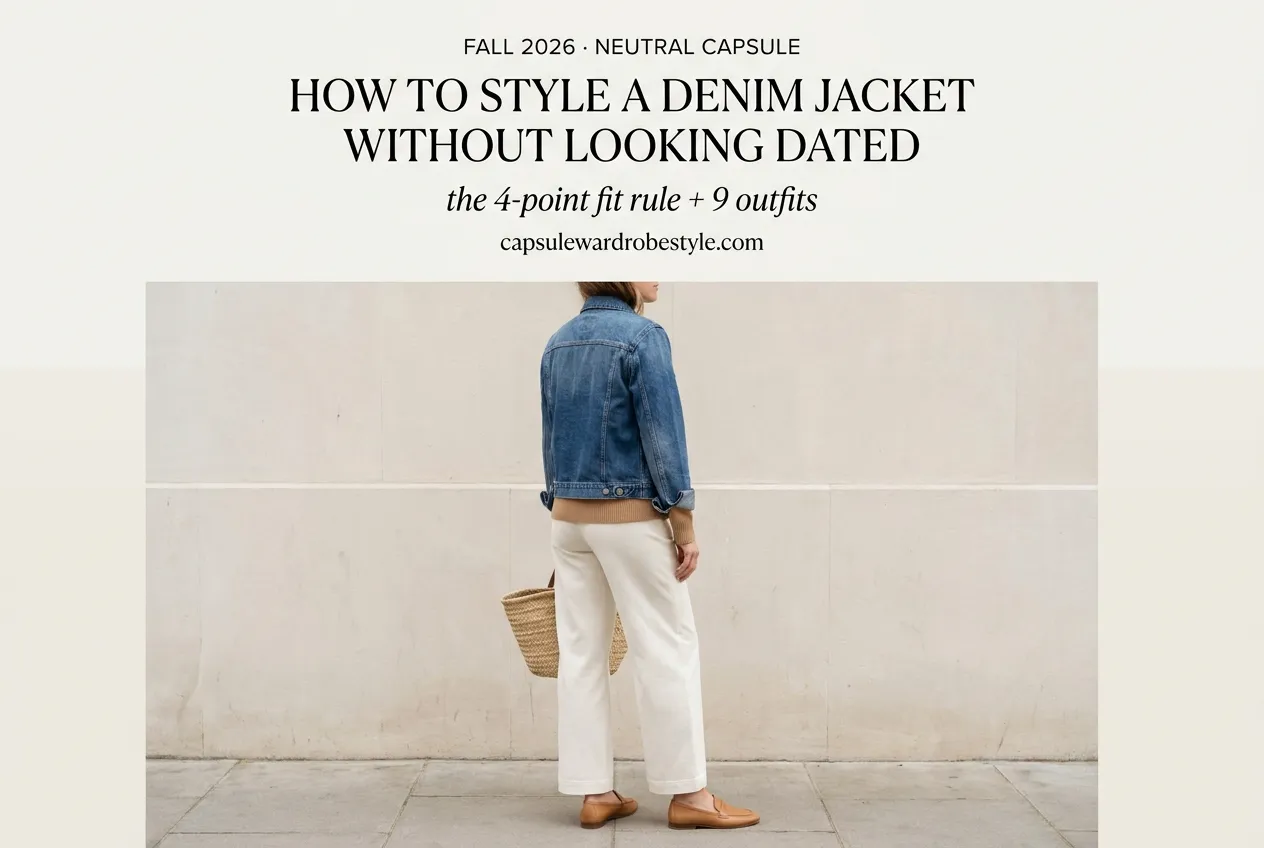
Learning how to style a denim jacket is less about finding new outfits and more about fixing the three or four small things making your current ones look slightly off. You own the jacket. You’ve worn it a hundred times. And some mornings it pulls the whole look together, while other mornings it makes you look like you got dressed in a hurry, and you can’t work out what changed. The variable is almost never the jacket. It’s the hem, the wash, and what’s underneath.

By the end of this you’ll have a fit test you can run in thirty seconds, a grid that turns one jacket into nine outfits, a wash-matching rule that stops the jacket from fighting your neutrals, and a short list of combinations to stop wearing. No shopping required for most of it.
Start With the Jacket You Already Own
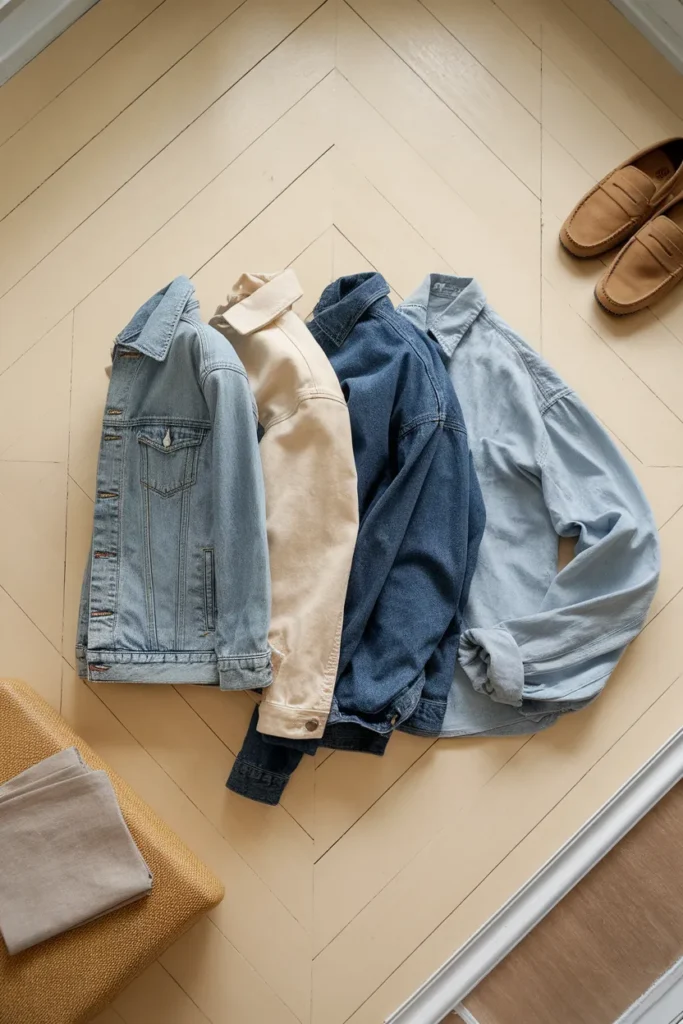
Before styling anything, work out which jacket is hanging in your closet, because the four common shapes behave completely differently and most styling advice quietly assumes you have the classic.
The classic trucker is the boxy, waist-length one with the two vertical seams down the front and the button tabs at the hem. It’s the Type III silhouette, and it’s the shape almost everyone pictures. It was assigned its lot number in 1967 and designed by Jack Lucier, who stripped out the pleats and copper rivets of the earlier version and added the two V seams that break up the boxiness. If you want the full lineage, Levi Strauss & Co.’s own archive on the Type III trucker has the original design notes. Useful thing to know: those V seams are the reason a trucker reads structured rather than shapeless, so a jacket without them will always look softer on you.
The cropped version stops at or just above your natural waist. It’s the easiest shape to wear with high-rise anything and the hardest to wear with a low-rise or mid-rise bottom, because it strands a band of shirt between the jacket hem and your waistband.
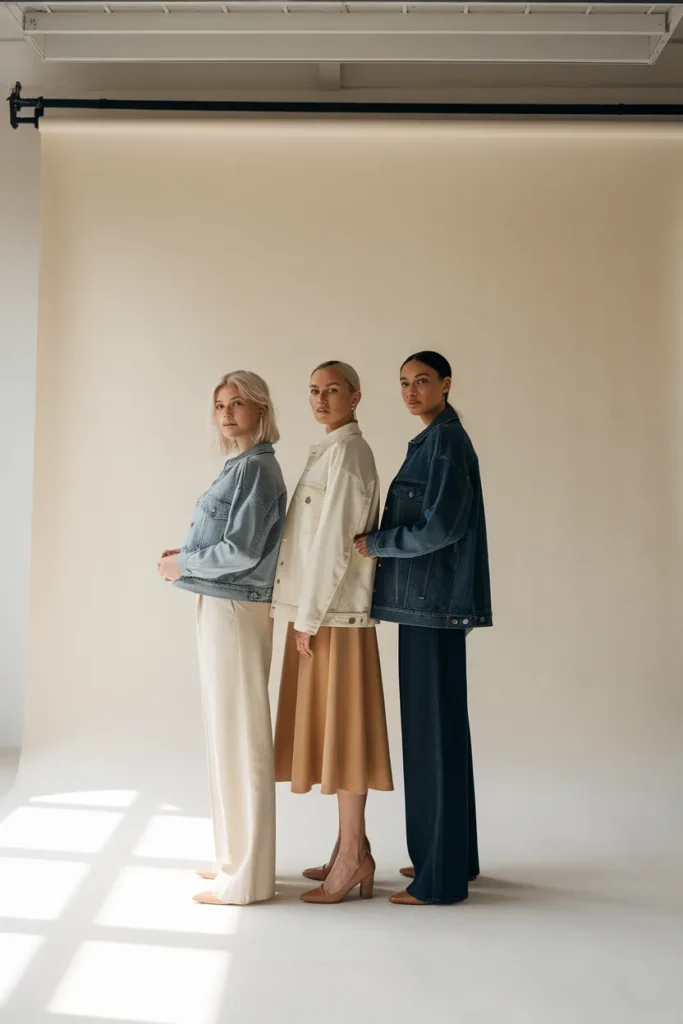
The oversized version drops the shoulder seam past your shoulder bone on purpose. Worn with volume on the bottom, it reads sloppy. Worn with something narrow, it reads deliberate.
The denim shirt jacket has no rigid structure at all. Soft, drapey, usually a lighter fabric weight. It layers like a shirt, so it belongs over a tee and under a coat, not as your only outer layer in forty-five degree weather.
Worth checking which of these you actually reach for, because the answer usually tells you which shape belongs in your rotation long term. If you’re rebuilding your outerwear, the six capsule wardrobe jackets that earn their hanger space covers where a denim jacket sits alongside a trench and a wool coat.
Fit Is the Whole Game: The 4-Point Denim Jacket Check
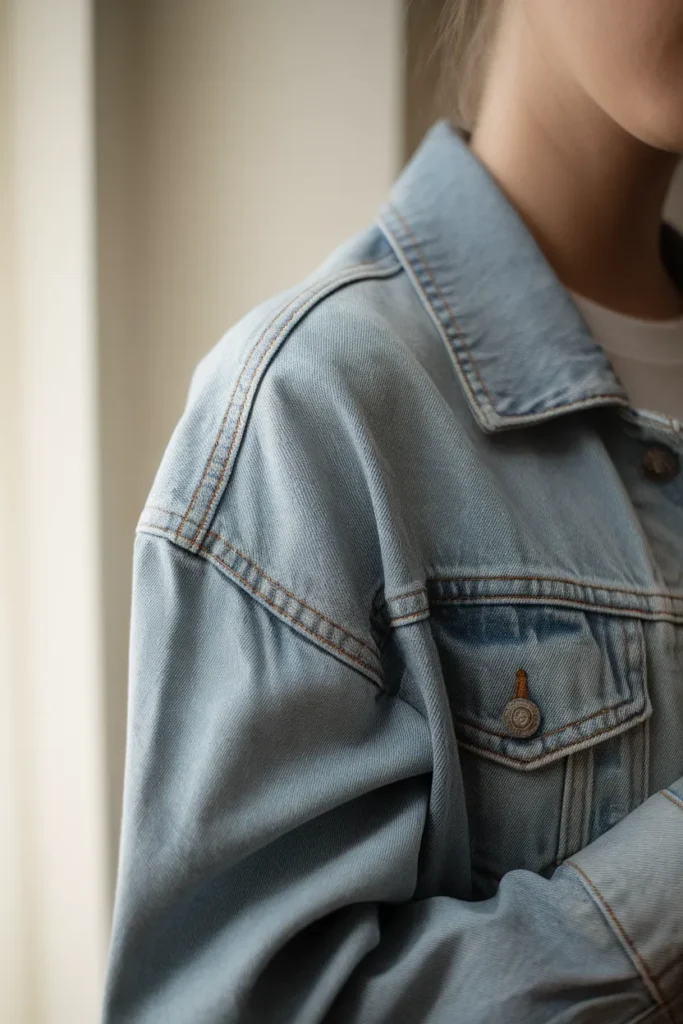
Here’s the diagnostic. Put the jacket on with whatever you were planning to wear and run these four checks in front of a mirror. Most “this looks dated” problems fail on point two.
1. The shoulder seam. It should sit right at the edge of your shoulder bone, or clearly past it if the jacket is meant to be oversized. The dead zone is in between. A seam sitting an inch off your shoulder with no other volume in the jacket reads like a sizing mistake rather than a choice.
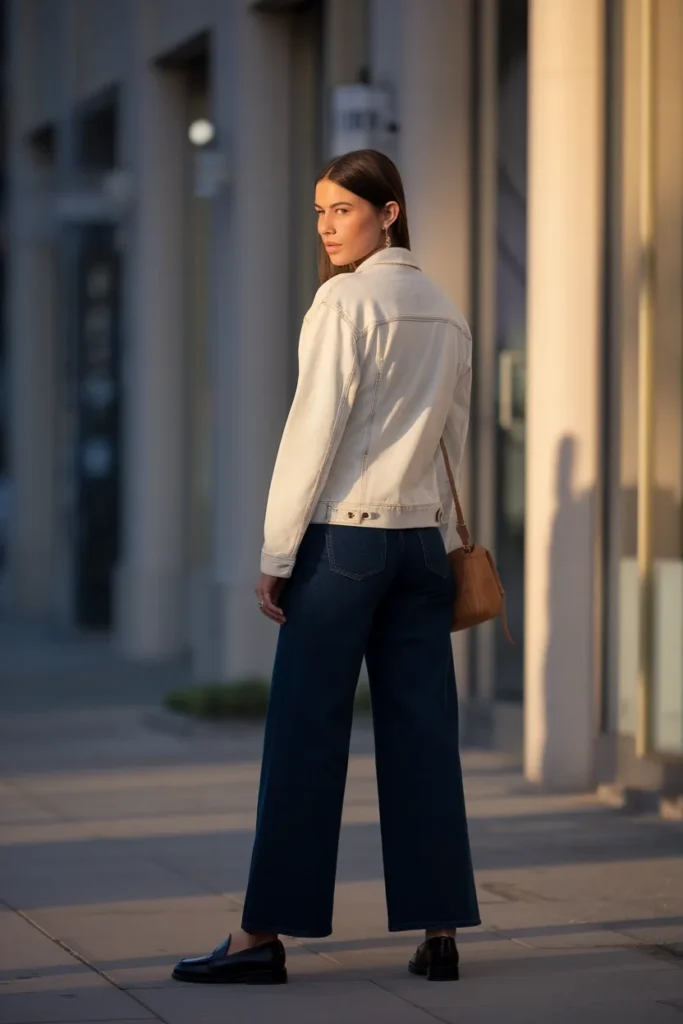
2. The hem landing point. Your jacket hem should land at your natural waist or one to two inches below it. If it lands at the widest part of your hip, it cuts you at your widest point and adds visual weight exactly where nobody wants it. This one fix solves more outfits than every other tip on this page.
3. The sleeve end. It should hit your wrist bone. If it’s longer, cuff it twice, firmly, so the cuff holds. A single loose cuff unrolls by lunchtime and starts looking accidental.
4. The middle button test. Button the middle button. If the front flares open in a V or the seams pull sideways, the jacket is too small through the chest, and you’ll only ever be able to wear it open. That’s fine if you know it, but it halves the outfits the jacket can do.
A jacket failing points one and four is a replacement. A jacket failing points two and three is a tailoring job, and both are cheap: shortening a denim hem and sleeves runs roughly $20 to $45 at most US alteration shops, which is worth it on a jacket you’ll wear for a decade.
The 1×9 Denim Jacket Grid
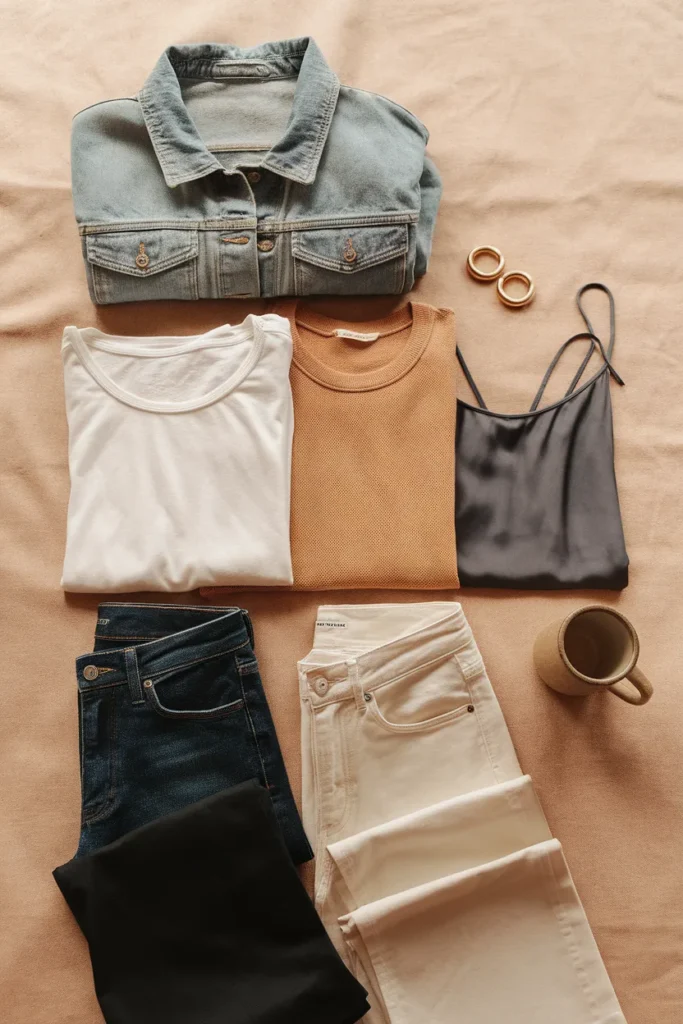
This is the part I’d screenshot. Three bottoms, three tops, one jacket, nine outfits. Pick pieces you already own and fill in the grid, and the jacket stops being a coin-flip and starts being a system.
| White tee | Camel fine-gauge knit | Soft black cami | |
|---|---|---|---|
| Straight indigo jeans | Saturday errands. Sneakers, tote. | School run into coffee. Loafers. | Casual dinner. Ankle boots, gold hoops. |
| Ivory wide-leg trousers | Weekend brunch. Ballet flats. | The one that always works. Loafers, crossbody. | Evening out. Heeled mule, small bag. |
| Black midi skirt | Warm-weather everyday. Sneakers. | Layered transitional. Boots, belt. | Date night. Heel, jacket worn open. |
Nine outfits. One jacket. If you own even a rough version of those six pieces, you already have a week and a half of outfits and never opened a shopping tab.
The grid works because the jacket is the only structured element, so everything under it has to be soft or slim. Two structured pieces at once (a stiff jacket over a stiff blazer-cut shirt, for example) is what makes people feel bulky in denim. If your grid feels thin on the top row, the capsule wardrobe tops that anchor every outfit you own will fill it out fast.
Run the cost-per-wear math while you’re here. A $110 jacket worn twice a week across the eight months of the year the weather allows it lands somewhere near a dollar fifty per wear in the first year alone, and denim outlives almost everything else in a closet. Very few pieces at any price come close.
Denim on Denim, Without the Costume
Denim on denim works. It goes wrong for exactly one reason, which is that the two denims are close enough in tone to look like an attempted match that missed.
The rule: go two full shades apart, minimum. A light-wash jacket over dark indigo jeans is the safest version and reads intentional from across a room. Dark jacket over ecru or white denim is the sharper version. What fails is a mid-blue jacket over mid-blue jeans, because your eye clocks the near-match and reads it as an accident.
Break up the middle if you want insurance. A belt at the waist, a tucked top in a contrasting color, or a bag in tan or black stops the denim running as one unbroken column from shoulder to ankle.
Wide-leg denim is the easiest bottom to pair with a denim jacket, because the volume difference does the separating for you before color even comes into it. How to style wide-leg jeans for your proportions goes deeper on getting that ratio right.
One more thing: keep the distressing on one piece only. Ripped jacket over ripped jeans is where denim on denim tips into looking unplanned.
Dresses, Skirts, and the Hem Problem Nobody Mentions
Pairing a denim jacket with a dress is the fastest way to make a dress work in three seasons instead of one. There’s one thing to get right, and almost nobody says it out loud.
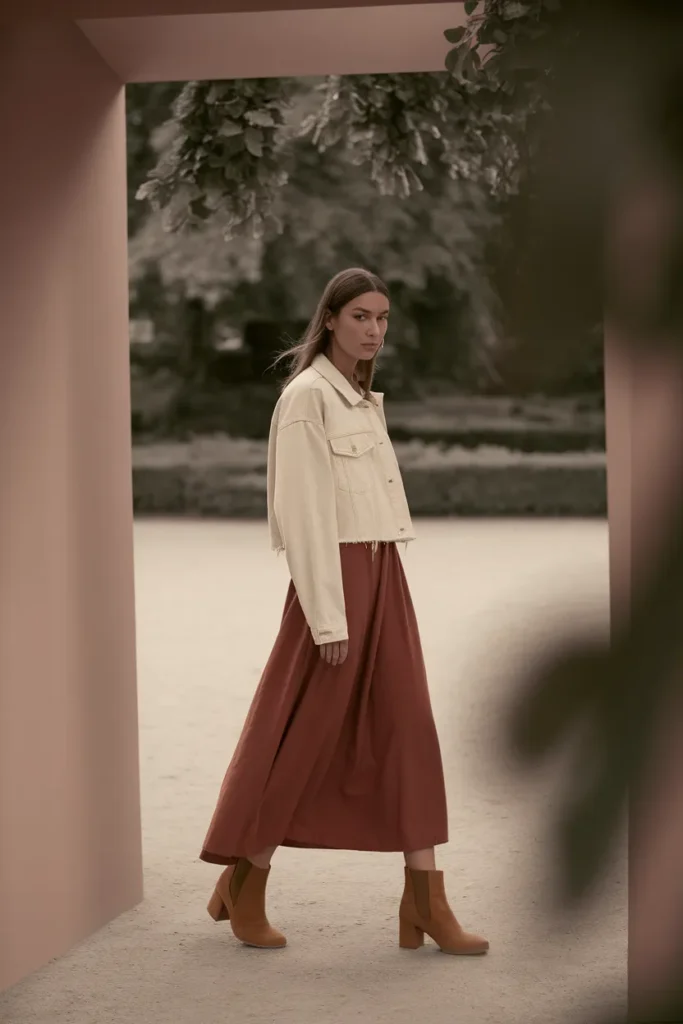
The two hems must not compete. If your jacket hem and your dress hem land within a few inches of each other, they create a stacked horizontal line at your hip and the whole silhouette flattens. With a mini dress or a short skirt, wear a cropped or waist-length jacket so the hems are far apart. With a midi or maxi, anything works, because the distance is already there.
Specific pairings that hold up:
- Floral midi dress, mid-wash jacket, tan sandals. The jacket cuts the sweetness of the print and makes it wearable for daytime.
- Black slip dress, dark indigo jacket, black boots. Genuinely good, and works from September through November.
- Knit sweater dress, cropped ecru jacket, ankle boots. The cropped jacket keeps the knit from reading bulky through the middle.
- Pleated midi skirt, soft black top, oversized jacket worn open. The open front adds a vertical line down your center that a buttoned jacket kills.
The one to be careful with: a body-skimming dress plus a jacket ending at mid-hip. Both the hem rule and the widest-point rule fail at once, and no accessory fixes it.
The Polished Version: Denim Jacket for Work and Dinner
A denim jacket can absolutely go somewhere that isn’t the grocery store. Three levers do all the work, and you need at least two of them.
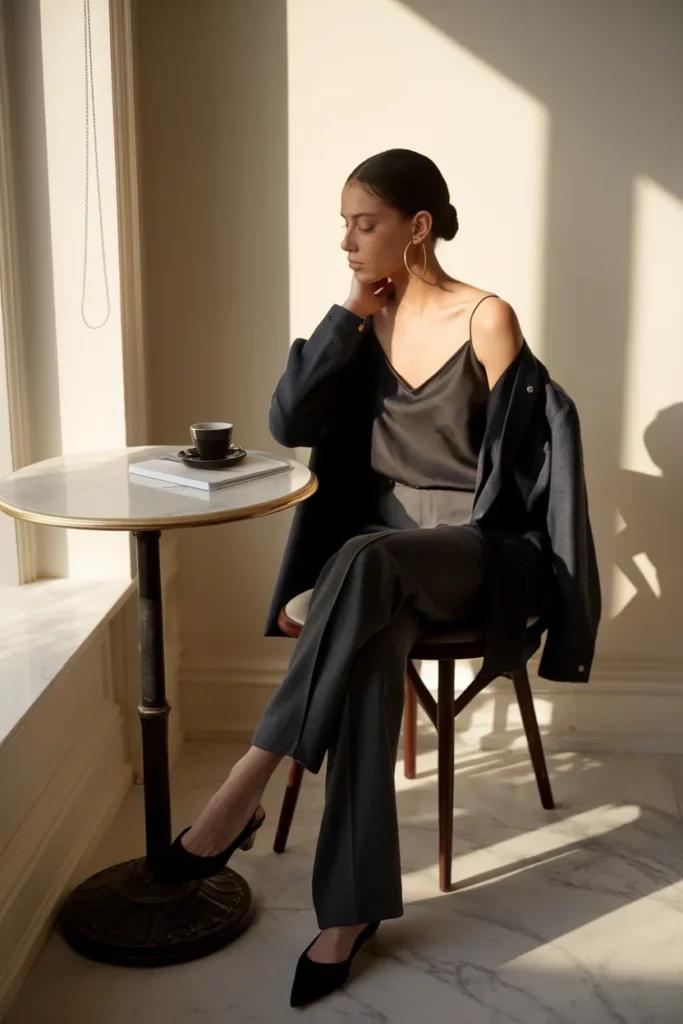
Lever one: raise the fabric quality of everything else. Denim next to cotton jersey reads casual. The same denim next to silk, fine wool, or a crisp poplin reads deliberate. A jacket over a silk-feel cami and tailored trousers is a completely different register than the same jacket over a tee and leggings.
Lever two: change the shoe. Sneakers cap the outfit’s formality no matter what else you do. A loafer, a pointed flat, a heeled mule, or a clean ankle boot lifts it several notes instantly. This is the cheapest and fastest of the three levers, which is why the best loafers for women chosen the capsule way is worth a read if your shoe rotation is all sneakers.
Lever three: add one piece of real metal. Gold hoops, a slim watch, a fine chain. Denim is a workwear fabric at its core, and a single polished metal accent is what tells people the casualness is a choice.
For actual offices, know your room. A denim jacket over a sheath dress reads fine in most creative and business-casual environments in the US, and reads too casual in law, finance, and formal client-facing work. If you’re unsure, wear it in and take it off at your desk. It works as a commute layer even where it doesn’t work as an office layer.
Match Your Wash to Your Neutral Base
Here’s the piece that competitors leave out entirely. Your denim jacket doesn’t exist alone, it sits on top of whatever neutral base your closet already runs on, and the wash either agrees with that base or quietly fights it every time you put it on.
Find your base, then check your wash:
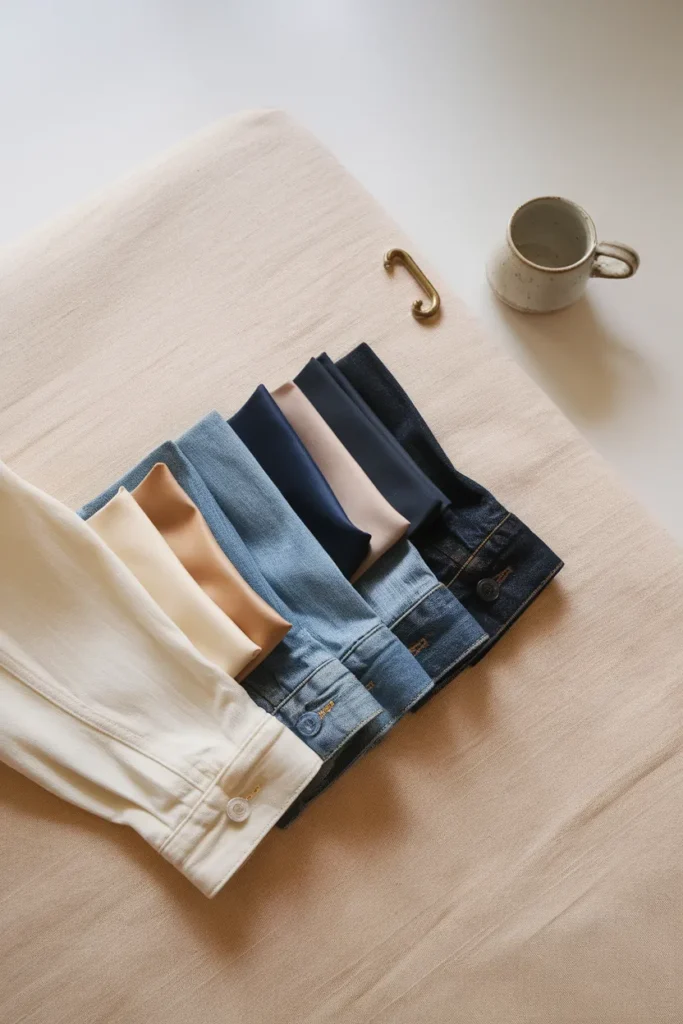
- Ivory, cream, and oat base: light wash or ecru denim. A dark indigo jacket will feel heavy and disconnected over a closet this pale.
- Camel and taupe base: mid-blue. The warm neutral and the mid-blue balance each other, and this pairing is the most forgiving of the four.
- Soft black and espresso base: deep indigo, black denim, or a rigid one-wash. Light stone wash over an all-black closet always looks like two different wardrobes colliding.
- Navy base: light wash only. Mid-blue denim next to navy is the same near-match problem as denim on denim, at a smaller scale, and it’s the single most common closet clash I see.
If your base is a mix, buy the wash that matches the neutral you wear most, not the one you own the most of. Those are frequently different numbers. Working out your base properly is its own project, and how to pair neutral colors so nothing in your closet clashes walks through it.
One accent color per outfit is plenty when denim is in the mix. Burgundy, butter yellow, and tomato red all sit well against blue denim. Bright cobalt does not, because it competes with the denim directly.
Styling by Proportion: Petite, Tall, Curvy, Midsize, Over 40
Proportion beats size every time. What follows is about where the jacket’s lines land relative to your own, which has nothing to do with what number is on the tag.
Petite (5’4″ and under). Cropped or true waist-length. Have the sleeves shortened, because a sleeve covering half your hand shrinks the whole frame. Skip anything hitting past your hip, and look at the shoulder seam carefully, since standard jackets often sit wide on a petite shoulder.
Tall (5’9″ and over). You have room for a longer body, so a jacket hitting mid-hip works on you when it doesn’t on others. Check the sleeve length before anything else, and consider tall sizing or a men’s cut for genuine sleeve reach.
Curvy and hourglass. Buy for the shoulder and chest, then have the waist taken in. Choose a jacket buttoning at your narrowest point rather than above or below it. A jacket you can’t button through the chest will only ever be an open layer.
Midsize. A relaxed fit through the chest with a hem clearing your hip is the reliable combination. Rigid non-stretch denim holds its shape better across a day than stretch denim, which softens and starts clinging by afternoon. More on proportion in building a midsize capsule wardrobe that actually fits.
Pear. Keep the hem above the widest part of your hip. Even an inch matters here.
Apple. Wear it open for the vertical line, and pick a slightly longer body so it doesn’t stop at your midsection.
Rectangle. Add a belt over the jacket or choose one with a defined waist tab, since the shape gives you a waist the jacket doesn’t.
Inverted triangle. Look for a soft shoulder with no epaulettes or heavy seam detail up top.
Over 40 and over 50. Fabric weight matters more than cut. Heavier non-stretch cotton denim holds structure through a full day, while thin stretch denim collapses and bags at the elbows by three in the afternoon. This is the one place where paying more genuinely shows.
Five Denim Jacket Combos Worth Retiring
Everyone tells you what to add. Here’s what to stop doing, which usually moves the needle faster.
1. Jacket hem landing at mid-hip over a fitted dress. Two rules break at once. Either change the jacket or change the dress.
2. Distressed jacket, distressed jeans, distressed boots. Distressing on one piece looks lived in. On three, it reads unplanned. Cap it at one.
3. Buttoned to the top over a collared shirt with the collar pulled out. The two collars fight and the layering reads dated. Leave the top two buttons open or lose the shirt collar.
4. Very light stone wash with black bottoms in December. The wash carries a season, and a summer wash over winter black looks off even when the pieces individually work. Save the palest washes for March through September.
5. Denim jacket, leggings, sport sneakers, and a crossbody worn across the chest. Every element is doing errand duty. Swap any one of the four (trousers instead of leggings, or a shoulder bag instead of the crossbody) and it becomes an outfit again.
Care It So It Looks Better in Year Three
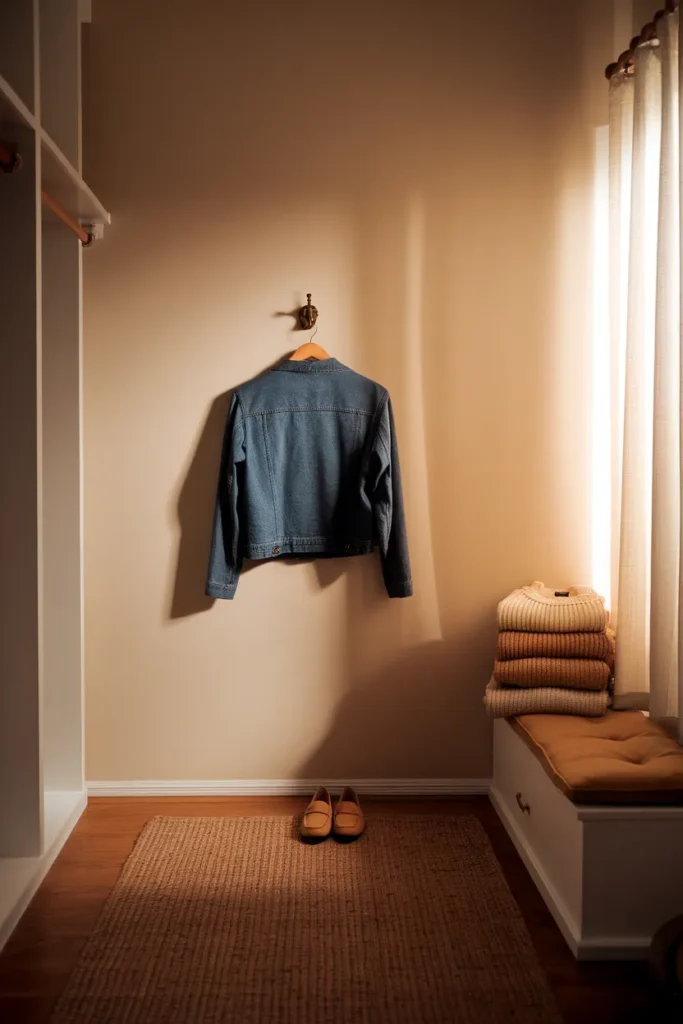
Denim is one of the few fabrics genuinely improving with age, and the main thing standing between you and a jacket you love in five years is washing it too often.
Wash it every eight to ten wears unless something spills. Cold water, inside out, gentle cycle. Hang to dry, always, because the dryer is what shrinks and stiffens the cotton and blows out the shoulder seams over time.
Air drying takes a while and there’s a reason for it. Cotton Incorporated notes cotton can absorb up to twenty-seven times its own weight in water, which is exactly why a soaked denim jacket feels like it weighs ten pounds coming out of the machine, and why hanging it over a shower rail overnight beats any shortcut.
For spot cleaning between washes, cold water and a damp cloth handle most of it. For odor, hang it outside for a few hours or run it through a no-heat dryer cycle with a dryer ball.
On price and quality: a Levi’s Original Trucker runs $110 in 100% non-stretch cotton, and Madewell’s denim trucker sits around $148, with their softer shirt-jacket version near $128. Under $50 you’re looking at Old Navy, Target’s Universal Thread, or Uniqlo, and the trade-off there is real: lighter fabric weight, more stretch content, and a shoulder seam that loses shape faster. If you want the look of a $300 to $400 contemporary jacket without the spend, buy rigid non-stretch cotton in the mid tier and have the waist and sleeves tailored. Construction and fit are what read as expensive, and neither one requires the price tag. (Prices move, so confirm current numbers before you publish or shop.)
Frequently Asked Questions
Does a denim jacket work for petite women? Yes, with two adjustments. Choose a cropped or true waist-length jacket rather than anything hitting past your hip, and get the sleeves shortened to your wrist bone. Sleeve length is the single biggest tell on a petite frame, and it costs very little to fix.
Can you wear a denim jacket with jeans? Yes. Keep the two washes at least two full shades apart, so a light jacket over dark indigo or a dark jacket over ecru. Break the column with a belt, a contrasting tucked top, or a tan bag. Avoid mid-blue on mid-blue, which is the pairing that looks like a near-miss.
What color denim jacket is the most versatile? It depends on your neutral base rather than on any universal answer. A mid-blue wash is the most forgiving over camel and taupe closets. Ecru or light wash suits ivory and cream closets. Deep indigo or black denim is the pick if you wear mostly soft black and espresso.
Is an expensive denim jacket worth it, or is a cheaper one fine? The difference you’ll feel is fabric weight and shoulder construction, not the label. Rigid non-stretch cotton at any price holds shape better than stretch denim. A well-chosen mid-tier jacket with $30 of tailoring will outperform an untailored jacket at three times the price.
Can I wear a denim jacket to work? In most creative and business-casual US workplaces, yes, particularly over a sheath dress or tailored trousers with a real shoe. In law, finance, and formal client-facing roles, treat it as a commute layer and take it off at your desk.
How often should I wash a denim jacket? Every eight to ten wears is plenty unless something spills. Cold water, inside out, gentle cycle, hang to dry. The dryer causes most of the shrinkage, stiffness, and shoulder-seam damage people blame on the jacket itself.
Are denim jackets still in style in 2026? The silhouette in demand shifts (right now relaxed and slightly cropped shapes are outperforming the tight, long cuts of the mid-2010s), but the jacket itself has been in continuous rotation since the 1960s. Treat it as a permanent layer whose proportions you update every several years, not as a trend piece.
One Jacket, Rebuilt
Try one thing this week. Put the jacket on with the outfit that always felt slightly wrong, and run the four-point check on it. Nine times out of ten it’s the hem landing at your hip, and the fix is either a different bottom or a $25 alteration.
Then fill in the 1×9 grid with pieces you already own. If you end up with seven workable outfits instead of nine, that’s still seven mornings you don’t have to think, out of one jacket you’ve had for years.
Which of the five retired combos have you been wearing without realizing it? Tell me in the comments, I’d bet on number five.
Keep reading

8 Hoodie Outfits for Plus-Size Women That Actually Look Put-Together
Your closet has a hoodie in it. Probably three. And every cold morning you reach for one and think the same thing:...

How to Style a Hoodie for Women Over 50: 8 Outfits That Work
The hoodie in your closet is probably fine. The problem is usually three inches of it you have never looked at closely....

8 Cozy Hoodie Outfits for Fall and Winter That Never Look Sloppy
Your hoodie is not the problem. The seven inches of fabric hanging off the back of your neck is the problem, and...