
Capsule Wardrobe Accessories: The Small Pieces That Change Everything
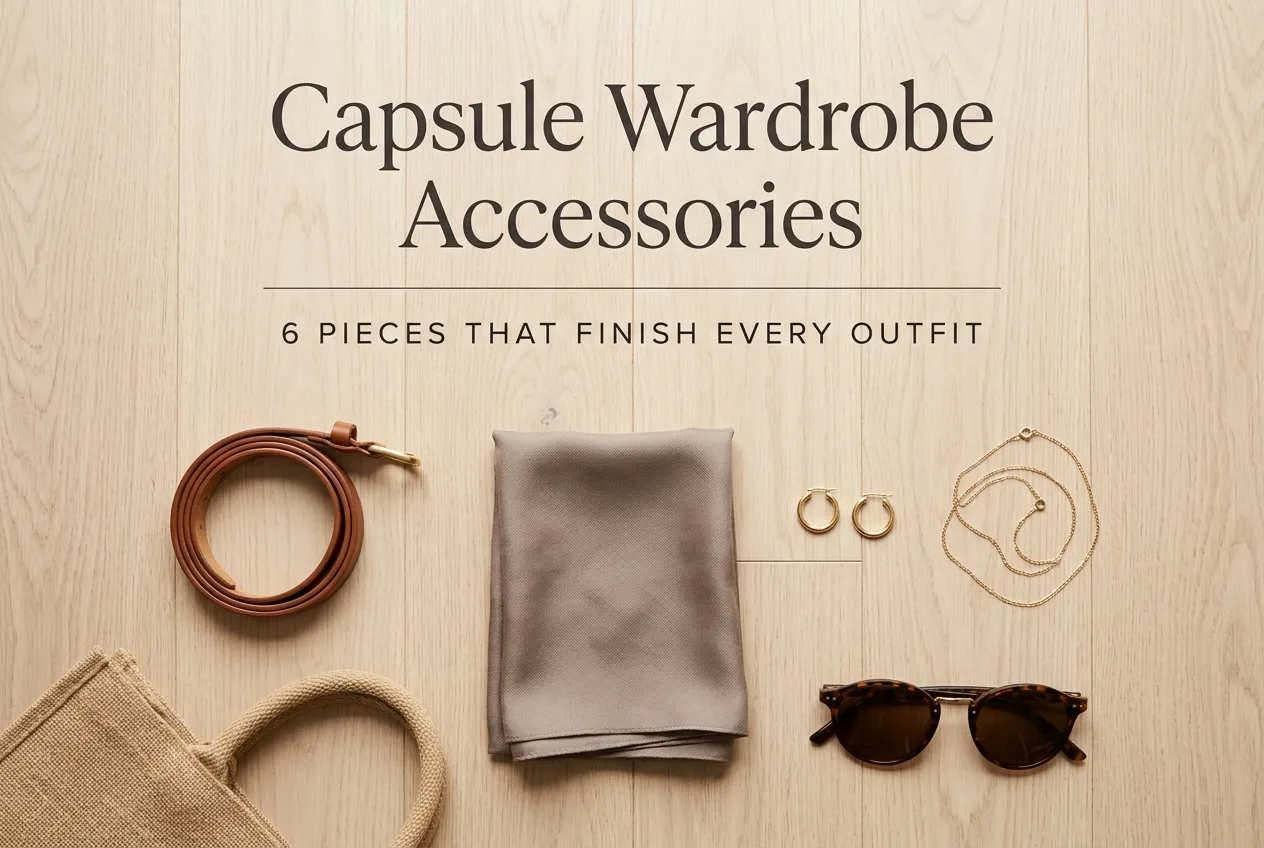
You built the capsule. Thirty pieces, mostly neutral, all of them things you actually like. And getting dressed is faster now, which was the whole point. But somewhere around week three you caught your reflection and thought: this looks fine. Just fine. Not quite finished.
That gap between fine and finished is almost never a clothing problem. Capsule wardrobe accessories are the layer most people skip, and they’re the layer doing the heaviest lifting. Six small pieces can turn twelve garments into a wardrobe that reads intentional instead of plain. This guide shows you how to audit what you already own, where the real gaps are, and what to buy last.
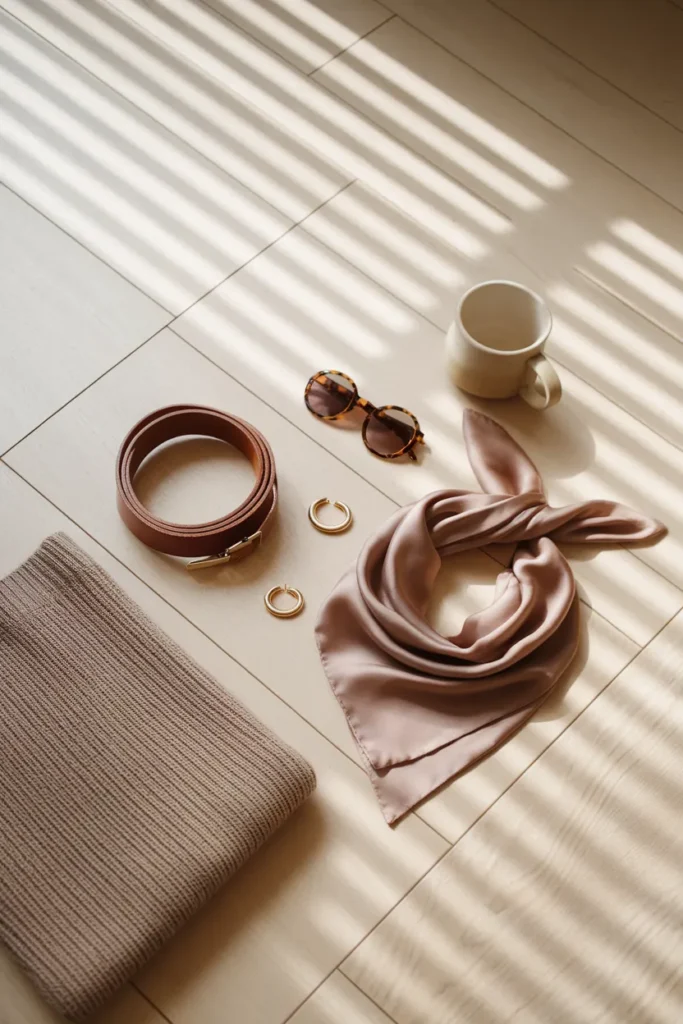
Your capsule isn’t boring. It’s unaccessorized.
Here’s what usually happens. You edit your closet down to a neutral base because neutrals mix, and mixing is the entire mechanism that makes a capsule work. Good instinct. It’s the right first move.
But a neutral base is a canvas. Canvases aren’t supposed to be interesting on their own. When every piece you own sits in the same three tones and the same soft silhouettes, the outfits stop having a focal point. Nothing draws the eye anywhere in particular, so the whole look reads as pleasant and forgettable.
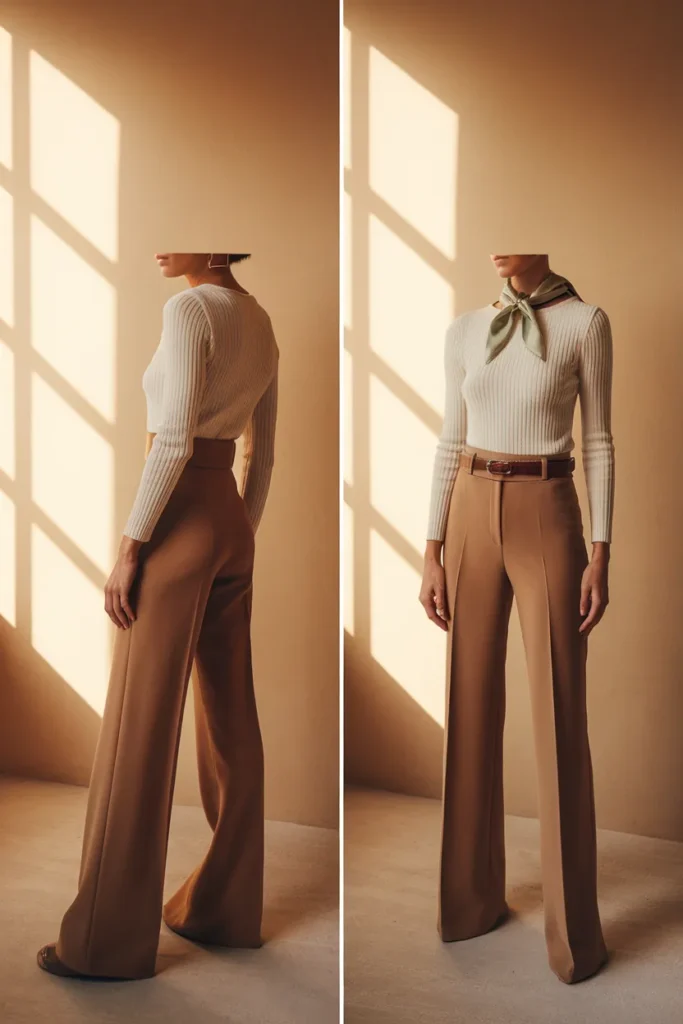
Accessories fix this for a fraction of what new clothes cost, and they do it without touching your hanger space. A belt changes where your waist appears. A scarf adds a color your closet doesn’t contain. Earrings put light near your face. None of these require you to buy another sweater.
If your instinct is to solve flatness by buying a colorful garment instead, read adding color without losing cohesion first. Color in clothing has to coordinate with everything. Color in accessories doesn’t.
Do accessories count toward your capsule number?
Page one of Google genuinely disagrees on this, so let’s settle it.
Project 333, the original thirty three piece challenge, counts accessories inside the total. Most other capsule frameworks exclude them, along with underwear, loungewear, and workout clothes. Both approaches have been running for over a decade and both work.
The honest answer is that it depends what problem you’re solving. If your issue is closet volume, count them. If your issue is outfit variety, don’t, because counting accessories inside a tight number pressures you to cut the exact pieces that make a small wardrobe feel large.
Here’s the position I’d take. Keep accessories outside your garment count, then give them their own ceiling. Something like fifteen to twenty pieces across every category, jewelry included. That way they can’t quietly become a second closet, and you still get their full multiplying effect.
Two practical reasons this works. Accessories don’t compete for hanger space, so they don’t create the visual overwhelm that clothing does. And most of them don’t need to fit, which means they survive weight changes, pregnancy, and the years when your size moves around.
The Gap Grid: audit before you buy anything
Every accessories guide online opens by telling you what to buy. Almost none of them start where you actually are, which is owning a drawer of things you never touch.
So start here instead. This grid is the one thing in this article worth screenshotting.
Down the left, the categories. Across the top, the four situations most of us actually dress for. Fill in what you already own in each cell. Leave a cell blank only if you own nothing that works there.
| Everyday | Work | Evening | Cold weather | |
|---|---|---|---|---|
| Belt | ||||
| Scarf | ||||
| Earrings | ||||
| Necklace | ||||
| Bag | ||||
| Sunglasses / hat |
Now look at it. Two things will jump out.
First, you’ll find categories where you own four things that all do the same job. Six pairs of gold studs. Three black crossbody bags. That’s not a collection, that’s a habit, and it’s the same habit that filled your closet with near identical shirts.
Second, you’ll find genuine blanks. Those blanks are your entire shopping list. Not the roundup at the bottom of somebody’s blog post. Yours.
Most people finish this grid with two or three empty cells and a drawer they can cull by half. That’s a much better outcome than a shopping trip. If you want to run the same audit logic across your clothing too, a capsule template that starts with your real closet uses the same principle.
The 60-30-10 split, applied to accessories
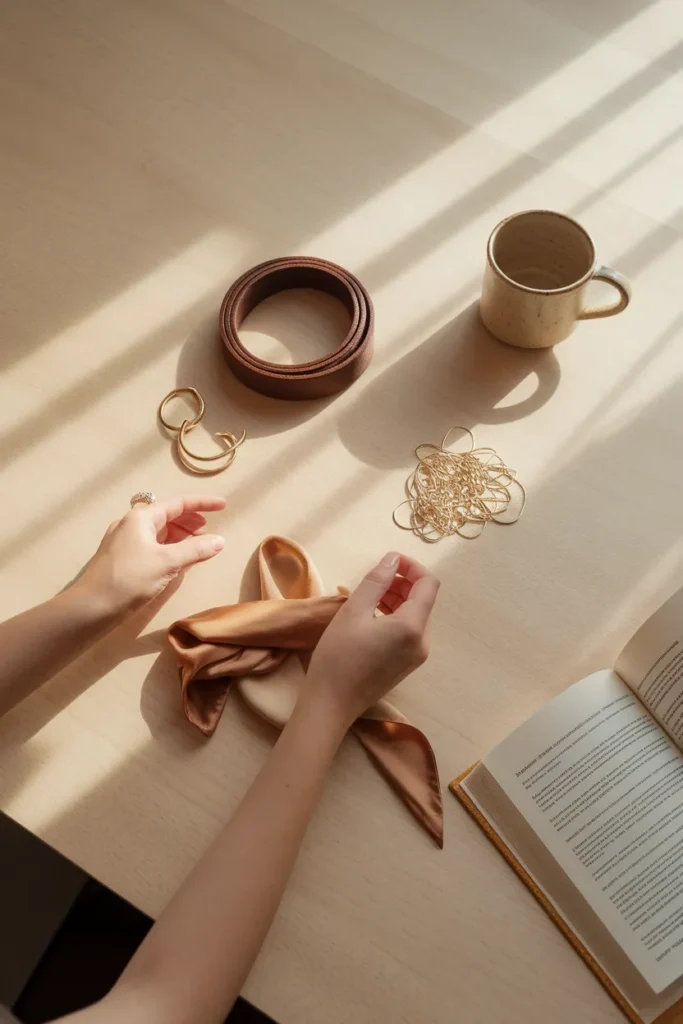
Interior designers use a ratio to keep rooms cohesive: sixty percent dominant color, thirty percent secondary, ten percent accent. It works on closets for the same reason it works on rooms. The eye wants a clear hierarchy.
For accessories, run it like this.
Sixty percent sits in your base neutral, the color that already dominates your closet. Camel, black, ivory, whatever you edited toward. These are the pieces that go with everything and get worn without thinking.
Thirty percent sits in a second neutral that contrasts with the first. If your base is warm (camel, cream, cognac), your second is cool (espresso, soft black, navy). This contrast is what stops a neutral outfit from looking like one long beige column.
Ten percent is accent. One or two pieces, and they earn their place by being the only source of color in the outfit. A burgundy scarf. Tomato red earrings. Butter yellow anything.
The mistake almost everyone makes is putting the accent too low. A bright shoe or a bright bag sits at hip level or below, where it pulls the eye down and away from you. Accent works hardest near the face or at the waist, because that’s where people are already looking.
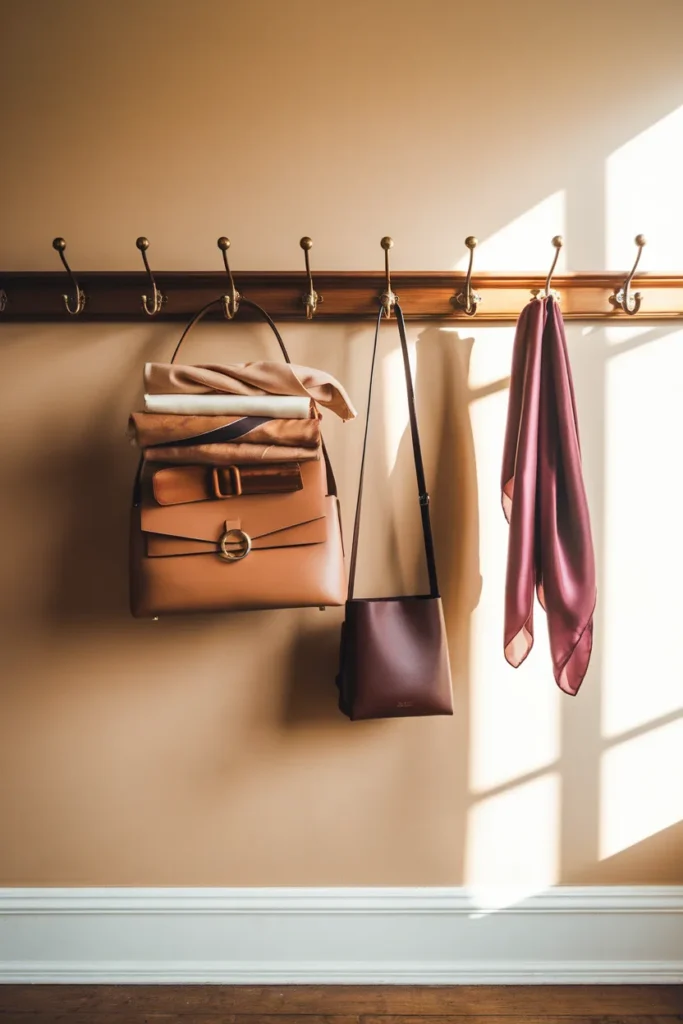
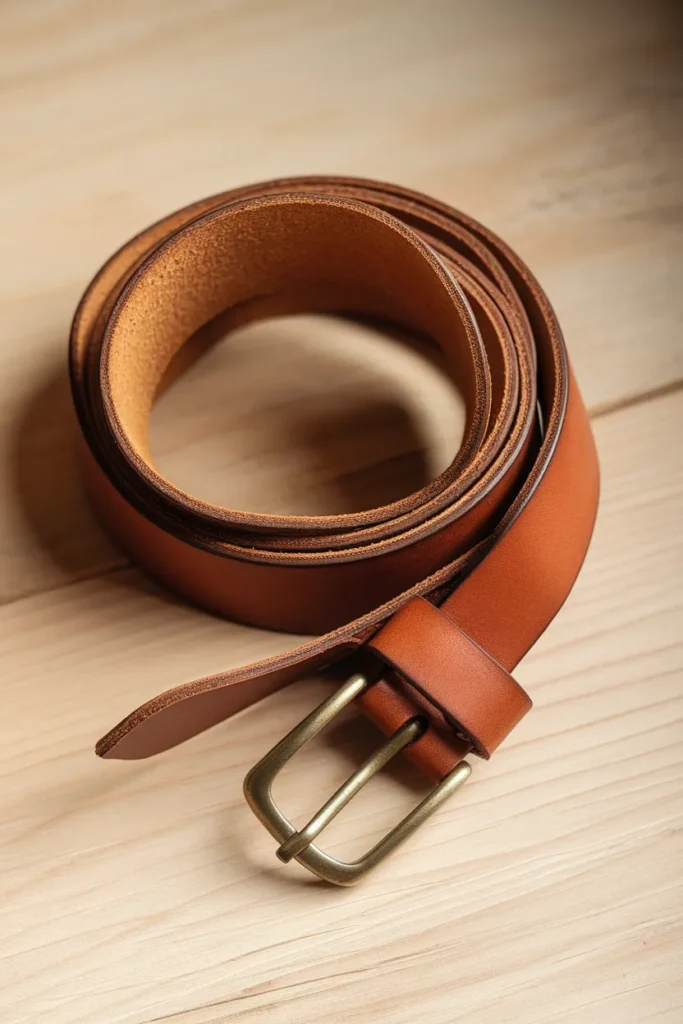
Belts do more work than anything else you own
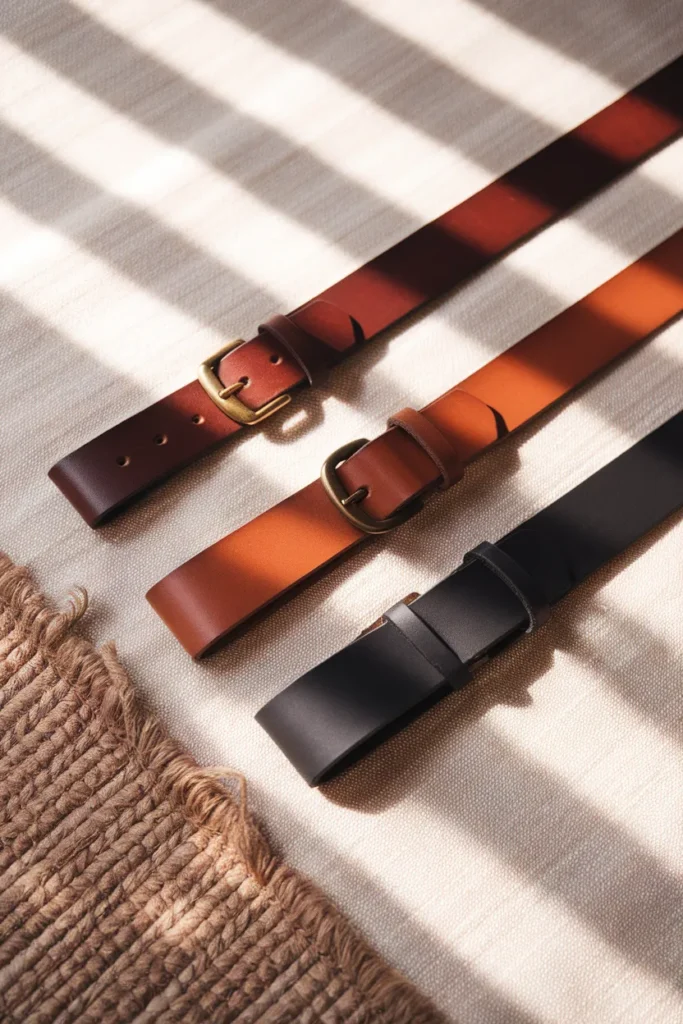
If you only add one category this season, add belts. Nothing else changes an outfit’s proportions this cheaply.
A belt does one thing clothing struggles to do: it tells the eye where your waist is. An untucked shirt over trousers reads as one continuous vertical block. Add a belt and you’ve created two shapes instead of one, which is the difference between an outfit that looks thrown on and one that looks arranged.
Three widths cover almost everything. A slim belt, roughly half an inch to an inch, works with trousers and tucked shirts. A medium belt, around an inch and a half, is the everyday workhorse for jeans. A wide belt, two inches and up, goes over knitwear, blazers, and dresses, where it needs presence to register at all.
On placement: belt where your torso is naturally narrowest, not where a rule says. If you’re petite, a slimmer belt keeps the proportion in scale with your frame. If you’re tall or long waisted, a wider belt sits better because it fills more visual space.
Two belts genuinely cover most people. One in your base neutral, one in the contrast. For which specific styles are worth it, five belt styles that earn their drawer space breaks it down.
Scarves: the category worth going bigger on
Scarves are the most underused accessory in a neutral wardrobe, and it’s easy to see why. They feel fussy. They seem like something you have to know how to do.
But a scarf is the only accessory that adds pattern, color, and texture in one move, sitting exactly where you want the eye to land. It’s also the cheapest way to make a wardrobe feel seasonal without buying seasonal clothes.
Fabric weight decides everything. A lightweight silk or modal drapes close and knots small, which suits necks and bag handles. A midweight cotton or linen holds a looser shape and works from spring into fall. A wool or cashmere scarf has real bulk and needs a coat to balance it, or the proportions go wrong fast.
Three ways to wear one, in order of how often you’ll actually use them. Loose around the neck with the ends hanging, which takes two seconds. Folded into a triangle and knotted at the side, which reads more deliberate. Tied to a bag handle, which is the lowest effort way to add color to an outfit you’ve already put on.
Silk scarves in the mid tier run roughly $40 to $90 at retailers like Quince and Madewell. Under $30 you’re generally looking at polyester, which is fine to try the habit with, though it slides against knitwear and won’t hold a knot as well.

Building a jewelry capsule you actually reach for
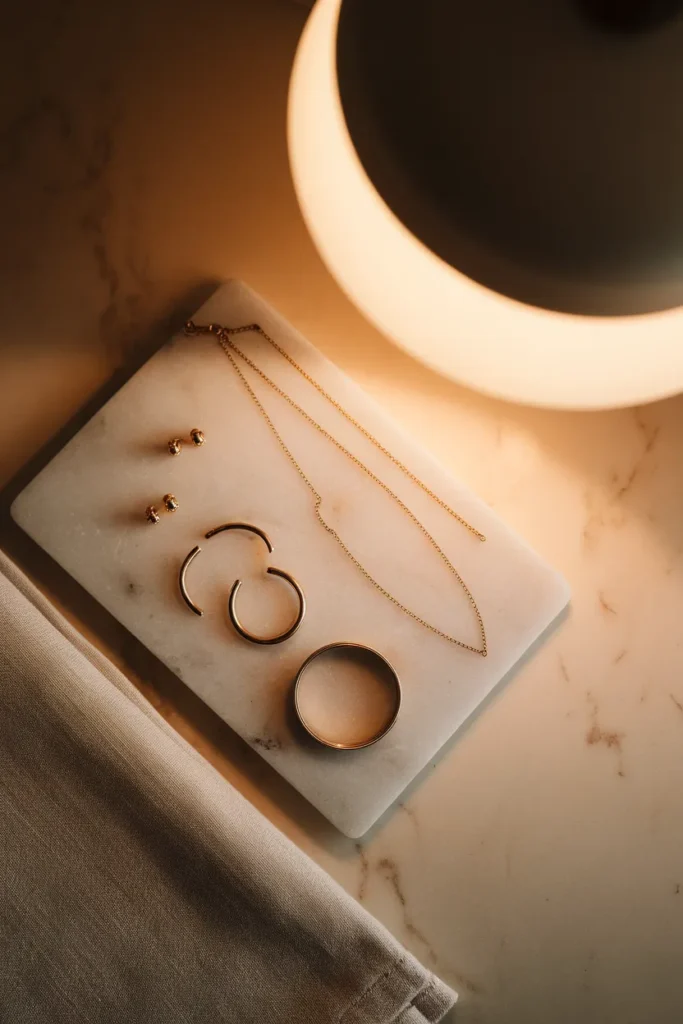
Six pieces cover almost every situation: studs, hoops, a short necklace, a longer pendant, one bracelet, one ring you wear daily. That’s the core. Everything past it is preference, not infrastructure.
Pick one metal and stay there for the core. Mixing metals looks intentional when it’s a choice and accidental when it’s the result of buying whatever was on sale. Warm skin tones generally sit easier with gold, cool tones with silver, though this is a preference and not a rule worth losing sleep over.
Now the part almost nobody explains, and the part that decides whether your $40 hoops survive a year.
Gold plated, gold filled, and vermeil are not marketing synonyms. They describe measurably different amounts of gold, and the FTC’s jewelry guides spell out what each term legally means, including the requirement that vermeil be gold over sterling silver rather than gold over a base metal. Gold plated is the thinnest layer and wears through fastest, particularly on rings and bracelets that rub. Gold filled carries substantially more gold and lasts years. Vermeil sits between them.
For pieces touching your skin all day, this matters beyond durability. Nickel turns up in a lot of inexpensive jewelry and in the buckles and clasps on belts and watches. It’s worth knowing that nickel is one of the most common causes of allergic contact dermatitis, and that reactions cluster in predictable places: earlobes from earrings, wrists from watch backs, and the lower abdomen from belt buckles. If you’ve had an unexplained rash in exactly one of those spots, that’s your answer.
Practical takeaway: buy plated for trend pieces you’ll wear for a season, gold filled or solid for the six core pieces you’ll wear daily for years.
The bag question, answered briefly
Two bags cover most lives. One that holds a laptop and one that holds a phone and keys. A structured tote and a small crossbody, both in your base neutral.
The mistake is buying a third bag before you’ve worn the second. Bags are the accessory people over collect precisely because they’re the most visible, and the most visible thing is the one that feels most worth replacing. It isn’t. A bag you carry four times a week for three years has done more for your wardrobe than five bags carried twice each.
If you’re deciding which shapes are worth the money, five bag styles that earn their hook space covers the full breakdown.
Sunglasses are a fit problem, not a style problem
Most people own three or four pairs and wear one. The other pairs aren’t ugly. They pinch at the temples, slide down the nose, or sit at the wrong height on the cheek.
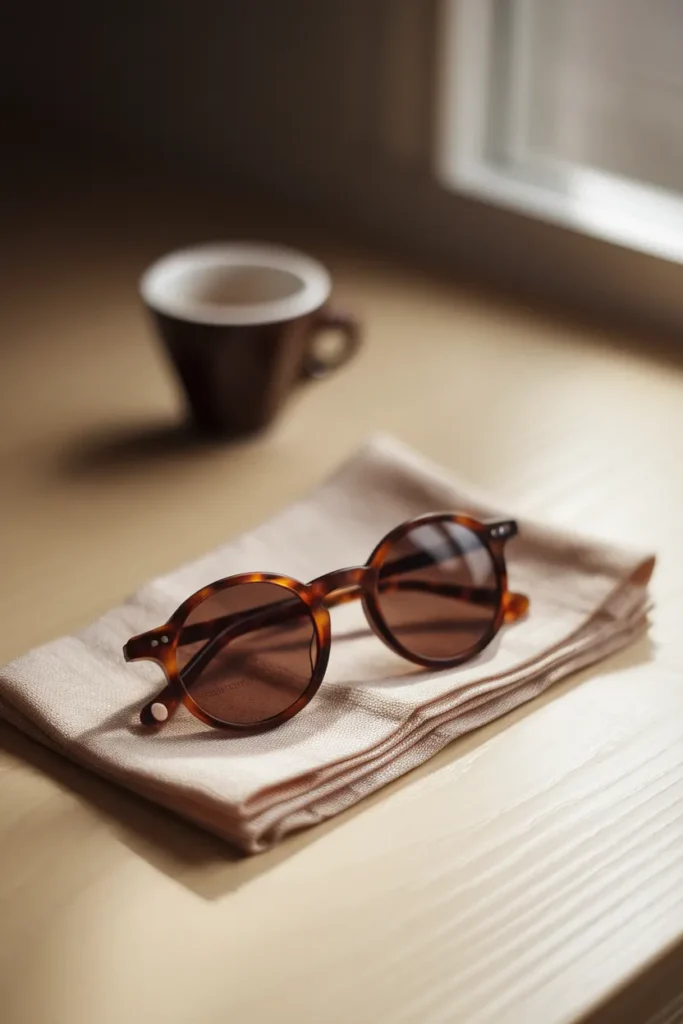
Fit beats frame trend every time, and fit comes down to three measurements you can check in ninety seconds: the frame shouldn’t be wider than your face at the temples, the lenses shouldn’t touch your cheeks when you smile, and your brows should sit above the top rim rather than inside the lens.
One pair in a neutral frame color, tortoiseshell or soft black, covers everything a capsule needs. For matching shape to your face, a face-shape guide to capsule sunglasses goes deeper than I can here.
Cost per wear is where accessories quietly win
Run the arithmetic and accessories stop looking like extras.
A $120 wool coat worn forty times over a winter costs $3 a wear. Reasonable. Now take a $45 belt worn twice a week for two years. That’s roughly two hundred wears, which lands under twenty five cents. A pair of $60 gold filled hoops worn most days for five years drops below five cents.
The reason accessories score so well isn’t that they’re cheap. It’s that they don’t wear out the way garments do, they don’t go out of fit, and they aren’t tied to one season. A knit sweater has maybe four wearable months a year. A belt has twelve.
This changes what “expensive” means. Spending $90 on a scarf you’ll wear for a decade is a better decision than spending $90 across three tops you’ll rotate out in eighteen months. The number on the tag is the least useful figure available to you.
Taking one fall 2026 trend without wrecking your palette
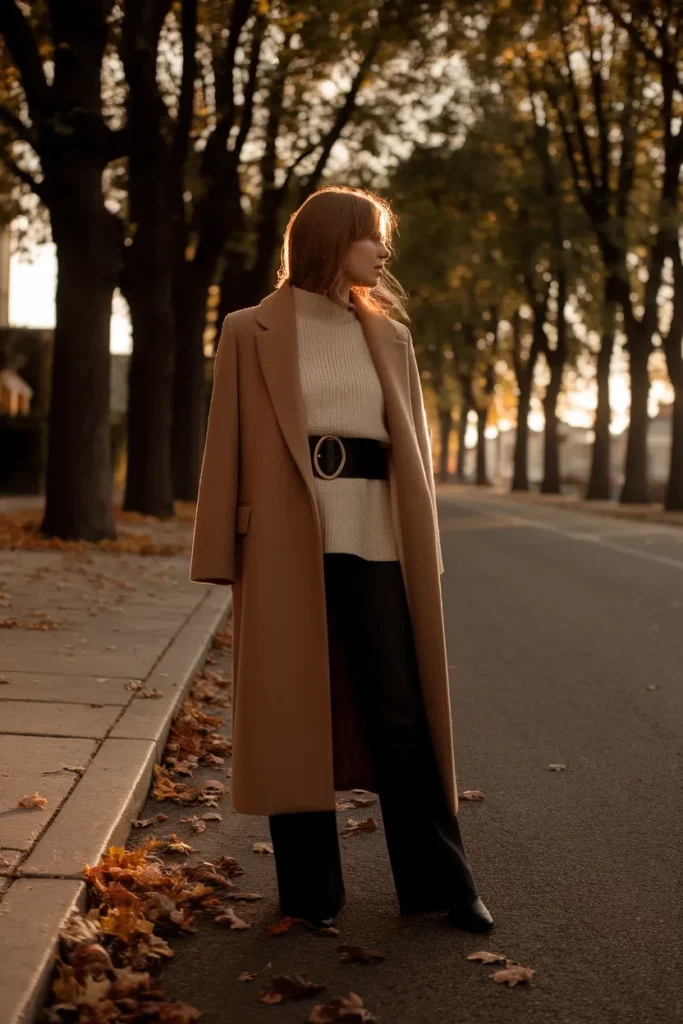
Worth naming the tension here, because it’s real this year. The fall 2026 accessory mood is loud. Buyers coming out of the shows reported statement belts with oversized buckles, scarves worn as a focal point rather than a finish, and jewelry stacked in accumulation rather than chosen singly. Color is returning after several years of neutral dominance.
Your capsule is quiet by design. So most trend coverage this season is useless to you as written.
The workable version is a one trend rule. Pick a single trend per season, express it in one accessory, keep everything else in your base neutrals. One statement belt over a neutral outfit reads current. A statement belt plus stacked jewelry plus a bright scarf reads like you’re wearing a trend report.
Of this season’s options, the statement belt is the most capsule friendly, because it slots into a category you already needed. Layered scarves are second, since a scarf works in a neutral palette regardless. Stacked jewelry is the hardest, because it fights the restraint that makes a small jewelry capsule function.
And skip anything that only works with one outfit. That’s the whole test.
What to spend, by category
Ranges, not fixed numbers, and worth confirming before you buy.
Spend the least on: trend pieces and anything you’re testing. Mass retailers like Target, H&M, and Uniqlo run roughly $10 to $35 for belts, scarves, and simple jewelry. The trade off is real: thinner leather that creases rather than softens, plating that wears through in months, and polyester that slips. Fine for finding out whether you’ll wear a category at all.
Spend the most on: the two or three pieces you’ll wear several times a week for years. Mid tier brands like Madewell, Quince, J.Crew, and Everlane generally land between $50 and $150 for leather belts, silk scarves, and gold filled jewelry, which is where quality starts outpacing price.
Skip the contemporary tier unless a specific piece is genuinely the one you want. Sezane, COS, and similar sit around $150 to $400, and for accessories that premium buys design rather than durability more often than not.
If you’re building the clothing side of the wardrobe alongside this, basics under $30 that actually hold up applies the same spend logic to garments.
Frequently asked questions
Do accessories count toward my capsule wardrobe number? Depends on the framework. Project 333 counts them inside the total; most other approaches leave them out alongside underwear and workout clothes. I’d keep them separate and give them their own cap of fifteen to twenty pieces, so they multiply your outfits without quietly becoming a second closet.
How many accessories does a capsule wardrobe actually need? Usually eight to twelve pieces covers everything: two belts, two scarves, four to six jewelry pieces, two bags, one pair of sunglasses. Run the Gap Grid above and let the blank cells tell you, because the right number depends on how many situations you dress for.
Are shoes considered accessories? Most capsule frameworks count shoes as clothing, not accessories, because they take real closet space and have to fit. Worth treating them as their own category with their own budget.
How do I accessorize a neutral capsule without it looking boring? Add contrast rather than color first. A second neutral that opposes your base (espresso against cream, navy against camel) creates visual separation that a matching tone can’t. Then add one accent piece near your face or at your waist.
Does this work for petite proportions? Yes, with scaling. Slimmer belts, smaller bag shapes, and shorter necklace lengths keep the proportion in scale with a smaller frame. The categories don’t change, only the dimensions.
Is expensive jewelry worth it for a capsule? For the six core pieces you wear daily, gold filled or solid metal pays off, since plating on high contact pieces wears through in months. For trend pieces you’ll wear one season, plated is a reasonable call.
Can I use accessories to stretch a capsule across seasons? That’s their strongest use. A wool scarf and a lightweight silk scarf turn the same neutral base into a fall outfit and a spring one without a single new garment.
Start with the drawer, not the cart
The instinct when your wardrobe feels flat is to buy something. Resist it for one afternoon.
Empty the drawer, run the Gap Grid, and look at what you actually own against what you actually do. Most people find they already have four of the six categories covered and were missing two, not twelve. That’s a twenty minute job and a much smaller shopping list than any roundup will give you.
Then buy the blanks. Slowly, in your base neutral, at the tier that matches how often you’ll wear them.
If you want the clothing side sorted with the same logic, the 30-Piece Capsule Wardrobe Checklist is free and fits on one page. Grab it, and I’ll send a new outfit formula each week.
Keep reading

Capsule Wardrobe Shoes: The 7 Pairs That Cover Everything
Capsule wardrobe shoes are the part of the closet edit almost everyone skips. You can get the tops right, get the trousers...

The 8 Capsule Wardrobe Tops That Anchor Every Outfit You Own
You have more tops than anything else in your closet. You also have the least to wear. That contradiction is what sends...

The 6 Capsule Wardrobe Jackets That Actually Earn Their Hanger Space
You own more jackets than you wear. Most of us do. The denim one from three summers ago, the blazer that fits...