
What to Wear on a Rainy Day: Outfits That Stay Cute and Dry
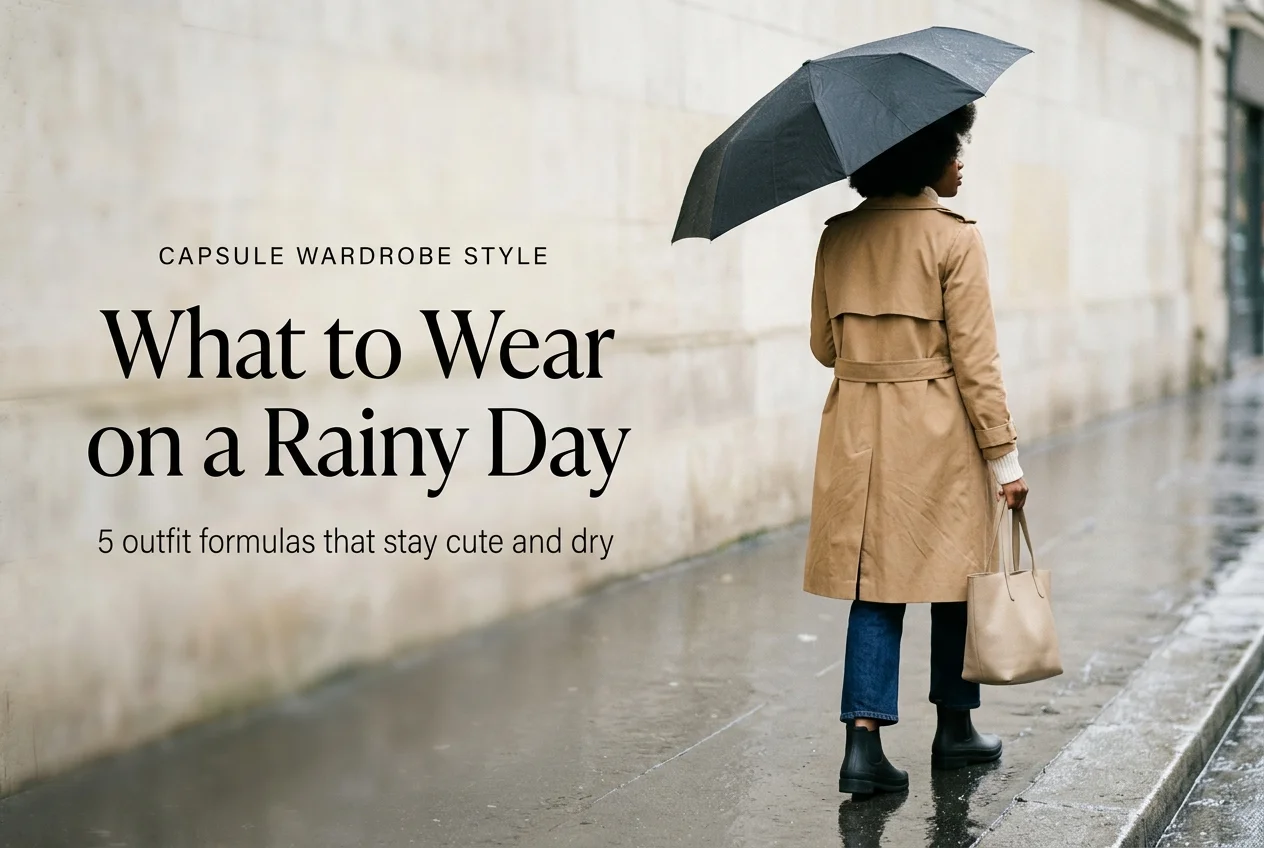
Figuring out what to wear on a rainy day comes down to about four decisions you make before you ever pick an outfit. Fabric. Hem length. Shoes. Whether your coat sheds water or drinks it. Get those right and almost anything already hanging in your closet will work. Get them wrong and the best outfit you own turns into wet denim stuck to your ankles by the time you reach the parking lot. Below you get five formulas, a fabric rule that changes how you shop, and a nine-piece rain kit you likely already own most of.
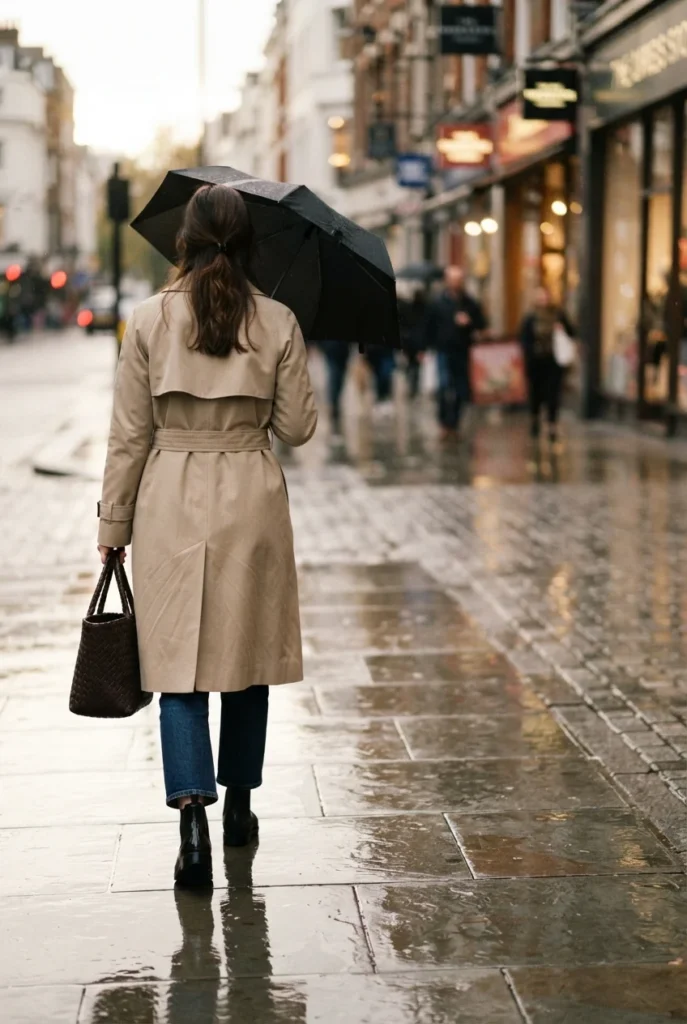
Start With the Forecast, Not the Outfit
Here is the thing almost every rainy day outfit guide skips. Rain is not one condition. It is three, and each one breaks a different part of your outfit.
Drizzle and mist barely touch your clothes. Your hair takes the hit, and so does anything with a nap that spots, like suede or unlined viscose. Steady rain is when water starts finding seams, hems, and the gap between your collar and your scarf. A windy downpour makes your umbrella mostly decorative, and your coat has to do every bit of the work alone.
Match the outfit to the type and you stop overdressing for a sprinkle or underdressing for a soaking.
| Rain type | What actually gets wet | What to change |
|---|---|---|
| Drizzle and mist | Hair, shoulders, delicate surfaces | Hood or hat. Skip suede. Everything else stays normal. |
| Steady rain | Hems, shoulders, bag, feet | Crop the hem. Waterproof shoes. Water-resistant outer layer. |
| Downpour with wind | Everything, including under the umbrella | Full waterproof shell with a hood. Nothing precious. Change of socks in the bag. |
Screenshot that table. It is the whole article in nine lines, and it works in any US climate from Seattle to Miami.
The Fabrics That Survive Rain, and the Four That Quit Immediately
This is the part nobody tells you, and it is the actual reason your outfits fail in wet weather. Fabric decides the day.
Tightly woven cotton, cotton blends with a bit of nylon, polyester, and technical shells all hold up. Wool is the quiet overachiever here: it stays warm even when damp, and a wool coat sheds a light rain far better than most people expect. Leather survives if you have conditioned it, though it will water spot and needs wiping down before it dries.
Then there are the four that give up on contact.
- Suede. Water darkens it at the exact point of impact, and that ring sets as it dries. One walk to the car can permanently mark a pair of boots.
- Silk and silk blends. Every drop leaves a visible water spot. The spot does not always come out.
- Raw-hem or unfinished denim. The hem wicks. Water climbs up the leg by capillary action, and a two-inch dark band spreads while you stand at the crosswalk.
- Linen and unlined viscose. Both go translucent when wet and hold the wrinkle exactly where the water landed.
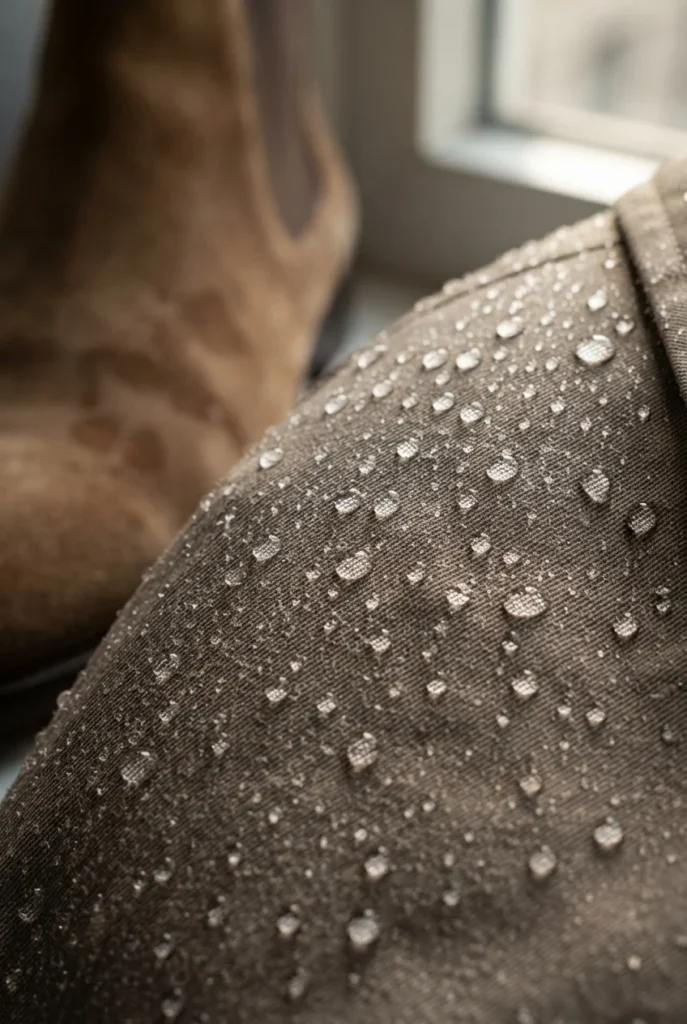
One more thing worth understanding, because it changes how you buy coats. Water-resistant and waterproof are different categories. Most pretty raincoats rely on a surface treatment called DWR, which makes water bead up and roll off. That treatment wears down with washing, friction, and time, which is why the trench that shrugged off rain in year one soaks through in year three. Patagonia’s own explainer on durable water repellent finishes and how they actually work walks through the difference between a waterproof membrane and a surface repellent, and it is worth five minutes if you are about to spend real money.
The short version: a membrane keeps water out. A finish delays it. Know which one you bought.
Five Rainy Day Outfit Formulas That Actually Hold Up
Every formula below is built from pieces most capsule closets already contain. Front-loaded, so the first one is the one to steal if you read no further.
1. The Commuter. Belted trench, white cotton tee, straight-leg jeans cropped at the ankle, waterproof Chelsea boots, structured tote. This is the outfit that works in the most conditions with the least thought, and it photographs beautifully, which is why it dominates Pinterest. The cropped hem is doing more work than the coat.
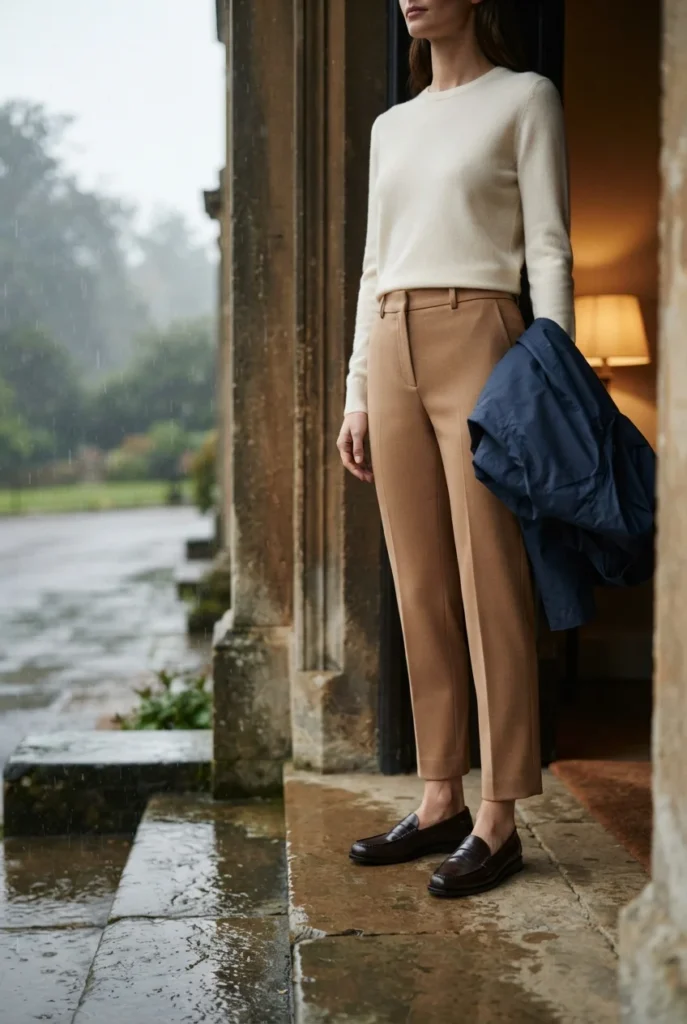
2. The Office Arrival. Merino crewneck, tailored trousers with a clean hem, waterproof leather loafers, and a packable shell over everything. The shell comes off at your desk and the outfit underneath is completely dry and completely office-appropriate. Nobody knows you walked six blocks.
3. The Weekend Errand. Quilted or lightly padded jacket, ribbed knit, dark straight jeans, lug-sole boots, crossbody bag worn under the jacket. Hands free for the umbrella and the coffee. The crossbody-under-the-coat trick keeps your bag bone dry.
4. The Warm Rain. For a summer rainy day outfit at 80 degrees and pouring: cotton poplin midi dress, unlined and quick-drying, with waterproof sandals or rubber-soled slides. Skip the jacket entirely, carry a good umbrella, and choose a print or a mid-tone color rather than a pale solid so nothing goes see-through.
5. The Cold Downpour. Waterproof shell with a hood over a wool sweater, thermal or ponte leggings, tall rubber boots with a thick wool sock, and a knit beanie instead of an umbrella you cannot hold in the wind.
If you are trying to figure out which outer layer to actually invest in, the six capsule wardrobe jackets that actually earn their hanger space breaks down where a trench, a shell, and a wool coat each earn their keep across a year.
Hem Math, or Why Your Pants Are Wet Before You Reach the Car
Here is the variable nobody in the top search results mentions, and it is the single most visible way a rainy day outfit falls apart.
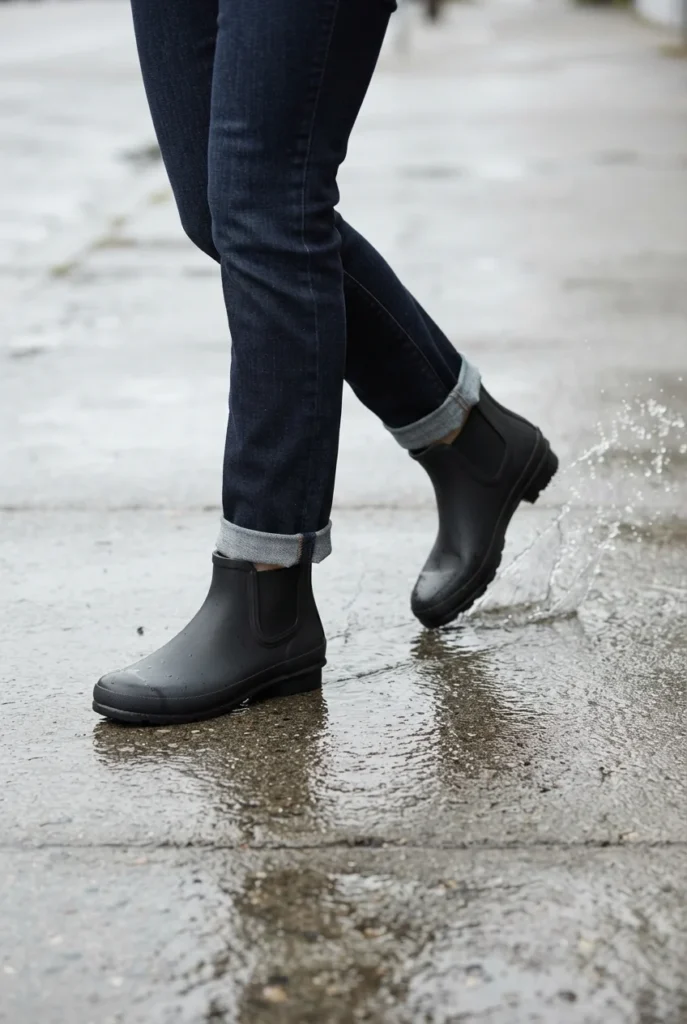
Every step you take throws water upward off the pavement. That spray reaches roughly ankle height on a normal walk, higher if you are moving fast or the sidewalk is pooling. Any fabric sitting inside that zone gets soaked from below, not from above, which is why your umbrella feels useless and your cuffs are still ruined.
So the rule is simple: on a wet day, your hem wants to clear your ankle bone.
- Cropped straight jeans, ankle trousers, and midi skirts all clear the splash zone naturally. These are your rain silhouettes.
- Full-length wide legs and puddle hems act like a wick and a mop at the same time. Beautiful in dry weather, a genuine problem in rain.
- Maxi dresses and long skirts are fine in light drizzle and miserable in anything more, because the hem carries water for hours.
Petite readers get a hidden advantage here, since standard inseams often already sit at or above the ankle on a 5’4″ frame. Tall readers face the opposite problem: a pant labeled “cropped” may hit exactly at the splash line on a 5’9″ frame, so size up in inseam and cuff it deliberately instead. If wide legs are your signature and you refuse to give them up on principle, how to style wide leg jeans without drowning your frame covers the hem-length adjustments that make them work with a boot.
A quick fix that costs nothing: cuff once, deliberately, about an inch and a half. It reads as styling, not as panic.
What to Wear to Work on a Rainy Day Without Looking Damp at 9 a.m.
Work rain has a specific problem that weekend rain does not. You have to survive the commute and look composed after the outer layer comes off. Most people dress for one and get ambushed by the other.
Build the outfit in two separate layers and the problem disappears.
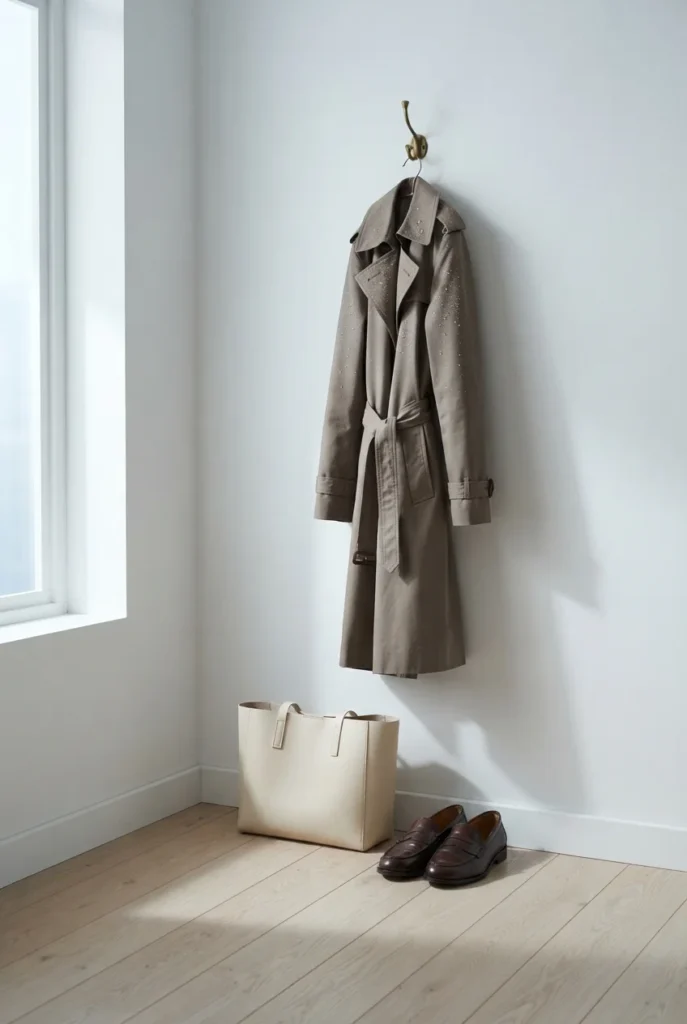
Commute layer: the shell or trench, the umbrella, and the shoes that are allowed to get wet. This layer is disposable in the sense that it gets hung on the back of a door and forgotten.
Arrival layer: everything underneath, chosen so it looks intentional with no jacket at all. A merino crewneck, a fine-gauge knit, a button-down, a ponte blazer. Nothing that wrinkles from being compressed under a coat, which rules out most pure linen and loosely woven cotton.
Two details that carry more weight than they should:
- Keep a pair of flats or loafers at your desk. Walk in rubber-soled boots, change once you arrive. This single habit ends most rainy day work outfit stress permanently.
- Choose a bag with a flat, structured base. Soft bucket bags collapse and sit their bottom seam directly in the puddle by the elevator.
Layering intelligently in transitional weather is a related skill, and what to layer under a denim jacket from 40 to 70 degrees maps the temperature side of the same problem if you are dressing for a day that starts wet and ends mild.
Shoes Are the Decision That Makes or Breaks the Whole Day
You can recover from a damp sleeve. You cannot recover from wet socks at 8:40 in the morning.
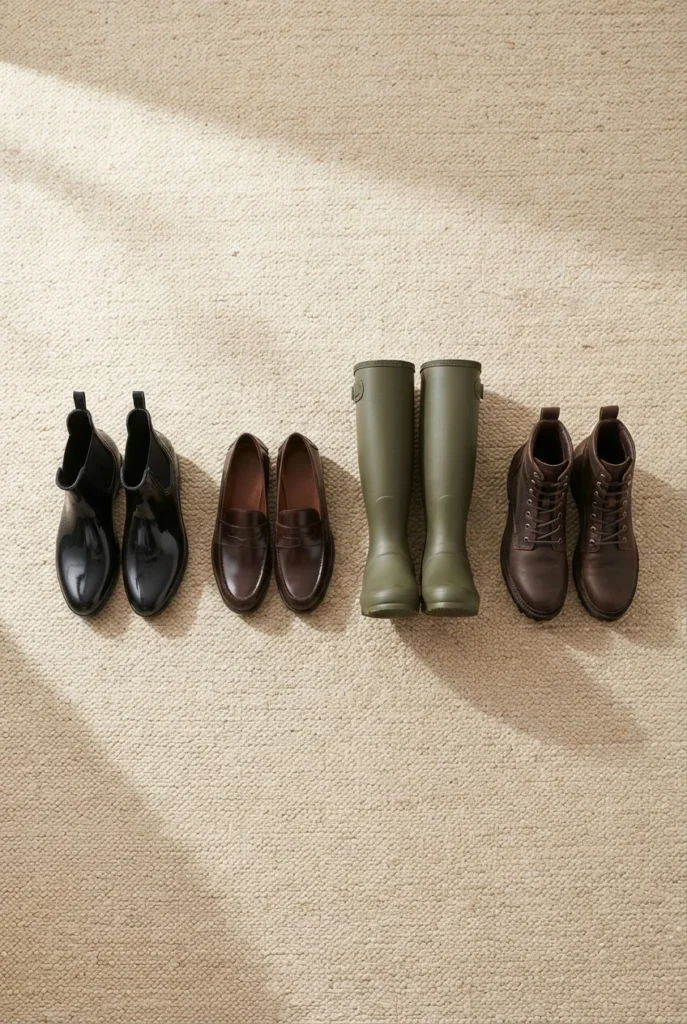
| Shoe | Rain verdict |
|---|---|
| Rubber Chelsea boots | Best all-round choice. Reads as style, performs as gear. |
| Tall rubber rain boots | Correct for a real downpour, bulkier to style. Pair with a cropped or midi hem. |
| Waterproof leather loafers | Excellent for light and steady rain. Wipe dry the same day. |
| Lug-sole leather boots | Good, if the leather is treated and the seams are sealed. |
| Canvas sneakers | Poor. Absorbs immediately, dries slowly, and stains. |
| Suede anything | Avoid completely. |
| Ballet flats | Only under an overhang. No sole grip, and the vamp scoops water. |
Price-wise, a workable pair sits in a wide range: rubber Chelsea boots typically run somewhere from around $40 at Target or Old Navy up to $150 or so at Madewell or Everlane, and a genuinely waterproof leather boot generally starts higher. Prices move, so check current listings before you commit. The cheaper rubber option is legitimately fine in performance terms. What you trade at the low end is footbed comfort over a long day and how well the shaft holds its shape after a season, which is exactly the kind of thing cost per wear should decide for you rather than a rule.
For the pairs that stay in rotation once the sun comes back out, the best ankle boots for a capsule wardrobe covers which shapes carry across seasons instead of sitting idle nine months a year.
The Accessories That Do Real Work
Most rainy day accessories are decorative. Four are functional, and they are worth choosing carefully.
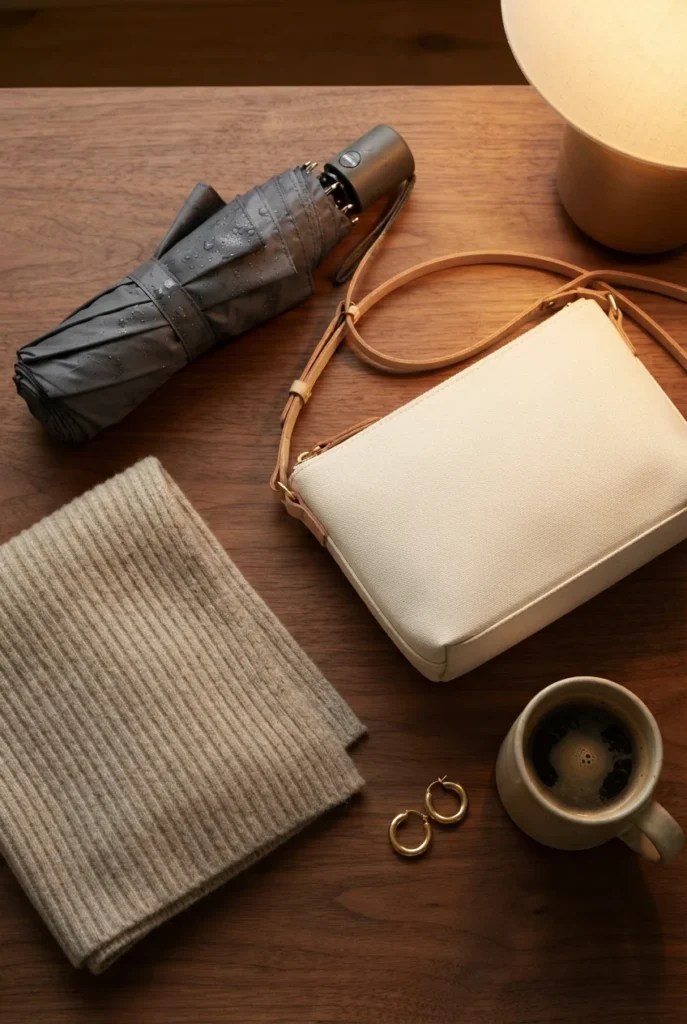
The umbrella. A vented double-canopy design survives wind that turns a flat canopy inside out on the first gust. Compact ones live in a bag permanently, which matters more than any feature, because the best umbrella is the one that is actually with you.
The bag. Coated canvas, treated leather, or nylon. Worn crossbody and tucked under your coat during a downpour. Unlined suede and untreated raffia both stain permanently, and neither recovers.
The scarf. A tightly woven cotton or wool scarf seals the gap at your collar where water otherwise runs straight down your neck. Silk looks lovely and spots on contact.
Your hair strategy. A hood beats an umbrella in wind, every time. Anything that keeps humidity off works better than fighting it after the fact.
Small pieces carry disproportionate weight in a small closet, and the small accessories that quietly change an entire outfit goes deeper on which ones justify their space.
Rainy Day Outfits by Season
Rain in April and rain in November are different problems wearing the same name.
Spring (March to May, 50 to 70°F). Peak trench season. Trench, cotton knit, cropped jeans, rubber Chelsea boots. Light enough to carry, warm enough for a 52-degree morning.
Summer (June to August, 75 to 95°F). Warm rain is its own category. A poplin or seersucker dress dries fast and stays opaque. Waterproof slides. No jacket, because a shell in humidity turns into a sauna. Choose mid-tone colors and prints over white and pale pastels.
Fall (September to November, 45 to 70°F). The best rain-dressing season and Pinterest’s biggest save window. Wool coat, chunky knit, straight jeans, lug-sole boots. Wool genuinely earns its place here since it insulates while damp.
Winter (December to February, 20 to 45°F). Cold rain is the most dangerous of the four and the one people dress for worst. A waterproof outer layer is not optional at 38 degrees and raining. Wet clothing pulls heat away from your body far faster than cold air alone, which is why the National Weather Service advises changing out of wet clothing immediately and dressing in layers rather than one heavy piece. Style aside, that is the reason to keep a dry pair of socks in your bag between December and February.

The Nine-Piece Rain Kit That Is Probably Already in Your Closet
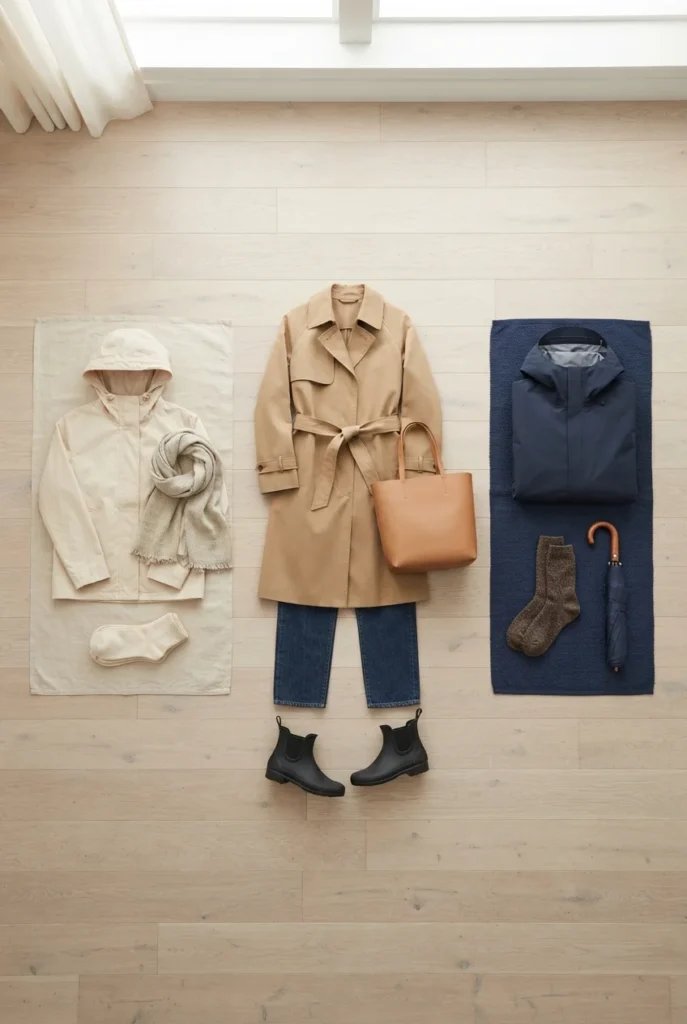
You do not need a rain wardrobe. You need nine pieces that cover every rain type, and most closets already hold six or seven of them.
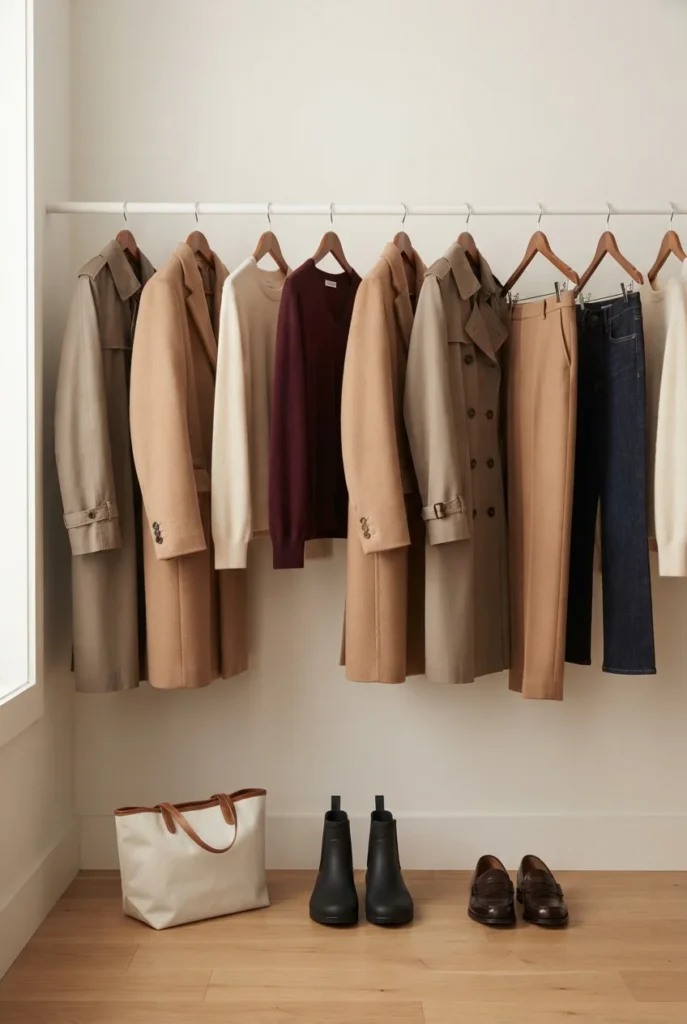
- One water-resistant trench or shell with a hood
- One wool coat for cold, wet days
- Rubber Chelsea boots
- One pair of waterproof leather loafers or flats
- Cropped or ankle-length straight jeans
- Tailored trousers with a clean, non-dragging hem
- Two merino or fine-gauge knits, one neutral and one with color
- A coated canvas or treated leather crossbody
- A compact vented umbrella that lives in your bag
Count what you have. Buy only the gaps, and buy them one at a time. This same buy-fewer-wear-more logic drives layered outfits built for genuinely changeable weather, where the weather changes four times before lunch and overpacking is the real enemy.
Five Mistakes That Read as “Caught in the Rain”
- Wearing suede because the forecast said 30 percent. Thirty percent still ruins the boot. If suede is your default, how to style Uggs so they read as fashion is worth reading for the dry-day rotation, and save them for it.
- Choosing an outfit that only works with the coat on. Style the layer underneath first, then add the shell.
- Ignoring the hem. A dragging hem undoes an otherwise perfect look faster than anything else on this list.
- Carrying a soft, unstructured bag. It slumps, the base sits in water, and the contents get damp through the seam.
- Assuming water-resistant means waterproof. A treated coat buys you fifteen minutes in real rain. Plan accordingly.
Rainy Day Outfit FAQ
What should I wear on a rainy day to look cute and not sloppy? Start with a belted trench or a structured shell, add a fitted knit, cropped straight jeans, and waterproof Chelsea boots. Structure is what separates polished from soggy. Belted and tailored outer layers hold their shape when wet, while oversized soft fabrics collapse and cling.
What shoes should I wear in the rain? Rubber Chelsea boots handle the widest range of conditions and still look styled. Tall rubber boots are correct for heavy rain. Waterproof leather loafers work for light and steady rain. Avoid canvas sneakers, ballet flats, and suede in any form.
Can I wear jeans on a rainy day? Yes, with one adjustment. Choose a cropped or ankle-length straight leg in dark, tightly woven denim, and skip raw or frayed hems. Unfinished hems wick water up the leg. Dark washes also hide splash marks that show clearly on light denim.
What should I wear to work on a rainy day? Build two layers. A commute layer that gets wet (shell, umbrella, rubber boots) and an arrival layer that stays dry and looks complete without a jacket (merino knit, tailored trousers, ponte blazer). Keep loafers or flats at your desk and change when you arrive.
Does rain actually ruin suede and leather? Rain permanently marks suede in most cases, because water darkens the nap at the point of contact and the ring sets as it dries. Treated leather survives if you wipe it dry the same day and condition it afterward. Untreated leather stiffens and water spots.
What do I wear when it rains in summer and it is still 80 degrees? Skip the jacket. A cotton poplin or seersucker midi dress dries quickly and stays opaque when damp. Add waterproof slides or rubber-soled sandals and carry a compact umbrella. Choose prints or mid-tone colors over white and pale pastels, which turn sheer when wet.
Is a trench coat actually waterproof? Usually not. Most trench coats are water-resistant, meaning a surface finish makes water bead and roll off for a while. That finish degrades with washing and wear. For sustained heavy rain you want a coat with a waterproof membrane and sealed seams, not a surface treatment alone.
The Short Version
Rain is not a reason to give up and wear the same hoodie every time the sky goes grey. Pick the fabric that survives water, get the hem above the splash line, put something waterproof on your feet, and the outfit takes care of itself. Nine pieces cover an entire year of wet mornings.
Take five minutes this week to pull your version of the nine-piece rain kit out of your closet and see what is genuinely missing. It is usually one thing, not nine. Save this post for the next grey morning when you are standing in front of your closet with ten minutes to spare.
Keep reading

What to Wear for Family Pictures Without Buying Everyone New Clothes
Your session is in eleven days and you’ve already spent two evenings with forty tabs open. I know that feeling. Deciding what...

What to Wear in Nashville: Outfits With a Little Twang
Deciding what to wear in Nashville trips people up for one reason nobody warns you about, and it isn’t the cowboy boots....

What to Wear in Ireland: Layered Outfits for Changeable Weather
Every packing list for Ireland tells you to bring layers. Almost none of them tell you which layers, in what fabric, or...