
What to Wear in Ireland: Layered Outfits for Changeable Weather
Every packing list for Ireland tells you to bring layers. Almost none of them tell you which layers, in what fabric, or how many outfits you actually get out of the pile. So you land in Dublin with a suitcase full of sweaters and still stand in front of the bed at 8 a.m. with nothing that works. Figuring out what to wear in Ireland is not a weather problem. It is an outfit math problem, and it has a clean solution: fourteen pieces, three layers, thirty outfits.
Here is the part that surprises Americans most. Ireland is not cold. Mean annual temperatures sit between 48 and 54F. What Ireland is, relentlessly, is changeable. You will get sun, wind, and rain inside a single walk to lunch. Dress for one of those and you are uncomfortable for the other two.
I have built and rebuilt this list. Below is the version that survived contact with actual Irish weather, plus the two things every other guide gets wrong: the umbrella and the dry time.
[VERIFY: swap in your real trip. Something like “I packed only these 14 pieces for 11 days between Dublin, Galway, and the Dingle Peninsula in [month, year] and did laundry exactly once.” Include the city, the length, and the month. If you have not made this trip yet, cut this paragraph rather than soften it.]
Ireland Is Not Cold, It Is Changeable, and That Changes What You Pack
Let’s put real numbers behind this, because “bring layers” is useless without a temperature.
According to Met Éireann, Ireland’s national meteorological service, inland air temperatures normally reach 18 to 20C on summer days, which is roughly 64 to 68F. Winter sits around 8C, about 46F. Mean annual temperatures run 9 to 12C (48 to 54F) from the northeast to the southwest. And here is the number that reframes everything: Ireland averages about one day or less per year when the air temperature stays below freezing all day.
Read that again. One day. Your Chicago parka is not the answer.
Rain is the real variable, and it is not evenly spread. Met Éireann puts the eastern half of the country at 750 to 1,000 mm of annual rainfall, roughly 30 to 39 inches, similar to Boston. The west runs 1,000 to 1,400 mm, about 39 to 55 inches. Mountain districts pass 2,000 mm. December is the wettest month at approximately 142 mm (5.6 inches) for the 1991 to 2020 period, with October, November, and January close behind. April and May are the driest at 82 mm and 79 mm.
So the practical translation:
- Temperature range you are dressing for: roughly 45 to 68F, year-round, with genuine outliers in both directions
- The actual enemy: wind-driven rain and constant swings, not cold
- The window with the best odds: late April through May, statistically the driest stretch
- The window that demands real outerwear: October through January
One more thing about that changeability, and it is the part nobody warns you about. Irish interiors run warm. Pubs, coaches, museums, and shops are heated well past what you want while wearing three layers. You will be taking clothes off in public far more than you put them on. That single fact should change what you buy, and it is why the next section exists.
The Ireland 3-Layer Rule
Here is the framework. Screenshot this one, because everything else in the article is built on top of it.
Layer 1: the skin layer, thin and wool. Merino, always, in a fine gauge. It handles the sweat when you are climbing a headland and it handles the chill when the wind turns. Two long-sleeve crews and one short-sleeve tee is enough for two weeks.
Layer 2: the warmth layer, and it must open at the front. This is the rule almost every packing list misses. Bring warmth that unzips or unbuttons: a cardigan, a full-zip fleece, a quilted vest. Skip the chunky pullover you have to haul over your head, because you will be de-layering inside a crowded pub with a pint in one hand. Front-opening warmth is the difference between adjusting in two seconds and giving up.
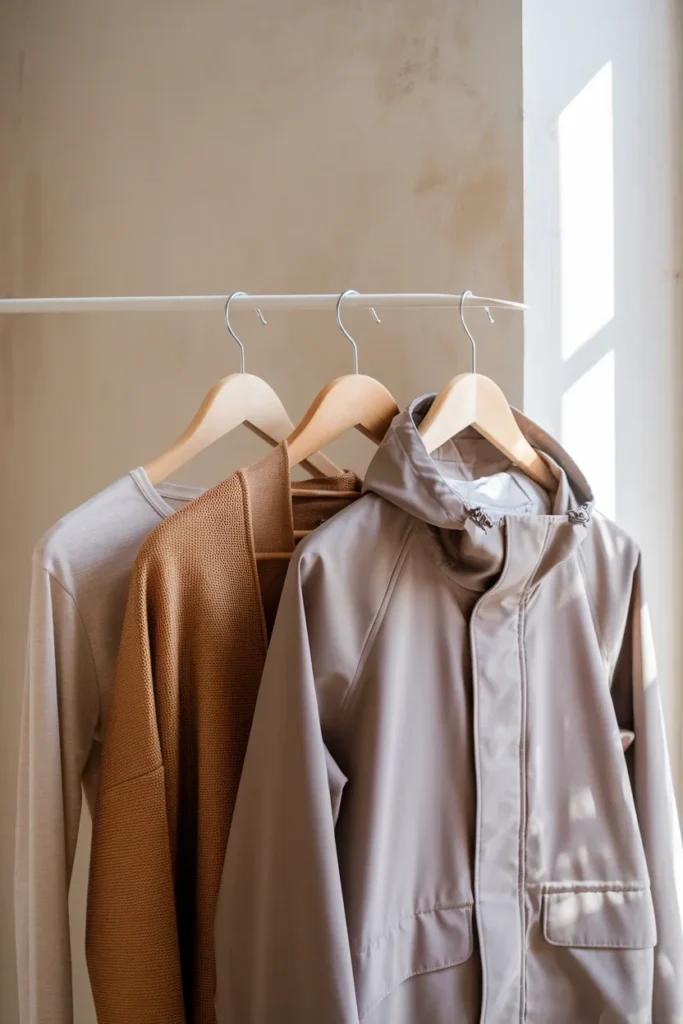
Layer 3: the weather layer, waterproof and hooded. One shell. Not two jackets, not a jacket plus a raincoat. One properly waterproof, properly hooded shell that fits over Layers 1 and 2 without pulling at the shoulders. Try it on over a sweater before you buy, because half of rain jackets are cut for a t-shirt.
That is the whole system. Three layers, worn in every combination the day demands: Layer 1 alone in a warm pub, 1 plus 2 on a mild afternoon, all three on a headland in a squall, 1 plus 3 when it is raining but not cold.
If the structure feels familiar, it should. It is the same layering logic behind my Japan travel capsule wardrobe, adapted for wetter air and stronger wind.
The 14-Piece Ireland Capsule That Makes 30 Outfits
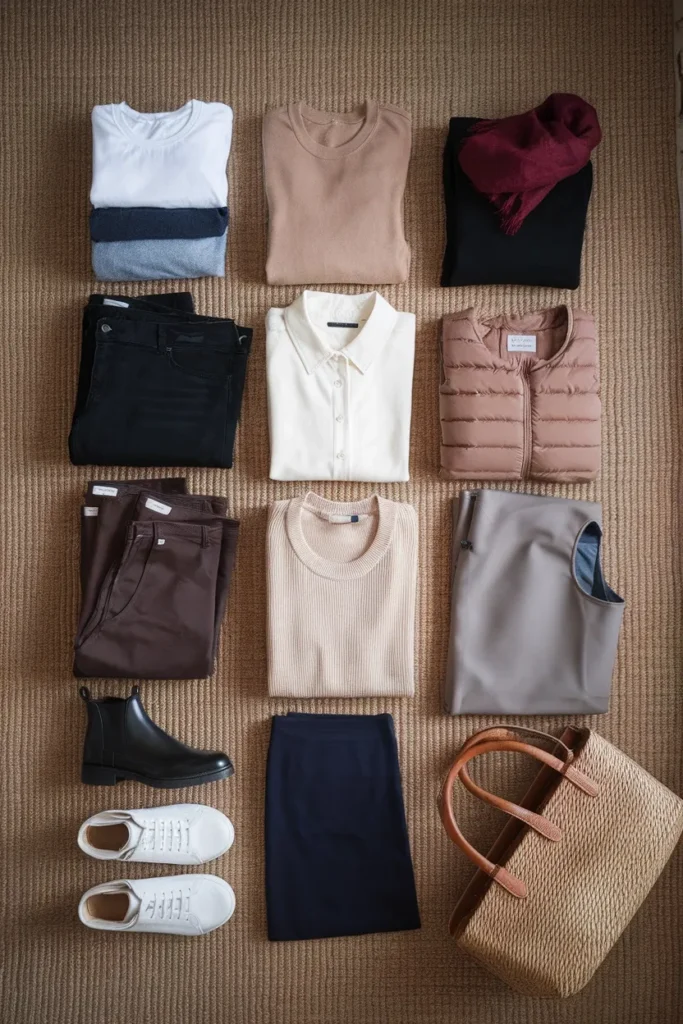
Fourteen pieces. Carry-on only, if you wear the boots and the shell on the plane. Every item below is real, currently sold in the US, and mapped to a price tier.
Tops (5)
- White cotton tee. Your warm-day base and your under-layer. Target’s A New Day or Uniqlo run roughly $10 to $20 [VERIFY current pricing]. At that price you are trading some fabric density, so expect it to look tired after a year of hot washes and treat it as a replaceable piece rather than an investment.
- Long-sleeve merino crew in oat or camel. The single hardest-working piece in the bag.
- Long-sleeve merino crew in soft black. Same piece, different neutral, so nothing looks repeated in photos. Uniqlo’s merino line typically lands around $30 to $50, Quince around $50 to $80, Everlane a little above that [VERIFY current pricing].
- Merino or cashmere-blend crewneck sweater in cream. Warmth without bulk.
- White cotton poplin button-down. Wear it open over the tee, layered under the sweater, or on its own for dinner. Madewell and J.Crew usually sit in the $70 to $110 window [VERIFY].
Bottoms (3)
- Dark straight-leg jeans. Madewell jeans typically run $98 to $138 [VERIFY]. Do not bring two pairs of heavy denim, and the dry-time table below explains why.
- Black ponte or twill trouser. Dries faster than denim, reads dressier at dinner, and does not crease in a carry-on.
- Wide-leg wool-blend trouser in espresso or navy. This is your “we booked somewhere nice” piece. COS and Everlane cover the $90 to $200 span depending on fabric [VERIFY].
Layers (3)
- Camel fine-gauge cardigan. Front-opening, per the rule.
- Quilted vest or full-zip fleece midlayer. Warmth for October through March that packs to nothing. Uniqlo and Old Navy handle this cheaply; Quince and Patagonia sit above.
- Waterproof hooded shell in taupe, olive, or soft black. Detailed in the next section, because it deserves its own.
Shoes (2)
- Waterproof Chelsea or lace-up boot. Blundstone typically runs $200 to $250 [VERIFY]. Thursday Boot Company and Sam Edelman come in lower.
- Low-profile leather or coated-canvas sneaker. Leather, not mesh. Mesh soaks.
One flex piece (1)
- Midi skirt or midi dress in a dark neutral. Wear it with tights and the boots in cold months, with the merino crew layered over the top in mild ones, or alone at dinner. One piece, three completely different outfits.
The outfit math, shown rather than claimed
5 tops multiplied by 3 bottoms gives you 15 base combinations. Add the cardigan or the midlayer over any of them and that becomes 30, with no silhouette repeating. The midi piece adds at least six more on its own. So thirty is the conservative floor, not a marketing number.
Here is the grid. This is the second thing worth screenshotting.
| Dark jeans | Black trouser | Wide-leg trouser | |
|---|---|---|---|
| White tee | Weekend walking | Casual dinner | Gallery day |
| Oat merino crew | Cliff walk | Coach day | City lunch |
| Black merino crew | Pub night | Evening out | Dressed-up dinner |
| Cream sweater | Cold day out | Cozy travel day | Nice restaurant |
| White button-down | Classic and easy | Business casual | Most polished look |
Every cell doubles once you add the cardigan or the vest.
If you want the full framework behind why fourteen works and thirty-eight does not, the ultimate capsule wardrobe checklist with the free printable walks through the ratios piece by piece.
The Rain Shell Is the Only Piece You Should Overthink
If you buy one thing before this trip, buy this. And ignore most of what packing lists tell you about it.
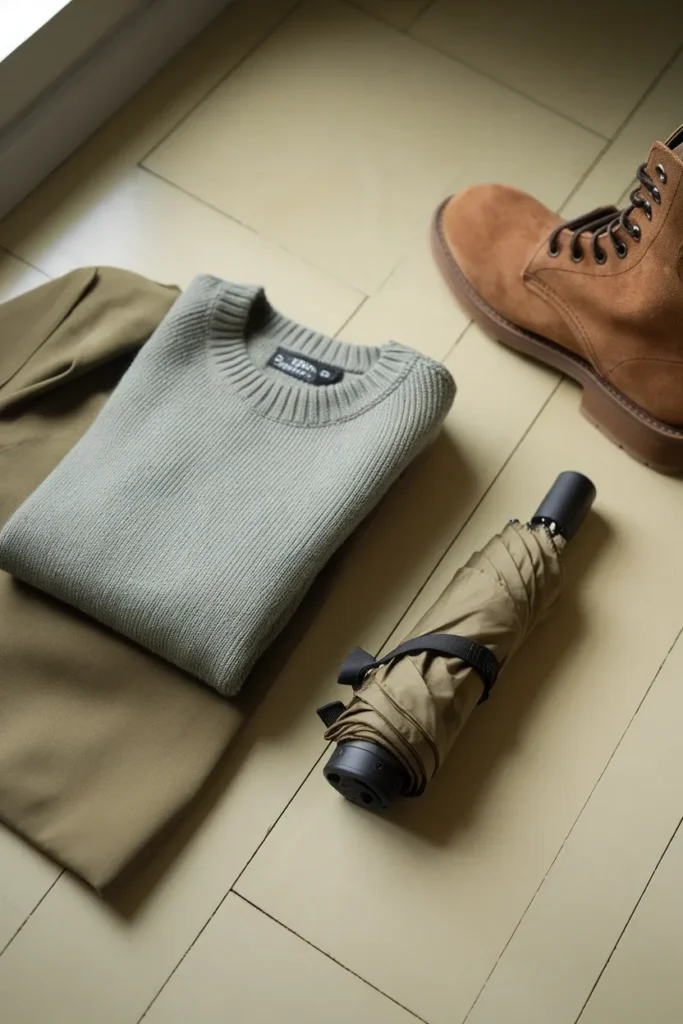
Skip the umbrella. Four of the five top-ranking Ireland packing lists recommend a travel umbrella. On the Atlantic coast, in Galway, Doolin, Dingle, along the Cliffs of Moher, an umbrella inverts. Irish rain arrives sideways on wind, not straight down. Locals mostly do not carry them, which tells you what you need to know. Your hood is your umbrella.
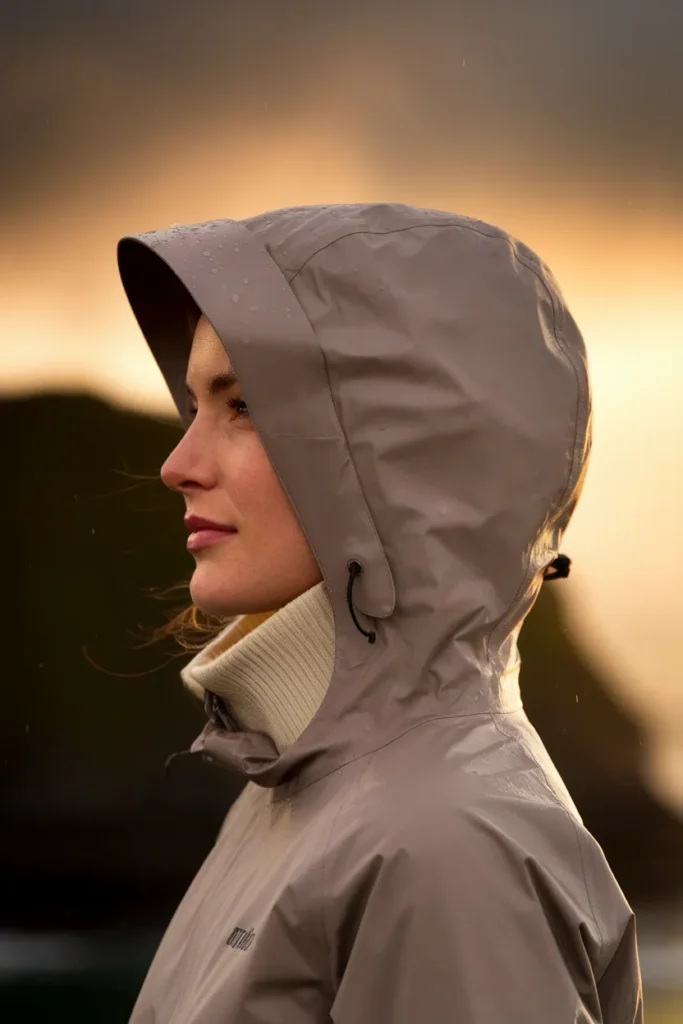
Which means hood construction matters more than the jacket’s waterproof rating. Look for three things, in this order:
- A stiffened or wired brim. Without it the hood collapses onto your face the second the wind picks up, and you spend the day holding it with one hand.
- A rear cinch or volume adjuster. This pulls the hood back off your peripheral vision so you can actually see the view you flew for.
- A hood that turns with your head, not one that stays put while your face rotates into the rain.
Waterproof, not water-resistant. These are different categories and the labels get used loosely. Water-resistant means a surface coating that sheds a light shower for a while and then wets through. Waterproof means a membrane rated to hold out sustained pressure, with taped or welded seams. In Ireland, in October, on the coast, you want the second one. Check the seams: if they are stitched and untaped, water comes through the stitch holes no matter what the fabric does.
Fit test before you buy. Put a merino sweater on, then try the shell over it. Raise both arms straight overhead. If the hem lifts above your waistband or the shoulders bind, size up. Rain jackets are routinely cut for a single t-shirt and it catches people out.
Color, honestly. Taupe, olive, soft black, and navy all photograph well against green countryside and gray sky. A high-visibility yellow shell is a genuinely good safety choice on rural roads without sidewalks, so if you are walking country lanes, choose the yellow and let the photos be what they are.
[VERIFY: this is your best cost-per-wear anecdote slot. Something like “I tested three shells across Uniqlo, Patagonia, and Quince over one wet October and only one kept its hood up in real wind.” Name the brands you actually tested and the month. If you have not tested three, say how many you did.]
For how the shell fits alongside the rest of your outerwear once you are home, the six capsule wardrobe jackets that actually earn their hanger space covers the full rotation.
Dry Time Is the Packing Rule Nobody Tells You
This is the section no competing article has, and it is the one that will save your trip.
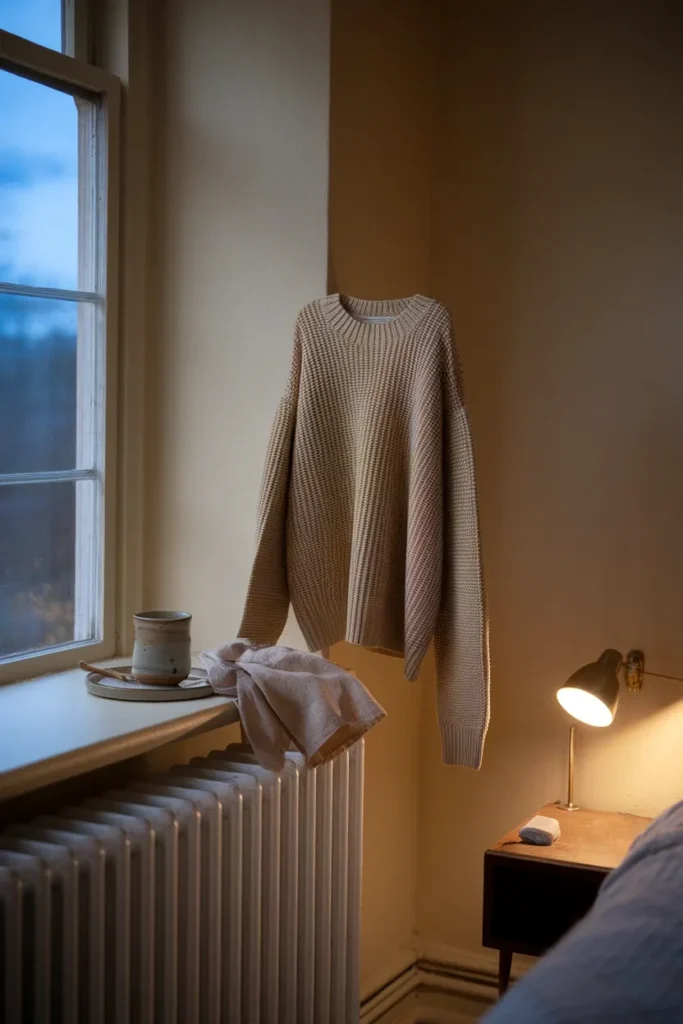
You will get wet. Not soaked necessarily, but damp, most days. Then you go back to a room in a B&B or a small hotel that has a radiator, a towel rail, and no dryer. Whether your clothes are wearable tomorrow comes down entirely to what they are made of.
Wool is the answer, and there is real science behind it rather than just marketing. The Woolmark Company’s research on wool breathability states that wool absorbs up to 35 percent of its weight in moisture before it feels wet against your skin, and that wool fabrics move roughly 25 percent more moisture away from the body than polyester. That is why a merino crew that caught drizzle at 2 p.m. feels dry by 6 p.m. while a cotton sweatshirt stays clammy for hours.
Here is the table. Third screenshot.
| Fabric | Dry overnight on a radiator? | Verdict for Ireland |
|---|---|---|
| Fine-gauge merino | Yes, usually by morning | Your base layers and sweaters. Non-negotiable. |
| Cotton poplin shirt | Yes if hung properly, slower in humid air | Fine for one shirt |
| Cotton jersey tee | Usually yes | Warm-day base only |
| Fleece or synthetic midlayer | Yes, fast | Excellent midlayer |
| Linen | Yes, very fast | Summer only, wrinkles freely |
| Heavy denim | No, can take two full days | Bring one pair. Wear it, do not wash it. |
| Down, once wet | No, and it loses its loft | Never as your outer layer |
| Suede | No, and it water-stains permanently | Leave it home |
Two rules fall straight out of that table.
One pair of denim, worn not washed. Jeans are the slowest-drying thing most people pack and the most likely to get soaked at the hem. One pair, plus a faster-drying trouser, beats two pairs of jeans every time.
No suede. Not the boots, not the bag, not the jacket. A single wet afternoon leaves a tide line you cannot remove.
Shoes for Ireland: Two Pairs, Both Already Broken In
Two pairs. Not three, and never a brand-new pair.
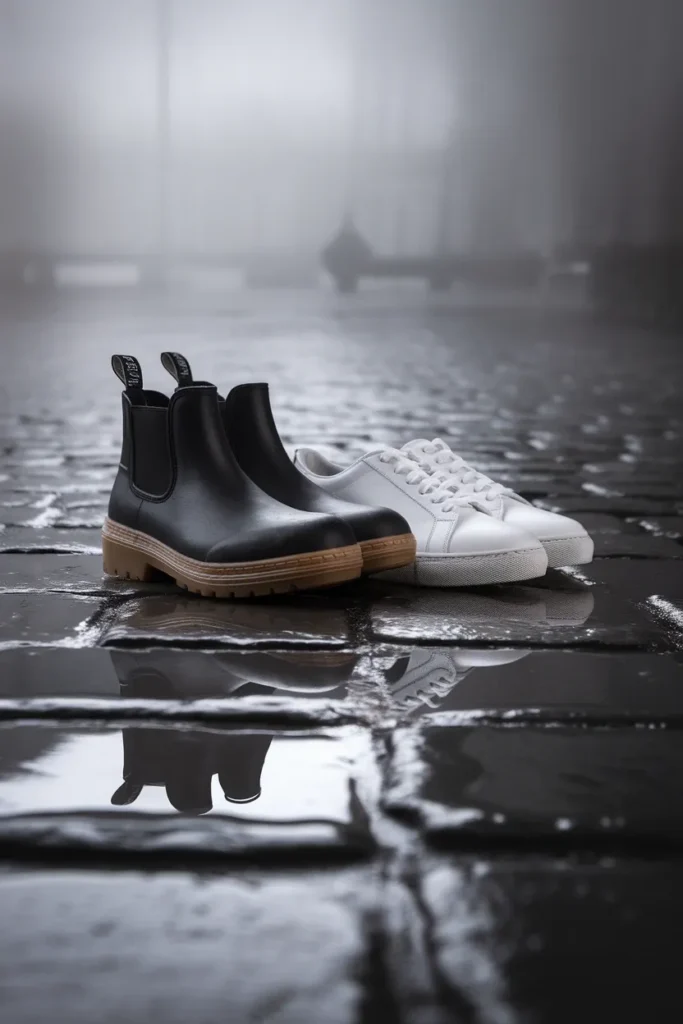
Pair one: a waterproof boot. A Chelsea or a low lace-up in treated leather with a lugged sole. Cobblestones in Galway and Kilkenny are uneven and slick when wet, and smooth soles slide. Blundstone typically runs $200 to $250 [VERIFY]; if that is above your line, Thursday Boot Company and Sam Edelman cover similar ground for less, and Target’s A New Day makes a budget version where you trade real leather for coated synthetic that will not breathe as well on a long walking day. Full breakdown in the best ankle boots for a capsule wardrobe.
Pair two: a low-profile leather or coated-canvas sneaker. For city days, museums, and the flight itself. Leather over mesh, every time. Mesh runners take on water in ten minutes of Irish drizzle and then you are wearing wet shoes for six hours.
What to skip:
- Mesh running shoes. Covered above.
- Anything new. You will walk more than you plan to. Two weeks of wear at home first, minimum.
- Heels over about two inches. Cobblestones, wet stone, and old stairs. A block heel under two inches is fine for dinner.
- Suede anything. See the table.
Socks are the quiet upgrade. Three pairs of merino socks change a walking day more than most people expect. They stay warm damp, dry overnight, and do not develop odor the way cotton does. Cotton socks in wet boots are how you get blisters by day three.
What to Wear in Ireland by Season
Same fourteen pieces. What changes is which layers do the heavy lifting and what you add or subtract.
Spring in Ireland (March to May)
Roughly 50 to 62F, and statistically your driest window, with April at 82 mm and May at 79 mm of rain.
Layer 1 plus Layer 2 most days, with the shell in your tote rather than on your body. Swap the quilted vest out and the cardigan in. This is trench-and-jeans territory, and it is the easiest Irish weather to dress for. Add a scarf. Wind still bites in March.
Summer in Ireland (June to August)
Roughly 60 to 68F inland on a good day, and that is the ceiling, not the average. Bring your American summer instincts down several notches: you will not need shorts, and a sundress alone will leave you cold by 6 p.m.
Keep all fourteen pieces. Genuinely. Add one linen shirt and swap the cream sweater for something lighter if you like, but the shell stays and the boots stay. Summer here means long daylight, not heat. Sandals are a lunch-in-Dublin item, not a Ring of Kerry item.
Fall in Ireland (September to November)
Roughly 48 to 60F, and the rain steps up hard: October and November both average around 130 to 140 mm.
This is the capsule at full strength. All three layers most days, quilted vest instead of cardigan from mid-October, tights under the midi skirt, and merino socks earning every dollar. Fall is also, for what it is worth, the most photogenic version of Ireland: low light, saturated green, empty coastal paths.
Winter in Ireland (December to February)
Roughly 40 to 48F, and December is the wettest month of the year at about 142 mm.
The temperature is milder than most Americans brace for. Remember: about one day or less per year stays below freezing. What you need is not more insulation, it is better waterproofing and a wind layer. Add a merino base layer under everything, a proper wool scarf, gloves, and a hat. Add tights. Keep the same shell as long as it is genuinely waterproof, and skip the down parka, which soaks and then quits.

Five Ireland Outfit Formulas From Those 14 Pieces
Formulas rather than photographs, so you can rebuild them from what is already in your closet.
1. The cliff walk. Oat merino crew, dark jeans, waterproof boots, quilted vest, shell over the top, merino socks. This is the one you will wear most and the one worth getting right first. Nothing about it is precious, everything about it dries.
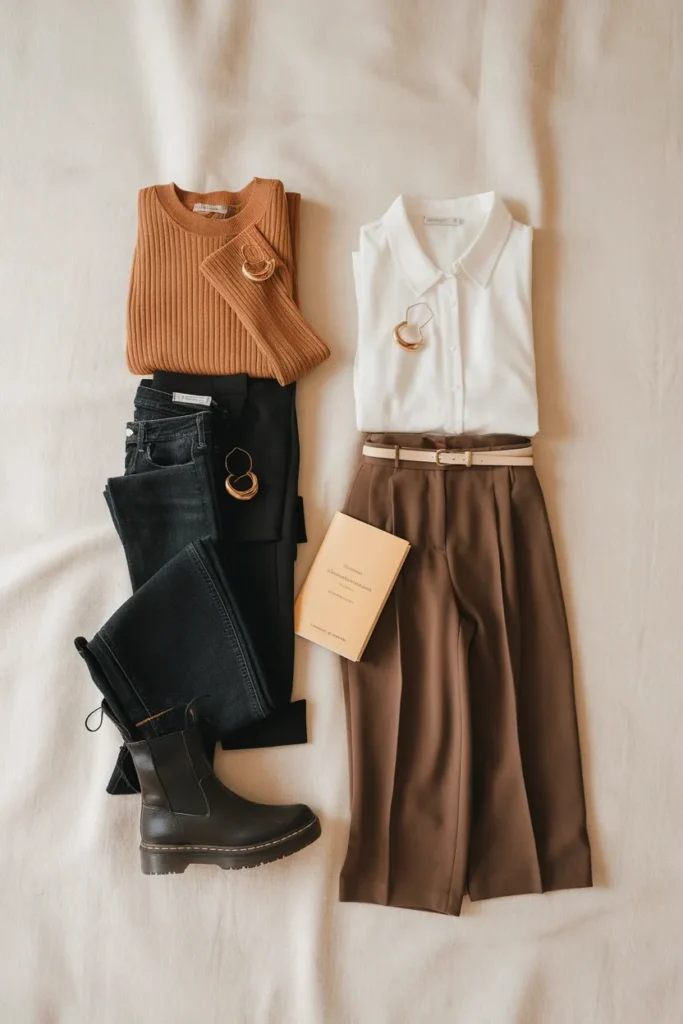
2. The pub night. Black merino crew, black trouser, Chelsea boots, cardigan carried not worn, gold hoop earrings. Warm interiors mean you want to arrive slightly under-dressed for the temperature outside.
3. The nice dinner. White button-down tucked into the espresso wide-leg trouser, boots, and the shell left at the hotel if the forecast holds. Add a belt. Ireland is casual, so this is plenty.
4. The coach or train day. Cream sweater, black trouser, sneakers, cardigan as the seat-side blanket. Comfort that does not read as sleepwear, and everything survives eight hours of sitting without creasing badly.
5. The city and gallery day. White tee under the open button-down, dark jeans, white sneakers, cardigan in the tote. Layers you can shed one at a time as you move between a cold street and a heated museum.
Notice what all five have in common: not one of them requires an item outside the fourteen.
What Not to Wear in Ireland, Including the Color Rule People Get Wrong
Let me be straight about this, because a lot of what circulates here is folklore repeated as fact.
On green: there is no rule, only an aesthetic call. You will read that wearing green in Ireland is offensive or unlucky. It is not. Irish people wear green. What bright kelly green paired with a shamrock motif does do is read as costume, in the same way a beret and a striped shirt reads as costume in Paris. If you want to skip it, skip it for that reason and not because someone told you it was taboo. Sage, olive, and forest are all quietly beautiful there and read as considered rather than themed.
Actually worth skipping:
- Suede, in any form. Already covered, still true.
- A travel umbrella as your rain plan. Fine in Dublin city. Useless on the west coast.
- Mesh running shoes. They hold water.
- Two pairs of heavy jeans. Dry time.
- Down as your outer layer. Wet down loses its loft and stops insulating.
- White bottoms. Wet stone, mud, and sheep-track paths. One splash and your day is over.
- Neon athleisure as everyday wear. Ireland dresses casually but rarely loudly. You will feel conspicuous, though nobody will say anything.
- Anything requiring dry cleaning. No time, no access, no point.
And one thing everybody overpacks: clothes for the weather you hope for. Do not bring the sundress for the one warm day. Bring the midi you can layer, and let the warm day be a bonus.
Accessories That Do Double Duty
Four small things, each doing more than one job.
A wool scarf. Warmth on a headland, a shoulder cover in a cold church, and the one piece of color in your palette. Bring one, in a real wool, in an accent you actually like.
A crossbody bag with a zip top. Zip, not a magnetic snap, because rain gets in. Small enough to wear under the shell so it stays dry, big enough for a phone, a card, and a folded hat.
A packable tote. For the day you buy a wool blanket in Avoca and have nowhere to put it. Weighs nothing folded.
A brimmed hat, wool or waxed cotton. Keeps drizzle off your face when the hood is down, which is most of the time.
Skip statement jewelry entirely. Gold hoops carry every one of the five formulas above and weigh nothing. More on how the small pieces do disproportionate work in capsule wardrobe accessories that quietly change every outfit.
Will These Pieces Earn Their Hanger Space at Home?
Here is the question no Ireland packing list asks, and the reason this one is built as a capsule instead of a list.
Look back at the fourteen. Merino crews, a white button-down, dark jeans, a black trouser, a wide-leg trouser, a cardigan, a waterproof shell, Chelsea boots, white sneakers, a midi. That is not a trip wardrobe. That is a functioning fall capsule that happens to also survive Ireland.
Run the numbers on the shell, since it is the piece people resist buying. A genuinely waterproof shell at, say, $180 that you wear ten days in Ireland is $18 per wear, which sounds like a lot. Wear it another thirty days across the following American fall and spring, which any waterproof shell in a neutral color easily absorbs, and you are at roughly $4.50 per wear and dropping. That is the calculation that separates a trip purchase from a wardrobe purchase.
[VERIFY: your cost-per-wear proof point goes here. Something like “I tracked cost per wear on every piece in this capsule for six months after the trip and eleven of the fourteen stayed in weekly rotation.” Use your real number, and name the pieces that did not make it, because the misses are the credible part.]
The test, applied to anything you are tempted to add: if it only works in Ireland, it does not go in the bag. A rain poncho only works in Ireland. A camel cardigan works in October in Ohio. That is the filter.
One more piece of the same logic: build your travel-day outfit out of these fourteen too, so nothing in your bag exists only for the flight. What to wear on a plane so the flight outfit still works on arrival breaks that down.
Frequently Asked Questions
What should you wear in Ireland?
Thin wool base layers, a front-opening warmth layer, and one genuinely waterproof hooded shell, over dark neutral bottoms and waterproof boots. Temperatures sit roughly between 45 and 68F year-round, so you are dressing for change rather than for cold. Fourteen well-chosen pieces cover a two-week trip in any season.
Does Ireland have a dress code?
Not in any formal sense. Ireland is genuinely casual, and jeans with a sweater will take you almost everywhere, including most restaurants and every pub. A handful of upscale restaurants and hotel dining rooms prefer smart casual, which the white button-down and wide-leg trouser handle without needing a separate outfit. Nobody will turn you away for wearing walking boots.
What should I not pack for Ireland?
Suede, mesh running shoes, white bottoms, a down coat as your outer layer, more than one pair of heavy jeans, anything needing dry cleaning, and a travel umbrella you are counting on. That last one surprises people: on the west coast the wind inverts umbrellas, so a well-built hood does the job instead.
Are jeans and leggings okay to wear in Ireland?
Jeans, absolutely, and you will see them everywhere. Bring one pair, wear them repeatedly, and pair them with a faster-drying trouser rather than a second pair of denim. Leggings are fine for travel days and hiking, and locals mostly wear them as activewear rather than as everyday trousers, so if you would rather not read as a tourist, a ponte or twill trouser does the same comfort job and looks more deliberate.
Does this Ireland capsule work for petite and curvy women?
Yes, with two adjustments. If you are petite at 5’4″ and under, buy the wide-leg trouser in a petite inseam or plan on a hem, because a dragging hem in wet weather stays wet, and choose a shell that ends at the hip rather than mid-thigh so your proportions stay balanced. If you are curvy, prioritize the shell fit across the bust and shoulders over the waist, since that is where rain jackets bind, and look for one with a drawcord waist so you can shape it back in. The merino crews are worth sizing to your fullest measurement and letting the wool skim rather than cling.
Is a waterproof shell worth the investment, or will a $40 rain jacket do?
For a Dublin city break in May, a $40 water-resistant jacket will probably be fine. For the west coast, or for October through January anywhere, it will wet through. What you are paying for at the higher tier is a membrane rather than a surface coating, taped seams, and a hood that holds its shape in wind. On longevity: any waterproof shell needs its water-repellent finish refreshed periodically, either with a wash-in product or a heat cycle in the dryer per the care label, and skipping that is the most common reason a good jacket stops performing after two seasons.
Does this same capsule work for an Irish winter trip?
Yes, with four additions rather than a rebuild: a merino base layer under everything, a real wool scarf, gloves, and opaque tights for the midi. Swap the cardigan for the quilted vest as your warmth layer. Winter sits around 40 to 48F with December the wettest month of the year, so the upgrade you need is waterproofing and wind protection, not more bulk.
Your Fourteen Pieces, Then Stop Packing
The reason Ireland trips go wrong in the suitcase is that “bring layers” gets treated as “bring more.” It is the opposite. Fourteen pieces in a tight neutral palette, three layers that combine in every direction, one shell you actually trusted enough to research, and two pairs of broken-in shoes. That is a bag you can carry on, and a wardrobe you will still be wearing in October at home.
Pull the three tables out of this article before you start: the 3-Layer Rule, the fourteen-to-thirty grid, and the dry-time list. Lay your pieces on the bed against them. Anything that fails the dry-time test or only works in Ireland goes back in the closet.
Then go. The weather will do whatever it wants, and for once it will not matter.
Keep reading

What to Wear for Family Pictures Without Buying Everyone New Clothes
Your session is in eleven days and you’ve already spent two evenings with forty tabs open. I know that feeling. Deciding what...

What to Wear on a Rainy Day: Outfits That Stay Cute and Dry
Figuring out what to wear on a rainy day comes down to about four decisions you make before you ever pick an...

What to Wear in Nashville: Outfits With a Little Twang
Deciding what to wear in Nashville trips people up for one reason nobody warns you about, and it isn’t the cowboy boots....