
What to Wear on a Plane: Comfy Travel Outfits That Still Look Good
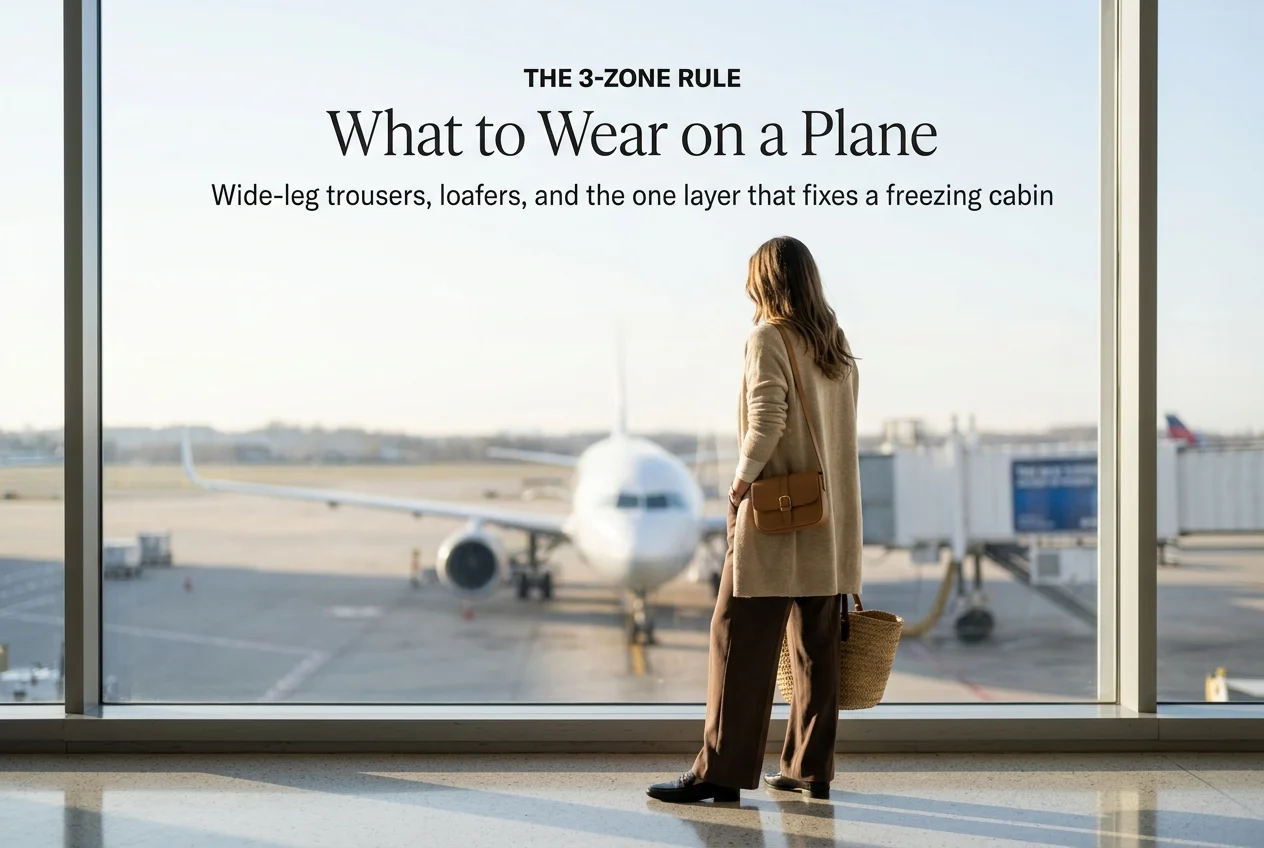
Figuring out what to wear on a plane is a puzzle disguised as an outfit. You’re dressing for a warm terminal, a freezing cabin, and an arrivals curb that might be thirty degrees colder than the one you left, all in one set of clothes you cannot change out of for eight hours. Most flight outfit advice hands you a list of rules. This one hands you a system, plus five copy-and-go formulas sorted by how long you’re actually in the air.
And every piece in here already lives in a normal capsule wardrobe. Nothing on this page is a travel-only purchase.
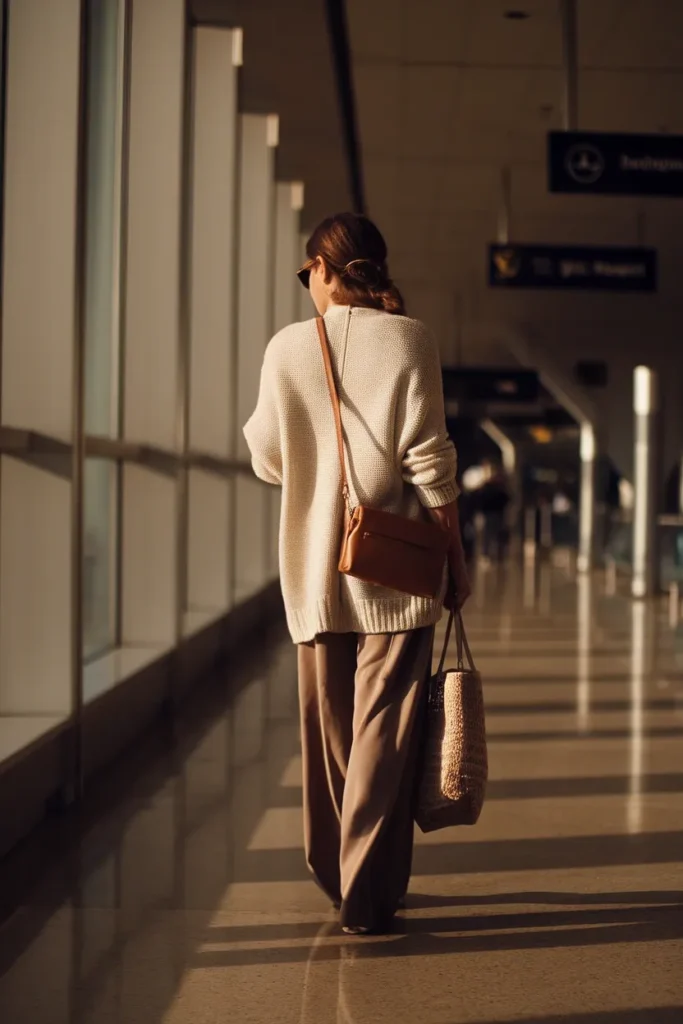
Why Flight Outfits Are Harder Than They Look
Here’s the thing nobody tells you. Deciding what to wear on a plane is hard because you are not dressing for one environment. You’re dressing for three, and they disagree with each other.
Cabin temperature is the part most people get wrong. There’s no industry-wide standard for it, which is exactly why it feels random. The Association of Flight Attendants has pushed for a range of 65 to 75 degrees Fahrenheit, and pilots generally aim for something around 70. In practice it swings. Crews in layered uniforms are moving constantly, so they run warm while you sit still in a thin tee. Pilots often overcorrect for the stuffy heat at the gate and cool the cabin harder than the seated passengers would like. Nobody up front knows how cold it’s gotten back there until someone calls.
Then there’s the air itself. Cabin humidity typically sits far below what your skin is used to at home, which is why your throat feels scratchy and your ankles feel puffy two hours in.
So the outfit has three jobs. Keep you from overheating while you’re hauling a bag through the terminal. Keep you genuinely warm while you sit still in cool, dry air. Then walk you out into whatever the destination is doing.
The 3-Zone Rule: A Framework You Can Screenshot
I build every flight outfit around three zones instead of one. Each zone gets one dedicated layer, and each layer has to be removable without a bathroom trip.
Zone 1, curb to gate. You’re moving, carrying, standing in line, and probably a little stressed. Temperature feels like 75 to 80 degrees no matter what the thermostat says. You want the least clothing you’re comfortable being seen in.
Zone 2, cruise. You’re still for hours in 65 to 75 degree dry air. This is where people are miserable. Zone 2 needs a real insulating layer, not a decorative one.
Zone 3, arrivals. Unknown. Could be humid and 92, could be sleeting.
Now the actual rule: your Zone 1 outfit is your whole outfit minus two layers. Build the complete look for Zone 2, then peel two things off and carry them. Those two things are almost always your third layer and your scarf.
| Zone | Where | Feels like | Your job |
|---|---|---|---|
| 1 | Curb to gate | 75 to 80°F | Base layer only, carry the rest |
| 2 | Cruise, 4+ hours | 65 to 75°F, very dry | Add third layer and scarf |
| 3 | Arrivals | Anything | Subtract or add, one move |
The whole point of building it this way is that you never have to open your carry-on to fix your temperature. Everything you need is either on your body or over your arm.
Start With the Pants, Because That’s Where Flight Outfits Fail
If you only fix one thing, fix the bottom half. A waistband that felt fine at 7 a.m. becomes the main character of your day by hour four, because sitting still in dry cabin air causes real, normal, temporary swelling.
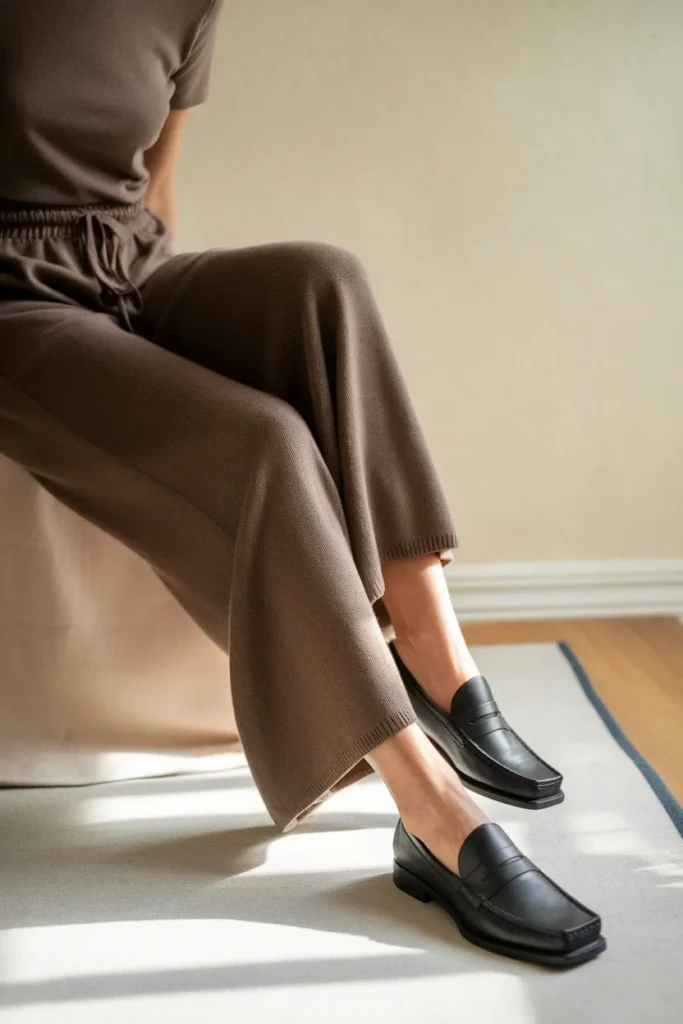
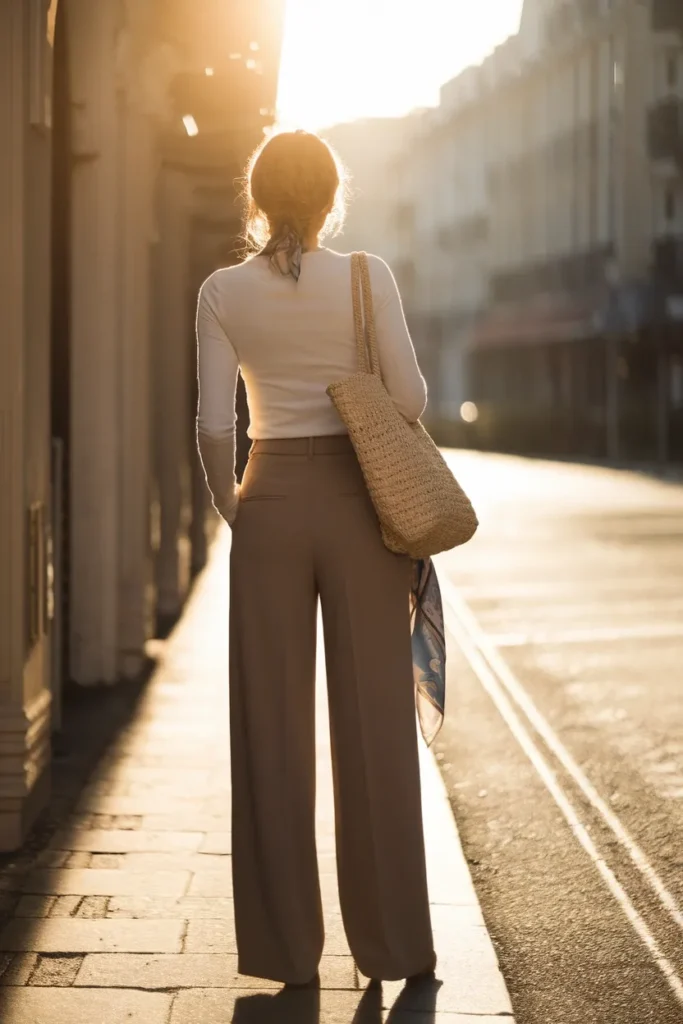
Wide-leg knit or twill trousers are the top performer. Elastic or drawstring waist, enough room through the thigh that crossing your legs doesn’t pull, and a fabric with some weight so it hangs instead of clinging. A ponte or double-knit trouser in black, espresso, or taupe reads like real clothes in every airport photo and feels like nothing. Old Navy and Target’s A New Day line both run these in the twenty to forty dollar range. Quince, Everlane, and J.Crew sit higher, roughly fifty to a hundred and twenty, and the difference you’re paying for is fabric recovery, meaning the knee area still looks smooth after six hours of sitting.
Joggers work, with one condition. A tapered ankle plus a slouchy top reads like you’re on your way to bed. A tapered ankle plus a structured third layer and a real shoe reads intentional. If joggers are your comfort default, how to style joggers so they read polished instead of pajama covers the full set of pairings that fix it.
Jeans are fine, with an asterisk. Rigid non-stretch denim on a nine-hour flight is a genuinely bad time. Denim with three to five percent elastane in a straight or wide leg is comfortable for most flights under about four hours. Madewell typically runs ninety-eight to a hundred and thirty-eight dollars in that category. Under about fifty dollars you can absolutely find a comfortable pair, though the trade-off is usually a lighter, thinner fabric that bags out at the knee faster.
Leggings, honestly. They’re comfortable and millions of people fly in them. Two real considerations: a tight compressive legging can feel restrictive over many hours, and most are synthetic, which some flight crews prefer travelers avoid for emergency-evacuation reasons. If you love flying in leggings, a thicker opaque pair with a wide soft waistband, worn under a longer top or a knit dress, splits the difference well.
The Base Layer That Does the Most Work
A long-sleeve cotton or merino tee is the single most useful thing you can put on your body for a flight. Long sleeves, specifically.
Three reasons, and only one is about warmth. It covers your arms against a cold vent you cannot redirect. It puts a layer between your skin and a tray table and armrest that many people have touched. And flight crews consistently recommend covered arms and legs for evacuation safety, because more covered skin means more protection.
Merino is the upgrade worth talking about. It regulates temperature in both directions, which matters enormously when you’re going from an 80 degree jetway to a 66 degree cabin, and it resists odor across a long travel day in a way cotton simply does not. Uniqlo and Quince both carry merino and merino blends in a reasonable range. Cotton jersey feels wonderful at the gate and slightly clammy by hour three, so if you run warm, merino earns the swap.
Fit note: you want it skimming, not tight. A tee that’s snug across the ribs when you’re standing gets uncomfortable when you’re slouched into a seat with a seatbelt across your lap.
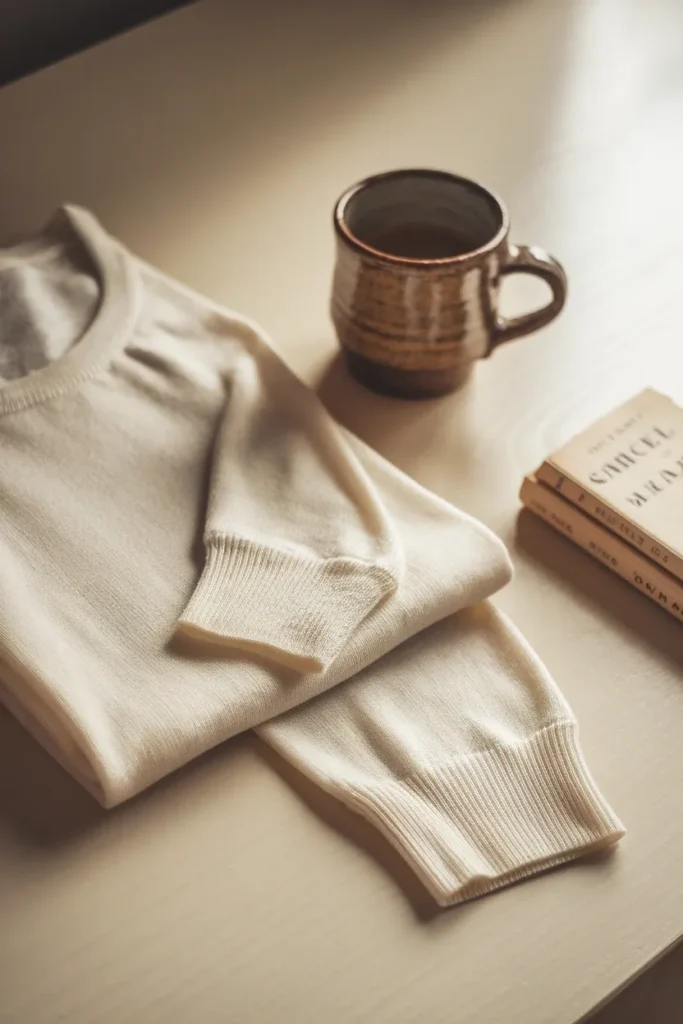
Your Third Layer Is the Whole Outfit
Everything above is comfort. The third layer is what makes it look deliberate, and it’s the piece that solves the cold cabin.
Four options that all work, ranked by how much structure they add:
- A relaxed blazer. Most polished, best if you’re going straight into a meeting or dinner. Choose an unstructured one in a soft wool or linen blend so it doesn’t fight you in the seat.
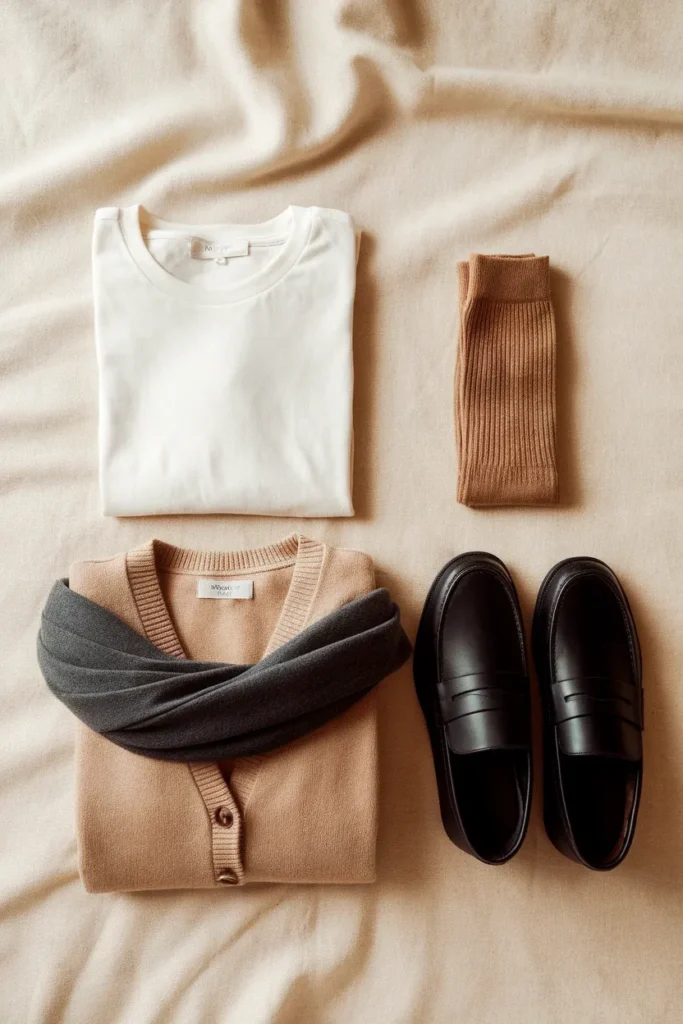
- A coatigan or long sweater jacket. My favorite for anything over four hours. Long enough to pull across your lap like a blanket, soft enough to bunch behind your neck as a pillow, structured enough that it doesn’t look like a robe.
- A trench. Ideal for spring and fall travel and for the cold-to-mild route. Packs into an overhead bin without holding a crease.
- A cashmere or wool cardigan. Lightest and warmest by weight, so it’s the one to reach for when carry-on space is tight. Quince has made real cashmere accessible in the fifty to a hundred dollar range, where it used to start around three hundred. Worth knowing the trade-off: lighter-weight and lower-priced cashmere pills faster, so a heavier gauge is the piece to spend on if you fly often.
If your closet is missing this layer entirely, the six capsule wardrobe jackets that actually earn their hanger space walks through which one to buy first based on the climate you actually live in.
One quiet rule I follow: the third layer should be a shade you’d wear to dinner. It’s the piece in every arrivals photo, and it’s the piece you’ll throw on over a dress all week.
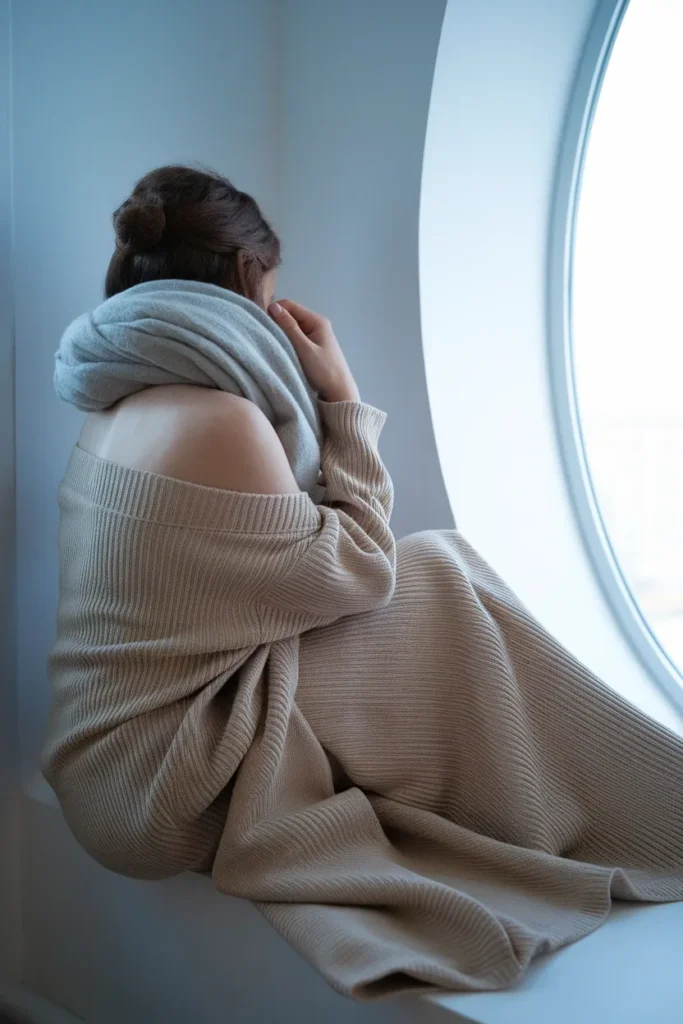
What Shoes to Wear on a Plane
Two requirements, in this order: they come off in one motion, and you could run in them.
Loafers are the best all-around answer. Slip on and off at the checkpoint without bending down, have a real back so they stay on if you need to move quickly, look finished with trousers and jeans both, and go straight into your destination wardrobe. The best loafers for women, chosen the capsule way breaks down which shape works with which pant hem, which matters more than people expect when your pant is wide.
Sneakers are the comfort pick for long haul, especially if you have a tight connection in a large airport. Choose a low-profile leather or canvas pair over a chunky trainer, because chunky soles eat carry-on space if you swap them and they photograph heavy with a wide-leg pant.
Ankle boots are the right call in winter, and they solve the cold arrivals problem instantly. The trade-off is real: they’re slow at security and warm on board. Wear them if your destination demands them, not otherwise.
What to skip: heels, which are genuinely restricted on emergency slides and miserable in a terminal sprint. Backless mules and flip-flops, which fall off and leave your feet bare on a cabin floor. Anything that laces up your calf, which turns a thirty second checkpoint into a three minute one.
Always socks, even with loafers. Cabin floors are cabin floors, and cold feet are the fastest route to being cold everywhere.
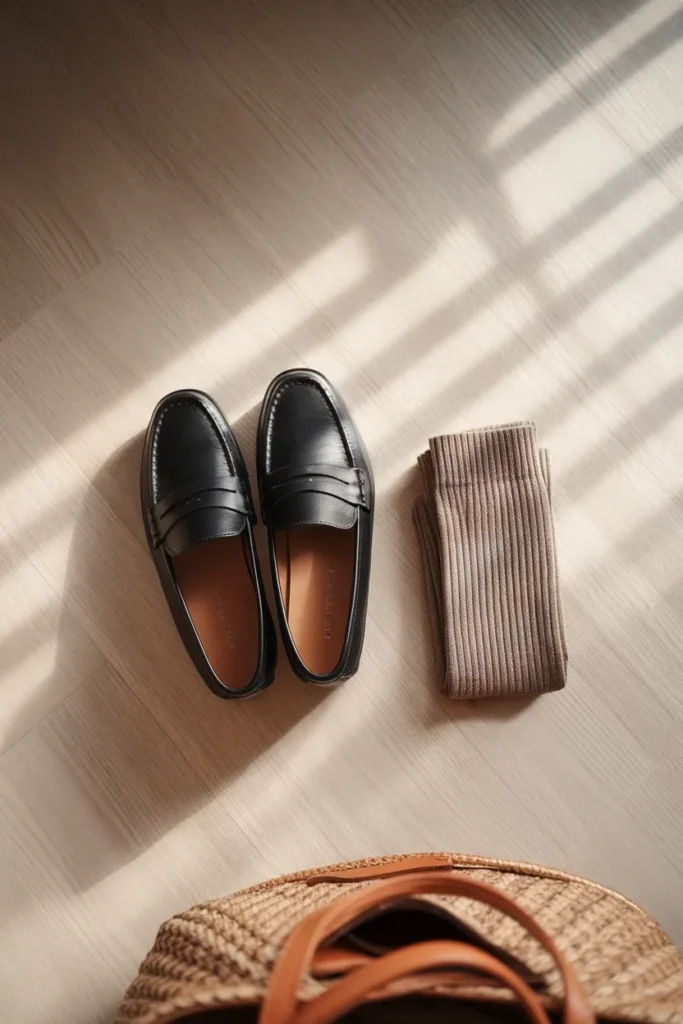
The 90 Second Security Line
This is the part where a good outfit quietly pays for itself. Dress for the checkpoint and you glide through. Dress against it and you’re the person holding up the bin line, barefoot, unthreading a belt.
TSA officers have said it plainly: TSA officers say slip-on shoes are best at the checkpoint, and shoes that lace up your calf will slow you down. They also note that with TSA PreCheck you can leave on your shoes, your belt, and a light outerwear jacket, which changes the calculus completely on whether a belt is worth wearing.
My actual order of operations, standing in line:
- Jewelry goes in the bag before you get in line, not in a bin. Stack rings, a chunky cuff, and a big pendant are the usual culprits.
- Empty every pocket completely. A tissue or a mint is enough to trigger a pat-down.
- Third layer comes off and goes over your arm while you’re still walking up, so you’re not doing it at the belt.
- Phone goes into your carry-on, not loose in a bin.
- Shoes off in one motion if you’re not in PreCheck.
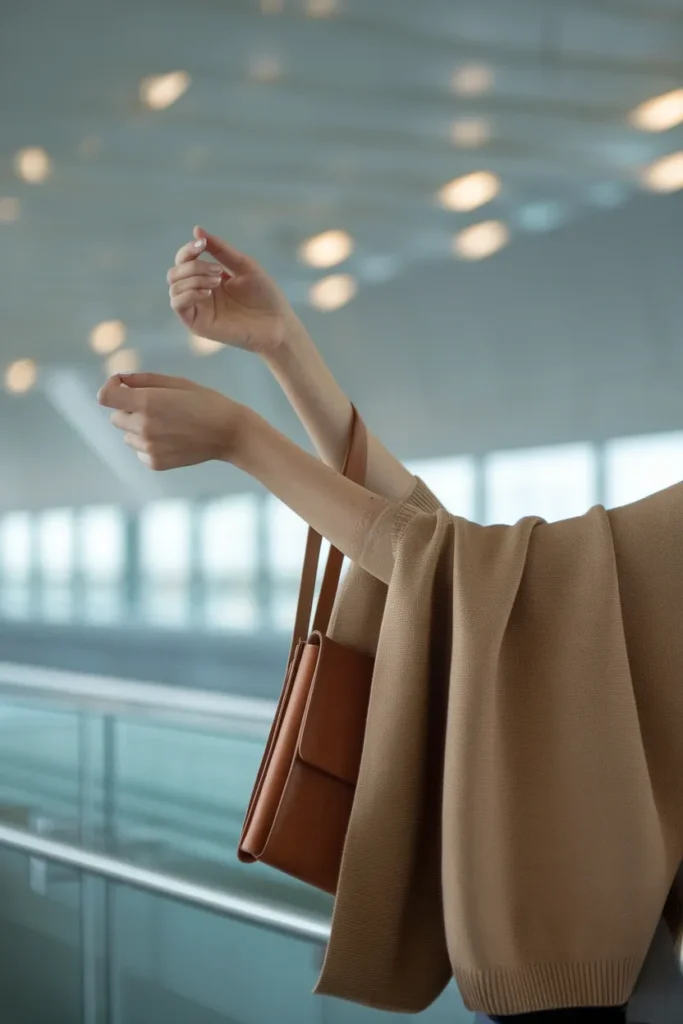
The clothing implications are simple. A belt is optional if your waistband stays up on its own, and it usually should on a drawstring trouser. Metal-heavy hardware on shoes, bags, and buckles is worth avoiding on a travel day. A crossbody with a slim frame beats a bag with a heavy chain strap.
The Accessories That Earn Their Space
Five things, and each one has to justify itself.
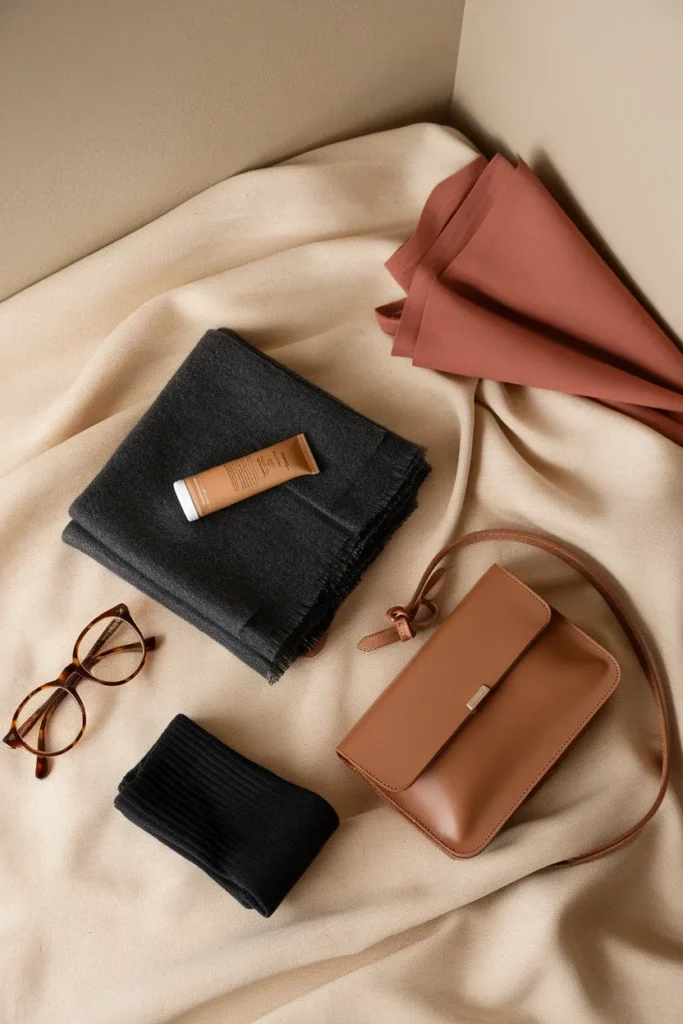
Compression socks. Worth understanding rather than just buying. The CDC puts the threshold at four hours of sitting still for elevated blood clot risk, whether that’s a plane, a car, a bus, or a train, and it notes that some travelers may benefit from graduated compression stockings while pointing out that most travel-related clots happen in people with additional risk factors. It’s a talk-to-your-doctor situation rather than a universal rule. What is universally true: they reduce that puffy-ankle feeling on long flights, and they’re cheap. Skip the medical-beige ones. Ribbed black or espresso pairs look like normal socks with loafers.
A large scarf. The highest-value item you can carry, and the reason is that it’s four things at once: a blanket across your lap, a pillow behind your neck, a warm layer at your throat when the vent wins, and an actual accessory when you land. A wool or cashmere blend in a neutral, roughly 27 by 27 inches or larger, beats a small silk square for this. Ten ways to style a scarf that all work in a plane seat covers the folds worth learning.
A slim crossbody plus one tote. Passport, phone, and card live in the crossbody, which never leaves your body. Everything else lives in the tote, which goes under the seat. Digging through one bag for boarding passes while holding a coffee is how things get left behind.
Glasses over contacts. Cabin air is dry enough that contacts get uncomfortable fast on anything long, especially if you plan to sleep.
Lip balm and hand cream in your pocket, not in the overhead bin. Nothing else matters if you can’t reach it.
5 Flight Outfit Formulas by Trip Length
Screenshot this section. The right answer to what to wear on a plane changes with how long you’re in the air, so each formula below is sorted by flight length. Every one uses pieces that already belong in a capsule, and every one lands ready to wear again.
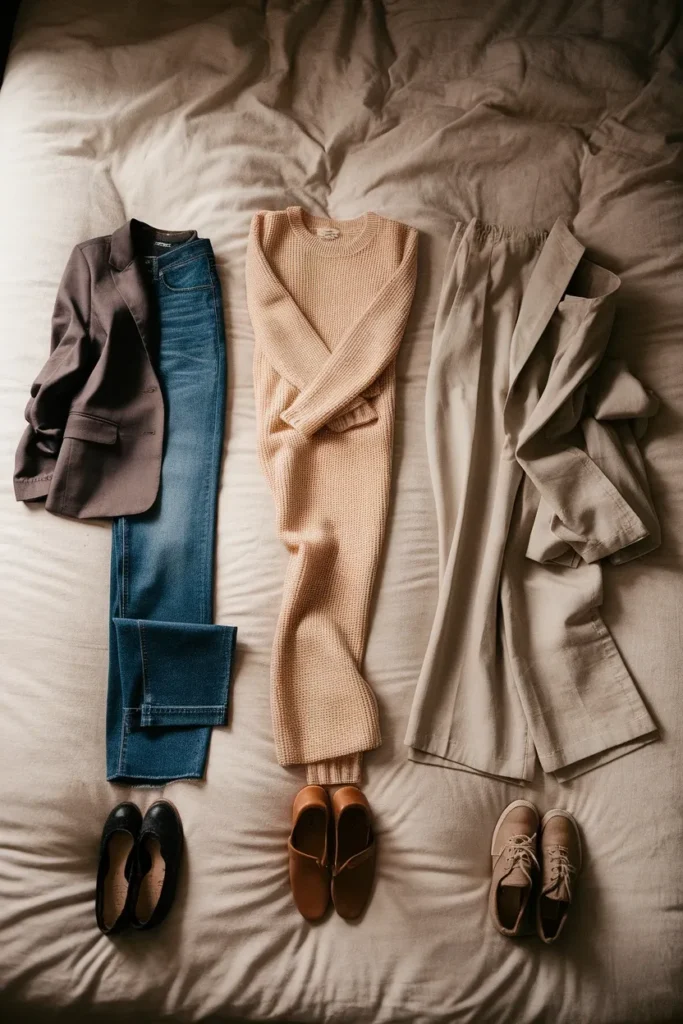
1. Under 3 hours, domestic day trip. Straight-leg jeans with a little stretch, white or ivory long sleeve tee, relaxed blazer, loafers, slim crossbody. This is the formula that goes straight from the plane into lunch, and it’s the one I’d put first if you only remember one.
2. Three to six hours, transcontinental. Wide-leg knit trouser, merino long sleeve tee, long coatigan, low leather sneakers, large neutral scarf, compression socks. The coatigan and scarf come off in Zone 1 and go on at cruise.
3. Over eight hours, long haul. Soft knit set in oat or charcoal (matching top and wide-leg bottom), merino base layer underneath, cashmere cardigan, slip-on sneakers, compression socks, oversized scarf. The set is the trick here: it reads as one considered outfit rather than loungewear, and both halves separate into your vacation rotation.
4. Red-eye or overnight. Everything from formula three, plus two adjustments. Wear the softest, least structured version of every piece, and choose a third layer with a hood or a high collar so you have something to lean into. Skip the blazer entirely. You’ll be trying to sleep, and nothing wakes you up like a lapel in your neck.
5. Cold departure, hot arrival. The hardest one, and the one competitors handle worst. Build the whole outfit from the hot destination up, then add removable warmth on top. Linen or lightweight cotton wide-leg pants, short sleeve or sleeveless base, merino long sleeve over it, trench on top, loafers with socks. On landing you shed the trench and the merino and lose the socks, and you’re dressed for 90 degrees in about forty seconds. If you’re working out how much warmth a light jacket actually buys you, what to layer under a denim jacket from 40 to 70 degrees maps the same logic onto a temperature range you can feel.
Dressing for the Landing, Not Just the Flight
Here’s the reframe the top-ranking articles miss entirely. A flight outfit is not a costume you wear twice a year. It’s a normal outfit selected for a specific set of constraints, and it should walk directly into your trip.
Run every piece against one question before it goes on your body: will I wear this again on day two of this trip?
The wide-leg trouser becomes your dinner pant with a nicer top. The merino tee is your layer under everything for the rest of the week. The cardigan goes over a dress. The loafers are the shoes you wear all trip because you can walk in them. The scarf handles every cold restaurant and every chilly evening. If a piece fails that question, it’s taking up space in your suitcase for one day of use.
That single filter is also why the plane outfit is worth building out of pieces you already own rather than shopping for. You’re not assembling a travel wardrobe. You’re picking six pieces from a closet that already works together, which is the entire point of building a capsule in the first place. And once you land, how to style wide-leg jeans once you’re off the plane covers the outfits those same bottoms carry for the rest of the week.
What Not to Wear on a Plane
Short list, and each one is here for a practical reason rather than a style opinion.
- Anything with a rigid waistband. Belts pulled tight, rigid denim, structured waistbands. Swelling is normal and this is where you feel it.
- Heels, mules, and flip-flops. Heels are a genuine problem on evacuation slides. Backless shoes come off when you least want them to.
- Complicated one-pieces. A jumpsuit that requires a full undress in an airplane bathroom is a decision you will regret at hour five.
- Heavy fragrance. You’re sharing recycled air in a small space with strangers for hours.
- Metal-heavy accessories and hardware. Stacked jewelry, studded shoes, and chain straps all slow you down at screening.
- Your bulkiest coat, worn. Carry it. Wearing a parka through a warm terminal is how you arrive at your gate already overheated.
Fit Notes by Proportion
None of the top-ranking articles on this keyword address proportion at all, which is a strange gap given that the default flight recommendation is a wide-leg pant.
Petite (5’4″ and under). Wide legs work well when the hem hits right at the top of your shoe, so a cropped wide-leg or a hemmed pair keeps the line long instead of pooling at the ankle. A shorter third layer, hitting at the hip rather than mid-thigh, keeps your leg line visible.
Tall (5’9″ and over). Length is your advantage here. A long coatigan and a full-length wide leg both read intentional. Check the rise on knit trousers, since a low rise on a long torso is the usual comfort problem.
Curvy and hourglass. A trouser with a real contoured waistband, rather than a straight elastic band, stops the waist gap that makes a soft pant sit wrong. A wrap or open cardigan works with your waist instead of squaring it off.
Midsize and plus-size. Fabric weight matters more than cut. A heavier ponte or double knit drapes cleanly and holds its shape through a long sit, while a thin jersey clings and creases. Look for a trouser with side seam pockets that lie flat rather than gape.
Everyone. Sit down in the outfit at home for ten minutes before you commit to it. Standing-up comfort and sitting-down comfort are different questions, and the flight only asks the second one.
Frequently Asked Questions
What should you not wear on a plane? Skip rigid waistbands and tight belts, heels or backless shoes, complicated one-piece outfits, heavy fragrance, and metal-heavy jewelry or hardware that slows you at security. Carry your heaviest coat rather than wearing it through a warm terminal. Flight crews also generally suggest covering your arms and legs for evacuation safety.
Can I wear leggings on a plane? Yes, and plenty of people do comfortably. Two things worth knowing: very compressive leggings can feel restrictive across a long flight, and most are synthetic, which some crews advise against for emergency reasons. If leggings are your default, choose a thicker opaque pair with a soft wide waistband and wear them under a longer tunic or knit dress.
What shoes should I wear on a plane? Loafers or low-profile sneakers, both with socks. You want something you can slip off in one motion at the checkpoint and still move quickly in if you need to. Ankle boots are reasonable in winter if your destination requires them. Avoid heels, backless mules, and anything that laces up your calf.
Are jeans okay for a long flight? For flights under about four hours, yes, as long as they have three to five percent stretch and a straight or wide leg. Rigid non-stretch denim on a long haul gets uncomfortable once normal cabin swelling starts. Over six hours, a knit trouser or soft wide-leg is a noticeably better call.
How do I stay warm on a plane without packing a coat? Layer for 65 to 75 degrees rather than for the terminal. A merino long sleeve base, a long cardigan or coatigan you can pull across your lap, socks, and an oversized scarf handle almost every cold cabin. The scarf does the most work per ounce of luggage, which is why it’s the piece I’d never fly without.
What should I wear on a plane in summer, or on a red-eye? In summer, build from linen or lightweight cotton wide-leg pants and a breathable base, then add a merino layer and a light jacket you remove on landing. For a red-eye, use the softest version of every piece, skip the blazer, and pick a third layer with a hood or high collar you can lean into while you sleep.
Do I need to buy special travel clothes for this? Almost certainly not. Every formula above is built from pieces that belong in a normal capsule anyway: a merino long sleeve, a wide-leg trouser, a cardigan or coatigan, loafers, a large scarf. If you’re buying anything, buy the merino base layer and the scarf first. Both cost the least and do the most, and both work on days you’re nowhere near an airport.
Pack the Outfit, Then Forget About It
The reason flight-day dressing feels stressful is that most people decide what to wear on a plane at 5 a.m. with a suitcase half open. Build it once using the three zones, and the decision is made for every trip after this one.
Start with the pants. Add a long sleeve base, one real third layer, shoes you can run in, and a scarf that doubles as a blanket. That’s the whole thing. Then check every piece against the day-two question, because the outfit that carries you through the flight should also be waiting for you at dinner.
If you want the pieces first, start with the third layer. It’s the item that fixes the cold cabin, finishes every photo, and gets worn most once you land.
Keep reading

What to Wear for Family Pictures Without Buying Everyone New Clothes
Your session is in eleven days and you’ve already spent two evenings with forty tabs open. I know that feeling. Deciding what...

What to Wear on a Rainy Day: Outfits That Stay Cute and Dry
Figuring out what to wear on a rainy day comes down to about four decisions you make before you ever pick an...

What to Wear in Nashville: Outfits With a Little Twang
Deciding what to wear in Nashville trips people up for one reason nobody warns you about, and it isn’t the cowboy boots....