
Midsize Capsule Wardrobe: Building One That Fits Between Sizes
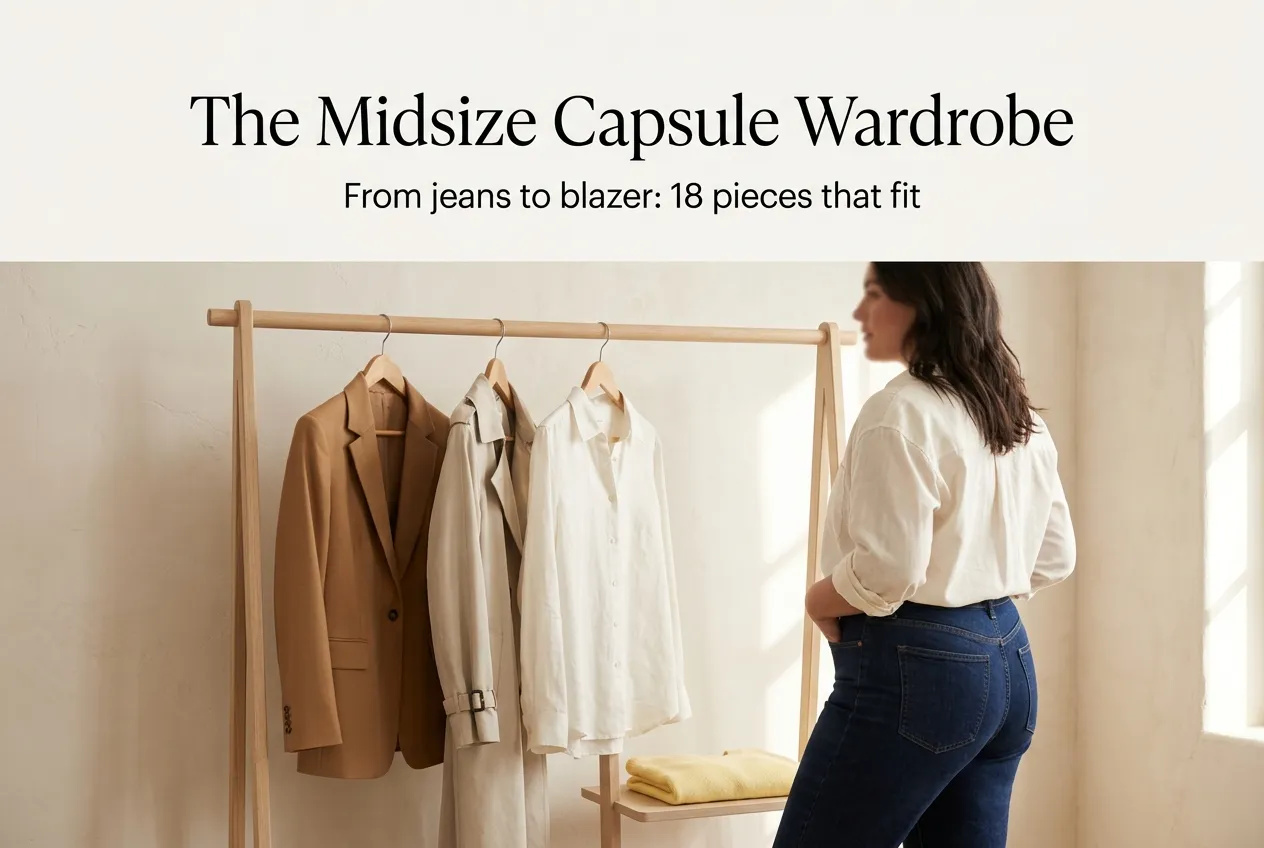
You’re a 10 in one brand, a 14 in another, and a medium that fits everywhere except the bust. So when a capsule wardrobe guide hands you a tidy list of “essentials,” it skips the only question that matters: will any of it actually fit? This midsize capsule wardrobe guide starts there. Below you’ll find the 18 pieces worth owning, a fit rule that makes online shopping far less of a gamble, real US price tiers from Old Navy to Sezane, and enough outfit math to dress a full week without repeating. Fewer clothes. Better mornings. A closet that fits the body you have today.
What Midsize Actually Means (and Why the Charts Disagree)
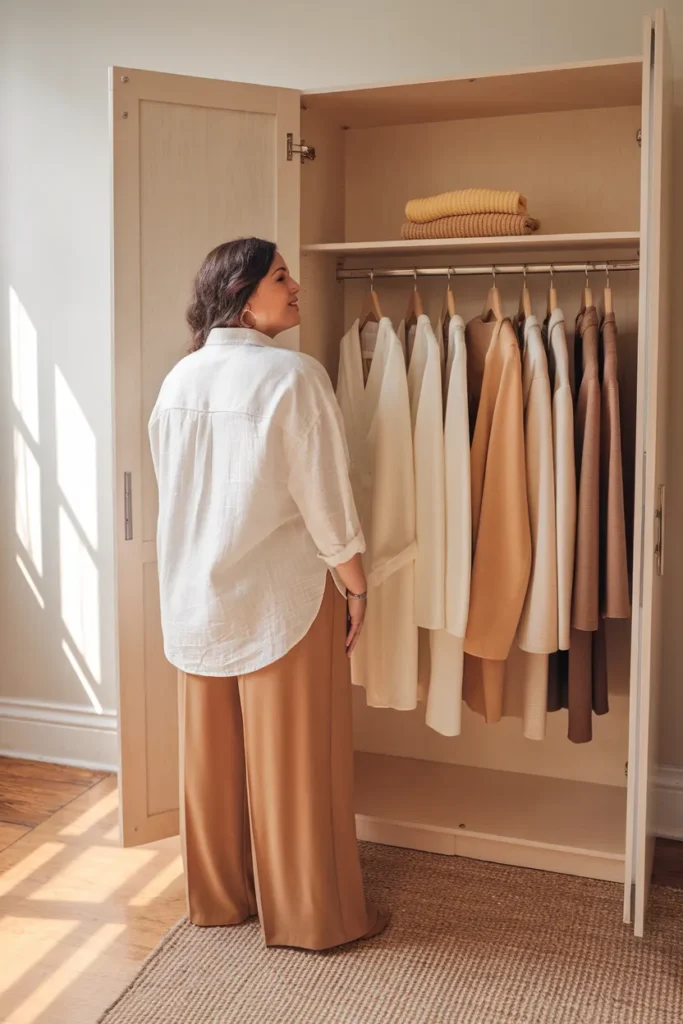
Ask five sources to define midsize and you’ll get five answers. Most land somewhere between a US 8 and a 16, with sizes 10 to 14 as the common core: bigger than the straight sizes stores keep on the floor, smaller than where most plus lines begin.
Here’s the part that should change how you shop. According to CDC body measurement data, the average American woman stands about 5 feet 3.5 inches with a 38.5 inch waist. Midsize describes the statistical middle of the country. Retail just never got the memo, which is why the fit models most brands cut for share almost nothing with the customers buying the clothes.
So treat the label loosely. What matters for your capsule are the fit problems the label names: waistbands that gap, buttons that pull, thighs that wear through denim, and a tag number that changes every time you switch brands.
Why Standard Capsule Formulas Fail Between Sizes
The classic capsule list was written for one fit reality: a crisp slim button-down, rigid straight jeans, a fitted blazer. On a midsize body, that exact list turns into a button gap at the bust, denim that fits the hip and gaps two inches at the waist, and a blazer that won’t close over anything thicker than a camisole.
The other failure is number worship. Guides argue over 33 pieces versus 37 as if the count were the point. If you’re curious where the math genuinely lands, I’ve broken down how many clothes a minimalist wardrobe actually needs separately, and the honest answer is a range, never a magic number.
For a midsize capsule, flip the order of operations. Fit comes first, count comes last. A 14-piece closet where everything closes, drapes, and moves beats a 33-piece checklist you fight every morning.
Fit Math: The 3-Number Rule
Here’s the framework that fixes between-sizes shopping, and it takes ten minutes with a soft tape measure.
Write down three numbers in inches: your full bust, your natural waist (the narrowest point, usually above the belly button), and your high hip (about 3 inches below the waist, across the widest part). Ignore the tag size completely. Tags lie across brands; inches don’t.
Then apply the rule: buy for your largest measurement, tailor the rest. If your hips put you in a 14 and your waist says 10, buy the 14 and have the waist taken in. A waistband nip at a US tailor typically runs $15 to $25, and hemming usually lands between $12 and $20. That’s the cheapest custom clothing you will ever own, and it beats living with a gap or a squeeze.
Before anything earns hanger space, run three quick checks you can screenshot:
- The button test. Fasten it and raise both arms. Any horizontal pull line across the bust means it goes back.
- The sit test. Sit down fully. Waistband digging or gaping more than one finger fails.
- The seam check. Shoulder seams should end at the edge of your shoulder bone, since that one line decides whether a top looks tailored or borrowed.
The Midsize Capsule Checklist: 18 Pieces That Mix and Match
Every piece below earned its spot on fit behavior, never on trend. Prices are typical US ranges as of this writing; always check current charts, since brands adjust often.
Tops (5)
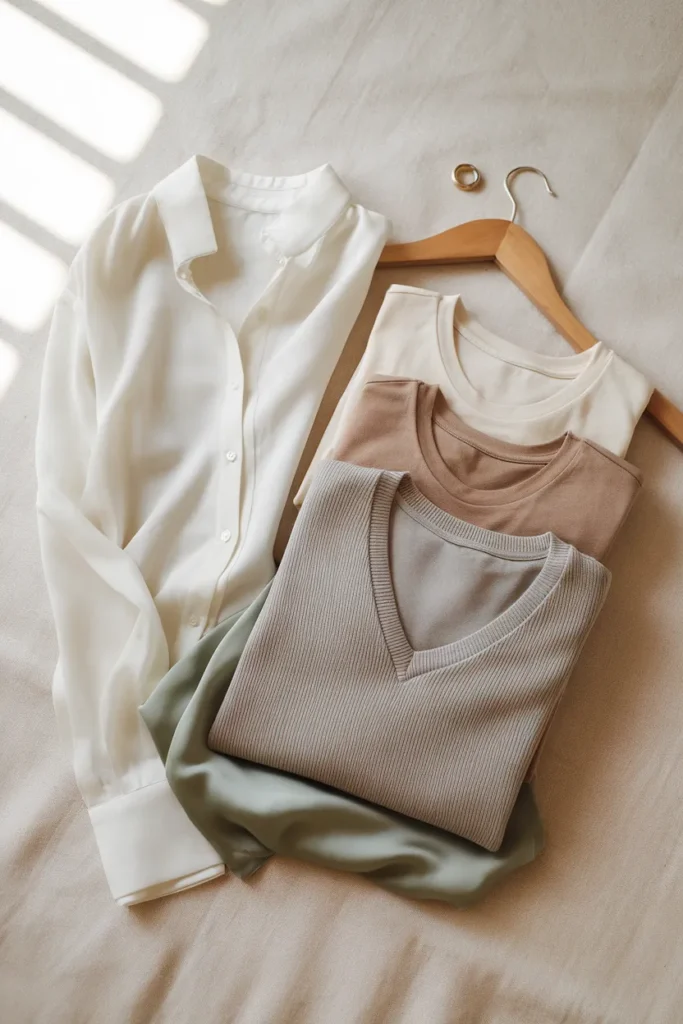
A relaxed white button-down. Relaxed is the operative word: a slight A-line or boyfriend cut skims where a slim cut pulls. Gap and Old Navy versions typically run $25 to $45. Quince’s washable silk version usually sits around $60 to $90 and drapes beautifully over a fuller bust.
Two quality tees, one crew and one V. Target’s A New Day tees typically cost $10 to $15; the trade-off at that price is a lighter fabric that may thin out after a year of heavy rotation. If a tee is your daily uniform, the $25 to $35 mid-tier versions from Madewell or Everlane hold their shape longer.
A fine-gauge crewneck sweater. Fine gauge layers under blazers without bulk. Quince’s Mongolian cashmere typically runs $50 to $80, a genuine outlier for the fiber; J.Crew’s versions usually sit between $80 and $120.
One drapey blouse in satin or a viscose blend, for the days a tee feels too casual. Banana Republic and Abercrombie both cut these generously through the bust, typically $50 to $90.
Bottoms (5)
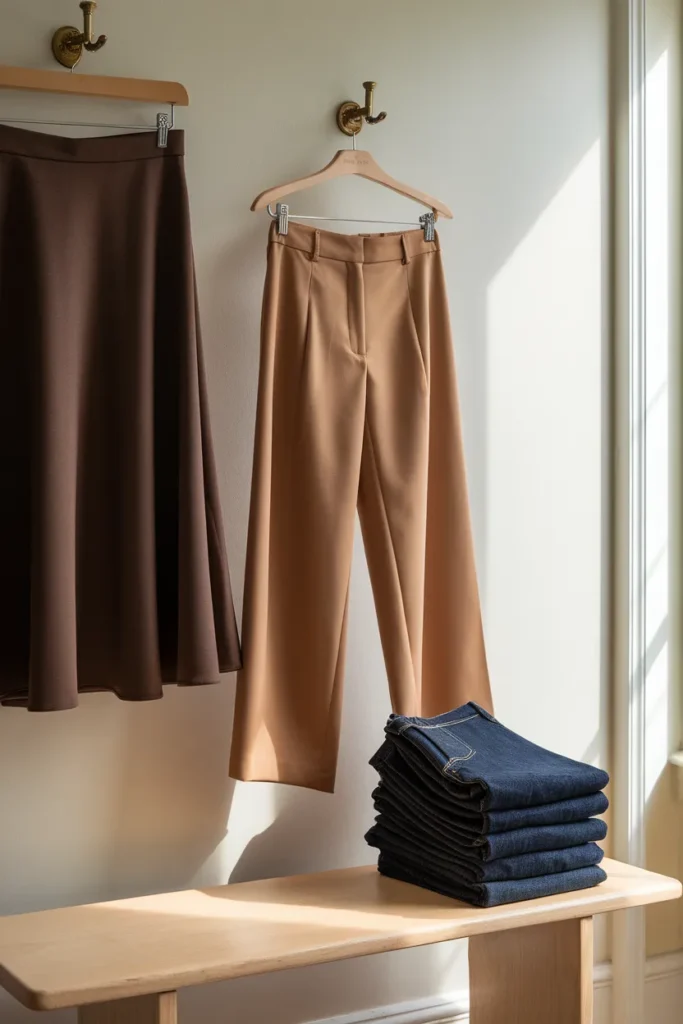
Dark high-rise straight jeans. The single hardest-working piece in a midsize capsule. Madewell jeans typically run $98 to $138, and their Curvy fit adds room through hip and thigh while keeping the waist honest. Abercrombie’s Curve Love cut (typically $80 to $110) is built on the same idea and has a devoted midsize following. On a budget, Old Navy’s versions run $30 to $50; expect lighter denim with more stretch that bags out faster between washes.
Wide-leg trousers with a hidden flex feature. Look for a back-elastic waistband or side zip. J.Crew and Banana Republic typically price these $90 to $130; Target’s usually land $25 to $35 with a softer, less structured drape.
A ponte pant. Ponte is the thick double knit that reads as tailoring and feels like a legging, which makes it the best travel and desk pant this size range can buy. Typically $40 to $80 across mass and mid tiers.
A midi skirt, bias-cut or A-line, in a matte fabric. Bias cuts move with a changing waistline instead of fighting it.
A seasonal fifth bottom: white or ecru jeans for summer, or a heavier trouser for winter.
Layers (4)
A blazer with a slightly relaxed shoulder. Structured but never tight; you should button it over the crewneck sweater. J.Crew and Banana Republic typically run $150 to $230, Quince around $100 to $150. H&M versions at $40 to $60 photograph well, though the shoulder pads and lining rarely survive year two.
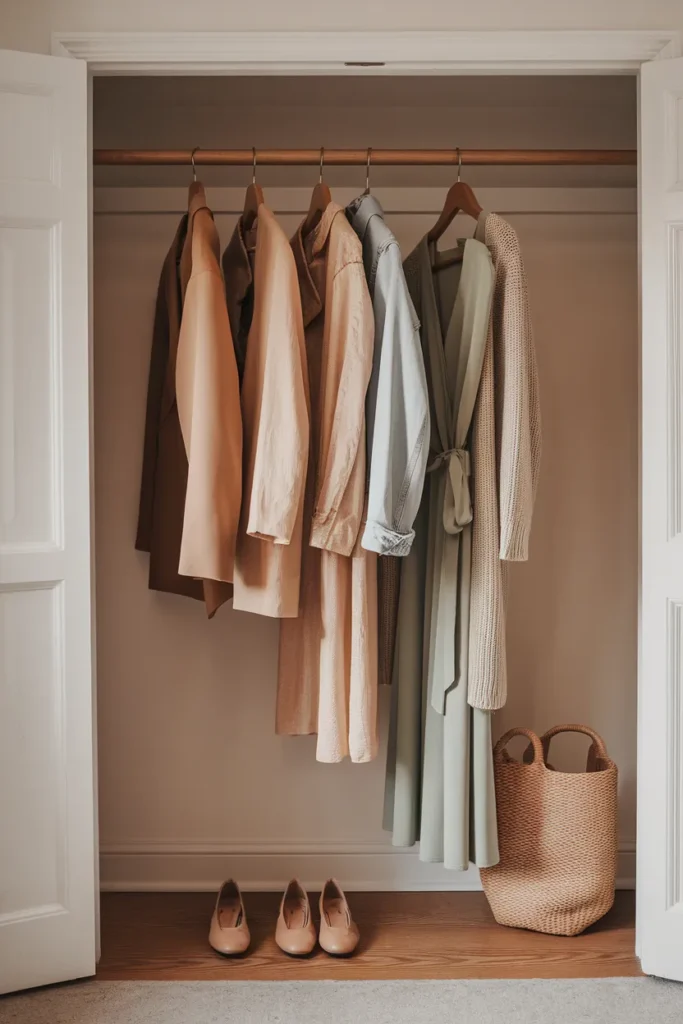
A classic trench in a water-resistant cotton blend, knee length, belt worn tied rather than buckled for an easier line.
A swing or boyfriend denim jacket, cut to skim rather than grip the upper arm.
A long cardigan or coatigan that hits mid-thigh: the piece that turns leggings and a tee into an outfit.
Dresses (2)
A wrap dress. The adjustable closure is the whole point: it fits at 148 pounds and at 162 without a single alteration, which makes it the most fluctuation-proof piece in the entire capsule.
A knit midi tank dress in a heavier matte jersey, worn alone in July and under the coatigan in October.
Shoes (2)
A white leather sneaker, clean and unbranded-looking, worn with literally every bottom above. Typical range $50 to $90 across tiers.
A loafer. One structured shoe dresses up denim faster than anything else in the closet; I keep a full breakdown of the best loafers for a capsule wardrobe if you want specific picks by budget.
That’s 18 pieces. Add a woven tote and a leather crossbody as non-counted extras, and the closet is done.
A 60-30-10 Color Palette That Makes 18 Pieces Feel Like 40
Piece count only works when the colors cooperate, so split the capsule three ways.
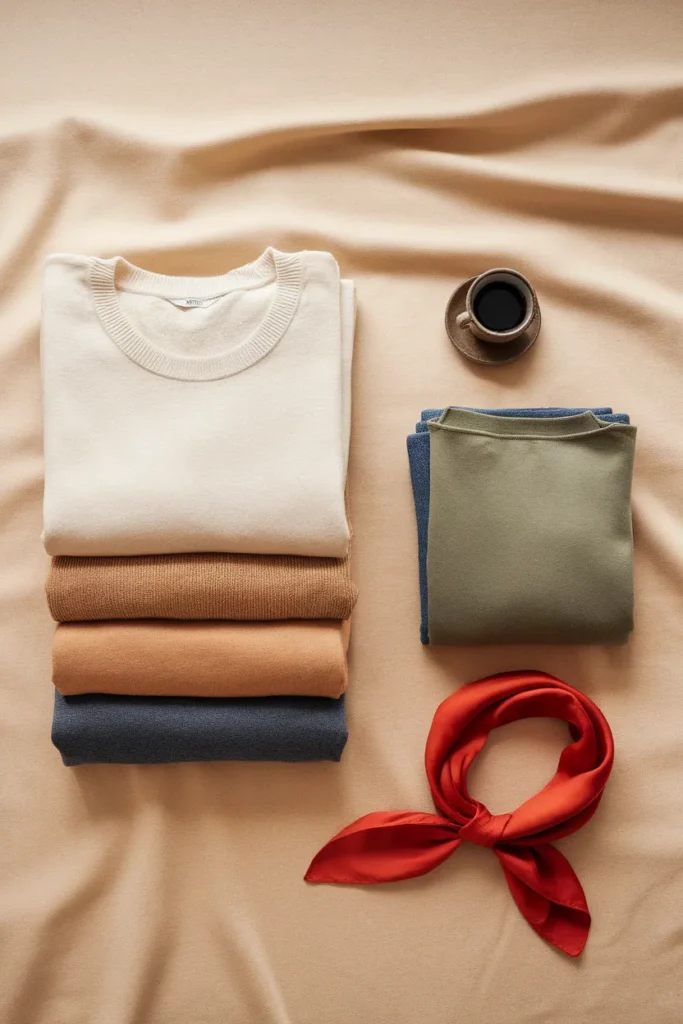
Sixty percent goes to two base neutrals (say, cream and camel, or black and gray). Thirty percent goes to your secondary layer: denim blues plus one soft tone like sage or taupe. The final ten percent is one true accent, a tomato red scarf or a butter yellow knit, that keeps the whole thing from reading as a uniform.
The midsize payoff is specific. When your top and bottom sit in the same color family, you build one unbroken vertical column, and an unbroken column visually lengthens the body the way a two-tone outfit never can. If your neutrals currently fight each other (beige against gray against greige), start with pairing neutral colors so every outfit looks pulled together and the column takes care of itself.
Outfit Math: One Week of Outfits, Zero Repeats
Here’s the same 18 pieces run through a working week.
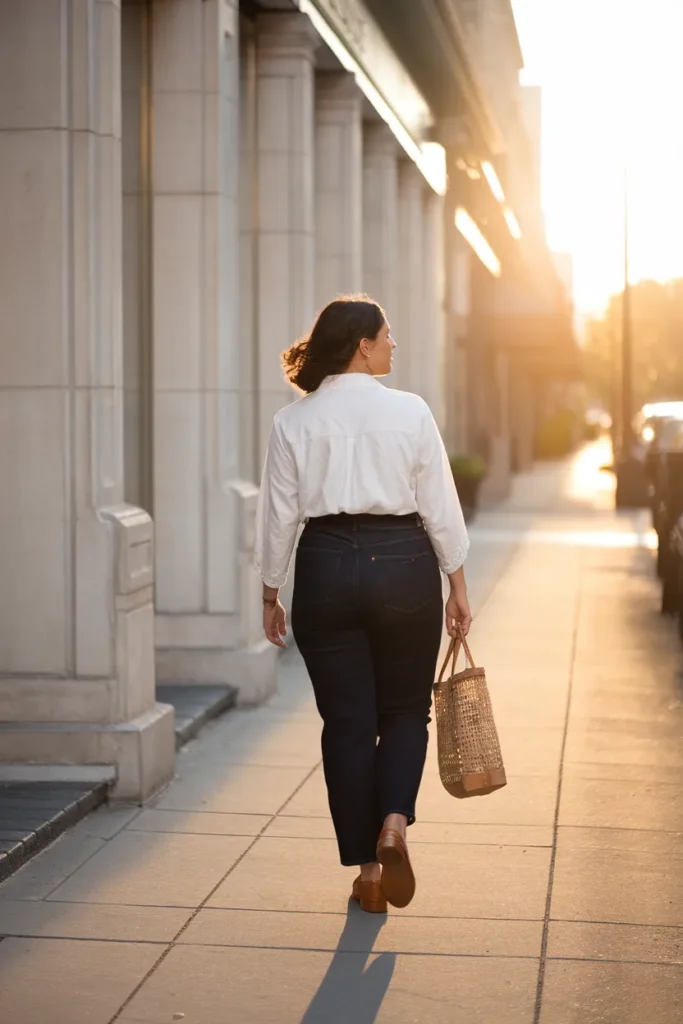
Monday: white button-down, dark straight jeans, loafers, tote. Tuesday: ponte pants, fine-gauge crewneck, blazer over the shoulders. Wednesday: wrap dress, denim jacket, white sneakers. Thursday: wide-leg trousers, drapey blouse, loafers; this one walks straight into a client meeting, and if your office runs more formal, the 20-piece workwear capsule wardrobe extends the same math. Friday: jeans, V-neck tee, coatigan, sneakers. Saturday: midi skirt, crew tee knotted loosely, denim jacket. Sunday: tank dress, trench open, sneakers, crossbody.
Notice the button-down never repeated, yet it could have carried three more days: open over the tank dress as a light layer, tucked into the midi skirt with a belt, or under the crewneck with the collar out. One piece, three extra outfits. That’s the mix-and-match ratio doing the work your old 80-piece closet never did.
Fabrics That Flex: Read the Label Before the Price Tag
Between sizes, fabric decides fit as much as cut does. Four things to check on the tag before the price even registers.
Two to five percent elastane in wovens. That small stretch percentage is the difference between jeans that accommodate lunch and jeans that hold a grudge.
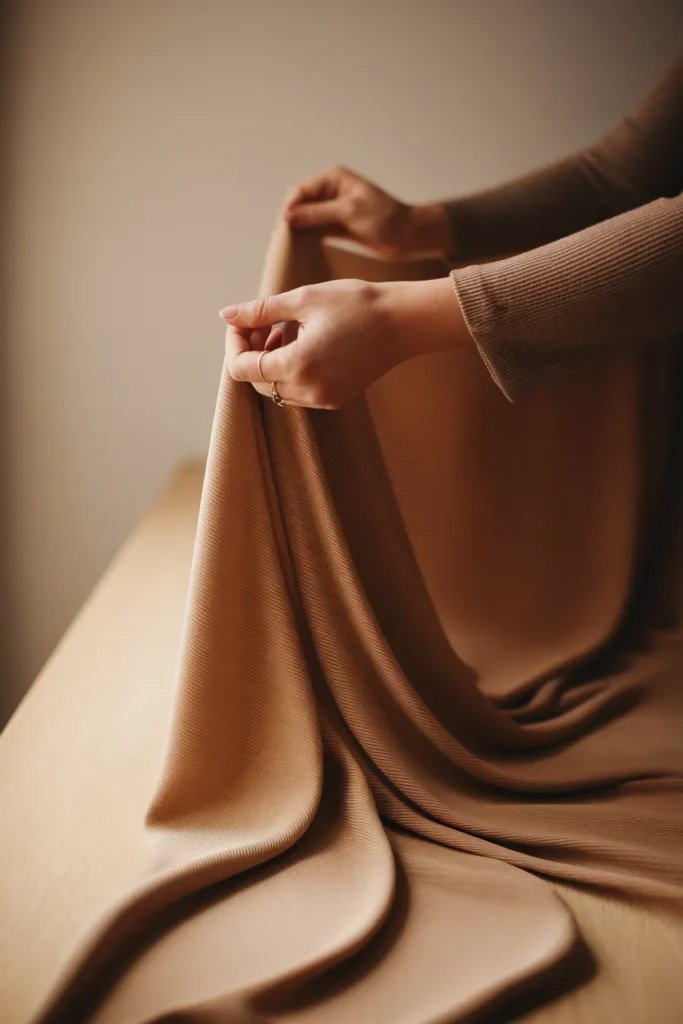
Weight in knits. Heavier matte jersey and ponte skim the midsection; thin shiny knits cling and reflect light at every contour, which amplifies exactly what you’d rather it didn’t.
Drape over structure for tops. Crepe, cupro, washed silk, and linen blends fall away from the body. Stiff poplin stands up on its own, and on a fuller bust it tents.
Fiber honesty. A $12 top that pills by wash five isn’t cheap, it’s disposable, and disposable adds up: EPA textile waste figures put US textile generation at 17 million tons in a single year, with 11.3 million tons landfilled. Buying fewer, better pieces is the quietest sustainability move a closet can make.
Cost Per Wear: The Only Price Math That Matters
Run the numbers on the two jeans from the checklist. The $128 Madewell pair worn twice a week for a year costs about $1.23 per wear, and the denim is built to survive that schedule. A $40 pair worn ten times before it bags out costs $4 per wear. The expensive jeans are the cheap ones.
So spend where friction lives: jeans, the blazer, shoes. Save where it doesn’t: tees, the seasonal fifth bottom, the accent scarf. And if the whole budget is tight right now, that’s a solved problem too; you can build a capsule wardrobe on a budget under $200 entirely from the mass tier and upgrade piece by piece as things wear out.
One habit makes this automatic. Before checkout, divide the price by an honest estimate of wears in the next year. Anything over $2 per wear needs a reason.
Where to Shop Midsize in the US, Tier by Tier
Sizing behavior matters more than the logo, so here’s the honest map. Ranges reflect typical pricing as of this writing.
Mass, $10 to $50. Old Navy runs generous and carries one of the widest size ranges in mass retail. Target’s A New Day and Universal Thread lines typically span XS to 4X and cut roomier through the hip. Uniqlo is the trap in this tier: beautifully made, cut slim on Asian sizing blocks, so plan on going up one to two sizes. Amazon Essentials works for basics if you read the size reviews first.
Mid, $50 to $150. The midsize sweet spot. Madewell’s Curvy denim and Abercrombie’s Curve Love were both engineered for a fuller hip-to-waist ratio. Quince delivers the best fabric-per-dollar in the tier. Everlane and J.Crew fit true through most of the range, though a few Everlane cuts thin out past a 14, so check each style’s chart. Banana Republic cuts generously through the bust.
Contemporary, $150 to $400. Sezane runs small on French sizing and tops out early, so size up and know the ceiling before you fall in love. COS leans oversized, which works beautifully for the drape-first approach above. Reformation has extended select styles. Vince on sale is where the investment-quality blazer becomes reachable.
Investment, $400 plus. Toteme and The Row are reference points for the silhouettes above, and that’s the polite way of saying: study the pictures, then buy the Quince version, because cost per wear almost always crowns the dupe.

FAQ
What size is considered midsize? Most definitions land between a US 8 and 16, with 10 to 14 as the common core. It describes the gap between the straight sizes stores stock on the floor and where plus lines begin. Treat it as a fit category rather than an identity: if waist-hip spread and bust fit shape your shopping, this capsule was built for you.
How many pieces should a midsize capsule wardrobe have? Most functional capsules run 15 to 30 pieces per season. This guide uses 18 because it covers a full week of outfits with room for one seasonal swap. The count matters far less than the fit: 14 pieces that pass the button, sit, and seam tests beat 33 that don’t.
What if I’m between sizes in the same brand? Size up and tailor down, following the 3-Number Rule: buy for your largest measurement. In stretch knits you can usually take the smaller size; in rigid wovens (denim, poplin, structured blazers) the larger size plus a $20 alteration wins almost every time.
Is it worth spending more on capsule pieces, or are cheap versions fine? Both, in different spots. Spend on high-friction pieces you wear weekly (jeans, blazer, shoes), where cost per wear rewards quality. Save on tees, the accent piece, and anything trend-adjacent. A $128 jean worn 100 times a year costs less per wear than a $40 jean that quits after ten.
Will this capsule still fit if my weight fluctuates? It’s designed to. Wrap dresses, bias-cut skirts, back-elastic trousers, relaxed button-downs, and two to five percent stretch denim all flex through a 10 to 15 pound range without alteration. The pieces that won’t flex (the blazer, rigid denim) are exactly where the tailoring budget goes.
Can I dress these pieces up for the office? Yes. The Thursday formula (wide-leg trousers, drapey blouse, loafers, blazer) covers business casual outright, and swapping the ponte pant in gives you a second office rotation. Only strictly formal dress codes need pieces beyond these 18.
Does an 18-piece capsule work year-round? The core 15 do. The seasonal slots (the fifth bottom, and swapping the trench for a wool coat in a US winter) rotate two or three times a year. Layering handles the rest: the tank dress alone in July becomes the tank dress under the coatigan in October.
The Bottom Line
A midsize capsule wardrobe isn’t a smaller version of someone else’s closet. It’s a system built around three honest measurements, fabrics that move, and a color plan that multiplies every piece you own. Start tonight with the ten-minute step: take your three numbers, write them in your phone, and run the button, sit, and seam tests on the five things you already wear most. Whatever passes is the foundation of your capsule, and you didn’t spend a dollar to find it. The rest is just filling gaps, one well-fitting piece at a time.
Keep reading
How to Style Cargo Pants for Women (Without the Combat Look)
Most women who ask how to style cargo pants for women already own a pair. That’s the part nobody says out loud....

How to Style a Denim Jacket: The Layer That Goes With Everything
Learning how to style a denim jacket is less about finding new outfits and more about fixing the three or four small...

How to Style a Denim Skirt: 8 Outfits You Can Build From What’s Already in Your Closet
Learning how to style a denim skirt gets easier when you start one step earlier than most guides admit. Start with the...