
What to Wear Hiking: A Capsule Approach to Trail Outfits You’ll Actually Repeat
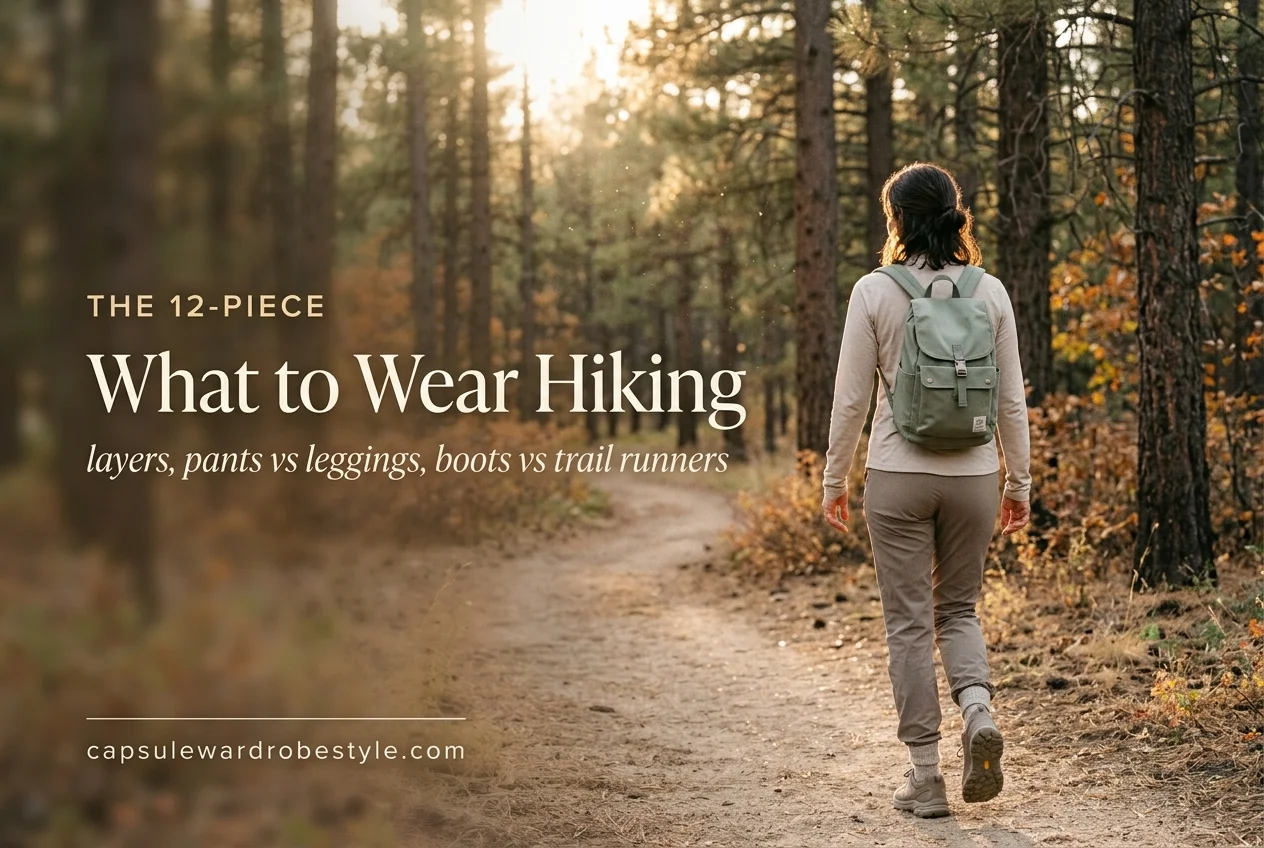
Figuring out what to wear hiking gets complicated fast, and most of that complication is manufactured. You do not need a separate outdoor wardrobe living in a bin in the garage. You need about twelve pieces, a layering order that makes sense, and one rule about fabric that saves you from a genuinely miserable afternoon. That’s the whole thing. Everything below is built around one idea: if a piece only works on a trail, it probably isn’t worth buying.
Here’s the part nobody says out loud. The reason your last hike felt bad was probably not your fitness. It was a cotton tee that soaked through by mile two and then turned cold in the shade.
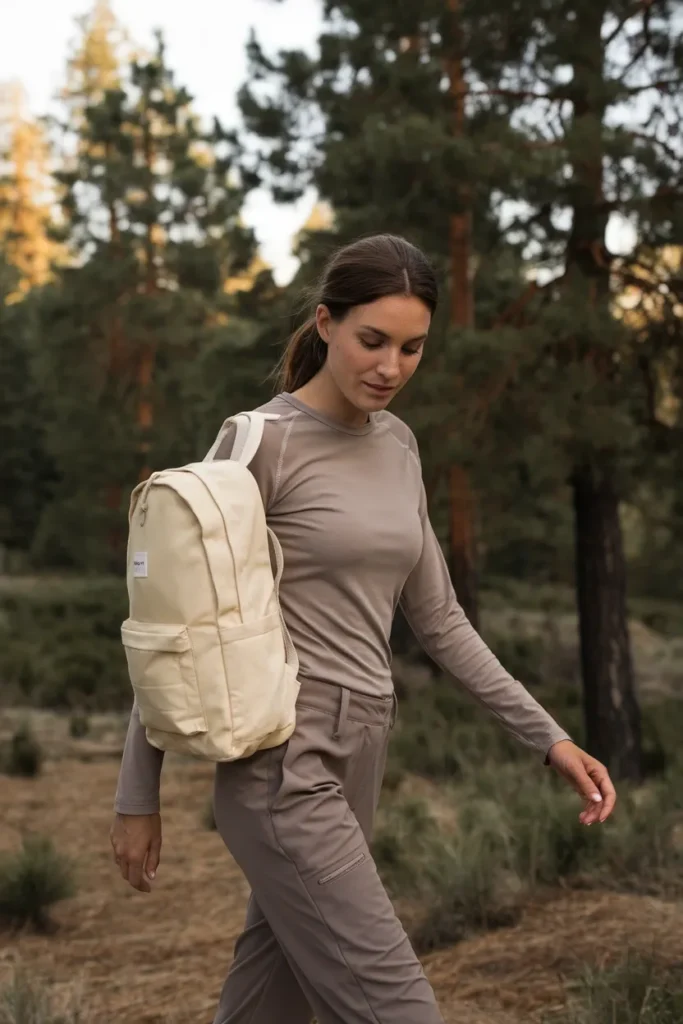
Answer Three Questions Before You Open Your Closet
Outfit decisions get easy once you know what you’re actually walking into. Skip this and you’ll overpack every time.
How long, and how much climbing? A flat two-mile loop and a six-mile climb with 1,800 feet of gain are different clothing problems. Elevation means you’ll start cold, get hot fast, and then get cold again at the top where the wind lives.
What’s the temperature swing, not the temperature? Check the forecast high and the forecast low, then look at the gap between them. A 20-degree swing means layers. A 6-degree swing means you can commit to one outfit and stop thinking about it.
Will you be wet? Rain, creek crossings, morning dew on overgrown trail, or just heavy sweat. Wet changes the fabric answer completely.
Write those three answers down the night before. It takes ninety seconds and it removes the standing-in-front-of-the-closet paralysis at 6 a.m.
The Three-Layer System, Minus the Gear-Shop Jargon
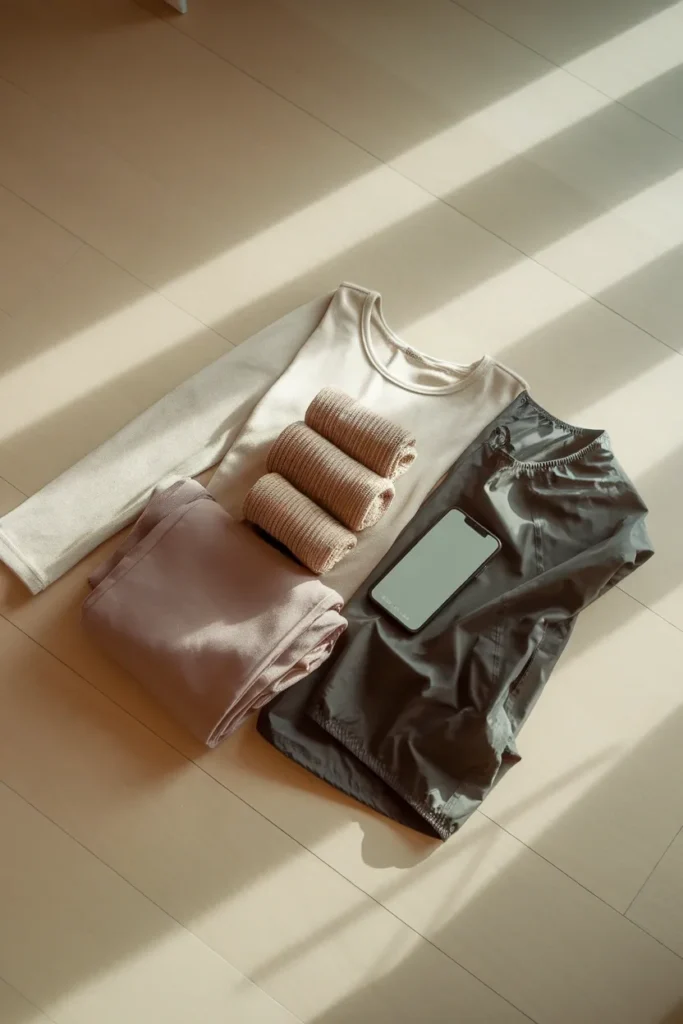
Layering sounds technical. It isn’t. Three jobs, three pieces, and you only wear all three at the same time in genuinely cold weather.
Base layer: move sweat off your skin
Sits against you. Its only job is to pull moisture away so you don’t get clammy. A fitted synthetic tee, a merino wool long sleeve, or a lightweight sun hoody all qualify. Snug beats loose here, because a baggy base layer can’t wick what it isn’t touching.
Mid layer: hold warmth, pack small
A grid fleece, a thin puffer, or a quilted vest. You want something that compresses down to about the size of a small loaf of bread so carrying it never feels like a punishment. A vest is quietly the most useful version of this because it warms your core without turning your arms into a sweat problem, and it’s the one piece here that reads as normal clothing. There are plenty of ways to style a vest that go beyond the trailhead, which is exactly the kind of double duty we’re after.
Outer layer: block wind and water
A wind shell or a rain jacket. Thin, packable, and it lives in your bag until the weather turns. This is the layer people leave at home and regret, and it’s the reason “extra clothing” shows up on the National Park Service Ten Essentials list alongside water and a headlamp.
The layering rule that matters most: start slightly cold. If you’re comfortable at the trailhead, you’ll be overheating within ten minutes. Peel before you sweat, not after.
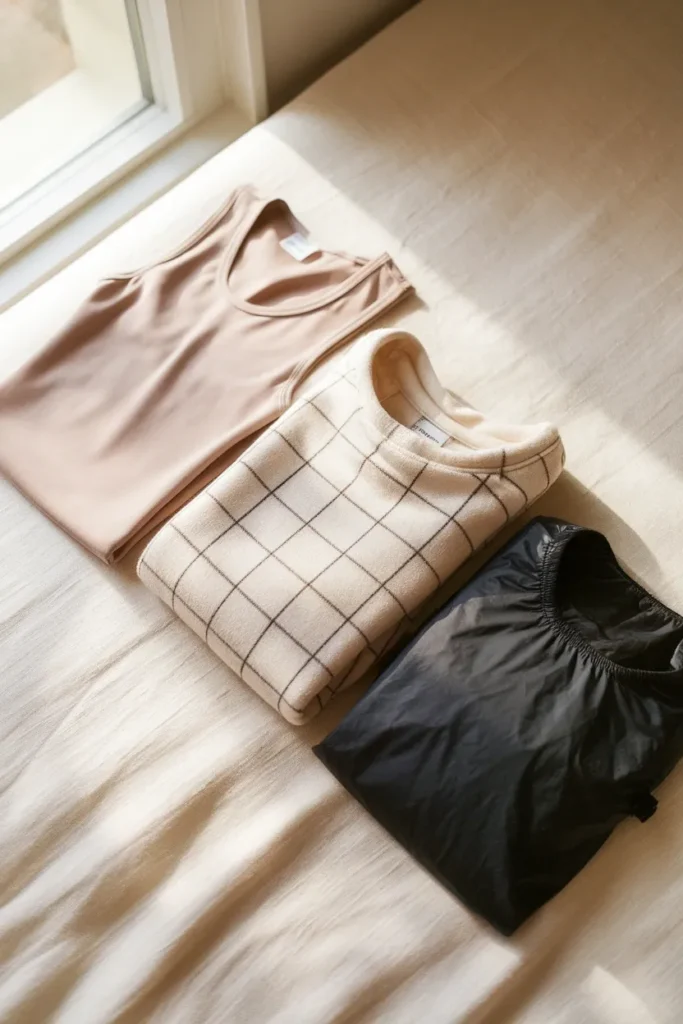
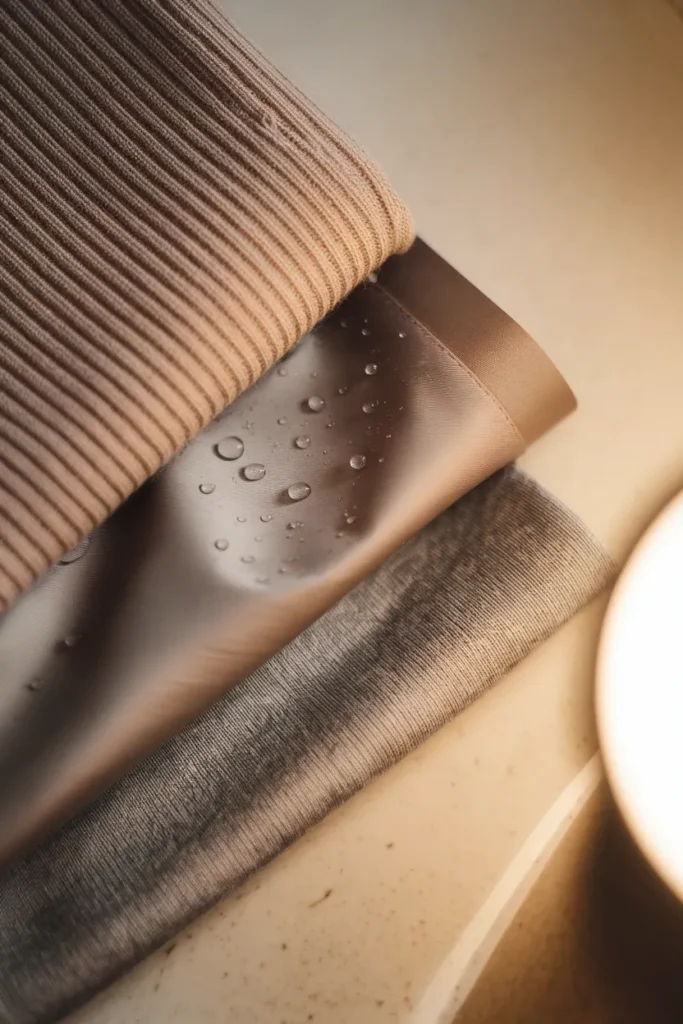
Fabric Is the Whole Ballgame, and Cotton Loses
If you remember one sentence from this article, make it this one: cotton holds water and refuses to give it back.
A cotton tee absorbs sweat, stays heavy and damp, stops insulating, and then actively pulls heat off your body once you stop moving. On a warm summer afternoon that’s just uncomfortable. On a windy ridge in October it’s the front end of a real problem. Denim behaves the same way, only worse, because wet denim chafes.
Here’s what to reach for instead.
Merino wool. Regulates temperature in both directions, resists odor for days, feels soft rather than itchy in modern weights. Costs more. Wears out faster at friction points. Worth it for socks and base layers specifically.
Synthetics (polyester, nylon, polyester blends). Dry fast, cost less, survive abuse, and handle abrasion better than wool. They hold onto smell, so plan on washing after each use.
Nylon-spandex blends. Where most good hiking pants live. Stretch for scrambling, quick drying, and enough structure that the fabric doesn’t cling when wet.
Fabrics to leave home: cotton anything, denim, rayon and viscose (they get heavy and stretch out), and any silk you care about.
Hiking Tops That Earn Their Hanger Space
Your top choice comes down to sun exposure and sweat rate.
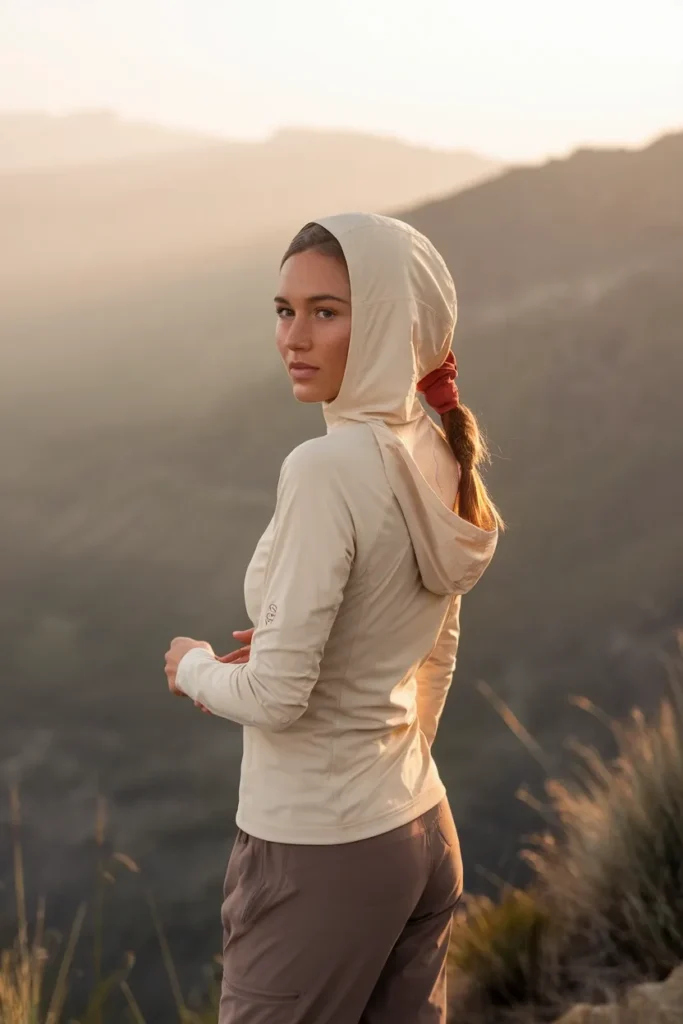
The long-sleeve sun hoody is the piece most experienced hikers convert to and never go back from. Lightweight, hooded, thumbholes, and typically rated UPF 50. It sounds hot. It isn’t, because covering skin beats baking it, and you stop reapplying sunscreen to your forearms every hour. Expect to pay somewhere around $45 to $90 depending on brand.
A fitted synthetic or merino tee works for shaded forest trails and shorter outings. Look for flat seams at the shoulders, since that’s exactly where a pack strap rubs.
A quarter-zip mid-weight long sleeve is the shoulder-season workhorse. The zip lets you dump heat without stopping to change.
Fit note worth more than any fabric spec: check the shoulder seam and the underarm. Raise both arms overhead in the fitting room. If the hem lifts above your waistband or the armhole binds, that shirt will drive you up a wall by mile three.
Hiking Pants vs Leggings vs Shorts: How to Actually Choose
This is the question that generates the most searching and the most returns. Short answer: all three work, for different trails and different bodies.
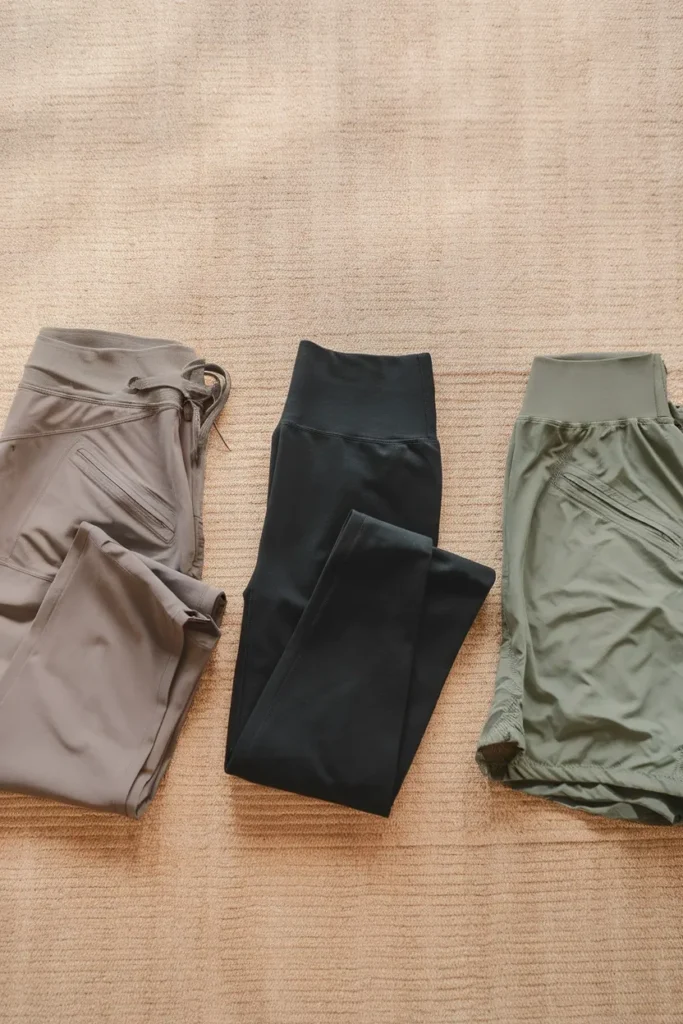
Hiking pants win on brush, bugs, sun, and pockets. Look for a nylon-spandex blend, an articulated knee, and at least one zip pocket you trust with a phone. Mid-tier pairs generally run about $70 to $100.
Leggings win on comfort, packability, and the fact that you already own several. They lose on durability against granite and on pocket capacity. Choose a thicker, opaque, high-compression pair rather than a thin yoga pair, because thin knits pill and snag. Squat-test them in daylight before committing.
Shorts win on hot, well-maintained, low-brush trails. Add a five-inch inseam minimum if chafing is a concern, or wear them over a fitted short liner.
Convertible zip-offs are having a legitimate comeback, and they solve the temperature-swing problem better than anything else in this category. If the utilitarian pocket look appeals, some of the same principles carry over to styling cargo pants for women off the trail.
Fit notes by proportion, because this is why pants get returned
Petite (5’4″ and under): buy the short inseam rather than cuffing a regular. A cuffed technical pant traps water and rubs at the ankle bone. Standard inseams run 30 to 32 inches, short versions run 28 to 29.
Curvy and hourglass: the waist gap at the back is the usual complaint. Look for a partially elasticized or drawcord waistband instead of a fully structured one, and prioritize a pant with a real rise (10 inches or more) so it doesn’t slide under a hipbelt.
Midsize and plus-size: inner-thigh friction is the deciding factor, not the size on the tag. A woven pant or a short liner under shorts solves it. Avoid raw flatlock seams running along the inner thigh.
Tall (5’9″ and over): check the rise as carefully as the inseam. A pant that’s long enough but short in the rise will pull down every time you take a big step up.
Footwear and Socks: Where Most Beginners Get It Wrong
You do not automatically need boots. That’s the myth costing people the most money.
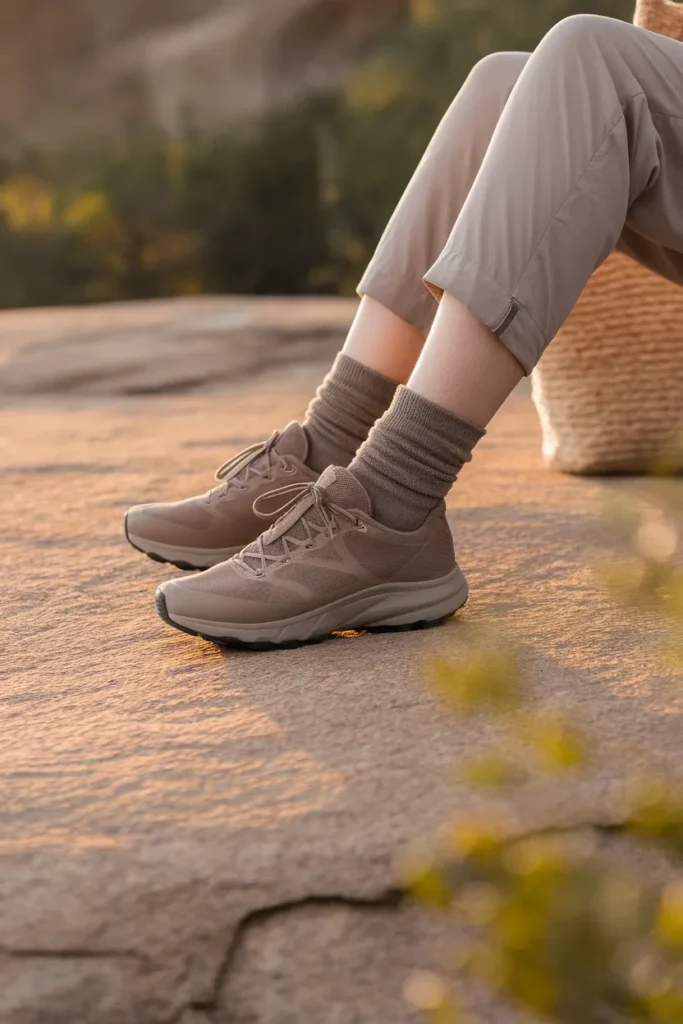
Trail runners suit most day hikes on maintained trail. Light, breathable, no break-in period, and they drain fast when wet. Typical range is about $130 to $165.
Low hikers add a stiffer sole and more toe protection, which matters on rocky terrain. Roughly $110 to $150.
Mid or high boots are for ankle support with a heavy pack, snow, scree, or a history of rolled ankles. They’re heavier and they need breaking in over several shorter walks before you trust them on a long day.
Regular sneakers deserve an honest answer, since everyone asks. A flat-soled canvas sneaker has almost no tread and no torsional stiffness, which makes it genuinely unsafe on loose descents. Save those for pavement, where Converse actually make sense for a casual day and nobody’s ankle is at risk.
Socks matter more than the shoe. Merino or a merino blend, cushioned, crew height if you’re in boots. Never cotton, which is the single most common cause of blisters on a first hike. A good pair runs $18 to $28 and lasts years. Buy three pairs and stop thinking about it.
Size up a half size from your street shoe. Feet swell on long descents, and a bruised toenail takes a month to forgive you.
The Rain Layer You Resent Carrying
Every experienced hiker has a story that ends with “and the shell was in the car.” Carry it.
What you want is a lightweight rain jacket with taped seams, a hood that adjusts, and pit zips if the budget allows. Packability is the deciding feature, because a shell that stuffs into its own pocket is a shell you’ll actually bring. Solid options start around $80 and climb steeply from there.
Skip the plastic poncho for anything with wind. It sails.
A wind shell is the lighter cousin, useful far more often than a rain jacket in dry climates. It weighs almost nothing, blocks the ridge-top chill instantly, and folds down to the size of your fist.
For wet-weather days that don’t involve a trail at all, the same principles carry into everyday dressing, and it’s worth reading how to dress for a rainy day without looking like you gave up.
One more thing about rain pants: most people don’t need them for day hiking in mild weather. Quick-drying pants get wet and then dry. Rain pants get you sweaty and then wet anyway. Save them for cold rain, where staying dry is a safety issue rather than a comfort one.
Sun Protection and the Accessories That Do Real Work
Accessories on a trail aren’t decorative, and this is where a lot of first-timers under-prepare.
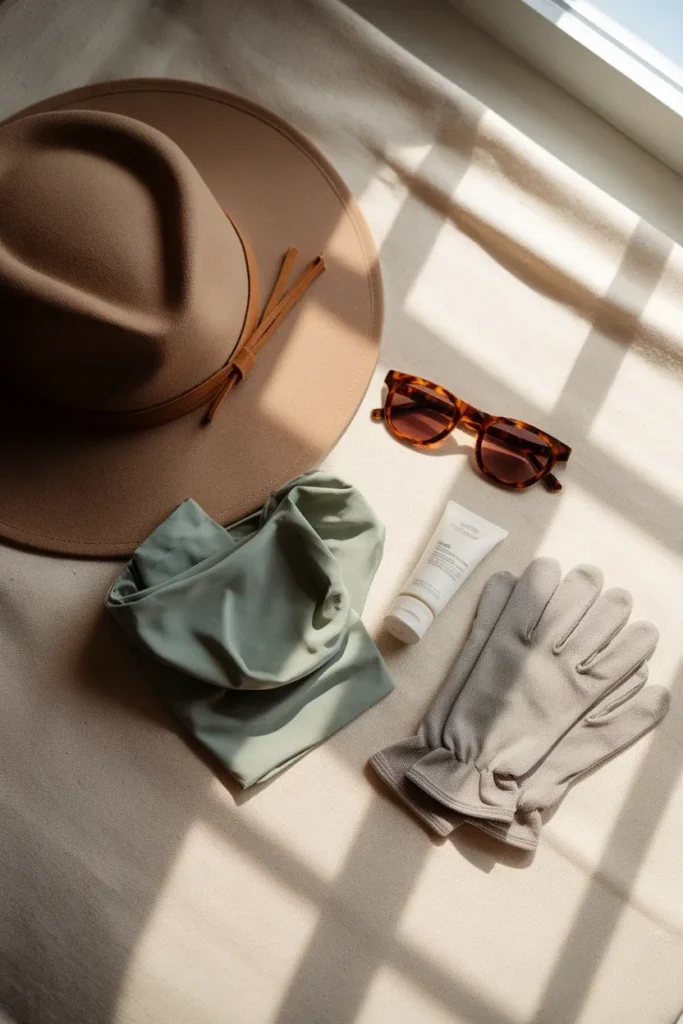
A brimmed hat beats a ball cap. The CDC specifically recommends a brim that goes all the way around to shade your face, ears, and the back of your neck, and notes that a baseball cap leaves those areas exposed. That’s the entire argument for a wide-brim hat in one sentence, straight from the CDC’s sun safety guidance.
Sunglasses that block UVA and UVB. Wrap styles cut side glare, which is the difference between squinting all day and not.
Sunscreen, broad-spectrum, SPF 30 or higher on exposed skin. Reapply every two hours, and more often once you’re sweating. Long sleeves in a tight weave do a chunk of this work for you, which is the real reason sun hoodies have taken over.
A neck gaiter or bandana pulls double duty: sun shield, sweat rag, wind block, and dust filter. If you’d rather use something you already own, a lightweight cotton-free scarf works, and there are different ways to tie a scarf that keep it secure under a pack strap.
Lightweight gloves for anything below 45°F. Fingers go numb well before the rest of you notices.
The 3-Layer, 3-Color Trail Formula
Here’s the framework that keeps a trail outfit from looking like a gear catalog exploded. It’s the 60-30-10 split applied to layers.
| Role | Share of the outfit | What it covers | Color job |
|---|---|---|---|
| Neutral base | 60% | Pants or leggings, plus base-layer top | Oat, taupe, soft black, espresso, gray |
| Supporting neutral | 30% | Mid layer, socks, hat | A second neutral one shade off the base |
| Single accent | 10% | Shell, pack, hair tie, gaiter, laces | One color only: burgundy, rust, sage, or butter yellow |
Two neutrals and one accent. That’s it. It photographs beautifully against green, granite, and desert rock alike, and it means every piece in your kit already matches every other piece, which is the entire point of building a capsule in the first place.
The mistake to avoid is three competing brights. Technical gear tends to come in loud colors, so if your shell is cobalt and your pack is red and your shoes are neon, the outfit fights itself in every photo.
The 12-Piece Crossover Hiking Capsule
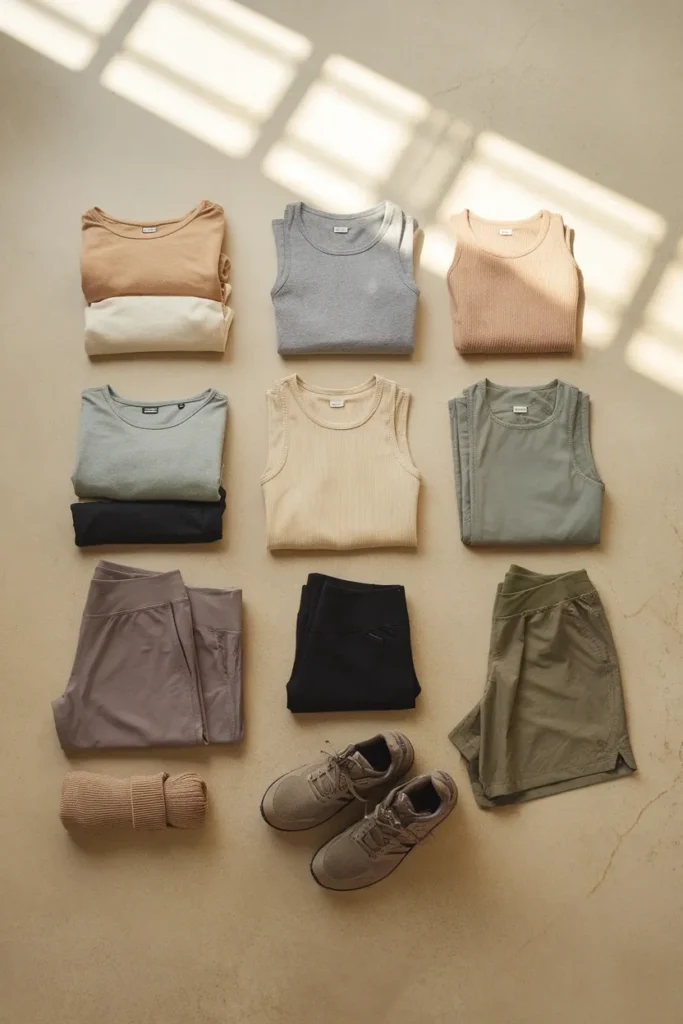
Nine of these twelve pieces work on a normal Saturday. That’s the test.
| # | Piece | Works off-trail? | Typical range |
|---|---|---|---|
| 1 | UPF long-sleeve sun hoody, oat | Yes, over leggings or under a jacket | $45 to $90 |
| 2 | Fitted merino tee, soft black | Yes, everyday layering | $50 to $80 |
| 3 | Synthetic tee, gray | Yes, gym and errands | $20 to $40 |
| 4 | Quarter-zip mid-weight long sleeve, cream | Yes, weekend staple | $40 to $70 |
| 5 | Grid fleece or quilted vest, oatmeal | Yes, this one gets the most wear of all | $60 to $110 |
| 6 | Packable wind shell, soft black | Yes, city walking | $60 to $110 |
| 7 | Rain shell with taped seams, sage | Yes, commuting | $80 to $160 |
| 8 | Technical hiking pants, taupe | Yes, travel days | $70 to $100 |
| 9 | Thick opaque leggings, black | Yes, constantly | $25 to $80 |
| 10 | Hiking shorts with liner, olive | Trail and warm-weather errands | $40 to $70 |
| 11 | Merino crew socks, three pairs | Trail only, honestly | $18 to $28 per pair |
| 12 | Trail runners or low hikers, taupe | Trail and casual, depending on the pair | $110 to $165 |
Run the cost-per-wear math and the picture changes fast. A $95 vest worn twice a week for two years lands under fifty cents a wear. A $70 pair of hiking pants worn only on four hikes a year sits above four dollars a wear, which is why you buy the pant that also works as a travel pant. Same logic that makes a good travel wardrobe efficient, which is exactly the thinking behind comfortable outfits for a long flight.
Prices above are ranges rather than fixed numbers, and retail moves constantly, so treat them as planning figures.
What to Wear Hiking in Each Season
Spring (March to May, roughly 50 to 70°F). The temperature swing is at its widest and the trail is at its muddiest. Base layer plus vest plus rain shell, with pants over shorts because of wet brush. Bring the shell even when the forecast says otherwise, since spring forecasts lie.
Summer (June to August, 75 to 95°F). Sun management is the whole job. Sun hoody or a tee with real sunscreen discipline, shorts or lightweight pants, brimmed hat, and start early enough that you’re descending before the afternoon heat. Carry a wind shell for the summit anyway, because exposed ridges stay cold.
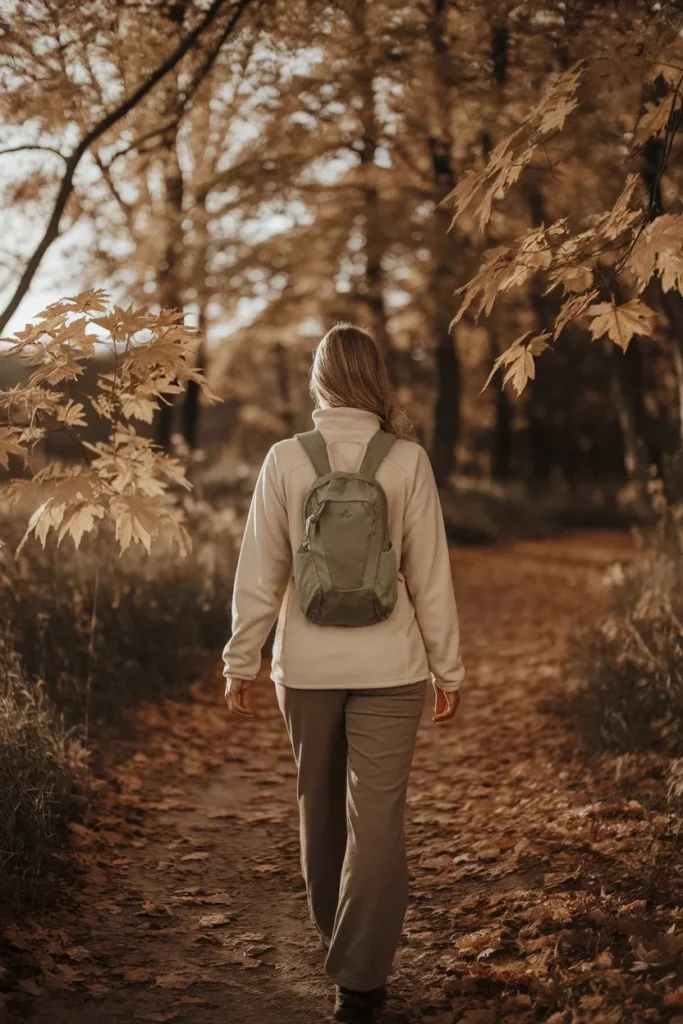
Fall (September to November, 45 to 70°F). The best hiking of the year and the easiest to dress for. Base layer, fleece or vest, wind shell in the pack, full-length pants. Add gloves and a beanie once you’re above treeline or out past 4 p.m.
Winter (December to February, 20 to 45°F). Full three-layer system, thermal base layer, insulated mid layer, waterproof outer layer, plus a beanie, gloves, and thicker socks. Traction devices if there’s ice. The rule shifts here: being slightly cold at the trailhead still applies, but stopping for a break means putting the puffer on immediately, before you cool down.
Trailhead to Coffee Shop in Five Minutes
The part of the day nobody plans for. You finish the hike, you want food, and you are wearing head-to-toe technical fabric.
Keep a small tote in the car with three things: a clean merino or cotton-free tee, a pair of flat slip-ons or loafers, and a soft ballcap or a claw clip. Swap the sweaty base layer, swap the shoes, deal with the hair. Five minutes, and the technical pants read as normal pants the moment they’re not paired with trail shoes.
The vest stays on. It always looks intentional.
If you want the swap to be seamless, this is another argument for the neutral palette. Taupe pants and an oat top go straight into a restaurant. A neon top and blue pants announce exactly where you’ve been.
What Not to Wear Hiking
Short list, high stakes.
- Cotton anything, including that soft old tee. It’s the top of the list for a reason.
- Jeans. Heavy when wet, restrictive on big steps, slow to dry, and the seams chafe.
- Brand-new boots. Break them in on short walks first, or accept the blisters.
- Flat canvas sneakers or slides. No tread, no support, no.
- Anything with an exposed metal zipper against skin under a pack strap. It will find you.
- A tightly fitted underwire bra for a long day. A sports bra with flat seams saves your ribcage.
- Jewelry you’d be upset to lose. Hoops catch on branches, rings shift as fingers swell.
Frequently Asked Questions
What should a beginner wear hiking? A moisture-wicking top, quick-drying pants or thick leggings, merino socks, trail runners or low hikers, and a packable shell in your bag. That combination handles the overwhelming majority of day hikes in mild weather. You almost certainly own two or three of those pieces already, so start by shopping your closet before buying anything.
Is it better to hike in jeans or leggings? Leggings, without much debate. Jeans hold water, dry slowly, restrict your stride on steep steps, and chafe once damp. A thick opaque legging in a nylon or polyester blend beats denim on every measure that matters on a trail. Purpose-built hiking pants beat both, mainly on pockets and abrasion resistance.
Can you wear leggings hiking? Yes, with two caveats. Choose a thicker, more durable pair rather than a thin yoga knit, since thin fabric snags on granite and pills at the inner thigh. And accept the pocket limitation, which means a small pack or a belt bag for your phone and keys.
Why is cotton bad for hiking? Cotton absorbs a lot of water, holds onto it, and stops insulating once it’s wet. On a cool or windy day that damp fabric pulls heat directly off your skin, which is uncomfortable at best and a real cold-weather risk at worst. Synthetics and merino wool move moisture away and keep insulating while damp.
Do I need hiking boots, or are sneakers okay? For maintained day-hike trails, trail runners or low hiking shoes are usually the better choice: lighter, more breathable, and no break-in period. Save mid or high boots for rocky terrain, snow, heavy packs, or a history of ankle injuries. Flat-soled fashion sneakers are the one category to genuinely avoid, since they lack both tread and torsional stiffness.
How do you layer clothes for a hike? Three layers, worn together only when it’s cold. A snug moisture-wicking base against your skin, a packable insulating mid layer such as a fleece or vest, and a wind or rain shell on the outside. Start the hike feeling slightly underdressed and remove layers before you sweat rather than after.
What should you not wear hiking? Cotton, denim, brand-new unbroken-in boots, flat canvas sneakers, and anything that chafes under a pack strap. Also skip jewelry you’d hate to lose and any bra with rigid underwire for a long day out.
Pack It Once, Wear It Everywhere
The best hiking wardrobe is the one that doesn’t feel like a hiking wardrobe. Twelve pieces, two neutrals and one accent, and nine of those pieces earning their keep on ordinary weekends too. That’s a closet that works harder, not a closet that grew.
Start with the three questions, get the fabric right, and let the rest sort itself out on the trail.
If you build the crossover capsule, save this to your fall board so it’s there the next time a hike lands on the calendar, and tell me which piece surprised you by becoming an everyday favorite.
Keep reading

20 Loungewear Outfits for Plus-Size Women That Still Look Put-Together
Soft pants are easy. Looking like you picked them on purpose is the hard part. Most loungewear outfits for plus-size women online...

20 Cozy Loungewear Outfits for Women Over 50
Soft pants were never the problem. The problem is the moment the doorbell rings, or a friend texts about coffee, and you...

20 Cozy Loungewear Outfits That Still Look Put-Together
Your closet is full, your laundry basket is full of sweatpants, and the only things you want to wear are the ones...