
How to Style Converse: Sneaker Outfits That Aren’t Boring
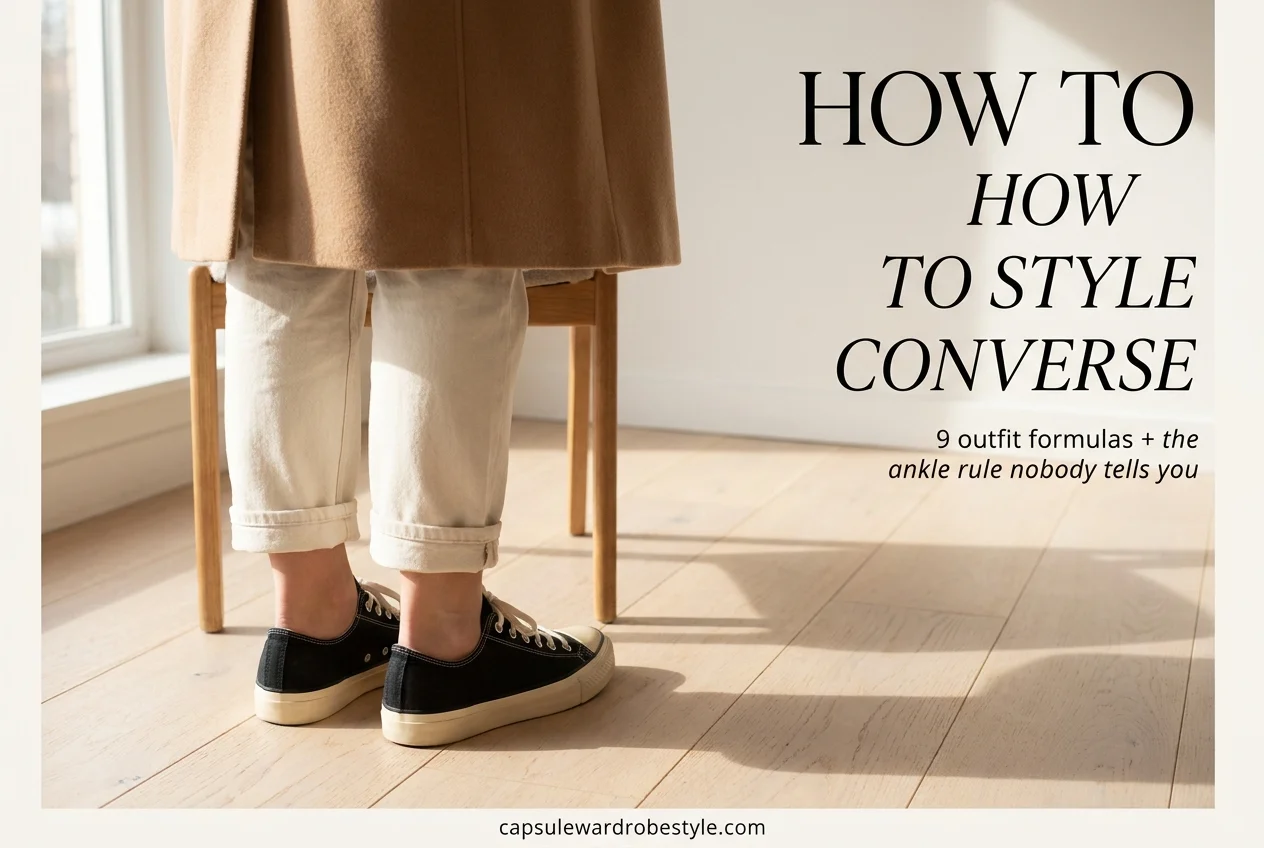
If you’ve ever pulled on your Converse, looked in the mirror, and felt like you’d accidentally dressed for a middle school field trip, you’re not doing anything wrong. You’re just missing one rule about where the shoe hits your ankle, and that single detail is the difference between looking like you got dressed on purpose and looking like you gave up at the door.
Learning how to style Converse isn’t about buying new clothes. It’s about understanding what a flat, low-volume canvas sneaker does to your leg line, then building around it. Below are nine formulas, a model-by-model breakdown, and the proportion rule that makes all of it click.

Why Converse Survived 108 Years When Almost Nothing Else Did
Most sneakers have a shelf life of about three seasons. Converse doesn’t work that way. The Chuck Taylor All Star launched in 1917 and has been in continuous production ever since, which puts it in a category with the trench coat and the white button-down rather than with whatever sneaker silhouette is peaking right now.
That matters for your closet. When Cab Calloway wore Chucks on stage, he wasn’t chasing anything, and today a pair of his Chuck Taylors sits in the Smithsonian’s collection at the National Museum of African American History and Culture. A shoe with a museum accession number is not a trend risk.
So when you’re deciding whether a pair earns its hanger space, the answer is easier than it is for almost anything else in your closet. You’ll wear them next spring. You’ll wear them in four years. Converse is one of maybe six items I’d call safe to buy without hesitation for a year-round capsule wardrobe that earns its hanger space, because the design has already survived every trend cycle since World War I.
Which leaves the only real question: how do you wear them so they look intentional?
The Ankle Rule That Decides Every Converse Outfit
Here’s the thing nobody writes down. Converse sit low and flat. The sole is thin, the profile is narrow, and the top line cuts straight across your ankle bone. Compared to a chunky trainer or a boot, they add almost no height and almost no visual weight at the bottom of your body.
That does two things. It makes your leg line depend entirely on your hem, and it means any gap between your hem and your shoe reads as a hard stop.
The rule: your hem should either break just above the ankle bone or fully cover the top of the shoe. Anything in between shortens you.
That’s it. Memorize that and roughly eighty percent of Converse outfit problems solve themselves.
How it plays out by pant style
Straight-leg jeans. Cuff once, land the hem at or just above the ankle bone. You want a sliver of skin or sock visible, not four inches of bare shin.
Wide-leg trousers and jeans. Go the opposite direction. Let the hem fall so it nearly touches the ground and covers the laces. The width of the leg balances the flatness of the shoe, and the long hem keeps your line unbroken. If you’ve been avoiding this pairing because it felt off, the hem was almost certainly too short. There’s more on getting that break right in how to style wide-leg jeans without losing your shape.
Cropped and ankle-length pants. Riskiest length with Converse, because a cropped hem plus a flat shoe plus bare ankle stacks three horizontal cuts in six inches. If you love the pair, add a visible crew sock in a color that matches the pant. It merges the two cuts into one.
Midi skirts and dresses. Aim for a hem that ends at the narrowest part of your calf. Mid-calf is the danger zone.
If you’re petite, the above-ankle break is doing more work for you than it does for anyone else, and a low top will almost always serve your proportions better than a high top. If you’re tall, you have room to play with the mid-calf lengths that shorten everyone else.

Pick Your Converse First, Then Pick the Outfit
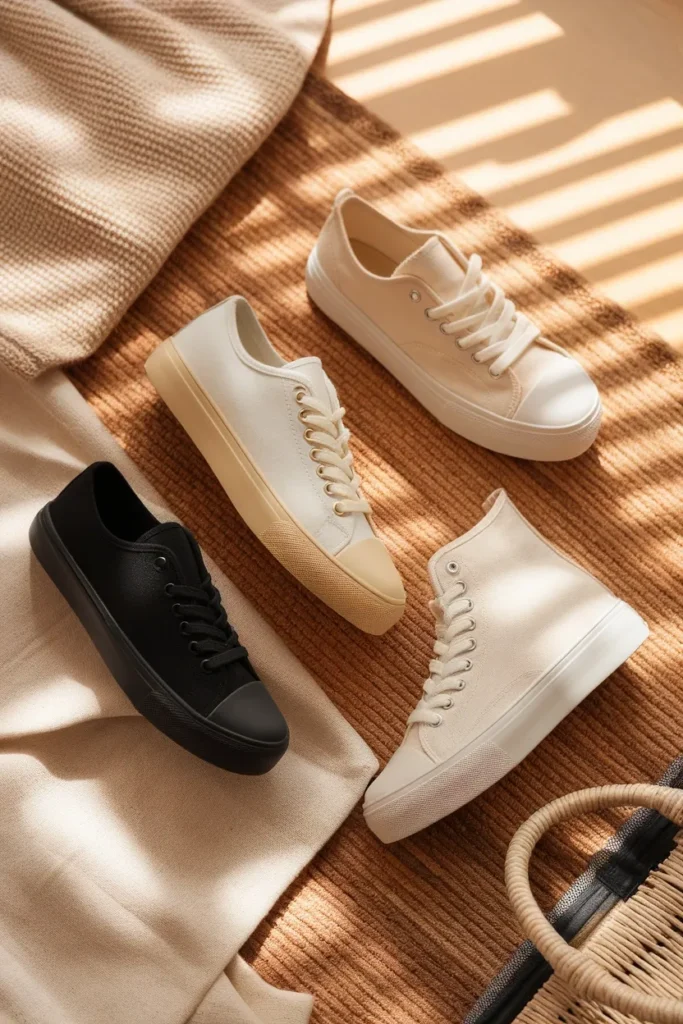
Every styling article treats Converse as one shoe. It isn’t. Three silhouettes dominate, and they sit at different heights, which means they change your leg line differently and pair with different hems.
I built this table after styling all three against the same four bottoms in one week. The differences were bigger than I expected.
The Converse Model Match
| Model | What it does to your line | Best with | Skip it if | Typical price |
|---|---|---|---|---|
| Chuck Taylor All Star (low top) | Flattest and narrowest. Disappears under a hem. Adds nothing. | Wide-leg trousers, midi skirts, cuffed straight-leg jeans, slip dresses | You want any height at all, or you need arch support for long days | Around $60 to $75 |
| Chuck 70 (low or high) | Slightly higher foxing stripe and a thicker midsole. Reads a little more substantial and a little more polished. | Tailored trousers, blazers, monochrome outfits, anything you want to look deliberate | You want the shoe to vanish. It has presence. | Around $95 to $110 |
| Lift Platform | Adds roughly an inch and a half. Rebalances a flat shoe against volume up top. | Oversized sweaters, puffy outerwear, wide-leg denim, anyone petite who wants the leg line back | You want a low-profile look, or you’ll be on your feet all day | Around $85 to $100 |
The high top version of any of these adds one more consideration: it creates a visible horizontal line above your ankle bone, which shortens the leg. High tops work best with a hem that covers them entirely, or with a hem that clears them by a good three inches. Half-covered high tops look like a mistake.
Pinterest is quietly telling you the same thing, by the way. There are more than a dozen separate Pinterest topic pages built around platform Converse specifically. Thousands of people found the height fix on their own before anyone wrote it down.
If Converse ends up being your casual anchor, the natural companion piece in a capsule is a flat with a bit more polish for the days a canvas sneaker is too relaxed. I’ve broken down the best loafers for a capsule wardrobe if you want the pair that covers the gap.
Formula One: Straight-Leg Jeans, Tucked Tee, Structured Layer
This is the one to master first, because it works for roughly nine months of the year and uses pieces you almost certainly own.
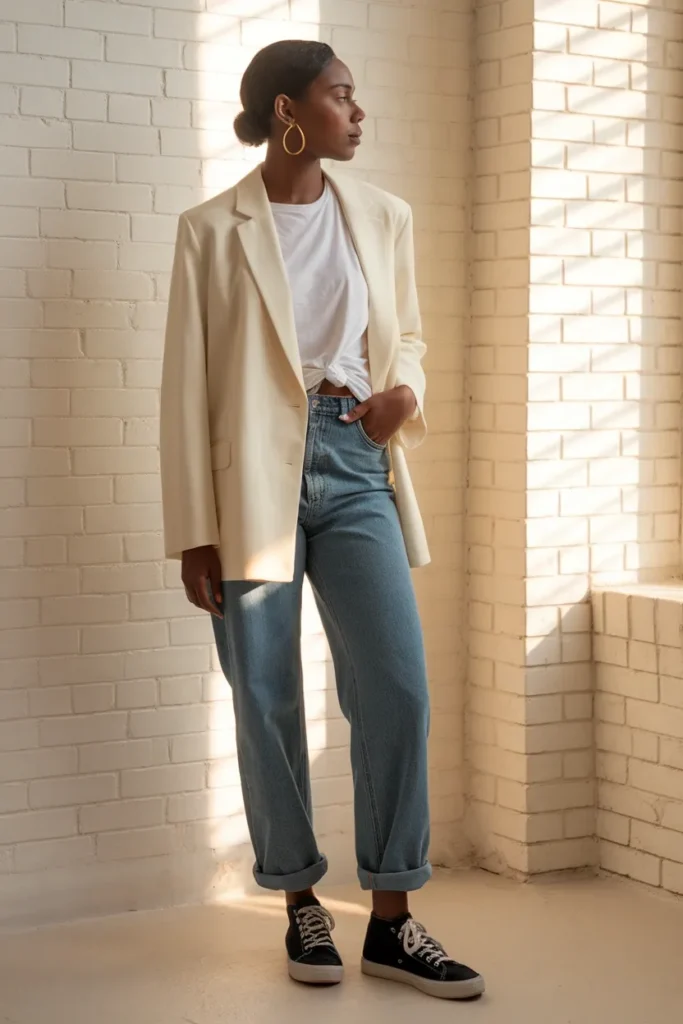
Straight-leg jeans in a mid or dark indigo. A white tee tucked at the front only. A layer with structure on top, meaning a blazer, a denim jacket, or a well-cut cardigan with some body to it. Black or white low tops.
The reason it works is the contrast. Your shoe is soft and casual, so the layer has to be the opposite. A blazer over jeans and Converse reads as a choice. A hoodie over jeans and Converse reads as laundry day.
Cuff the jeans once, an inch and a half, and stop. A double cuff climbs too far up the shin and creates the exact gap the ankle rule warns about.
Mom jeans deserve a specific note here, because the higher rise and slightly tapered leg are close to ideal for Converse. The taper narrows right where the shoe starts, so the transition is smooth instead of abrupt. The full breakdown lives in how to style mom jeans for your proportions, and most of it applies directly here.
Swap the tee for a fine-gauge merino crewneck in fall and this exact outfit carries you to about 45 degrees.
Formula Two: Wide-Leg Trousers and a Tucked Knit
This is where most people give up on Converse, and it’s the pairing with the highest payoff once you get it right.
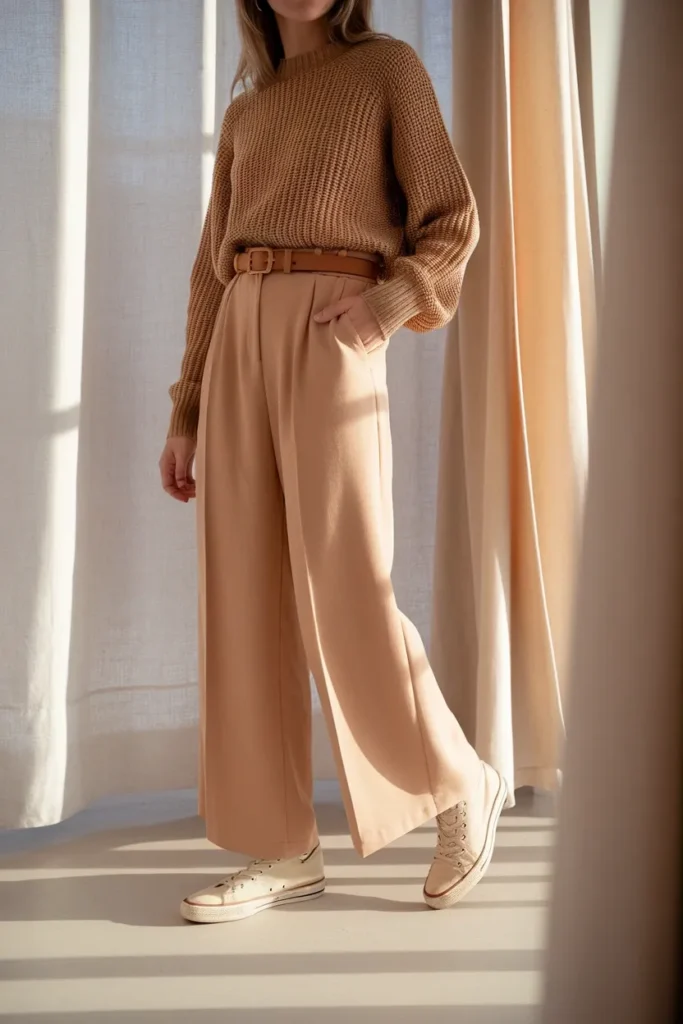
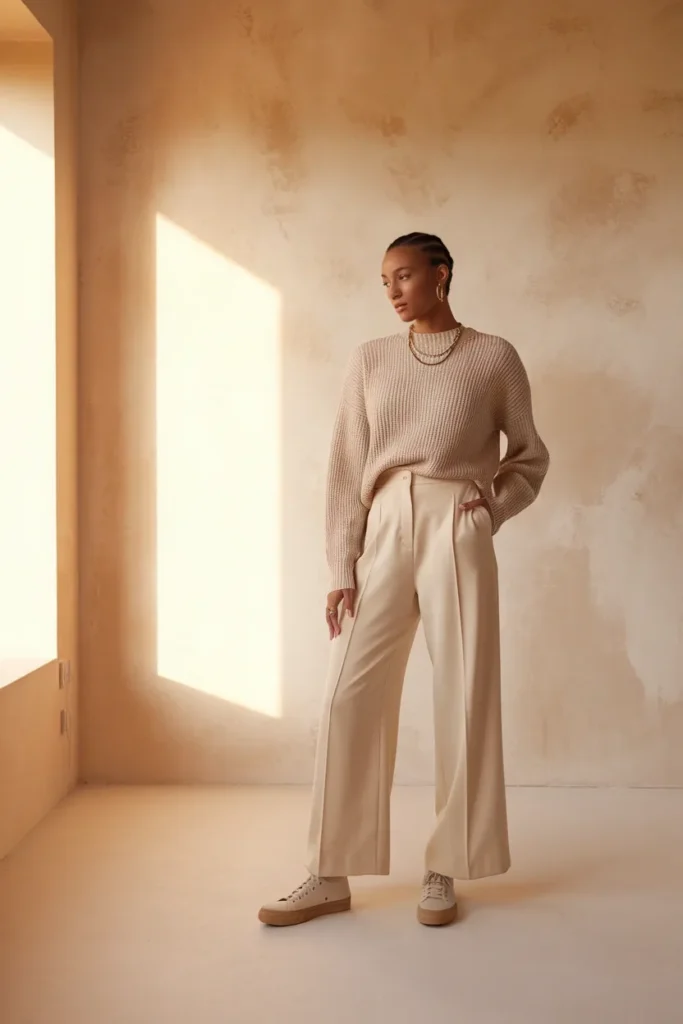
Wide-leg trousers in a neutral, so oat, camel, charcoal, or ivory. A fine knit tucked in fully. A belt if the waistband asks for one. White or cream low tops, hem falling long enough to graze the laces.
The volume math is what makes this work. Wide-leg trousers put a lot of fabric at the bottom of your body, and a flat sneaker underneath keeps that volume from tipping into costume. A heel would make it formal. A chunky trainer would make it heavy. Canvas keeps it easy.
Tuck the knit. Fully, not partially. When the trouser is that wide, a loose top erases your waist and the whole outfit becomes one column.
Fabric matters more than usual with this one. A trouser with real drape, meaning a wool blend, a heavy linen, or a fluid twill, will fall over the shoe correctly. A stiff cotton will hold its shape and hover, which is exactly the gap you’re trying to avoid. Quince and Everlane both do a drapey wide-leg in the $50 to $100 range that behaves the way you want.
For work, this is the outfit that gets Converse past a business-casual dress code without anyone quite noticing.
Formula Three: Midi Skirt, Fitted Top, Cropped Jacket
Skirts and sneakers together are where “on purpose” gets decided, and the fix is proportion rather than styling tricks.
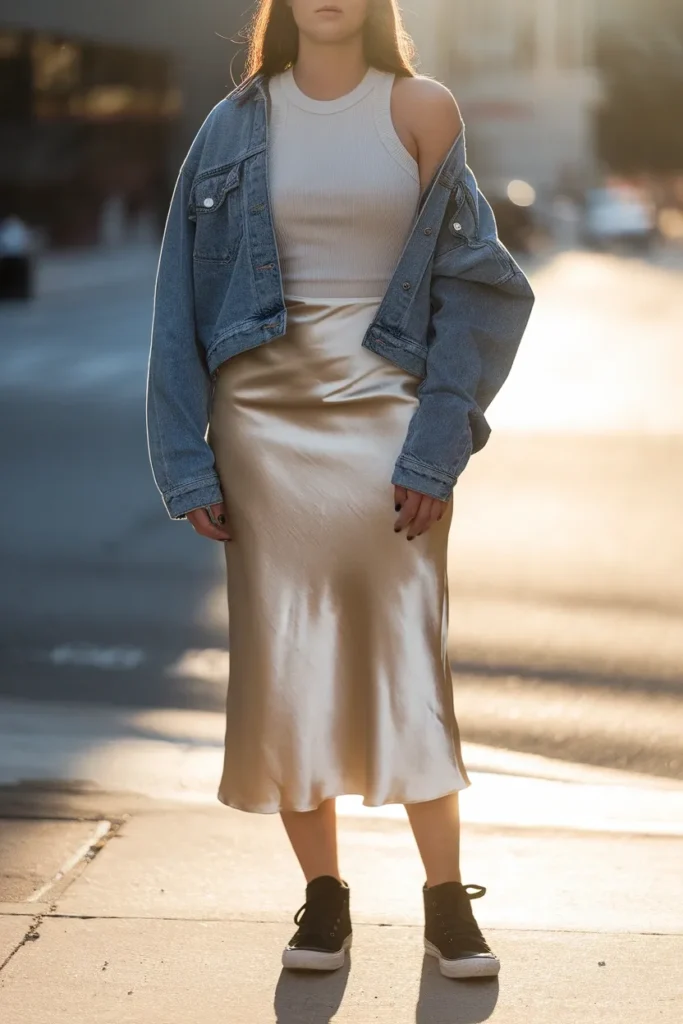
A midi skirt with movement, so a slip skirt, a pleated skirt, or a soft A-line. A fitted top tucked in. A cropped jacket, meaning a denim jacket, a leather jacket, or a short cardigan that ends at your waist. Low tops in a color pulled from the skirt.
Three rules make this land. The skirt hem should end at the narrowest part of your calf. The top must be fitted, because a slouchy top over a full skirt over a flat shoe loses your shape entirely. And the jacket must be cropped, since a long coat over a midi skirt over sneakers turns your whole body into one uninterrupted vertical block.
Color matters here in a way it doesn’t elsewhere. When your shoe picks up a color already in the skirt, even a faint one, the outfit reads as coordinated rather than assembled. Cream sneakers with an ivory pleated skirt. Black low tops with a black-and-white print. Faded olive with a sage slip.
A slip skirt plus a white tee plus black Chucks is one of the highest-return outfits in a minimalist closet. It costs almost nothing, works from March through October, and looks considered every single time.
Formula Four: Slip Dress and a Chunky Cardigan
The easiest outfit in this entire article, and the one that gets the most compliments.
A slip dress in a neutral or a muted color. An oversized chunky cardigan over the top, worn open. Low tops in cream or black. Done.
What makes it work is texture contrast. A silky dress against a heavy knit against flat canvas gives you three completely different surfaces in one outfit, and texture contrast is most of what separates expensive-looking from plain.
Layer a plain white tee under the slip dress and the whole thing shifts more casual and gets you another ten degrees of cold-weather range. Add opaque tights and it stretches into November.
Cardigan length is the only thing to watch. Aim for one that ends at your hip or just past it. A cardigan that hits mid-thigh over a midi slip dress creates a second hem, and two hems plus a flat shoe is a lot of horizontal information in one silhouette.
Denim dresses run on this same logic and layer even more easily, which I’ve mapped out in denim dress outfits that stretch across seasons if you’d rather start there.

Formula Five: The All-Neutral Monochrome
If you want Converse to look expensive, this is the shortest route.
Pick one neutral family and stay inside it from shoulder to ankle: cream, oat, and ivory together, or camel and taupe, or charcoal and soft black. Vary the texture heavily. Then let the sneaker be the same family, a shade off.
The effect comes from the unbroken vertical line. When nothing interrupts your outfit with a color change, your eye reads it as one long shape, and long shapes look intentional. A canvas sneaker in the same tone barely registers as footwear at all.
Cream low tops with ivory wide-leg trousers and an oatmeal knit is the version I reach for most. Everything is a slightly different shade of nothing, and it looks costly in a way that has no relationship to what it costs.
Texture is what saves it from looking flat. Pair a ribbed knit with a smooth trouser. Put a nubby cardigan over a silk cami. Without that variation, a monochrome outfit reads as a uniform.
Black-on-black is the fastest version if neutrals feel too soft on you. Black straight-leg jeans, black knit, black low tops, and one warm metal accessory to break it up.
This whole approach is really an argument for elevated basics that make casual look expensive, which is a broader piece worth reading if monochrome is where you want to live.
How to Wear White Converse Without the Upkeep Regret
White is the single most searched Converse color, and there are more than a dozen distinct Pinterest topic pages devoted to styling them. It’s also the highest-maintenance shoe in this article, and nobody seems to say so.
Canvas is porous. It absorbs everything: rain, coffee, sidewalk grime, the transfer from dark denim. A white pair looks its best for roughly the first six weeks, and after that it’s on you.
Three things extend that window considerably.
Treat them before the first wear. A canvas-safe fabric protector spray, applied to dry shoes and left overnight, buys you real time. Two coats on the toe box, which takes the worst of it.
Spot clean immediately, wash never. Converse’s own care guidance is explicit about this: do not machine wash or dry canvas shoes. Their instruction is a damp cloth or soft brush with mild dish soap in lukewarm water, tested on a hidden spot first. The washing machine breaks down the adhesive holding the sole to the upper, and the dryer finishes the job. That advice comes straight from the manufacturer, so it’s worth taking seriously.
Air dry stuffed with paper towels. Never near a radiator, never in direct sun. Heat warps the rubber and yellows the canvas.
If you want the look with a fraction of the effort, buy off-white or cream instead of optic white. Cream hides wear the way white refuses to, and it’s warmer against most skin tones anyway.
One more honest note: white canvas ages into looking worn, not vintage. Black and cream both develop a softness that reads as broken-in. White just looks dirty. If you’re building around cost per wear, that’s worth factoring in before you buy.

Converse Outfit Math: One Pair, Twenty-Four Outfits
Every article you’ve read shows you twenty photos of clothes you don’t own. Here’s the version you can run against your actual closet tonight.
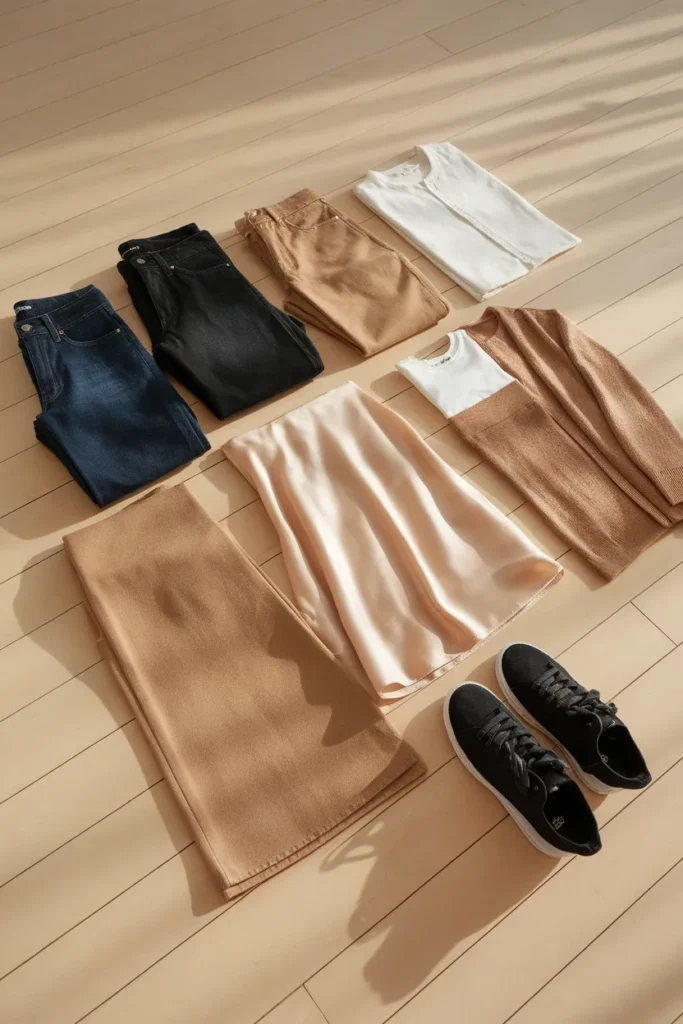
Take one pair of low tops in black or cream. Add these, most of which are probably already hanging up:
Four bottoms: straight-leg jeans · wide-leg trousers · a midi slip skirt · black jeans Six tops: white tee · fine-gauge knit · white button-down · ribbed tank · chunky cardigan · denim jacket
That’s four bottoms times six tops, which gives you twenty-four combinations before you’ve layered anything or changed a single accessory. Add the cardigan or the denim jacket as an outer layer over any of the tucked combinations and the number climbs past forty.
The math that actually matters
| What you spend | What you get | Cost per wear at 3 wears a week for a year |
|---|---|---|
| One pair of low tops, around $65 | 24+ outfits with pieces you own | Roughly 42 cents |
That’s the number that reframes the purchase. A shoe that cross-references with almost everything in a neutral closet is doing more work than a specialized piece at four times the price.
Two rules keep the math honest. Your pair should be a neutral, meaning black, cream, off-white, or a muted olive or navy. A bright color cross-references with maybe a quarter of your closet and the arithmetic collapses. And the sneaker needs to be the only casual sneaker in your rotation, or you’re just diluting your own wear count across three pairs.
Accessories are where the twenty-four becomes hard to count, since a swapped belt or bag changes an outfit more than most people expect. I’ve written up the capsule wardrobe accessories that change everything if you want to build that layer out properly.
Four Mistakes That Make Converse Look Sloppy
Worth naming these, because they account for most of the outfits that don’t work.
Loose, long laces. The single fastest fix in this article. Laces should be snug with short bows, or tucked entirely. Long trailing laces read as unfinished.
Athletic socks. A thick white crew sock with a logo cuff pulls the whole outfit toward gym clothes. Go with no-shows, or with a thin ribbed crew in a color that connects to something else you’re wearing.
Matching casual to casual. Sweatpants, hoodie, and Converse is three relaxed pieces stacked on top of each other with nothing to push against. One structured element rescues it every time, whether that’s a coat, a belt, or a bag with a defined shape.
Wearing a scuffed pair with a dressy outfit. Slouchy sneakers work with jeans. Against a silk skirt or a tailored trouser, they just look tired. Keep a cleaner pair for the outfits doing more work.
How to Style Converse FAQs
Are Converse still in style in 2026? Yes, and the framing is slightly off. Converse hasn’t been in or out of style since 1917, which is roughly the point of them. The Chuck Taylor All Star has been in continuous production for over a century, and it moves in and out of peak visibility without ever leaving. Right now the platform and Chuck 70 versions are getting the most attention, but a classic low top has never once looked dated. Buy for your proportions rather than for the current cycle.
Do Converse run big, and what size should I order? Chuck Taylors generally run about half a size large, and the standard advice is to size down half a size from your usual sneaker size. Two caveats. If you’re between sizes or have a wider foot, stay at your true size, because the canvas has almost no give across the width. And if you plan to wear them with anything thicker than a no-show sock, stay true to size as well. The Chuck 70 runs slightly narrower than the standard All Star, so if you’re ordering that model, factor that in.
Can you wear Converse without socks? You can, and plenty of people do, but canvas holds moisture and odor faster than leather. No-show socks with a silicone heel grip give you the barefoot look without the consequences, and they’re worth the small cost. If you do go sockless, alternate pairs so each one gets a full day to dry out between wears.
What’s the difference between the Chuck 70 and the Chuck Taylor All Star? The Chuck 70 is the premium version built to the original 1970s specification. Heavier canvas, a thicker and more cushioned midsole, a higher glossy foxing stripe along the sole, and a heel patch instead of the standard ankle badge. It costs roughly $30 more, feels noticeably more comfortable on long days, and reads a little more polished with tailoring. The standard All Star is lighter, flatter, and softer immediately out of the box. For a capsule, the Chuck 70 is worth the difference if you’ll wear it a few times a week. If it’s an occasional shoe, the All Star is plenty.
Can you wear Converse in fall and winter? Fall is arguably their best season, since denim, knitwear, and layering all suit a flat canvas sneaker. Winter is more limited. Canvas isn’t water-resistant and there’s no insulation, so anything below about 35 degrees or any real snow calls for a boot instead. On dry cold days, a merino crew sock and a long trouser hem extend the range considerably.
How do you clean white Converse without ruining them? Damp cloth or soft brush, mild dish soap, lukewarm water. Test on a hidden area first. Converse specifically warns against machine washing or machine drying canvas, because it degrades the adhesive at the sole. Air dry at room temperature, away from direct heat, stuffed with paper towels to hold the shape. For scuffs on the white rubber, a melamine sponge works better than anything sold specifically for sneakers.
Do Converse work if you’re petite, or over 40? For petite frames, yes, with one adjustment: a low top will nearly always serve your proportions better than a high top, since the high top’s collar cuts a visible line across the ankle and shortens the leg. Keep hems above the ankle bone or fully covering the shoe. For women over 40, the thing that shifts a sneaker from casual to considered is the rest of the outfit rather than the shoe. Converse under tailored trousers, a good coat, or a silk skirt reads as confident and current at any age. Under athleisure it reads as errands. Same shoe, entirely different outcome.
Where to Start Tonight
Pull out your Converse and one pair of straight-leg jeans. Cuff the jeans once so the hem sits just above your ankle bone. Tuck in a white tee at the front. Add whatever structured layer you own, so a blazer, a denim jacket, or a real cardigan.
Look in the mirror. That’s the whole thing.
Learning how to style Converse comes down to one flat shoe, one hem rule, and enough texture on top to keep it from going shapeless. Once the ankle rule is automatic, the other eight formulas fall into place without much thought.
Try one this week and see which one feels like you. If you land on a combination that works, that’s your outfit formula now, and formulas are what make getting dressed take four minutes instead of twenty.
Keep reading

How to Style a Jacket for Plus-Size Women: 10 Outfits That Work
A lot of jacket advice for bigger bodies is still written around hiding. Hide the hips, hide the arms, hide under something...

How to Style a Jacket for Women Over 50: 12 Outfits That Work
Your closet probably holds more jackets than you wear. There’s the blazer from an old job, the denim jacket you’re unsure about...

How to Style a Jacket: 10 Cozy Jacket Outfits for Fall and Winter
Your jacket is the first thing people see between October and March. It’s also the piece most of us grab last and...