
What to Wear in Greece: The 14-Piece Island Capsule That Fits in a Carry-On
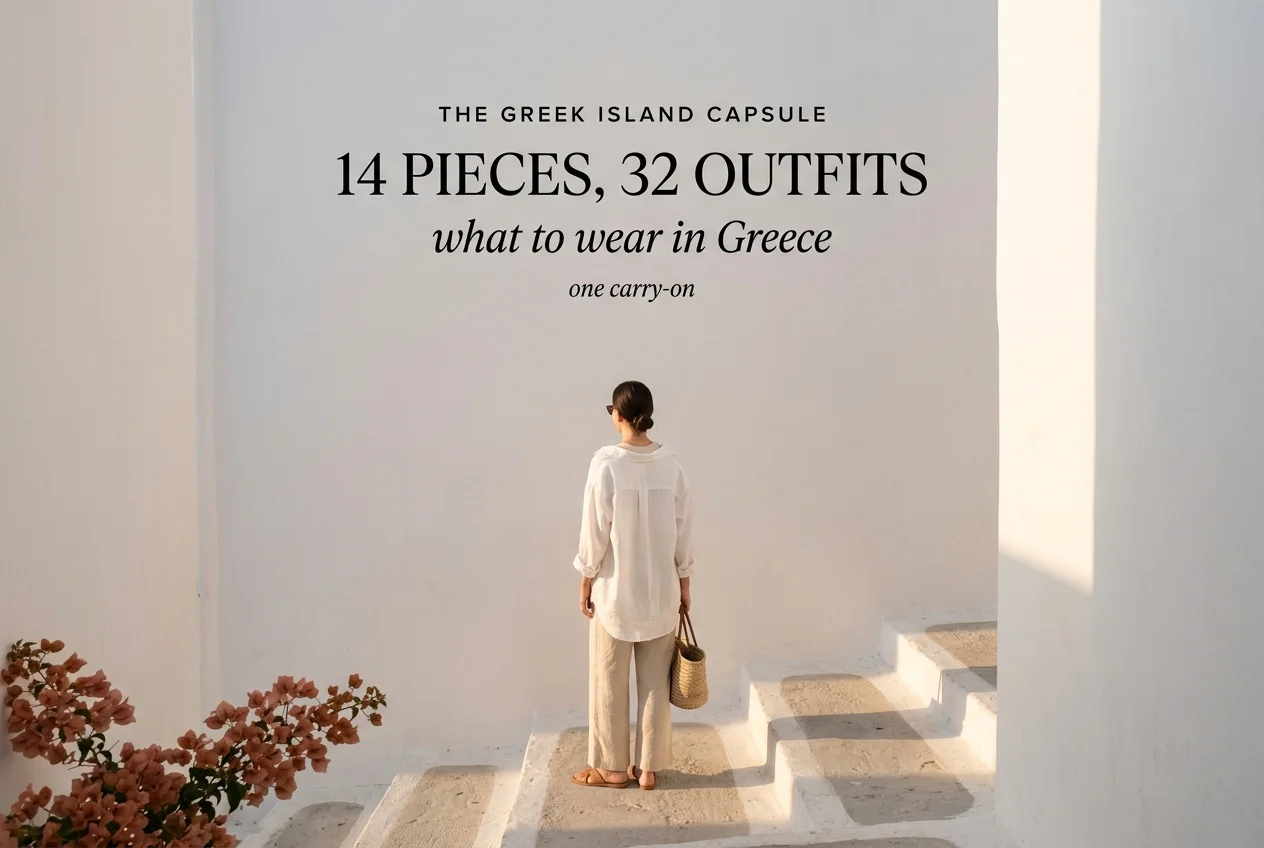
Figuring out what to wear in Greece is less a style problem than a physics problem. The marble at the ancient sites has been walked smooth by generations of visitors, and it turns slick under a hard rubber sole. Wind on an open ferry deck will take a wrap dress apart in about four seconds. Sun at two in the afternoon does not care that your linen set looked composed in the mirror at eight.
So this guide is built backward, from the conditions to the closet. Fourteen pieces, just over thirty outfits, one carry-on, zero mornings spent standing in front of a hotel chair asking what still smells clean.
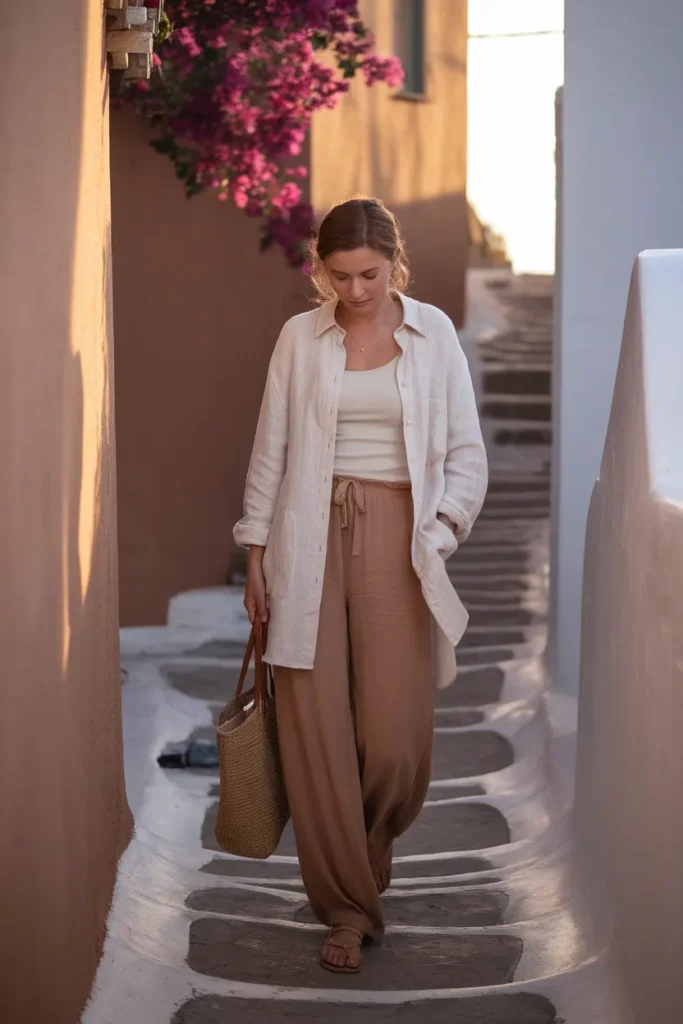
Greece Is Hotter, Brighter, and Windier Than the Pins Suggest
Here’s the part most packing lists soften. Cyclades averages run about 81F in June, 85F through July and August, and still 80F in September. Those are averages. Standing on unshaded limestone at midday, it reads hotter, and there’s very little tree cover at the archaeological sites.
Then the wind. The meltemi blows down the Aegean through the summer months, and it’s not a breeze. It cools the air, which is lovely, and it also flips hems, whips hair into lip gloss, and cancels ferries. Any packing plan that ignores it produces a suitcase full of clothes you can’t actually wear outdoors.
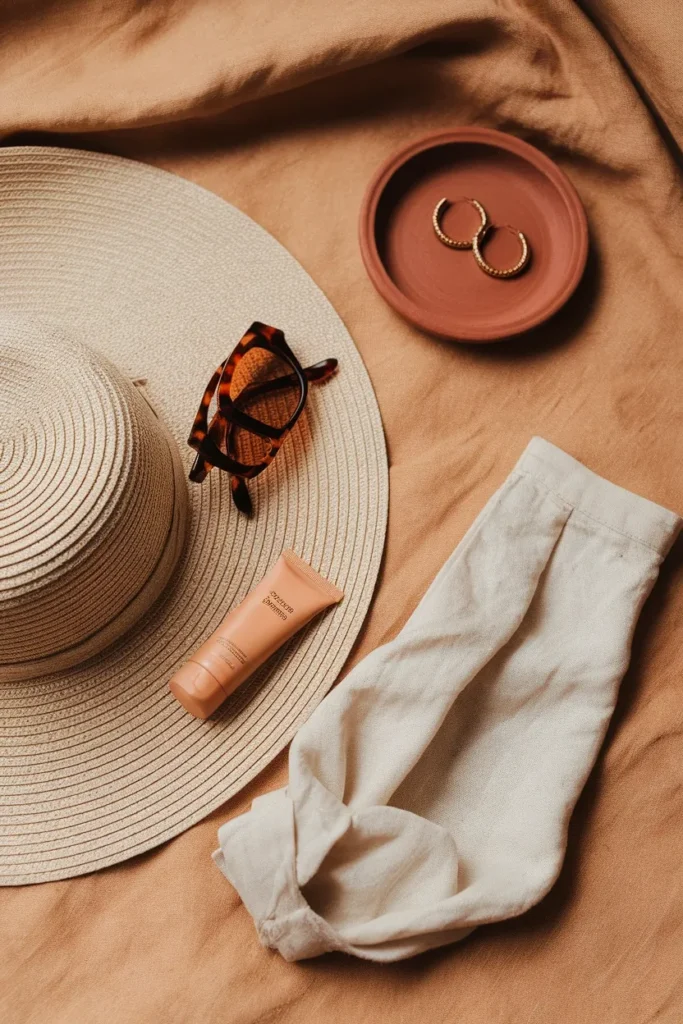
Sun exposure is the third factor, and it’s the one with consequences past your outfit. The EPA’s UV Index guidance recommends seeking shade and wearing “protective clothing, a wide-brimmed hat, and sunglasses” once levels hit very high, which Greek summer midday routinely does. A woven hat isn’t a styling flourish here. It’s equipment.
Build the Palette Before You Build the Pile
A trip capsule only works if every top talks to every bottom. That’s the whole trick, and it happens at the palette stage, before you fold anything.
Pick one neutral base and stay ruthless about it. Cream, oat, and soft black is a base. Cream, oat, soft black, navy, olive, and burgundy is a suitcase. Then add exactly one accent, and make it something that flatters your skin in bright light: dusty terracotta, butter yellow, or a deep tomato red all sit beautifully against whitewash and sea.
The base carries the volume, the accent carries the photos. If you’re rebuilding your top drawer before you go, the eight tops that anchor a capsule wardrobe is the same logic applied at home.
Use the 60-30-10 split to keep the proportions honest. Roughly sixty percent of the bag in your dominant neutral (cream and oat), thirty percent in a secondary neutral (soft black or navy), and ten percent in the accent. In a fourteen-piece capsule that lands at about eight pieces, four pieces, and one or two. Go heavier on the accent and pieces stop combining, which is exactly how a suitcase ends up full of clothes that only work with one other thing.
Two more palette notes that only matter in Greece. Pure stark white photographs beautifully and shows sweat immediately, so cream and oat do the same visual job with more forgiveness. And whitewashed walls bounce a huge amount of light back up at you, which washes out pale cool tones in photos and makes warm neutrals read richer. If you’ve ever wondered why everyone’s Greece pictures look better in camel than in gray, that’s the reason.
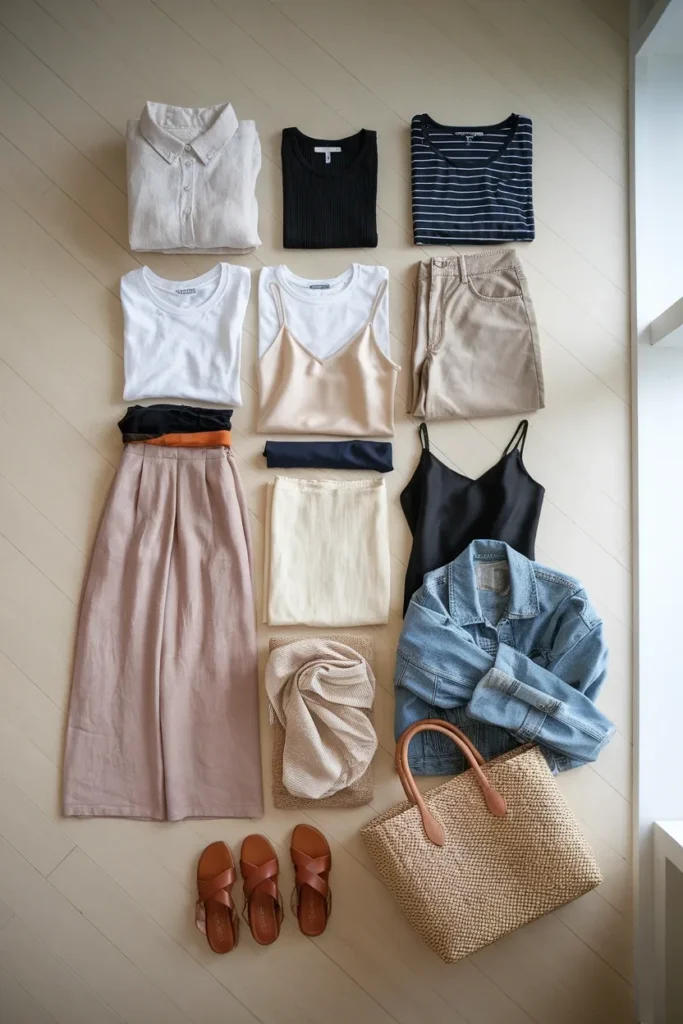
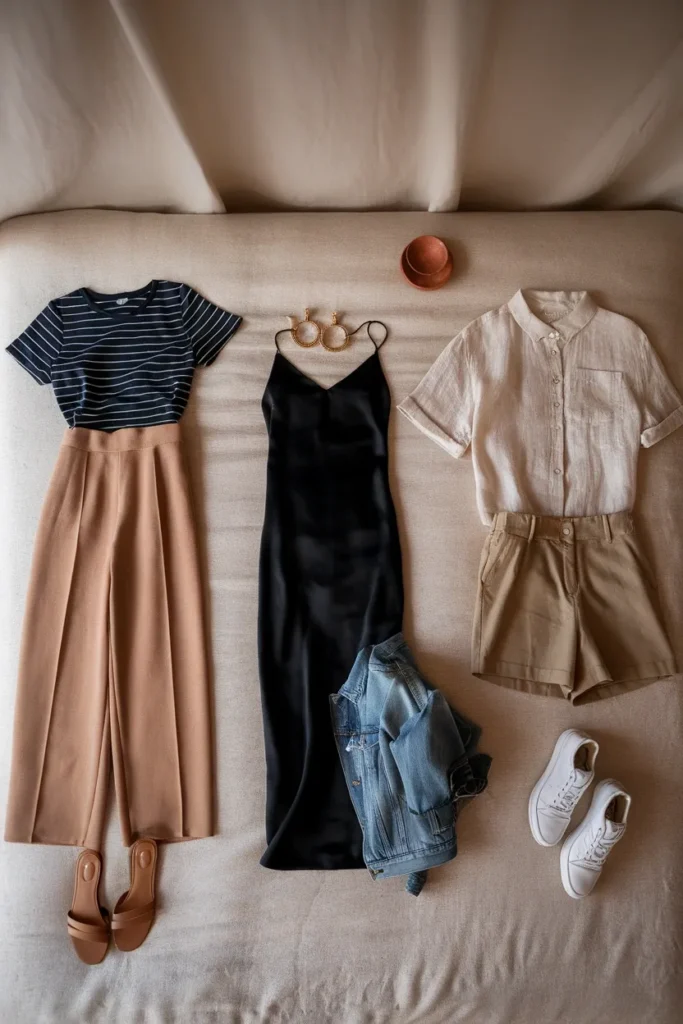
The 14-Piece Greece Capsule Wardrobe
Fourteen clothing pieces, three pairs of shoes. That’s a carry-on with room for the ceramics you’ll buy in Naxos.
Tops (5)
- Oversized linen button-down, ivory. Your most-worn piece. Shirt by day, beach cover-up by noon, shoulder cover at a church by four, layer over a slip dress by nine.
- White cotton tee, good weight so it isn’t transparent.
- Ribbed tank, soft black.
- Striped tee, navy and cream.
- Silk-feel camisole, champagne or black. This is the piece that turns daywear into dinner.
Bottoms (3)
- Wide-leg linen pants, oat or white. Airflow plus coverage, which is the exact combination sites and monasteries require.
- Tailored shorts, khaki or denim, mid-length.
- Drapey midi skirt in a neutral. Choose one with weight to it, and read the ferry section before you pick a light one.
Dresses (2)
- Midi slip dress, soft black. Dinner in Athens, dinner in Mykonos, dinner anywhere.
- Sleeveless linen midi, cream or oat. Daytime workhorse.
Layers (2)
- Lightweight knit cardigan or a linen overshirt in oat.
- Denim jacket in summer, or swap to a packable trench if you’re traveling in October.
Water (2)
- Swimsuit. Pack two, count it as one slot, because one is always damp.
- Gauzy cotton sarong that doubles as a shoulder wrap, a beach towel in a pinch, and an airplane blanket.
Shoes (3) Flat leather sandals for evening, cushioned walking sneakers for sites, and one pair of slides for the beach. Nothing else. Wear the bulkiest pair on the plane along with your heaviest layer, which is the same principle behind what to wear on a plane so you land looking human.
On price tiers: Quince and Uniqlo cover linen basics in roughly the $30 to $70 range, Madewell and J.Crew sit around $70 to $150 for linen and denim, and if you want a linen shirt that survives a decade, Frank & Eileen lands north of $250. Buy the $40 version of the shorts. Spend on the shirt, because it’s doing four jobs. Check current pricing before you order, since these ranges move with each season’s drop.
Outfit Math: How 14 Pieces Become 32 Outfits
Every packing guide promises versatility. Almost none of them show the arithmetic, so here it is.
| Combination type | How it works | Outfits |
|---|---|---|
| Tops with bottoms | 5 tops × 3 bottoms | 15 |
| Dresses worn plain | slip dress, linen midi | 2 |
| Dresses plus overshirt | shirt open over each dress | 2 |
| Dresses plus denim jacket | cropped layer over each | 2 |
| Tee layered over slip dress | slip becomes a skirt | 2 |
| Overshirt buttoned as a top | worn with each bottom | 3 |
| Denim jacket over top-and-bottom looks | reads as an evening change | 4 |
| Swim plus sarong | beach day | 1 |
| Sarong knotted as a dinner dress | evening on the sand | 1 |
| Total | 32 |
Screenshot that table. It’s the actual answer to “will I have enough to wear,” and the honest total is thirty-two, not the hundred that some lists claim by counting a scarf change as a new outfit.
The white wide-leg pants are the highest-leverage piece in the grid, appearing in five of those combinations, and they behave the same way at home. If you want more mileage out of them after the trip, here are nine outfit formulas for styling white pants.
Here’s how those thirty-two combinations actually distribute across a ten-day trip, so you can see the rotation rather than trust it.
| Day | Daytime | Evening |
|---|---|---|
| 1 travel | Tee, wide-leg pants, sneakers | Same, add overshirt |
| 2 city | Striped tee, shorts, sneakers | Camisole, wide-leg pants, sandals |
| 3 sites | Tank, wide-leg pants, sneakers | Linen midi, sandals |
| 4 ferry | Tee, wide-leg pants, shirt over | Slip dress, denim jacket |
| 5 beach | Swim, sarong, slides | Sarong knotted as dress |
| 6 town | Linen midi, sandals | Same, add gold and a belt |
| 7 sites | Striped tee, midi skirt, sneakers | Camisole, midi skirt, sandals |
| 8 beach | Swim, shirt as cover-up, slides | Tee over slip dress |
| 9 ferry | Tank, wide-leg pants, shirt over | Linen midi, denim jacket |
| 10 home | Shirt buttoned, shorts, sneakers | Travel day |
Nothing repeats within three days, and the two sink sessions land naturally on nights four and seven.
The Four-Surface Shoe Rule
This is where most Greece packing advice fails, because “bring comfortable shoes” treats the country like one surface. It isn’t. There are four, and they punish different soles.
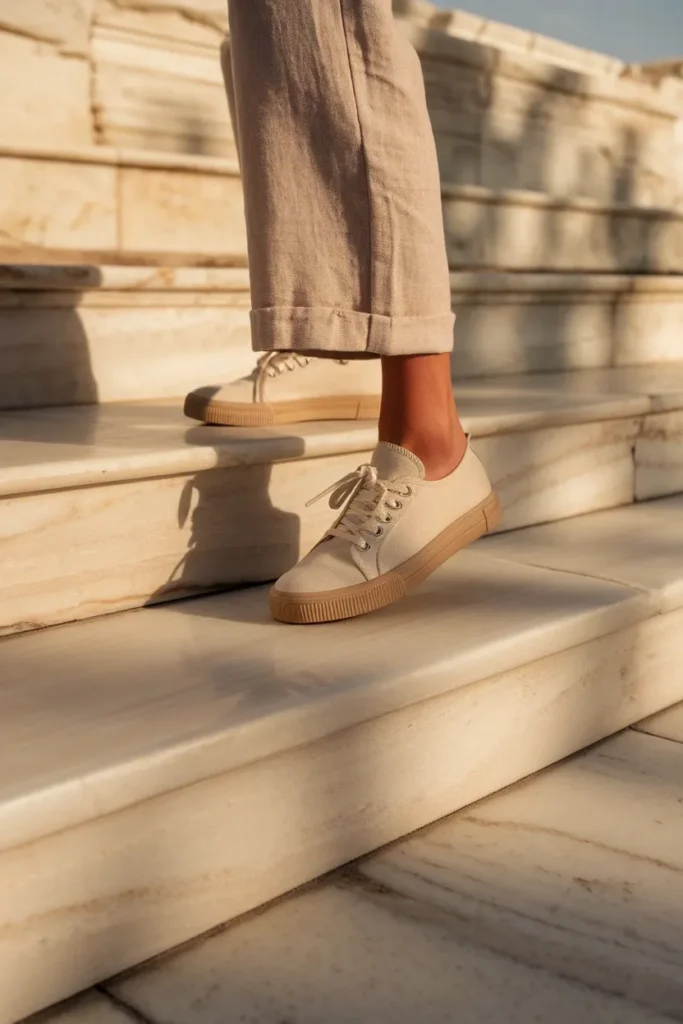
Polished marble. The stone at ancient sites has been buffed glassy by foot traffic and weather. Hard rubber and smooth leather both slide on it, and the descent is worse than the climb. You want a soft, flexible rubber outsole with real tread.
Kalderimi and cobblestone. Old stone paths with wide, uneven joints. A thin sole means you feel every edge by hour two, and a narrow heel wedges into the gaps. Cushioning matters more than grip here.
Volcanic gravel. Loose, sharp, and it gets inside everything. Any open shoe fills up within a few hundred yards. This is a closed-toe stretch.
Wet boat deck and harbor steps. Salt spray on painted metal and stone is the single slipperiest surface of the trip. Slides with a smooth footbed are genuinely risky here.
Which is why the three-pair list holds: cushioned sneakers handle marble, kalderimi, and gravel; flat leather sandals handle evenings and towns; slides handle only sand and hotel tile. Also worth knowing before you pack heels: at protected archaeological sites, footwear that concentrates weight on a small point is restricted, and staff do enforce it. You can read the Ministry of Culture’s official visitor regulations for the Acropolis directly, including the line that non-compliance can get a visitor removed from the site.
Monasteries, Churches, and Ancient Sites: The Actual Rules
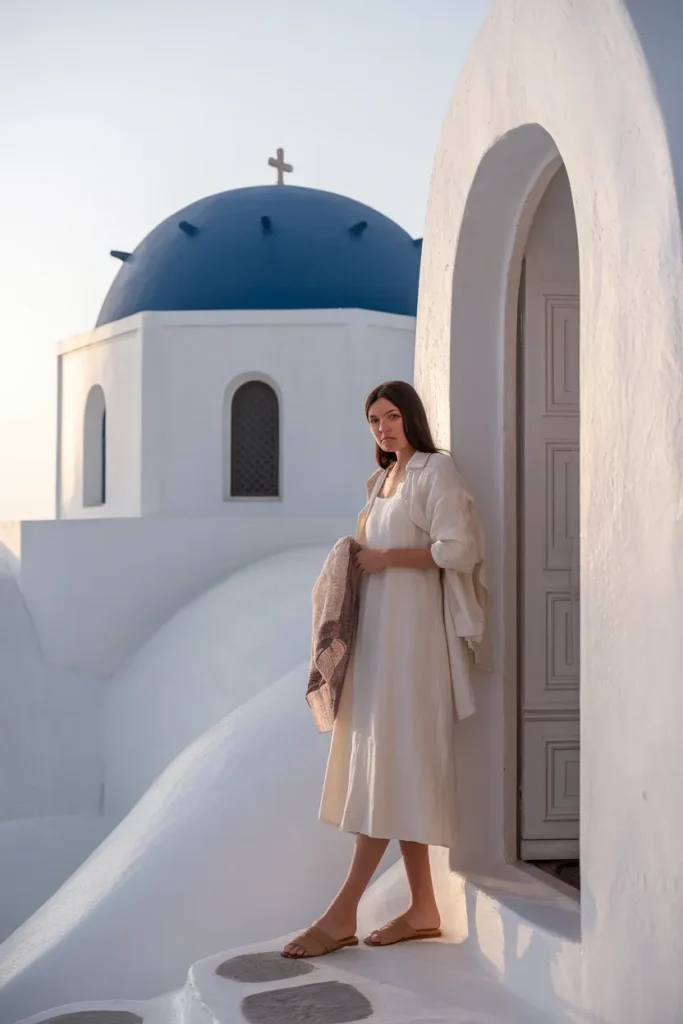
Greek Orthodox churches and monasteries have a real dress code, it’s posted at the door, and it’s enforced by someone whose whole job is enforcing it. Shoulders covered. Knees covered. That applies to everyone, and at the stricter monasteries women may be asked to wear a skirt rather than trousers.
The working monasteries usually keep a basket of wrap skirts at the entrance. They’re free to borrow, they’re the color of a bath mat, and every photo you take that day will feature one. Bring your own sarong and skip it.
Here’s the capsule paying off: the linen shirt covers shoulders over any tank, the sarong wraps to the ankle over shorts in about six seconds, and the wide-leg pants plus a tee already satisfies every rule without a single adjustment. You don’t pack a separate church outfit. You pack pieces that convert.
Tone matters too, and it’s the same instinct behind how to dress for church in a way that still feels like you. Covered isn’t frumpy. Cream linen and a good sandal reads respectful and put together at once.
One practical note: some sites restrict tripods, drones, and professional camera rigs, and photography rules vary between monasteries. Ask before you shoot inside.
Ferry Days and the Meltemi
Island hopping means open decks, and open decks in summer mean wind that has been building across the Aegean without anything to slow it down.
Three things go wrong. Wrap dresses and lightweight skirts become a full-time management job. Loose hats leave permanently. And the top deck is genuinely cold at speed even when the harbor was 85F, because you’re adding thirty knots of apparent wind to damp salt air.
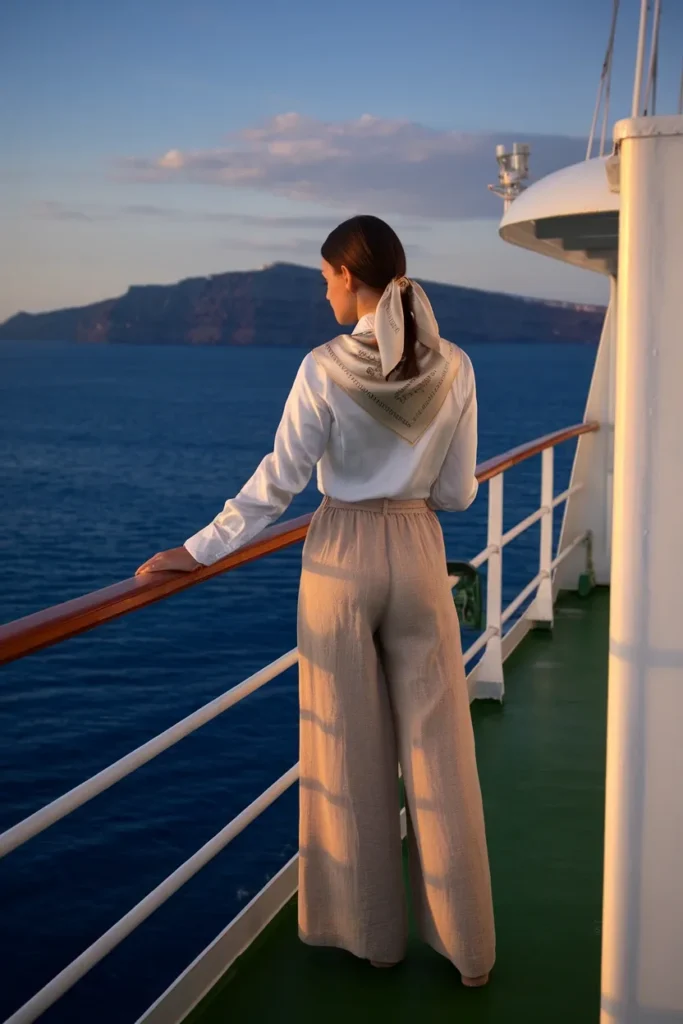
The ferry uniform, then. Wide-leg pants over a skirt, every time, since pants move in the wind without exposing anything. A tee with the linen shirt buttoned over it. Sneakers rather than slides, because the deck stairs get wet. Hair tied back before you board, not after.
A square silk scarf is the single best ferry accessory in the capsule: over your hair, around your neck against the chill, or knotted through the tote handle when you don’t need it. There are ten ways to tie a scarf that actually stay put, and the wind will find out fast which ones you know.
Skip the wide straw hat on deck entirely. Pack it flat in the tote and put it back on at the port.
Fabrics That Work at 90F, and Three That Betray You
Fabric decides comfort more than silhouette does, and the difference shows up around hour three of a hot day.
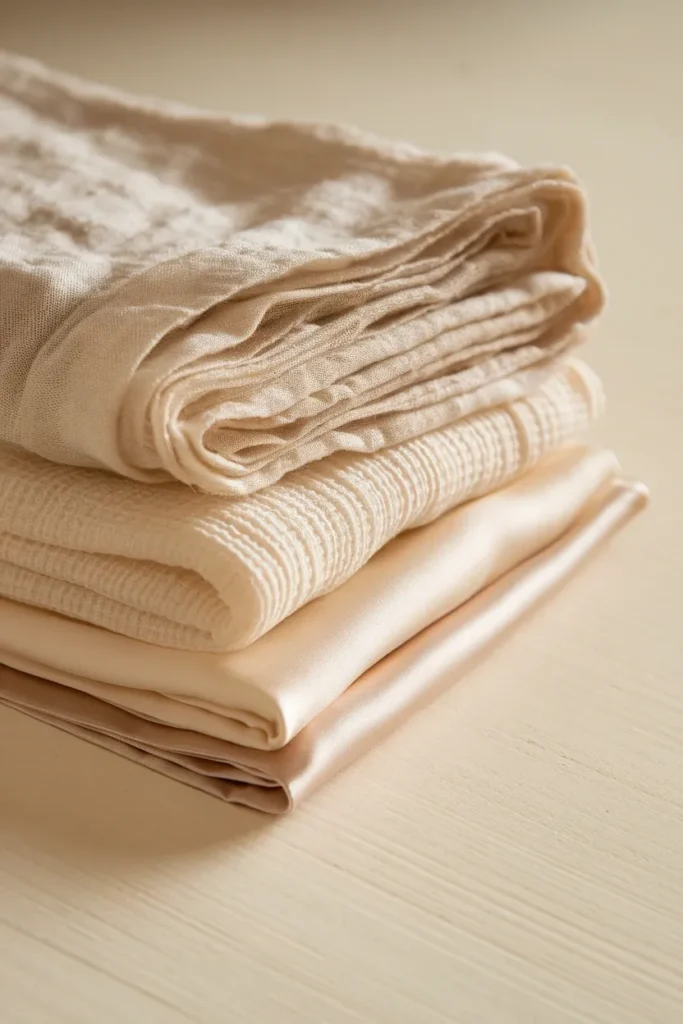
What works. Linen, obviously, because it breathes and it’s supposed to wrinkle so nobody’s judging. Cotton voile, gauze, and seersucker all move air. Silk and good rayon feel cool against skin and dry fast in a sink. Tencel or lyocell drapes better than linen and creases less, which makes it the smart pick for the midi skirt.
What betrays you. Polyester holds heat against your body and holds odor after one wear, so a poly sundress becomes unwearable by day two. Thick denim takes a full day to dry and weighs down a carry-on. Anything with a lining, because a lined skirt in August is a personal decision you’ll regret in public.
Weight is the quiet variable. A 4 to 6 ounce linen breathes and travels well. Heavier linen holds structure but holds heat too. When you’re comparing two shirts online, the lighter fabric almost always wins for this trip.
Color has a role here as well. Loose and light-colored beats tight and dark, since a fitted black tee in direct sun is measurably hotter than a relaxed cream one.
The Evening Shift: Day to Dinner in Three Moves
Greek dinner starts late. Nine is normal, ten is unremarkable, and nobody is going back to the hotel to change in between. So the capsule has to shift in place.
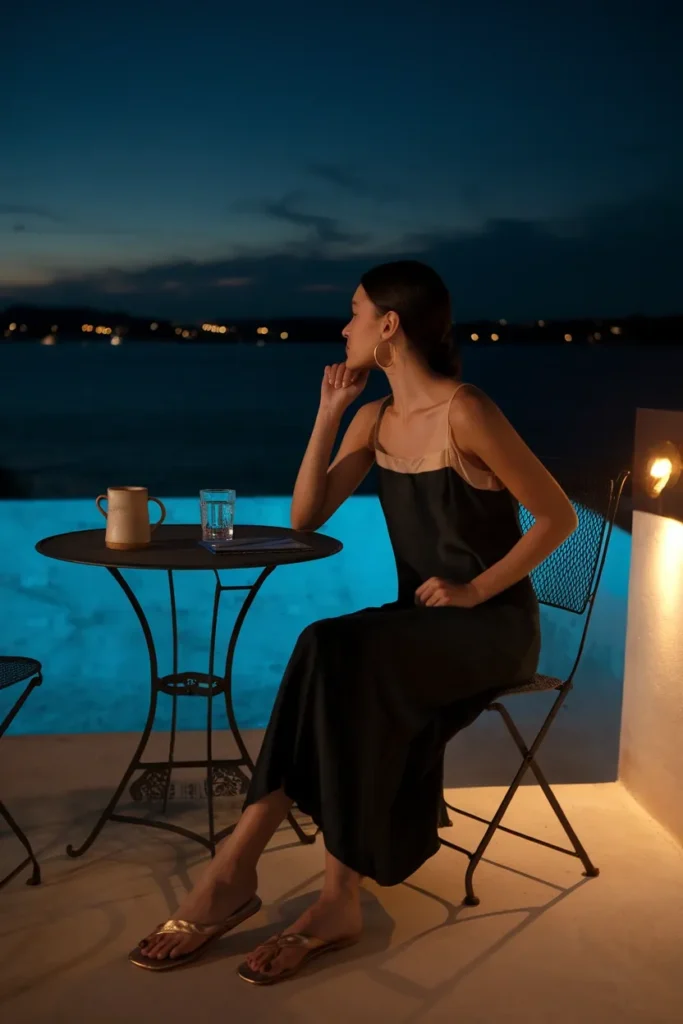
Move one: swap the top. The champagne camisole replaces the tee, same pants, and the whole outfit changes register in about fifteen seconds.
Move two: change the shoe. Sneakers to flat leather sandals. This does more visual work than any other single swap.
Move three: add metal. Gold hoops, a thin chain, a leather belt at the waist of the linen dress. Three small pieces of hardware read as intent.
That’s the entire system, and it works because the accessories that do the heaviest lifting in a small wardrobe are doing exactly that job here, just with sand in them.
What to leave home: the sequins, the going-out heels, the structured clutch. Island dinners run barefoot-adjacent and the nice restaurants are still, at the end of it, next to a harbor.
Athens Dresses Differently Than the Islands
Worth knowing if your trip includes both, because packing only for Santorini will leave you underdressed in the city.
Athens is a working capital. Locals dress noticeably more polished than the resort islands: real trousers, structured sandals, less visible swimwear, no beach cover-ups in a restaurant. The capsule handles it without additions. Wide-leg pants plus the camisole plus sandals is an entirely appropriate Athens dinner.
Islands run looser, and the looseness is graded. Mykonos and Santorini skew dressier at night. Naxos, Paros, and the smaller Cyclades are genuinely casual. Nowhere in Greece requires black tie, and nowhere accepts a wet swimsuit at a dinner table.
The one universal: swimwear stays at the beach. Walking into a town center in just a bikini reads badly everywhere in Greece, and in some municipalities it carries an actual fine.
The Bag Question, Which Is Really Two Bags
Most Greece packing lists file bags under accessories and move on. That’s a mistake, because Athens and the islands ask for genuinely different things and one bag can’t do both well.
In Athens, carry a zip-top crossbody worn across the body, not on one shoulder. The metro, Monastiraki, and the crowd funnel at the base of the Acropolis are all well known for pickpocketing, and an open tote is an invitation. You want a real zipper, a strap you can shorten so the bag sits in front of your hip, and enough room for water, sunscreen, and a folded sarong. Nothing bigger. A bag you can see the bottom of is a bag you’ll notice someone in.
On the islands, carry the woven tote. Different problem entirely. You’re hauling a towel, a swimsuit, a paperback, and whatever you bought at the morning market, and the threat is sand rather than hands. An open weave shakes out. A lined canvas tote does not, and you’ll be finding beach in it in November.
Two bags sounds like a lot for a fourteen-piece capsule. It isn’t, because the crossbody folds flat inside the tote and weighs almost nothing, and between them they cover every situation on the trip.
Skip the belt bag. It sits at exactly the wrong height under an oversized linen shirt, and it breaks the line of every wide-leg outfit in the grid.
Swimwear and Cover-Ups That Earn Their Hanger Space
Two swimsuits, and pick them for different jobs. One you can swim properly in, with straps that stay put. One you can lie in.
The cover-up decision is where people overpack. A dedicated beach cover-up is a single-use item, and single-use items lose their spot in a fourteen-piece plan. The gauzy sarong does the same job plus four others, which is the entire case for it.
Quick-dry matters more than you’d think, because most island accommodations don’t have a dryer and salt air keeps things damp. Rinse suits in fresh water each night, wring in a towel, hang inside near a window rather than out in direct sun, which breaks down elastane fast.
Shoulder Season: How the Capsule Changes in September and October
September in the Cyclades still averages around 80F and the sea holds its summer warmth, so the capsule barely moves. You’re swimming, wearing the same dresses, and getting thinner crowds and softer light for it.
October is the real transition. Averages drop to roughly 73F by day and 64F at night, and that evening gap is what catches people out.
Three swaps handle it. The denim jacket becomes a packable trench. Add one thin merino long-sleeve, which layers under everything and takes almost no space. Trade one pair of shorts for a second pair of long pants.
Everything else stays. That’s the test of a well-built capsule: the season changes and you’re editing three items, not repacking the bag.
If you’re choosing a shoulder-season window, late September is the sweet spot. Warm water, open restaurants, and roughly half the ferry traffic of August.
Washing in the Sink: The Ten-Day Reality
Fourteen pieces across ten days only works if you wash, and this is the step every packing list skips.
Plan on two sink sessions. Underwear and swimwear nightly, which takes four minutes. Tops and the linen shirt roughly every third day.
Bring a small tube of travel detergent or use hotel shampoo, which works fine on cotton and linen. The wringing technique is what matters: never twist. Lay the garment flat in a dry towel, roll the towel tight, press with both hands, then hang. That single move cuts drying time close to in half.
Linen dries overnight in Greek air. Silk dries in two or three hours. Denim does not dry overnight, which is one more reason the shorts should be the light pair.
What Not to Pack for Greece
Short list, high impact.
Heels of any kind, including block heels, because of the marble, the cobblestones, and the site restrictions. Brand-new sandals you haven’t broken in, since blisters on day one shrink the trip. More than three pairs of shoes. A hair dryer, because your accommodation has one and the outlets are 220 volts. Anything polyester. A separate outfit for each day, which is the habit this whole system replaces.
Also leave the very expensive jewelry. Salt water, sunscreen, and beach bags aren’t kind to it, and a lost heirloom is a bad souvenir.
The Cost-Per-Wear Case for a Trip Capsule
Here’s the argument for spending real money on two or three of these pieces rather than buying fourteen cheap ones.
A $180 linen shirt worn four times on a ten-day trip is $45 a wear, which sounds terrible. Wear it another forty times over the next three summers at home and it’s under $4. Meanwhile a $29 polyester sundress worn twice before it starts holding odor is $14.50 a wear and then it’s landfill.
The pieces worth the investment are the ones doing multiple jobs: the linen shirt, the wide-leg pants, the slip dress. The pieces to buy cheap are the shorts, the tank, and the sarong. That split is the difference between a trip capsule and a haul.
What to Wear in Greece Frequently Asked Questions
What should I not wear in Greece? Heels at archaeological sites, swimwear away from the beach, and anything polyester in July. Beyond that Greece is relaxed. The only genuine dress code is at churches and monasteries, where shoulders and knees need covering.
What is the dress code for Greek churches and monasteries? Shoulders and knees covered for everyone. Some working monasteries additionally ask women to wear a skirt over trousers and will lend a wrap at the door. Carrying your own sarong solves it and photographs better.
Can you wear shorts in Greece? Yes, everywhere except religious sites. Mid-length tailored shorts read better than very short ones in towns and at dinner, and they’ll also get you into more places without a cover-up.
What shoes should I wear in Greece? Cushioned sneakers with a flexible rubber sole for sites and walking, flat leather sandals for evenings, and slides only for the beach. The marble at ancient sites is polished slick, so grip matters more than it does at home.
Is there a dress code for dinner in Greece? Nothing formal. Athens and the dressier islands like Mykonos and Santorini lean smart casual at night, meaning real trousers or a dress and a proper sandal. Smaller islands are genuinely relaxed. Nowhere expects heels.
Is a 14-piece capsule really enough for two weeks? Yes, with two sink-washing sessions. Fourteen pieces produce thirty-two outfits, which is more than a fourteen-day trip needs. The constraint is laundry, not variety.
Does this capsule work for petite, curvy, or plus sizes? The structure does, since it’s built on proportions rather than a body type. If you’re 5’4″ or under, look for a midi that hits mid-calf rather than ankle and crop the wide-leg pants so they break at the ankle bone. If you’re curvy, a wrap or belted midi will hold its shape better in wind than a straight-cut shift.
Pack the System, Not the Suitcase
The reason “what to wear in Greece” feels hard is that most advice hands you a list of items instead of a system. Items multiply. A system converts.
Fourteen pieces in one palette, three pairs of shoes chosen for four surfaces, one shirt that covers your shoulders at a monastery and layers over a slip dress at dinner. That’s the whole thing, and it fits in a carry-on with room left over.
Build the palette first this week, then buy only what’s missing. You’ll almost certainly find you already own nine of the fourteen.
Keep reading

What to Wear for Family Pictures Without Buying Everyone New Clothes
Your session is in eleven days and you’ve already spent two evenings with forty tabs open. I know that feeling. Deciding what...

What to Wear on a Rainy Day: Outfits That Stay Cute and Dry
Figuring out what to wear on a rainy day comes down to about four decisions you make before you ever pick an...

What to Wear in Nashville: Outfits With a Little Twang
Deciding what to wear in Nashville trips people up for one reason nobody warns you about, and it isn’t the cowboy boots....