
How to Style a Shacket for Plus-Size Women: 16 Outfits That Work
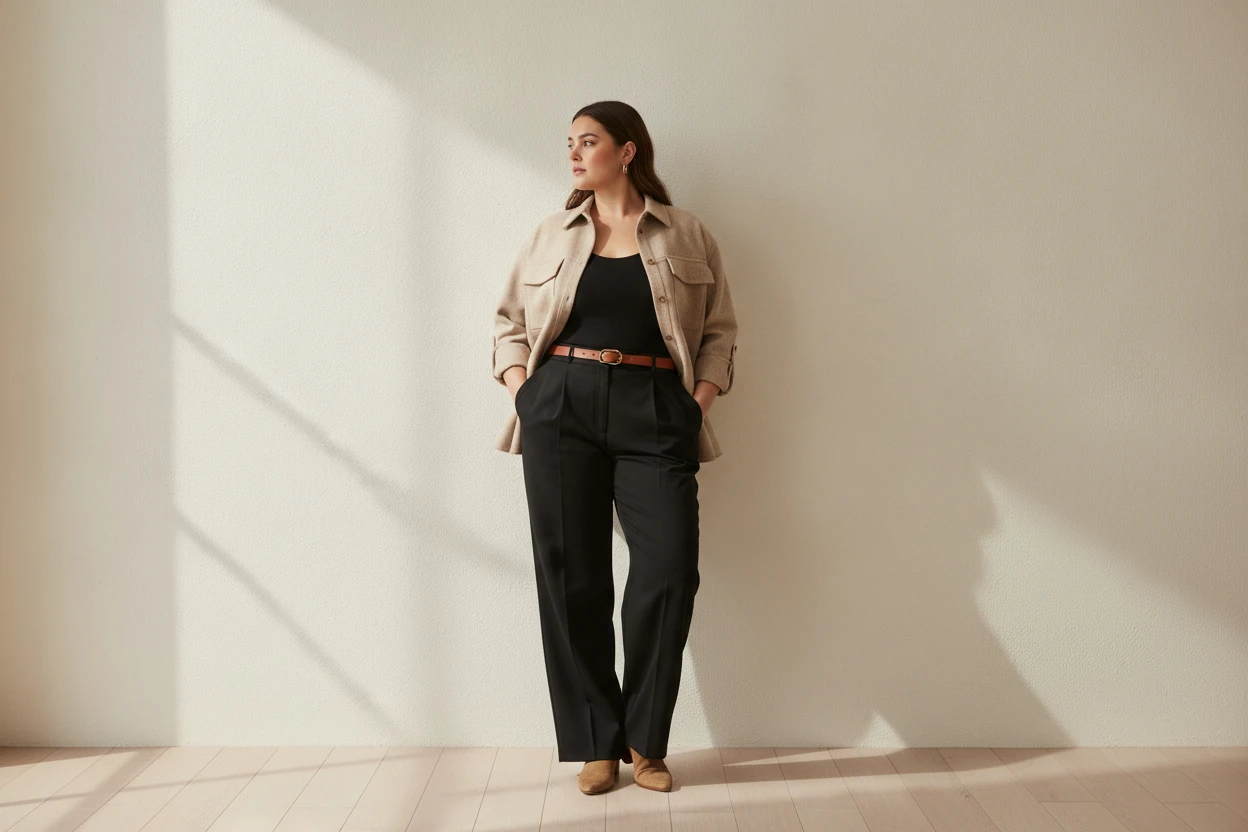
A shacket is the easiest piece in your closet to buy and the easiest one to get wrong. It hangs open, it has no waist, and it is cut to be roomy on purpose. On a curvy frame that combination can read either deliberate or like you grabbed your husband’s flannel on the way out the door, and the difference usually comes down to three inches of fabric.
Here is the good news. Shacket outfits for plus-size women do not need a special body type, a belt you do not own, or a size you have to hunt for. They need one fit rule and a base layer that skims instead of floats. Once you have those, the same jacket carries you from a school run to a dinner reservation without a single change of strategy.
Below are 16 outfits, each built from pieces that already live in most closets. Before the list there is a short fit section, because getting the proportions right once means every outfit after it works by default. Skim the looks, save the ones that match your week, and come back when you are standing in front of the closet at 7 a.m.
The Three-Break Rule: the fit check that makes every shacket outfit work
Most styling advice for this piece stops at “size up.” That is half an instruction. Going up a size makes a shacket bigger, not better, and a bigger boxy thing on a curvy frame is still a boxy thing.
What actually decides whether a shacket reads intentional is where it breaks. Three places, every time.
The shoulder break. The shoulder seam should sit slightly past your natural shoulder point, roughly half an inch to an inch out. Land it there and the jacket reads as a chosen oversized cut. Land it three inches out and it reads as the wrong size, because a dropped seam that low collapses the whole armhole and adds width exactly where you do not want it.
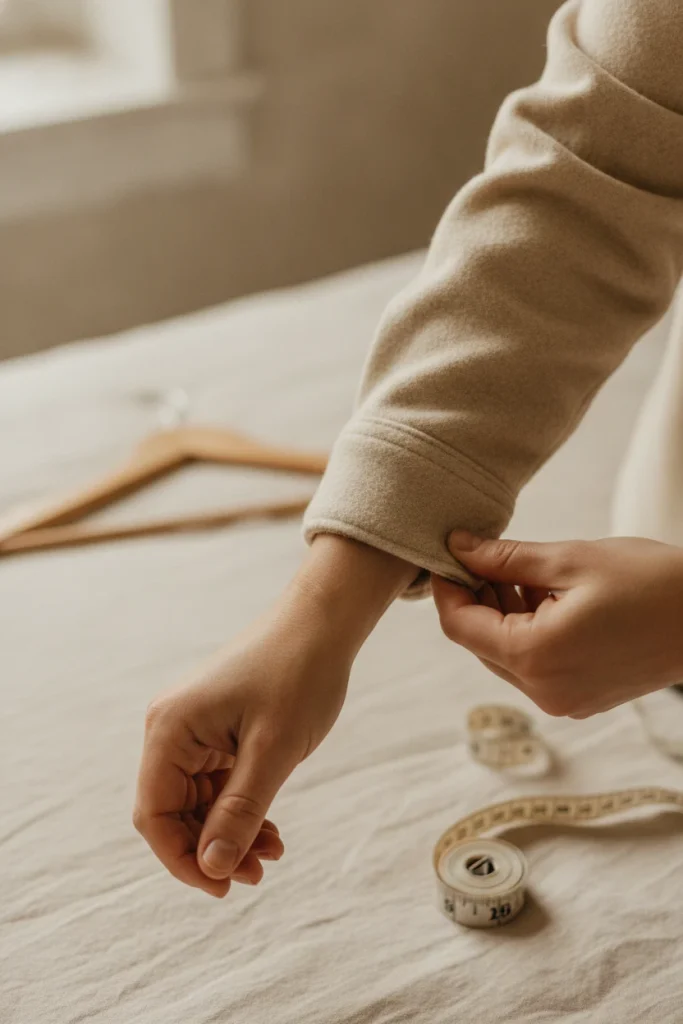
The sleeve break. Cuff the sleeve so it ends at the narrowest part of your forearm, just below the elbow or at the wrist bone. A rolled cuff there creates a visible taper, and a taper is what tells the eye this is a fitted silhouette wearing a loose layer, not a loose silhouette all the way down.
The hem break. The hem should stop either above the widest part of your hip or well below it, never exactly on it. Landing on the widest point draws a horizontal line at the widest point, which is the single most common reason a shacket photographs badly.
One more thing nobody tells you, and it happens before you ever try the jacket on. Read the fiber content tag. Under federal fiber content labeling rules, that percentage breakdown has to be on the garment, and it predicts bulk better than any product photo. A high polyester sherpa or a poly-filled quilted style holds its own shape and stands away from the body, which adds visual width. A wool blend or a brushed cotton flannel drapes down and follows your line instead of fighting it. Same size, same price band, completely different result in the mirror.
If you are building outerwear into something that mixes and matches, this piece slots neatly into a plus size capsule wardrobe built on 16 pieces, where one jacket needs to earn its hanger space across at least six outfits.
1. The half-tuck tee with straight jeans
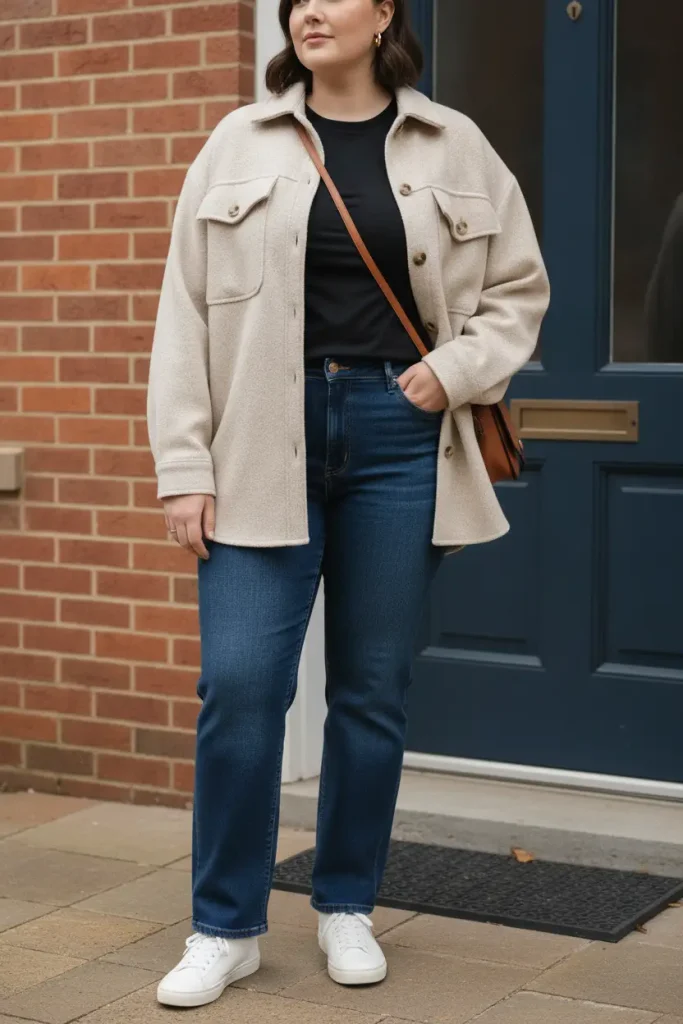
Start here, because it is the outfit that proves the rule. A fitted crewneck tee, a front half-tuck at the zipper, straight-leg jeans, and the shacket left open over the top.
The half-tuck is doing the structural work. It puts a visible waist point in the center of the frame, so even with a completely unstructured jacket hanging loose on either side, the eye still finds a middle. Skip the tuck and the whole thing goes to a rectangle.
Footwear decides where this lands on the dressy scale. White leather sneakers keep it Saturday. A tan suede ankle boot with a low block heel moves it to dinner without changing anything else.
A half-tuck gives an unstructured jacket a waist to hang from. One second of styling, and it is the difference between layered and draped.
The jeans matter more than the jacket here, since they carry the whole lower half. If yours gape at the back waist or twist at the knee, no shacket fixes that, and the best jeans for a capsule wardrobe is the faster problem to solve first.
2. Bodysuit and wide-leg trousers for a clean column
Swap the tee for a bodysuit and the whole silhouette changes, because a bodysuit cannot ride up, bunch at the waistband, or break the vertical line halfway down.
Build it in this order:
Scoop or square-neck bodysuit in the same color family as the trousers.
High-rise wide-leg trousers that hit the floor with a half-inch break over the shoe.
Shacket open on top, sleeves cuffed, hem finishing below the hip.
Match the bodysuit to the trouser color and you get a single unbroken column from collarbone to shoe, with the jacket reading as two vertical stripes framing it. That is the most reliable proportion trick in this entire list.
3. Belted over a midi dress
Nothing in the top search results does this, and it is the look that gets saved.
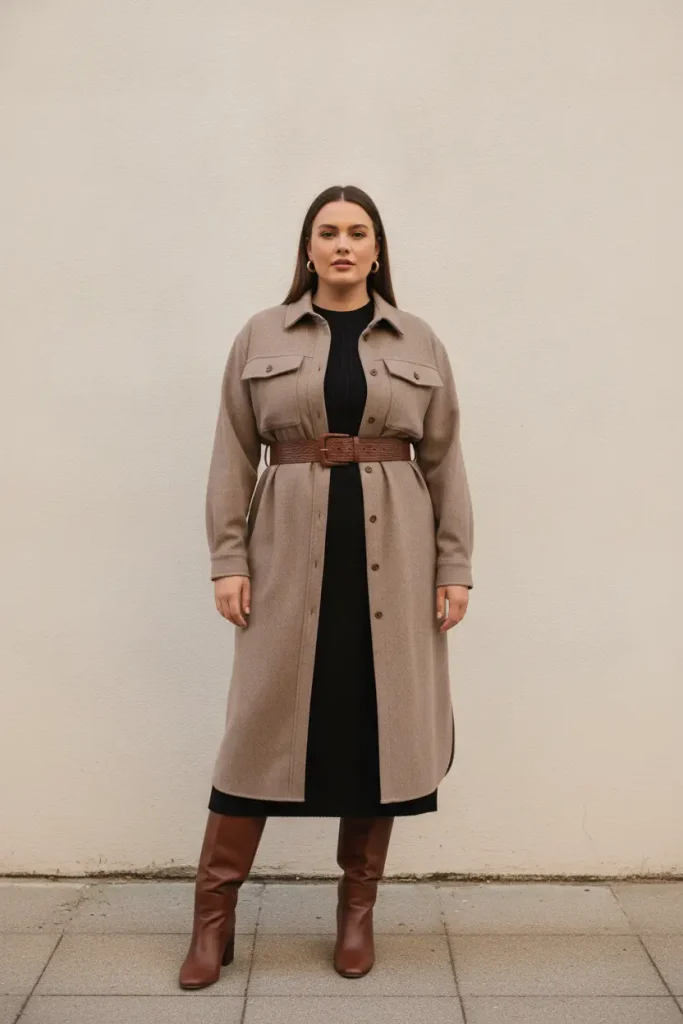
Put the shacket over a jersey or ribbed midi dress, then run a wide belt over the jacket itself at your natural waist. You are not belting the dress. You are belting the layer, which converts the shacket from outerwear into something closer to a coat dress.
Use a belt at least two inches wide. A skinny belt disappears into a thick flannel and looks like an accident rather than a decision.
4. Sherpa shacket, leggings and tall boots
Sherpa is the bulkiest fabric in this category, so it needs the slimmest base you own. Full-length black leggings, a fitted long-sleeve top, boots that come to mid calf or higher.
💡 Quick Tip
Run your leggings and boots in the same color. An unbroken dark leg makes the fluffy top half look intentional instead of top-heavy.
Keep the sherpa hem short on this one. A cropped or hip-length sherpa over a long dark leg is balanced. A knee-length sherpa over leggings is a lot of volume with nowhere to go.
5. Plaid shacket over an all-black base
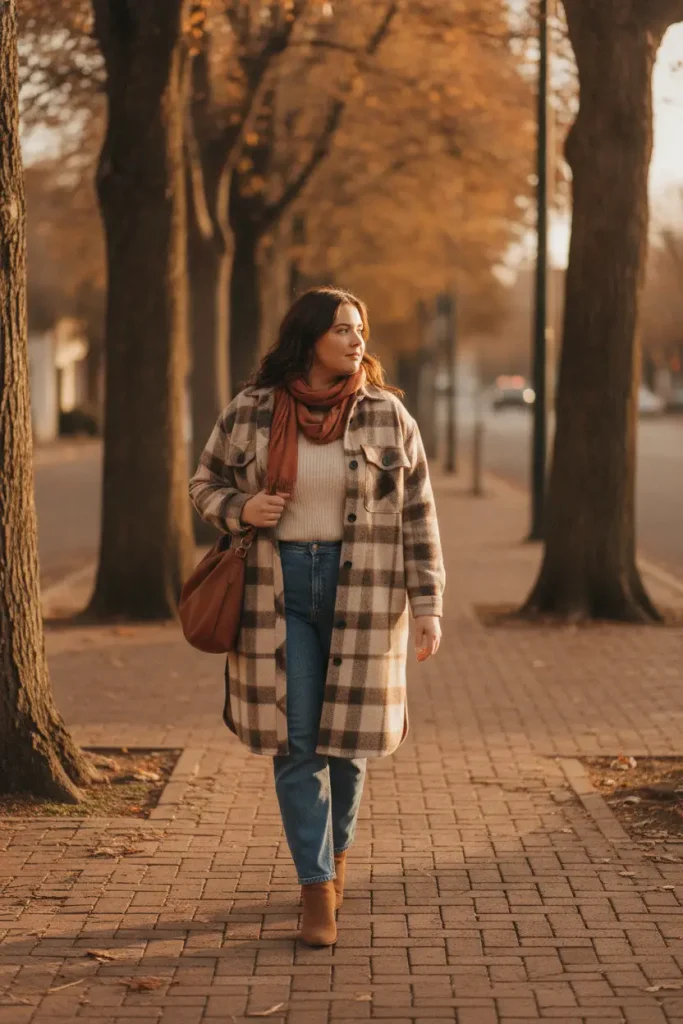
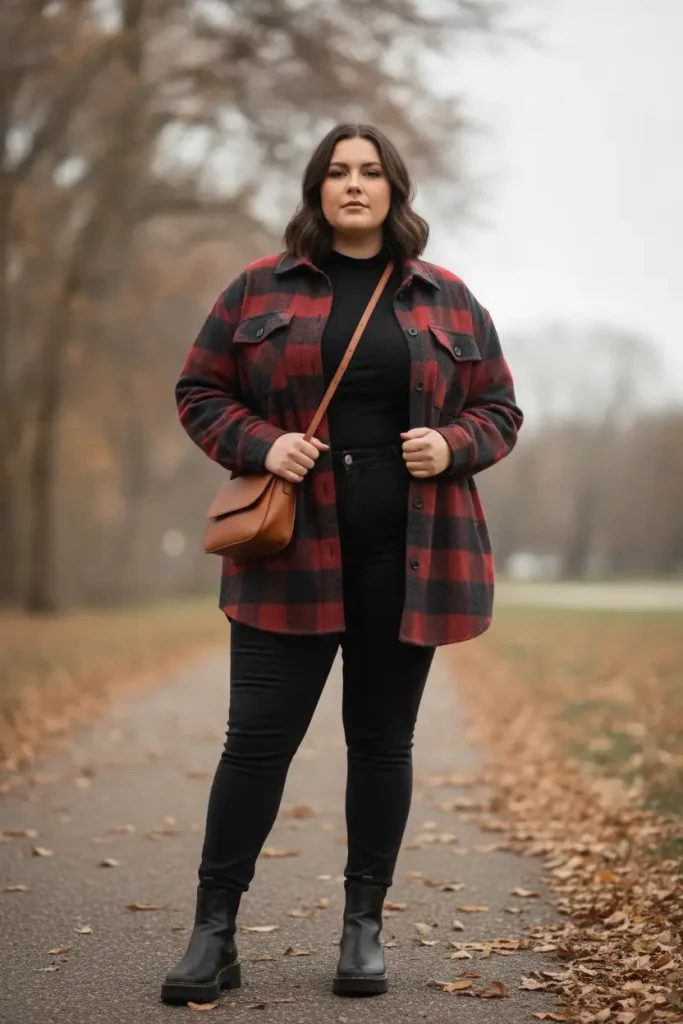
The plaid shacket outfit is the single most-pinned version of this piece, and the reason is contrast. Loud jacket, silent everything else.
Pull one color out of the plaid and repeat it in your bag or boot.
Keep the base a single solid, top and bottom.
Pairing plaid with a second pattern, including stripes.
Matching the plaid’s dominant color head to toe.
Black base, red-and-black buffalo check jacket, one warm brown accessory. That combination has been working for about forty years and it is not stopping this season.
6. Open over a turtleneck when it actually gets cold
Once temperatures drop into the 40s, the shacket stops being outerwear and becomes the middle layer. That is a promotion, not a demotion.
A thin ribbed turtleneck underneath solves the neckline problem a shacket creates. Left open over a crew neck, the jacket’s collar and the top’s neckline compete. A turtleneck fills that space and gives the whole stack a finished line at the top.
Over the shacket, add a wool coat in a neutral that sits one shade lighter or darker than the jacket. Three layers, three tones, no clash. If you want the same structure with a harder edge, the same layering logic works on a leather jacket and the proportions transfer directly.
Thin ribbed turtleneck, tucked or half-tucked.
Shacket open, sleeves pushed up, never buttoned under a coat.
Longer coat on top, at least four inches past the shacket hem.
7. The blazer swap for business casual
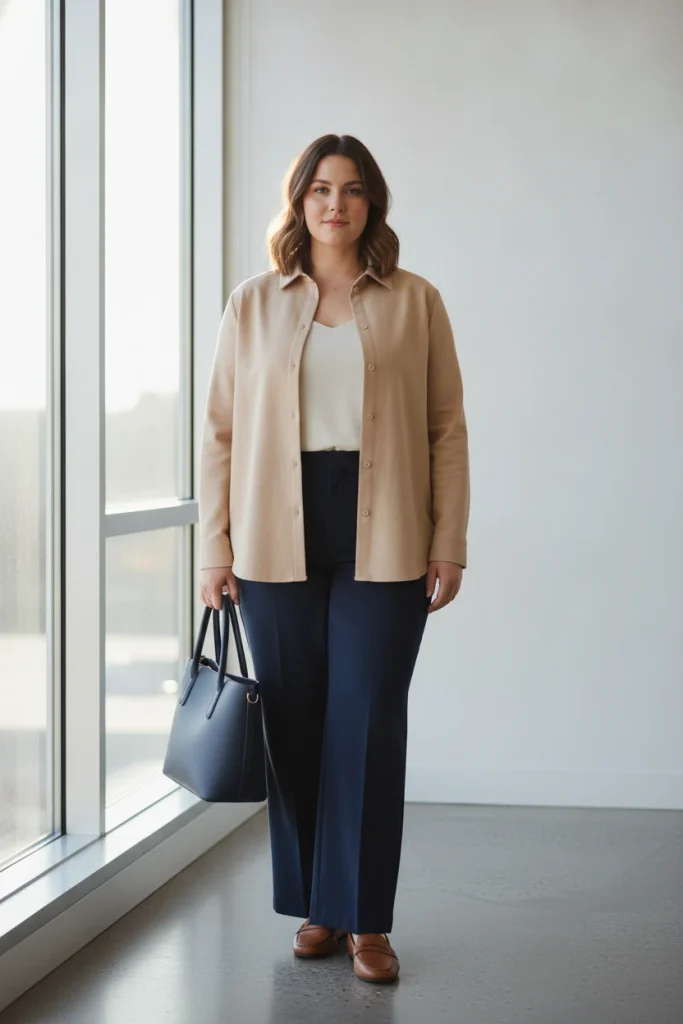
Office dress codes have loosened enough that a structured shacket in a solid neutral reads as a soft blazer, provided you treat it like one.
That means buttoning the top two or three buttons, which almost nobody does. A buttoned shacket has a center closure line, a collar, and a defined front. Left hanging open, it is a cardigan. Fastened, it is tailoring.
| Reads as outerwear | Reads as a blazer |
|---|---|
| Plaid, check or sherpa | Solid neutral, flat weave |
| Worn fully open | Top two buttons fastened |
| Patch pockets, visible topstitching | Welt pockets, clean seams |
| Sneakers or lug boots | Loafers or a low block heel |
Pair it with tailored trousers, a shell top, and loafers. Nobody in the meeting will identify it as the same category of jacket you wear to the grocery store.
8. Camel on camel, tonal and quiet
Tonal dressing is the fastest way to make inexpensive pieces read expensive, and a shacket is built for it.
Take three shades within one family. A cream knit, a camel shacket, oatmeal wide-leg trousers. Nothing matches exactly, and that is the point. Exact matching looks like a uniform. One or two shades apart looks considered.
- ▸Keep textures different so the tones do not flatten into one block.
- ▸Let the shoe be the darkest point, which grounds the whole outfit.
- ▸Add exactly one gold accessory and stop there.
Warm neutrals suit most skin tones, but if camel washes you out, run the same idea in gray and charcoal or in navy and slate. The structure is what works, not the specific color.
9. Cropped shacket with high-rise wide legs
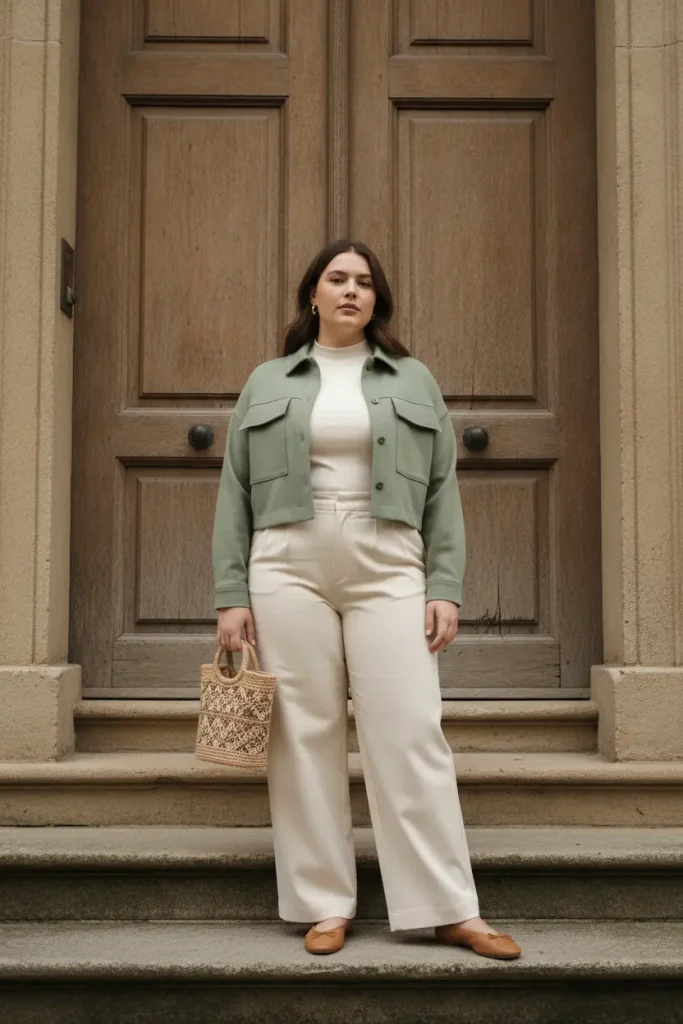
Here is the curvy shacket outfit that petite plus-size readers ask about most, because a standard shacket hem often lands mid-thigh on a shorter frame and eats the leg line.
A cropped or hip-length shacket fixes it. Pair it with high-rise wide-leg trousers and the waistband sits right at the jacket hem, so your leg visually starts at your actual waist rather than at your hip.
One warning. A cropped shacket needs a top long enough to cover the trouser waistband, or you get a sliver of visible waistband every time you raise your arms.
10. Shacket, slip skirt and sneakers
The texture gap is what carries this one. A heavy brushed flannel on top, a fluid satin or bias-cut slip skirt below, and a chunky white sneaker at the bottom.
Slip skirt on its own, which reads evening-only and needs a heel to feel finished.
Same skirt under a flannel shacket with sneakers, now a Saturday outfit you can run errands in.
Tuck a fitted tank or bodysuit into the skirt first. A loose top over a fluid skirt with a loose jacket over that is three soft layers with no anchor, and it collapses.
11. Denim shacket, white tee, and trousers for spring
A denim shirt jacket is the version that works past March, when flannel starts to feel heavy but mornings are still 52 degrees.
Keep the wash and the trouser color apart. Mid-wash denim jacket over cream or olive trousers stays crisp. Mid-wash over mid-wash jeans turns into an accidental head-to-toe denim moment that needs a lot of confidence to pull off.
Recreate this look
12. The long line shacket worn as a light coat
At knee length or just above, a shacket stops behaving like a shirt entirely and starts doing a coat’s job in 55 to 68 degree weather, which is most of October in a lot of the country.
Wear it fully open over a monochrome base so you get two long vertical panels down the sides. That is the most lengthening thing this piece can do, and it is why long shackets get recommended so often for curvy frames.
On a plane it doubles as a blanket, which is a small thing until you are on a 6 a.m. flight with the air vent stuck open. It is also the one outer layer worth packing when you are working from the 25-piece fall capsule wardrobe, since it covers three temperature bands on its own.
13. Shacket over a sweatshirt for the school run
Cozy does not have to mean shapeless. The trick is one fitted element somewhere in the outfit, and with a sweatshirt that element has to be the bottom half.
Slim straight jeans or a ponte legging, a cropped or regular-length sweatshirt with a front tuck, shacket open over the top. Two loose pieces need one narrow one, or the whole thing reads as pajamas with buttons.
⚠️ Watch Out
A hood under a collar creates a lump at the back of the neck that shows in every photo. Either pull the hood out over the collar deliberately, or pick a crewneck sweatshirt for this one.
The bulk question comes up constantly with layers like this, and the fix is almost always about thickness order rather than piece count. There is a full breakdown of how to layer outfits without adding bulk if this is the part of dressing that trips you up.
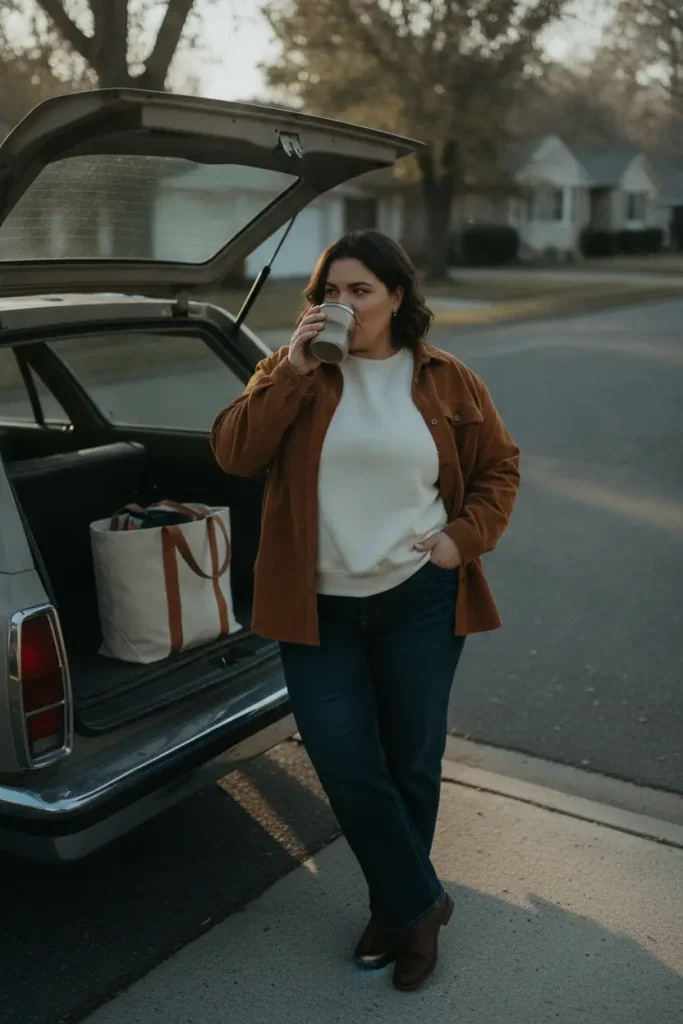
14. Shacket over a maxi dress
Length over length is the layering combination people are most afraid of, and it is the one that photographs best.
A floral or solid maxi dress with a shacket left open over it gives you two long lines running in parallel. Keep the shacket at or near the same length as the dress hem, or noticeably shorter. What does not work is a jacket hem that lands three inches above the dress hem, because that near-miss reads as a mistake rather than a choice.
A flat sandal in warm weather, an ankle boot once it cools. Both work. A heel under this combination tips it formal in a way the jacket cannot support.

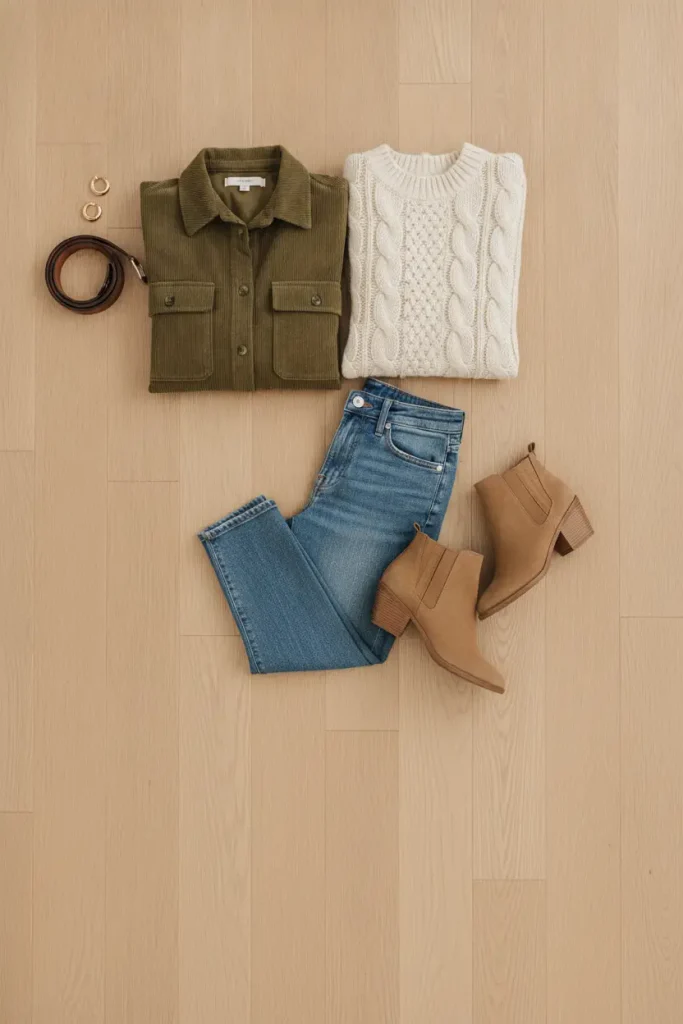
15. Corduroy shacket with a chunky knit
Corduroy showed up across the Target plus assortment this season alongside waffle knit, denim, plaid flannel, faux suede and tweed, and it is the most forgiving of the group because the wale runs vertically.
Those vertical ridges do quiet work on a wide panel of fabric. Over a chunky cream knit and straight jeans, a brown or olive corduroy shacket gives you texture without the visual weight of sherpa.
Fabric cheat sheet
If you go for a wool blend, it needs far less laundering than people assume. The Woolmark Company’s wool care guidance notes that wool is naturally odor and stain resistant, so airing a wool-blend jacket overnight usually does more than a wash cycle would. Fewer washes also means the shoulders keep their shape, which matters more on outerwear than on anything else. One good jacket, aired and not over-washed, covers a whole season.
16. Faux leather leggings and boots for dinner
The last one is the outfit that surprises people, because a flannel shirt jacket sounds like the opposite of a night out.
Faux leather leggings, a fitted black top, a heeled ankle boot, and the shacket over the top with sleeves pushed to the elbow. The leather catches light, the flannel absorbs it, and that contrast is what keeps the look from reading as either too casual or trying too hard.
One shacket, sixteen outfits, zero new purchases. That is roughly six cents per wear on a jacket bought at fall clearance, and it is why this piece earns its hanger space.
Push the sleeves higher than you would during the day. Exposed forearm is the smallest possible signal that an outfit is dressed up, and on this jacket it does most of the work.
Shacket Outfits for Plus-Size Women Frequently asked questions
What exactly is a shacket?
A shacket is a shirt jacket. It has a shirt’s construction, a button front, a collar, and cuffed sleeves, but it is cut looser and made in a heavier fabric like flannel, corduroy, sherpa or a wool blend. It is designed to work as a light jacket in mild weather and a middle layer in cold weather.
What do you wear under a shacket?
Anything fitted. A ribbed tee, a bodysuit, a thin turtleneck, or a slim knit all work because they keep the base narrow while the jacket stays loose. Avoid a second oversized piece underneath. Two loose layers with no fitted element between them is the main reason a shacket feels bulky rather than layered.
Are shackets still in style in 2026?
Yes, though the shape has shifted. Shorter cropped versions and long coat-length versions are both current, while the mid-thigh boxy cut that peaked around 2021 now looks dated. Corduroy, waffle knit and wool blends are showing up more than the heavy sherpa styles that dominated a few seasons ago.
Should plus-size women size up in a shacket?
Usually not more than one size, and often not at all. Most shackets are already cut oversized, so going up two sizes moves the shoulder seam too far down your arm and collapses the armhole. Check the shoulder seam first. If it sits about half an inch to an inch past your shoulder point, you are in the right size.
How do you wear a shacket without looking bulky?
Three things. Keep the layer underneath fitted, cuff the sleeves to the narrowest part of your forearm, and make sure the hem lands above or below the widest part of your hip rather than directly on it. Fabric choice helps too, since a draping wool blend or brushed flannel follows your shape while a stiff poly sherpa stands away from it.
Can you wear a shacket to work?
In most business-casual offices, yes, if you pick a solid neutral in a flat weave and fasten the top two buttons. Buttoning creates a center line and a defined front, which is what makes it read as a soft blazer. Pair it with tailored trousers and loafers rather than jeans and sneakers.
How much should a plus-size shacket cost?
There is a wide band. Old Navy’s oversized soft-brushed shacket lists at $69.99 and runs XS through 4X, with clearance colorways currently marked between $10.47 and $23.97. Target’s plus shirt-jacket assortment in sizes 1X to 4X sits roughly between $31 and $95 on sale against regular prices from about $41 to $127. Prices and availability change, so confirm before you buy.
Before you close this tab
A shacket is not a difficult piece. It is a forgiving one that happens to be styled badly most of the time, usually because the advice stops at “size up” and never gets to where the fabric actually has to break.
Get the shoulder, the sleeve and the hem right once, keep whatever is underneath fitted, and every one of these 16 shacket outfits for plus-size women becomes a two-minute decision on a morning when you have no decisions left in you.
Pick three looks that match your actual week, not your imaginary one. Save this to your fall board so it is there in October when the temperature finally drops and you are standing in front of the closet again.
Keep reading

16 Shacket Outfits for Women Over 50 That Look Deliberate, Not Borrowed
There is a moment, usually around the third try in front of the mirror, when a shacket stops reading as a jacket...

How to Style a Shacket: 16 Cozy Outfits for Fall and Winter
Your shacket is probably hanging in the closet right now, doing nothing, because it feels like a shirt that thinks it is...

8 Hoodie Outfits for Plus-Size Women That Actually Look Put-Together
Your closet has a hoodie in it. Probably three. And every cold morning you reach for one and think the same thing:...