
How to Layer Outfits Like a Pro (Capsule Wardrobe Tips That Actually Work)
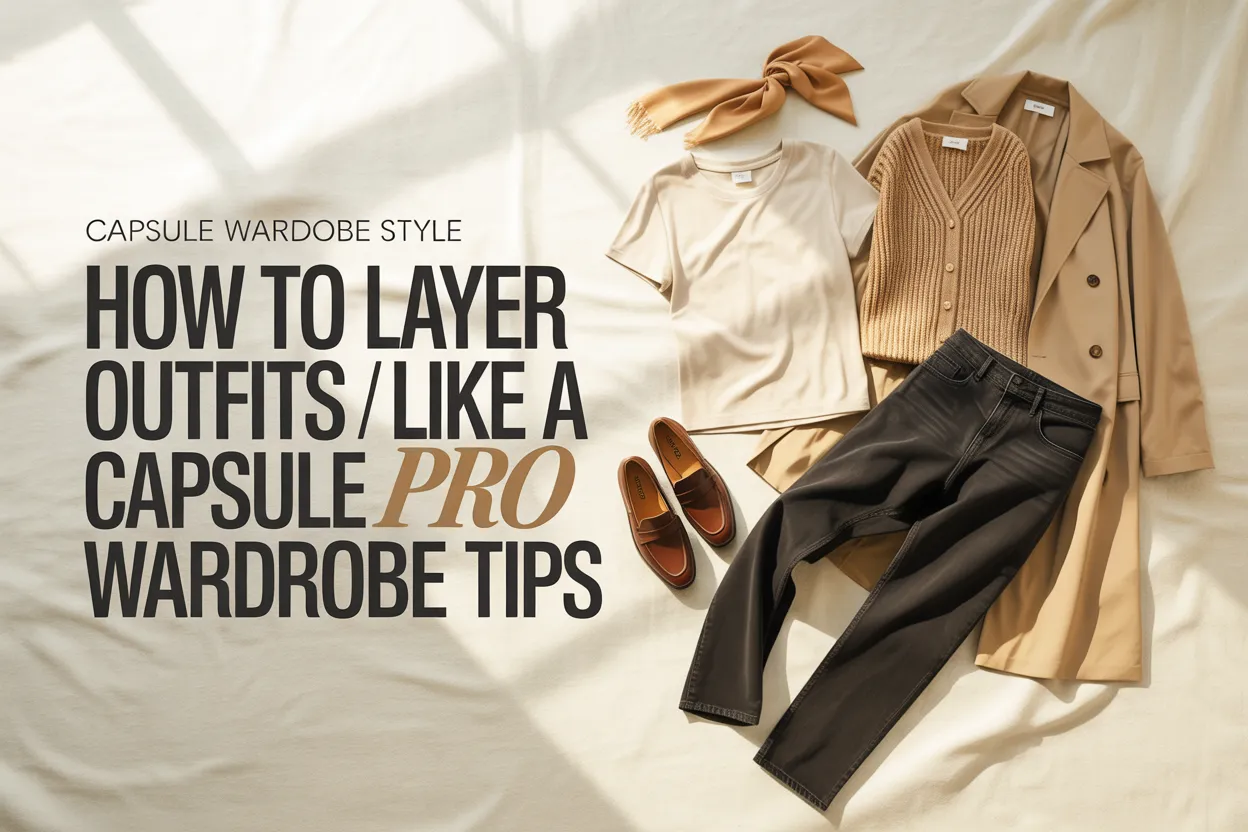
You stand in front of a packed closet at 7:42 a.m., the forecast says 48 degrees rising to 67, and absolutely nothing feels right. A sweater alone, too hot by lunch. A jacket alone, freezing on the drive in. So you grab three pieces, throw them on, and somehow end up looking like a walking laundry pile. Sound familiar? Learning how to layer outfits is the quiet skill that fixes that whole morning, and the best part is that you can do it with the capsule staples you already own.
I’ve rebuilt my own closet four times in the last six years, and layering is the single technique that doubled the outfits I get from the same 30 pieces. This guide walks you through every rule that actually matters, with adaptations for petite, tall, and plus sizes baked in.
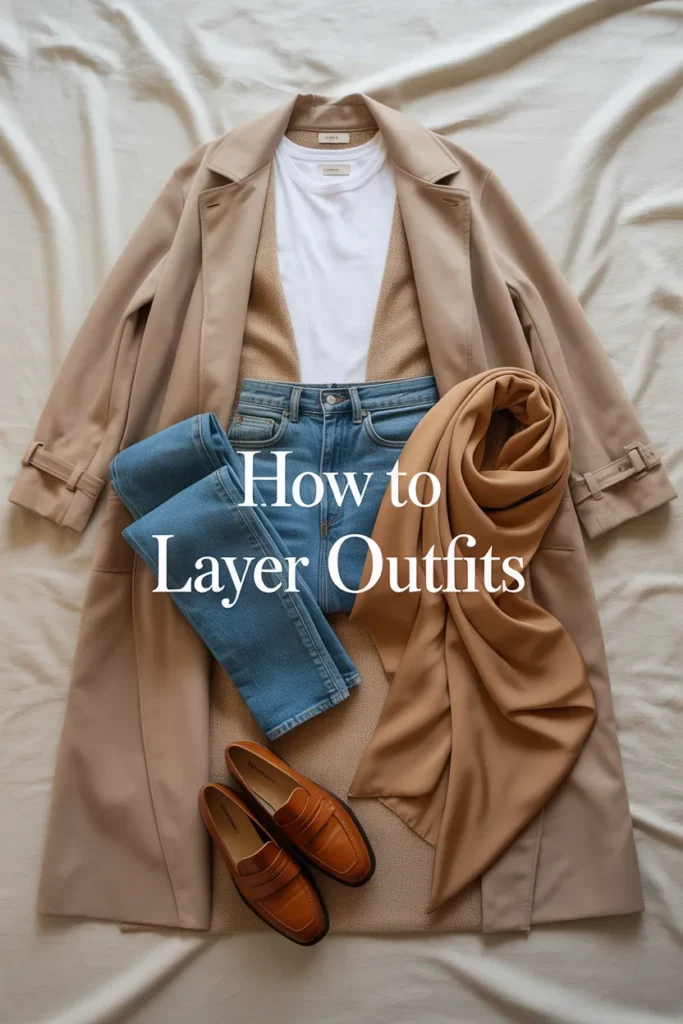
Who This Layering Guide Works For
This guide is built for women who own a capsule wardrobe or are building one. Size range covered: XS through 3X, with adaptations for petites under 5’4″, tall frames over 5’9″, and plus sizes through 22-24. Lifestyle fit: remote workers, school-run moms, office commuters, and travelers who pack carry-on only. Climate fit: anywhere with real seasons, plus mild-climate readers who deal with chilly mornings and warm afternoons.
If you live somewhere that stays above 75°F year-round, skip ahead to the summer layering section. Everyone else, start at the top.
The Foundation: 3 Rules Every Layered Outfit Follows
Before you stack a single piece, three rules sit underneath every layered look that actually works. Memorize these and you’ll stop guessing.
Rule 1: Thin to Thick, Light to Heavy
Your base layer is the lightest piece, usually a fitted tee, a thin long-sleeve, or a silk camisole. Each layer on top gets progressively heavier and looser. A merino long-sleeve goes under a chunky knit, not the other way around. A silk cami goes under a cotton button-down, never the reverse.
This works because thinner fabrics drape against the body, and heavier fabrics need room to fall properly. Get this wrong and you’ll feel every seam through your sweater.
Petite adaptation: Skip the third layer if it’s longer than mid-hip. Two layers always read taller.
Plus-size adaptation: Choose layers with similar drape, not similar weight. A drapey rayon cardigan over a fitted cotton tee gives shape without bulk.
Rule 2: The Length Stack
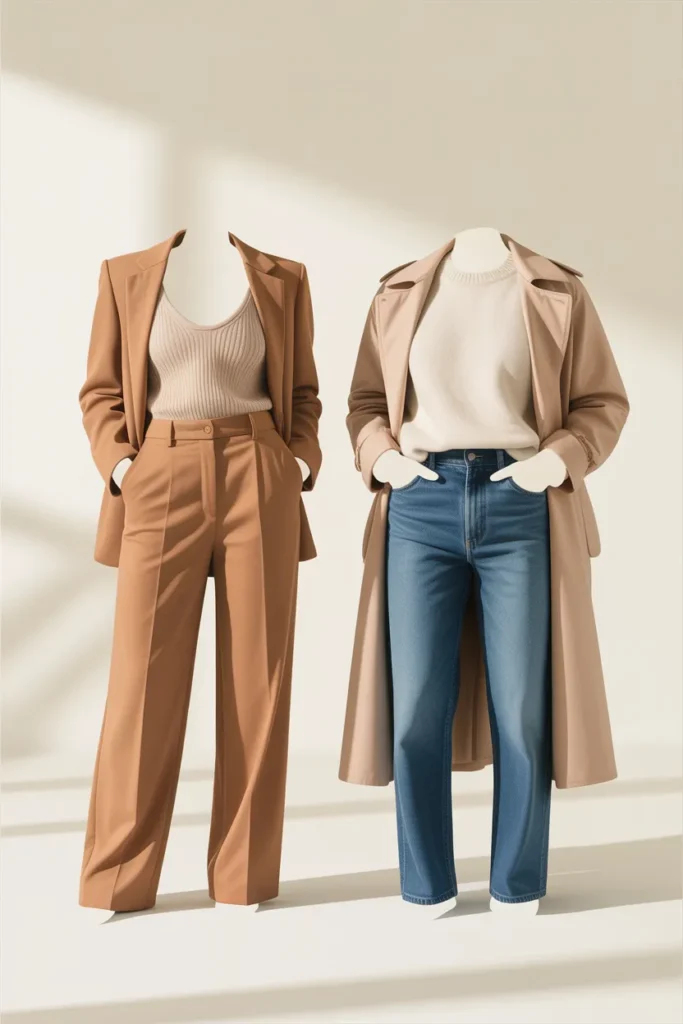
Each visible layer should hit at a different point on your body. Tee at hip, button-down at thigh, blazer at low hip, trench at knee. Four hemlines, four different reveal points. The eye reads this as intentional.
When two layers hit at the exact same length, the outfit looks flat and chopped in half. Always vary by at least 2 inches.
Rule 3: One Volume Per Outfit
If your bottom is wide-leg, your layers stay closer to the body. If your bottom is straight or skinny, your layers can go oversized. Volume on volume creates the marshmallow effect that nobody is going for.
The Temperature Band System (Nobody Else Teaches This)
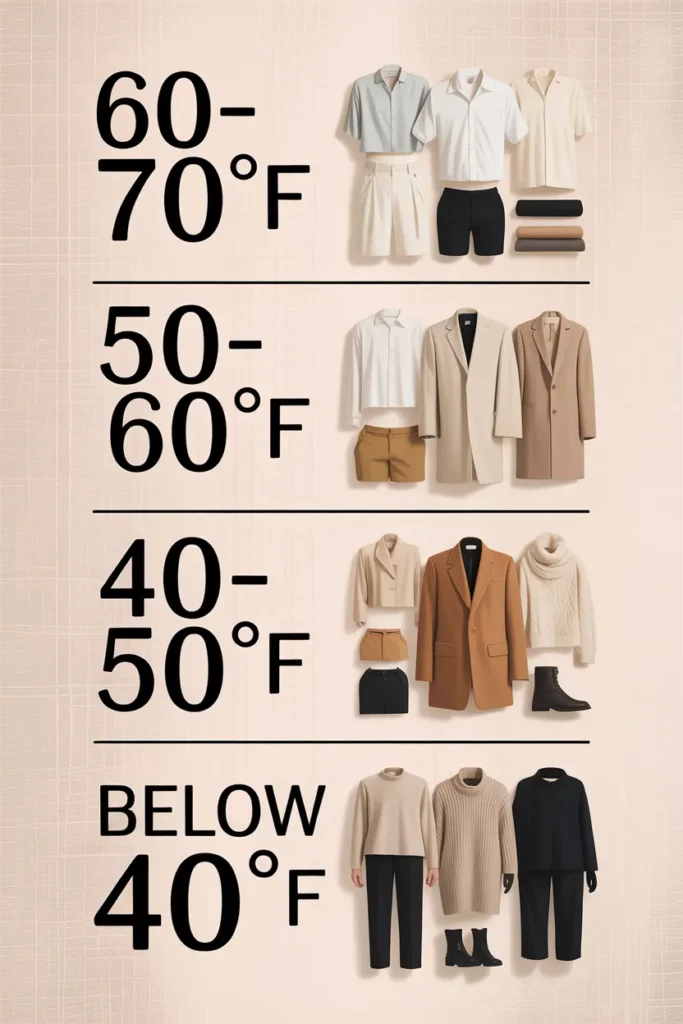
Most layering guides ignore the actual number on your weather app. Here’s how I dress by temperature band, tested through five Northeast winters and three Texas springs.
60-70°F (Mild Transitional Days)
Two layers maximum. A long-sleeve cotton tee or thin knit under an unbuttoned shirt, a cardigan, or a denim jacket. Skip the coat. This is the easiest temperature band to nail because almost any two capsule pieces work.
Style it casual: White tee, open chambray shirt, straight-leg jeans, white sneakers. Style it polished: Silk camisole, cream cardigan, tailored trousers, loafers.
50-60°F (True Layering Weather)
Three layers. Base layer, mid layer, light outer layer. This is where a trench coat earns its spot in your capsule. If you don’t already own one, our breakdown of classic trench coat picks covers the cuts and colors worth investing in.
Style it casual: Ribbed tank, oversized knit cardigan, denim jacket or light trench, jeans. Style it polished: Silk shell, fine-knit turtleneck, trench coat, straight trousers.
40-50°F (Cold but Not Freezing)
Three to four layers, with one thermal piece. Add a merino base layer that disappears under everything else. Merino is the magic fabric here because it insulates without bulk and resists odor across multiple wears, which the Woolmark Company breaks down in detail if you want the science.
Style it casual: Merino long-sleeve, oversized sweater, wool coat, jeans, ankle boots. Style it polished: Silk thermal, turtleneck, blazer, longline wool coat, trousers.
Below 40°F (Real Winter)
Four layers, including a heavyweight outer. Base, insulating mid, structured mid, outer coat. A puffer over a blazer over a sweater over a thermal is the formula city commuters have been using for years.
Petite adaptation: Choose a cropped puffer so the proportions don’t swallow you. Plus-size adaptation: Pick coats with belts or seaming at the waist for shape.
Fabric Pairing: Avoid the Puffy Layered Look
The biggest layering mistake I see on Pinterest comments is people stacking the wrong fabrics. Two thick knits trap heat and add inches. Two slippery fabrics slide around all day. Here’s the pairing chart that finally clicked for me.
| Base Layer Fabric | Mid Layer Fabric | Outer Layer Fabric |
|---|---|---|
| Cotton (100%) | Cashmere or merino | Wool, gabardine, or trench cotton |
| Silk or rayon | Cotton button-down or cardigan | Blazer or trench |
| Merino wool | Cotton sweatshirt or chambray | Puffer or wool coat |
| Modal or Tencel | Linen-blend overshirt | Lightweight jacket |
The rule that fixes 80% of bulk problems: Each layer should have a different texture and a different drape. Two smooth slippery fabrics will not stay put. Two rough fabrics will look heavy.
Care tip per fabric: Cotton (machine wash cold, tumble dry low). Cashmere (hand wash, dry flat, never hang). Merino (machine wash gentle, hang dry). Silk (hand wash or dry clean, steam don’t iron). Wool coats (dry clean, brush after wear). The American Cleaning Institute has a free fabric care symbol guide worth bookmarking.
Flag for pilling: Cheap merino blends, acrylic-heavy knits, and rayon. Buy these once and you’ll learn fast.
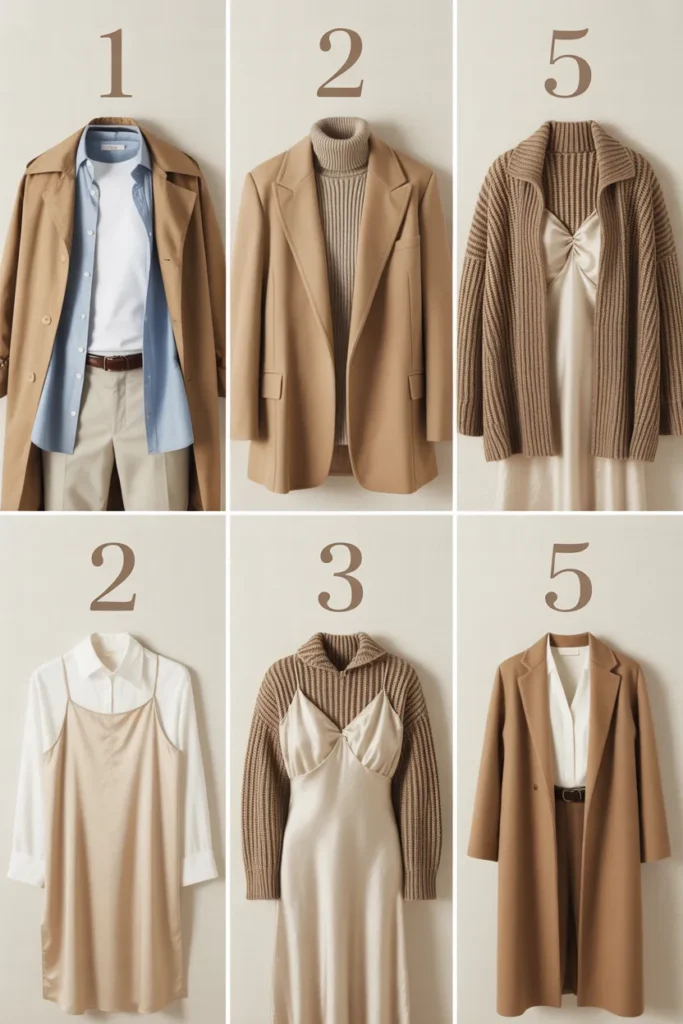
The 5 Layering Formulas That Work in Any Season
Stop overthinking and lean on these five formulas. I’ve used each one across hundreds of outfits, and they translate from a 7 a.m. school run to a 7 p.m. dinner.
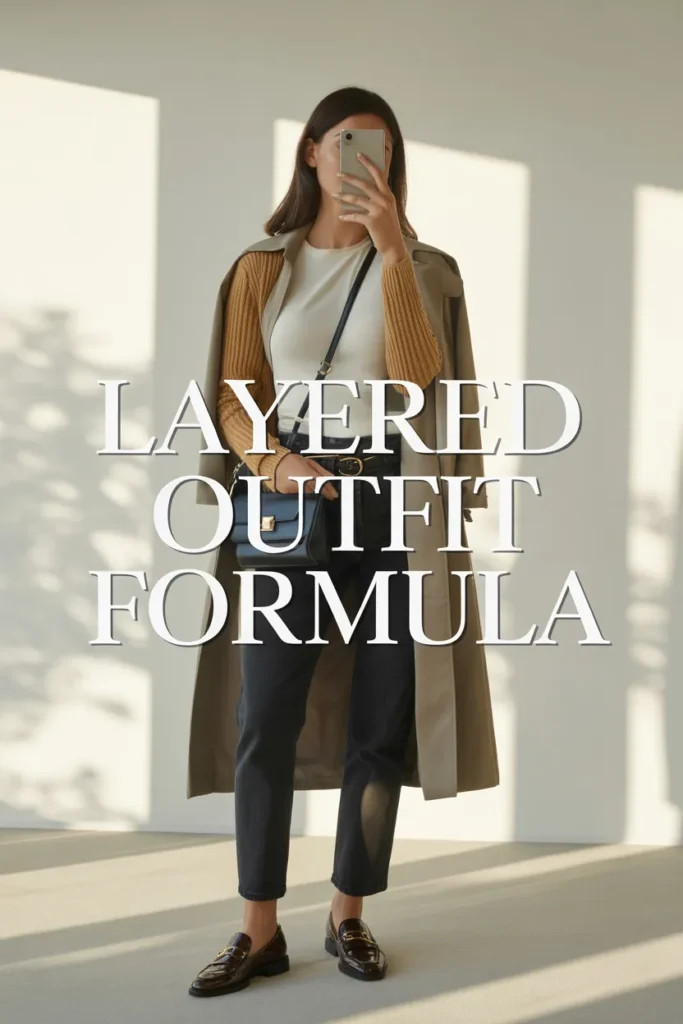
Formula 1: The Tee + Shirt + Outerwear Stack
White or cream tee, open button-down or chambray shirt, light jacket or trench. This formula works from spring through early fall and looks polished without effort.
What it is: The simplest three-piece layering combo using staples almost every capsule owns. Why it earns a spot: It scales from casual to smart-casual with a shoe swap. Sneakers down, loafers up. Two ways to style it: With wide-leg jeans and sneakers for weekend errands. With straight trousers and loafers for a smart-casual lunch.
Formula 2: The Turtleneck + Blazer
Fine-knit turtleneck (merino or cotton blend) tucked into trousers or jeans, with a structured blazer on top. Pin pin #5 in your data deck called this the “always looks put together” outfit for a reason.
What it is: A two-layer formula that reads expensive every single time. Why it earns a spot: Cost-per-wear on a great turtleneck and a great blazer hits pennies fast. Two ways to style it: With dark trousers and ankle boots for a meeting. With wide-leg jeans and white sneakers for off-duty polish.
Formula 3: The Slip Dress + Knit Layer
A slip dress (silk or satin midi) under a fitted crewneck sweater or oversized cardigan, with ankle boots or loafers.
What it is: A capsule outfit that turns a summer dress into a fall and winter staple. Why it earns a spot: One dress, three seasons. Few pieces earn their hanger space like this. Two ways to style it: Under a cropped sweater with tall boots for fall. Under a longline cardigan with ankle boots for winter.
Plus-size adaptation: Look for the same silhouette in extended sizes at Universal Standard or Anthropologie’s plus line. The slip-and-sweater layer reads beautifully on every body.
Formula 4: The Vest Layer
A knit vest, a quilted vest, or a sweater vest worn over a button-down shirt. Vests add a layer of warmth and visual interest without sleeves to fight with.
What it is: A non-bulky mid-layer that opens up your sleeve styling. Why it earns a spot: Vests pack flat for travel and add zero weight to a carry-on. Two ways to style it: Sweater vest over a white button-down and straight jeans for academia-leaning days. Quilted vest over a long-sleeve tee and leggings for an active weekend.
Formula 5: The Long Coat Over Everything
A wool coat, longline trench, or puffer that hits at the knee or longer, worn over any two-piece outfit underneath. The coat does the styling work for you.
What it is: The cheat code for cold days when you only have 90 seconds. Why it earns a spot: A great coat covers a multitude of outfit decisions and adds instant polish. Two ways to style it: Belted at the waist for shape with trousers and loafers. Open and unbelted with jeans and sneakers for casual ease.
Layering by Season
The same five formulas adapt to every season. Here’s how the long-tail Pinterest searches actually break down.
How to Layer Outfits for Fall
Fall is the easiest season to layer because the temperature swings every day. Lean on Formulas 1, 4, and 5. A trench coat, a chunky cardigan, and a few long-sleeve tees will carry you from September through November.
Key pieces: Long-sleeve cotton tees, fine-knit cardigans, a stone or camel trench coat, straight-leg jeans, ankle boots, a silk scarf.
How to Layer Outfits for Winter
Winter layering means leaning on Formulas 2, 3, and 5 with thermal base layers added. A merino long-sleeve under everything changes the game. Wool coats over blazers, blazers over sweaters, sweaters over thermals.
Key pieces: Merino thermals, turtlenecks, structured blazer, wool coat or longline puffer, dark jeans or trousers, knee-high boots.
How to Layer Outfits for Spring
Spring layering is fall layering in reverse. Mornings are cold, afternoons warm up fast, so build outfits you can peel down. Formulas 1 and 4 shine here. Skip the heavy outer and pick a denim jacket, trench, or knit blazer.
Key pieces: White tees, chambray shirts, sweater vests, trench coat, straight jeans, white sneakers or loafers.
How to Layer Outfits for Summer
Yes, summer layering exists, and it’s mostly about lightweight pieces that protect from sun and over-air-conditioned offices. Think a tank under a linen button-down (worn open and rolled), or a silk camisole under a relaxed blazer.
Fabric must: Linen, cotton lawn, silk, and modal. Nothing synthetic for the base layer or you’ll regret it by 10 a.m.
Petite adaptation: Crop the overshirt at the hip and keep sleeves rolled to mid-forearm.
How to Layer Outfits for an Aesthetic Look
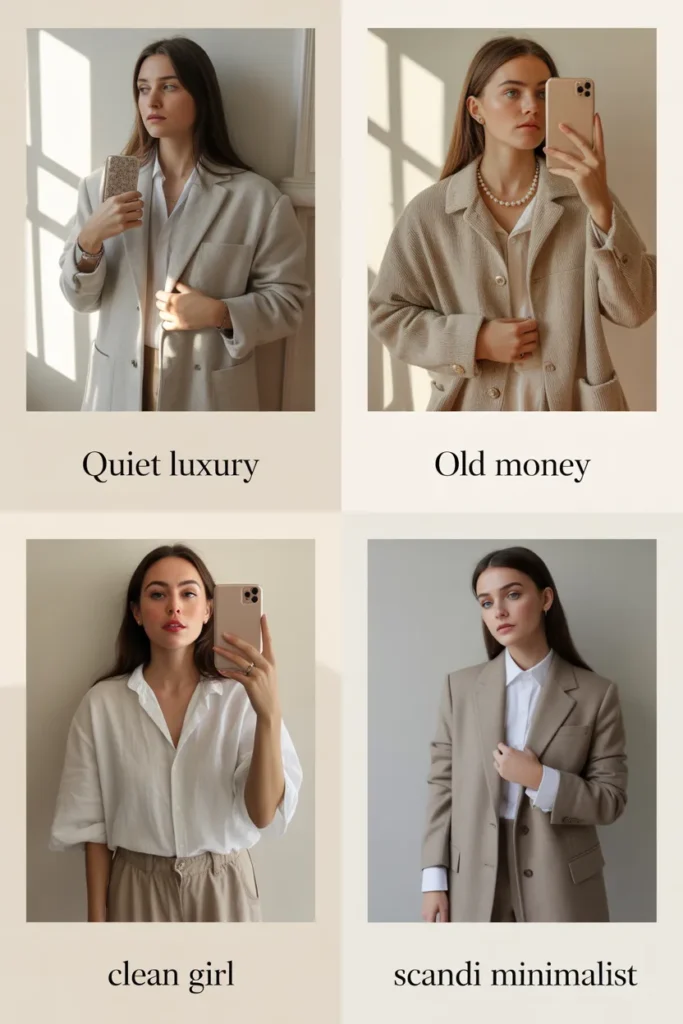
The trending aesthetics on Pinterest right now (quiet luxury, old money, clean girl, scandi minimalist) all rely on the same layering principles with different color palettes and fabric choices.
- Quiet luxury layering: Cream, oat, camel, charcoal. Cashmere, merino, silk. Long lines, minimal hardware.
- Old money layering: Navy, cream, hunter green, burgundy. Tweed, cotton oxford, cashmere. Structured pieces.
- Clean girl layering: White, beige, soft gray. Cotton, linen, knit basics. Tonal and uncluttered.
- Scandi minimalist: Black, white, gray. Wool, cotton, leather. Sharp lines and architectural shapes.
The pieces are the same. The palette and fabric weight do the aesthetic work.
The 60-30-10 Color Rule for Layered Outfits
Borrowed from interior design, the 60-30-10 rule keeps layered outfits from looking like a color collision.
- 60% dominant color: Your largest pieces (coat, pants, dress)
- 30% secondary color: Your mid-layer or top
- 10% accent color: Your shoes, bag, scarf, or jewelry
A camel trench (60%), a cream sweater (30%), and a chocolate brown loafer (10%) lands every time. Swap chocolate for a deep red lip and gold jewelry and you’ve still nailed the formula.
For a deeper dive into building a closet that hits this rule by default, our guide to building a neutral capsule wardrobe walks through the exact palette I use.
Build This Look From What You Already Own
Open your closet right now. Pull out:
- One white or cream tee (almost certainly there)
- One cardigan, sweater, or button-down shirt
- One coat or jacket
- One pair of straight-leg or wide-leg pants
- One pair of loafers or white sneakers
That’s a complete layered outfit using Formula 1. If you’re missing any of these foundation pieces, our roundup of 12 best basics under $30 covers wallet-friendly replacements that hold up.
The capsule mindset isn’t about buying more. It’s about wearing what you own in five different combinations instead of one.
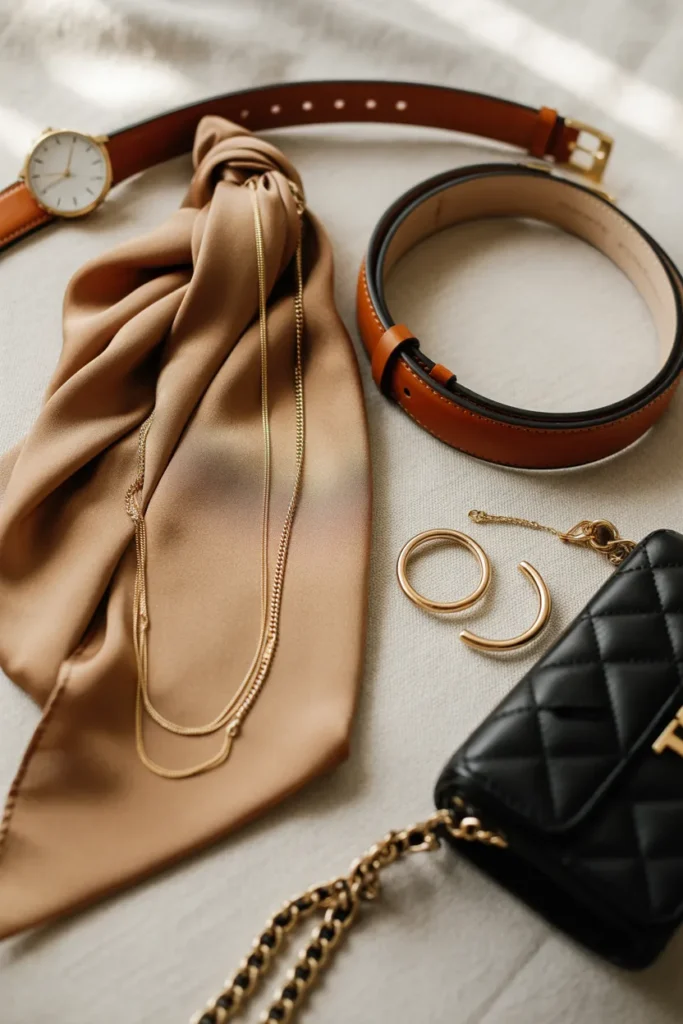
Accessory Layering (The Layer Nobody Talks About)
Once your clothing layers are dialed in, accessories add the finishing layer most outfits are missing.
- Scarves: A silk square at the neck, a wool wrap thrown over a coat, or a long oblong tucked into a trench collar.
- Jewelry: Two delicate necklaces of different lengths, stacked gold hoops, or a watch plus a cuff.
- Belts: Cinching a long cardigan or open trench at the waist creates instant shape and adds another visual layer.
- Bags: A crossbody worn over a coat introduces a fourth color and a structural line.
Care tip: Steam silk scarves on the steam setting, never iron. Polish gold and gold-plated jewelry with a soft cloth after wear to prevent tarnish.
How to Layer for Petite, Tall, and Plus Sizes
A note on adapting every formula above:
Petite (under 5’4″): Crop your longest layer or tuck it in. Two layers visible at any time, not three. Pick mid-rise or high-rise bottoms to lengthen the leg line.
Tall (over 5’9″): Embrace the third visible layer because you have the vertical real estate. Longline coats, maxi cardigans, and longer trousers balance your frame.
Plus size: Look for pieces with intentional shape (belts, ruching, structured shoulders) and stay in the same color family for the first three layers to elongate. Size up in outer layers to avoid pulling. Universal Standard and Old Navy both carry the same silhouettes through 4X.
Layering for Travel (Carry-On Capsule)
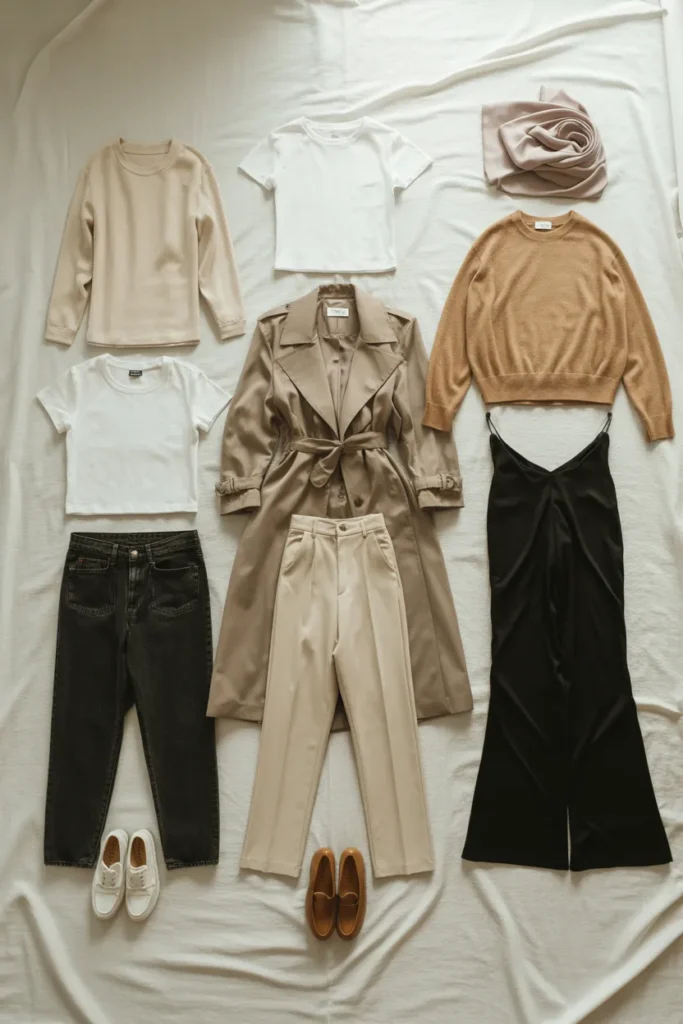
Layering is how you survive a 7-day trip with one carry-on. The trick is choosing pieces that each play three roles.
A trench coat is your warm layer on the plane, your rain shield in the city, and your evening cover-up over a dinner outfit. A merino long-sleeve is your base, your alone-piece on a warm day, and your pajama top in a pinch. A scarf is a wrap, a blanket, and an outfit upgrade.
Pack: 1 trench, 2 long-sleeve layers, 2 tees, 1 sweater, 2 bottoms, 1 dress, 2 pairs of shoes, 1 silk scarf. That’s it. Mix and match yields 25-plus outfits.
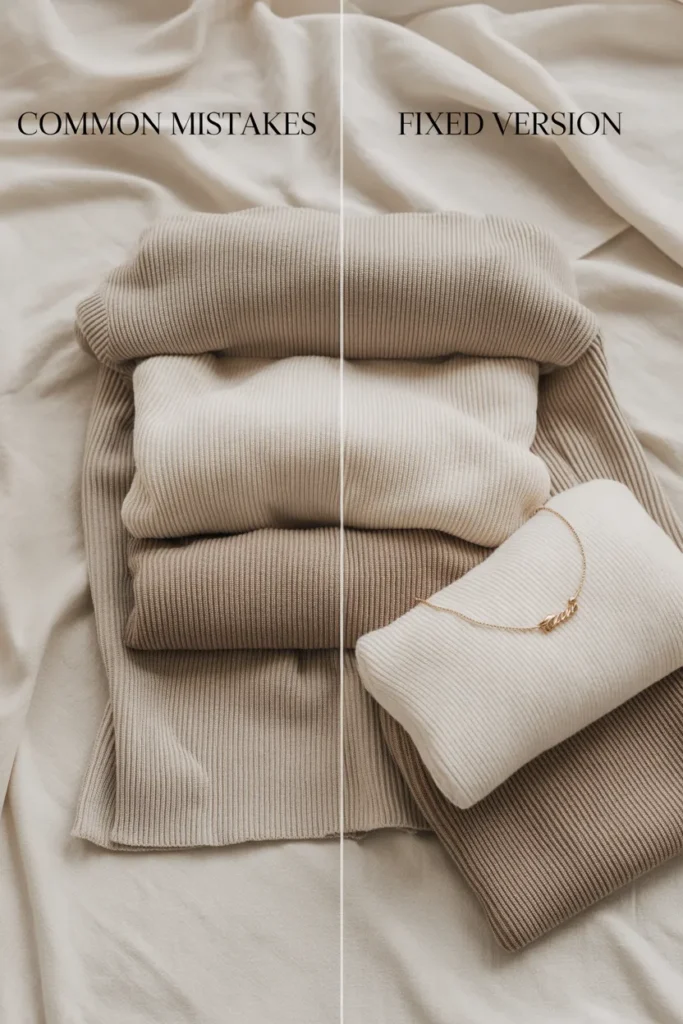
Common Layering Mistakes to Avoid
After helping readers troubleshoot their outfits for years, these are the five mistakes I see most often.
- Stacking three thick fabrics. Always alternate weights.
- Matching hemlines. Vary by 2 inches minimum.
- Skipping the base layer in winter. A merino long-sleeve transforms every cold-weather outfit.
- One color, one tone. Even monochrome outfits need a contrast in texture or shade.
- Forgetting accessories. A scarf or belt finishes 90% of layered looks.
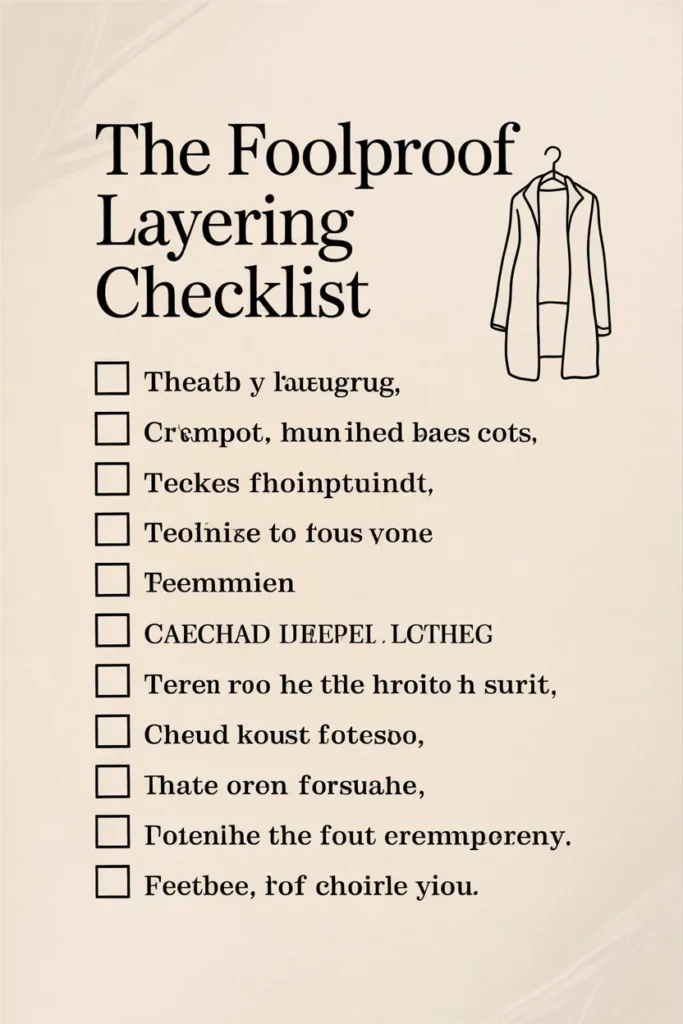
The Foolproof Layering Checklist
Screenshot this and save it to your phone.
- ☐ Base layer is the thinnest fabric
- ☐ Each layer has a different texture
- ☐ Hemlines vary by at least 2 inches
- ☐ One volume rule: full bottom equals slim top, slim bottom allows oversized top
- ☐ 60-30-10 color rule is in play
- ☐ At least one accessory layer (scarf, belt, jewelry, or bag)
- ☐ Outfit can survive a 15-degree temperature swing
Frequently Asked Questions
How do I layer outfits without looking bulky?
Alternate fabric weights. A thin base under a medium mid under a structured outer reads as intentional. Three thick pieces read as bulky. Also vary your hemlines by at least 2 inches so each layer is visible.
What is the rule of 3 in layering?
The rule of 3 means three visible layers: base, mid, outer. Each one serves a different purpose. The base manages comfort against the skin, the mid adds insulation, and the outer manages weather and structure. Three layers is the sweet spot for most outfits between 40°F and 60°F.
How do I layer outfits in summer without overheating?
Stick to natural breathable fabrics: linen, cotton, silk, modal. Wear an open layer (an unbuttoned linen shirt, a relaxed blazer worn open) rather than a closed one. Choose lightweight fabrics for both base and over-layer. Skip anything synthetic.
How do I style this if I don’t own a trench coat?
A trench is the most versatile layering coat, but a longline cardigan, a denim jacket, or a wool blazer all play the same role in different temperature bands. The trench wins on rain resistance, but any of the three substitutes will let you build the layered look until you invest in one.
What size should I order if I’m between sizes for layering pieces?
Size up on outer layers (coats, blazers, cardigans) so you have room for the layers underneath without pulling at buttons or shoulders. Size down or stay true on base layers so they sit close to the body. Mid-layers can go either way depending on the silhouette you want.
Is this layering system seasonal or year-round?
Year-round. The temperature-band system means you adjust the fabric weights and the number of layers, but the proportion rules, the hemline stacking, and the 60-30-10 color rule apply in July just like they do in January.
How do I pack layered outfits for travel?
Pack pieces that play three roles each. A trench, a merino long-sleeve, and a silk scarf each work as outerwear, base layer, and styling piece depending on the day. Roll knits and base layers, fold structured pieces, and pack shoes flat against the suitcase walls.
Can I layer outfits if I’m petite or plus size?
Absolutely. Petites should keep visible layers to two and use cropped or tucked top layers to maintain height. Plus sizes look beautiful in three-layer outfits with intentional shape (belts at the waist, structured shoulders, longline coats). The principles are universal. The proportions adapt.
A Final Note on Capsule Layering
Mastering how to layer outfits is the closest thing to a wardrobe cheat code. The pieces you already own become five times more useful. Mornings get faster. Closet regret quiets down.
Save this guide for your next capsule wardrobe refresh, and start with whatever formula matches the weather tomorrow. The pieces are already in your closet. The skill is in the stack.
Keep reading

How to Style a Jacket for Plus-Size Women: 10 Outfits That Work
A lot of jacket advice for bigger bodies is still written around hiding. Hide the hips, hide the arms, hide under something...

How to Style a Jacket for Women Over 50: 12 Outfits That Work
Your closet probably holds more jackets than you wear. There’s the blazer from an old job, the denim jacket you’re unsure about...

How to Style a Jacket: 10 Cozy Jacket Outfits for Fall and Winter
Your jacket is the first thing people see between October and March. It’s also the piece most of us grab last and...
3 Comments