
What to Wear to a Hockey Game Without Freezing or Buying Anything New
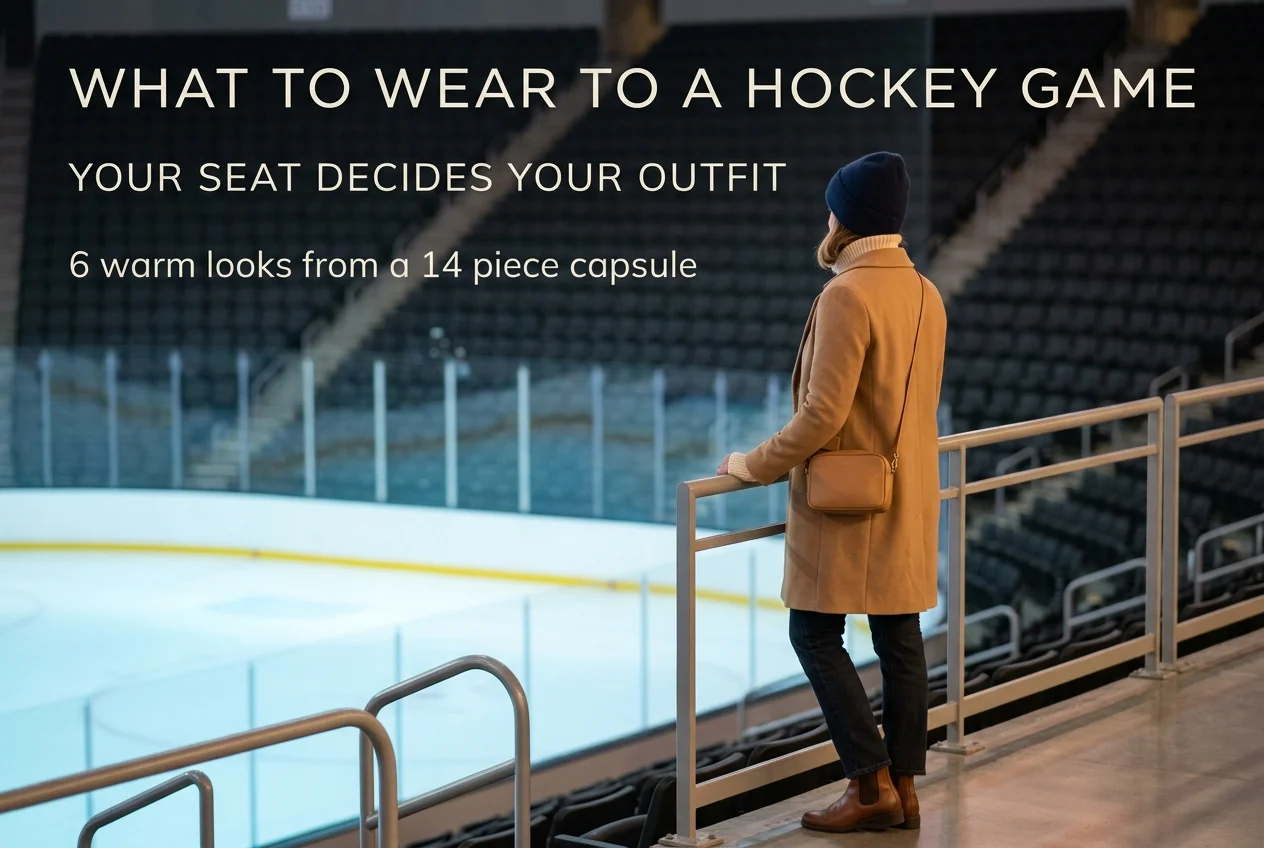
Someone hands you a ticket and your first thought is not about hockey. It’s about what to wear to a hockey game when you’ve never sat in an arena and have no idea how cold sixty minutes of ice actually feels from row twelve. Here’s the part nobody tells you: the answer is printed on your ticket. Your section number decides your outfit more than the weather does, and once you know that, the whole thing gets easy. Your closet already has this covered. <!– IMAGE 1 –>
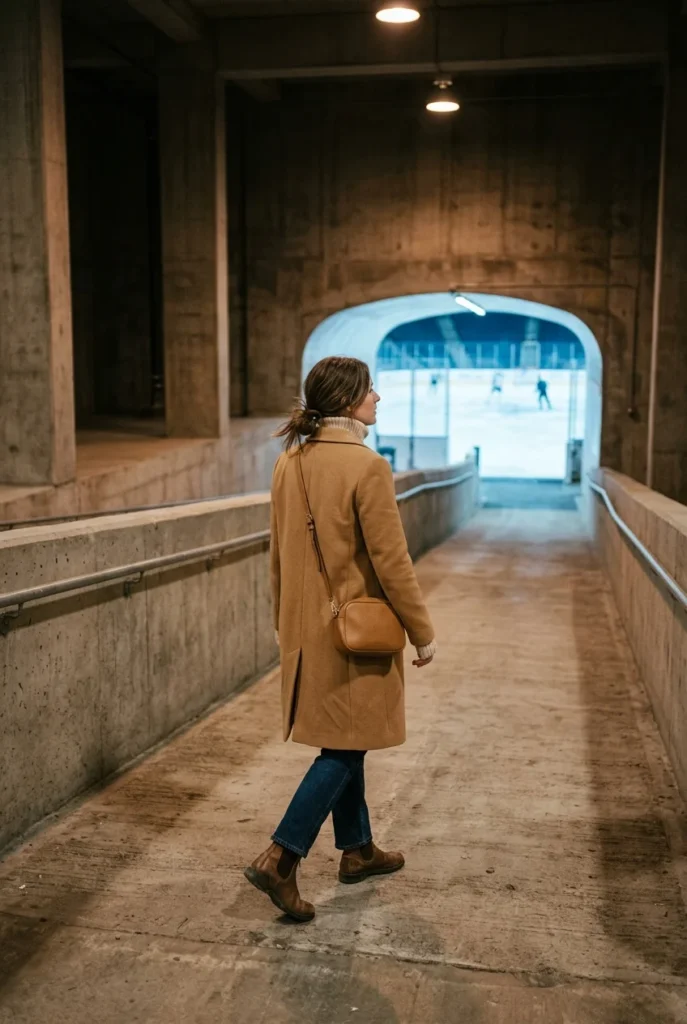
I’ve written a version of this guide for the way I plan an outfit for a baseball game, and hockey is the harder problem. Baseball you dress for the sky. Hockey you dress for a building that’s actively refrigerated for three hours while you sit still in it.
Your Ticket Tells You What to Wear: The Section Number Rule
Most guides give you one answer for a building that has four different climates in it. That’s why women show up in a parka and roast in the 300 level, or wear a cute cropped jacket to glass seats and spend the second period with their arms inside their sleeves.
Look at your ticket before you look in your closet.
| Where you’re sitting | What it actually feels like | Outfit weight |
|---|---|---|
| Glass seats, rows 1 to 10 | 40F to 50F, with cold air coming off the ice all night | Heaviest. Coat stays on. |
| Lower bowl, row 11 and back | 55F to 60F | Medium. Layer you can shed. |
| Club and concourse level | 60F to 65F | Medium light. |
| Upper deck, 200 and 300 level | 5F to 10F warmer than ice level, warm air rises | Lightest. You will overheat in a parka. |
| Local or rec rink, any seat | 32F to 40F, basic heating, outside air gets in | Everything you own. |
Screenshot that. It’s the single most useful thing on this page.
Glass seats are the trap. They’re the best seats in the house and the coldest, because you’re sitting at ice level with nothing between you and the sheet. Cold air sinks, so it pools exactly where you are. Upper deck is the opposite problem, and it’s a real one: I’ve watched people peel off three layers by the first intermission up there and sit in a t-shirt the rest of the night.
One more variable the ticket won’t tell you. If your seat is on an aisle near a tunnel or a concourse entry, you’ll catch a draft every time the doors swing. Add a layer for that.
How Cold Is It at a Hockey Game, Really
The ice itself sits at roughly 24F to 25F. That number scares people, and it shouldn’t, because you’re not sitting on the ice. Seating areas in professional arenas are generally held somewhere between 58F and 65F. <!– IMAGE 2 –>
Nano Banana prompt: A quiet detail shot of empty arena seats in soft charcoal, photographed from a low side angle with the pale blue ice surface blurred in the background. A folded oat colored wool scarf and a soft black beanie rest on one seat, with a woven tote leaning against the seat base. Cool ambient light comes from the ice below and slightly to the left, with dim warm overhead fixtures adding a faint glow from above. Editorial and photorealistic, generous negative space, muted neutral palette, no people, no logos. Alt text: Scarf, beanie and tote on arena seats showing how cold a hockey game gets.
So 60F, give or take. That sounds mild written down. It does not feel mild after two hours of sitting still, because your body isn’t generating heat and you’re getting a slow steady draft off a refrigerated surface. Sixty degrees moving is a nice fall day. Sixty degrees seated and motionless is a cardigan and then some.
Rec rinks and youth arenas are a different animal entirely. Those buildings often run 32F to 40F in the stands. If you’re going to watch a kid play at seven in the morning at a local rink, dress like you’re going outside, because functionally you are.
Season matters too, and not for the reason you’d think. The 2026-27 season opens September 29 and runs through April 10, so the league published an 84 game schedule this year that spans early fall through mid spring. An October game means you’re dressing for a 70F parking lot and a 58F arena. A January game means the arena is the warm part of your night. Same building, opposite problems, and the walk from the car is what changes.
The Five Slot Game Day Formula
Every outfit in this guide is built from the same five slots. Fill each one, walk out the door, stop thinking about it.
Slot 1: Base. Something long sleeved and close to the body. A fitted long sleeve tee, a ribbed turtleneck, a thin thermal. This is your insurance layer and nobody sees most of it.
Slot 2: Bottom. Full length, always. Denim, thick knit leggings, corduroy.
Slot 3: Mid. The piece doing the actual work. Sweatshirt, sweater, quilted vest, flannel.
Slot 4: Feet. Closed toe, warm sock, broken in.
Slot 5: Signal. One small thing in a team color so you read as a fan without wearing a costume. A beanie, a scarf, a hair ribbon, earrings. <!– IMAGE 3 –>
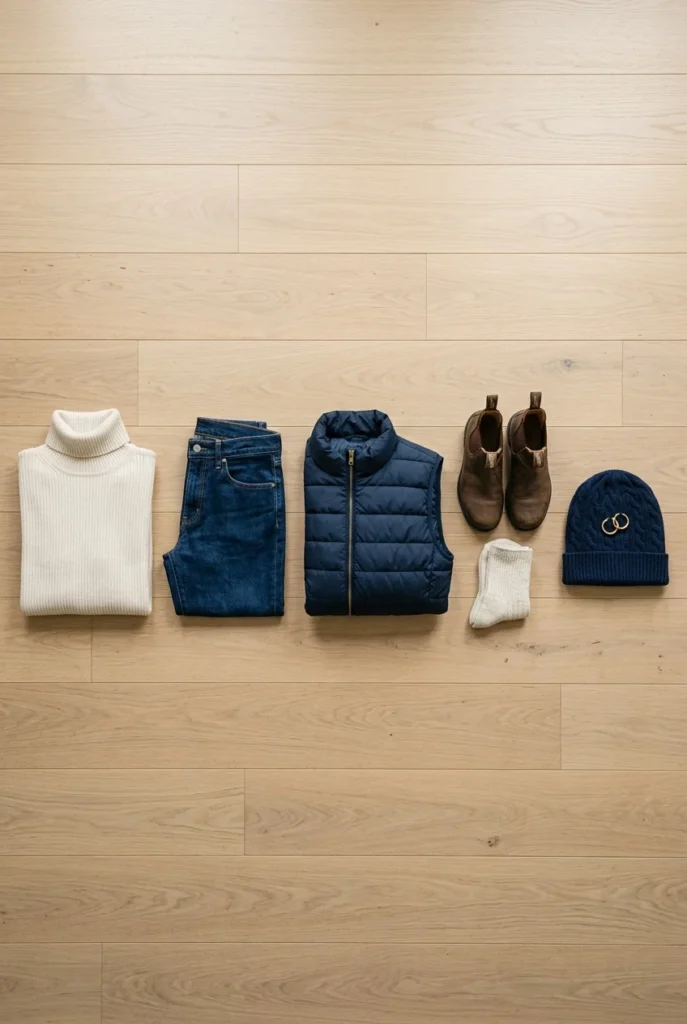
That’s it. Five slots, and slot five is the only one that has anything to do with hockey.
The reason this works better than a packing list is that it scales. Cold seats? Make slot three heavier and add a coat. Upper deck in October? Slot three becomes a cardigan you can tie around your waist. The structure doesn’t change, only the weight of what fills it.
Base Layers That Do the Quiet Work
A base layer is not thermal underwear from a camping store, though if you own that and you’re in glass seats, wear it and thank me later.
For most games, a fitted long sleeve cotton or modal tee is exactly right. Uniqlo’s Heattech line usually lands somewhere around $15 to $25 and is genuinely warmer than its thickness suggests, which matters when you’re trying not to look padded. A ribbed turtleneck in cream or oat does the same job and looks finished on its own if the building runs warm.
Skip anything sleeveless underneath. Your upper arms are what get cold first when you’re seated with a drink in your hand.
One fabric note worth having: cotton holds moisture, and if you walk in from a cold parking lot slightly damp you’ll stay cold all night. A merino or modal blend base solves this quietly. It’s the least visible upgrade in the outfit and the one you’ll feel most.
Bottoms That Survive Three Hours in a Stadium Seat
Full length, every time. This is the rule I’d break for nothing.
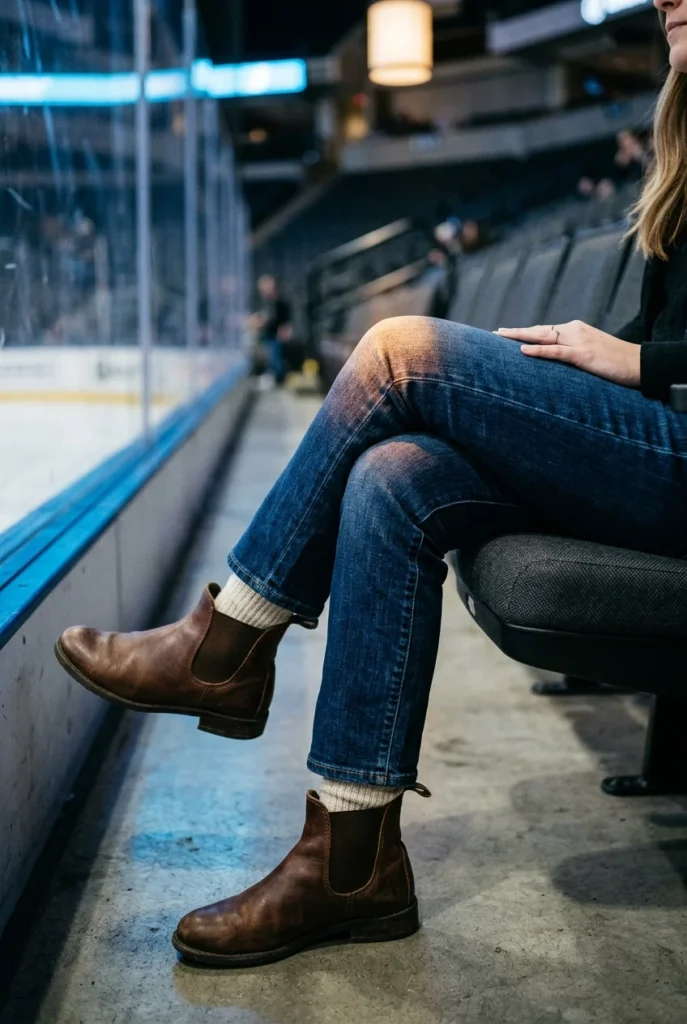
Straight leg or slightly relaxed dark denim is the workhorse. It handles a cold seat, it survives a spilled drink, and it photographs well in bad arena lighting, which is genuinely a factor if anyone’s taking pictures. Madewell’s straight leg jeans typically run around $98 to $148, and Old Navy or Gap will get you close for $35 to $50 with a slightly softer hand. <!– IMAGE 4 –>
Thick ponte or fleece lined leggings are the warmest option and the most comfortable for a long sit. The trade at the sub-$30 price point is usually opacity and pilling, so hold them up to a window before you commit. Pair them with a longer mid layer so the proportions stay balanced.
Corduroy is underrated here. It’s warmer than denim, it has texture that reads as intentional in photos, and a wide wale trouser in chocolate or camel looks considered without trying.
What doesn’t work: anything cropped at the ankle in a cold arena, and anything you have to keep adjusting when you stand up for a goal. You’ll stand up more than you expect.
The Mid Layer Is Doing Most of the Work
If you get one slot right, make it this one.
A quilted vest is the single best hockey layer I know, and it’s not close. It adds real warmth through your core, it leaves your arms free so you’re not fighting sleeve bulk when you reach for a drink, and it layers over a turtleneck or under a coat without turning you into a marshmallow. A quilted vest layers flatter than almost anything else when the temperature is unpredictable, which describes every arena I’ve been in. <!– IMAGE 5 –>
Nano Banana prompt: A woman photographed from the back at three quarter angle, leaning on a concourse railing overlooking the ice, wearing a navy quilted vest over a cream ribbed turtleneck with her hair loosely tied. Soft side window light from a concourse opening on the right rakes across the quilted texture, while the cool blue of the rink glows faintly below and to the left. Editorial and photorealistic, generous negative space to the left, warm neutral palette with the navy as the single deeper tone, no logos. Alt text: Navy quilted vest over cream turtleneck, a warm hockey game outfit that layers flat.
A crewneck sweatshirt in gray or cream is the easy answer and there’s nothing wrong with easy. A cable knit or lambswool sweater in camel or oat is the version that looks like you thought about it. Quince’s cashmere crewnecks tend to sit around $50 to $70, which is unusual for the fiber, though the knit runs finer than a chunky sweater so plan on a real base underneath.
Flannel deserves a mention because it’s the one piece that reads hockey without any team logo on it. Worn open over a white tee with the sleeves pushed up, it’s the most natural looking thing you can wear to a rink.
Outerwear You Can Actually Sit Down In
Here’s the thing about coats at hockey games. You’re going to be wearing yours for at least part of the night, and you’re going to be sitting in a seat that’s about eighteen inches wide with people on both sides of you.
A giant puffer is warm and it’s a genuine problem in a packed lower bowl. You take up two seats worth of space, you can’t put your arms down, and there’s nowhere to put it if you take it off. A packable puffer that compresses into your lap solves both halves of that.
A wool overcoat is the better looking choice and works down to about 30F outside if your base and mid layers are doing their jobs. It also drapes rather than puffs, so you can sit in it. Camel, charcoal, and navy all read polished in a setting where almost nobody is trying. If you’re building outerwear from scratch, the capsule wardrobe jackets that earn their hanger space covers which shapes actually pull their weight across a season. <!– IMAGE 6 –>
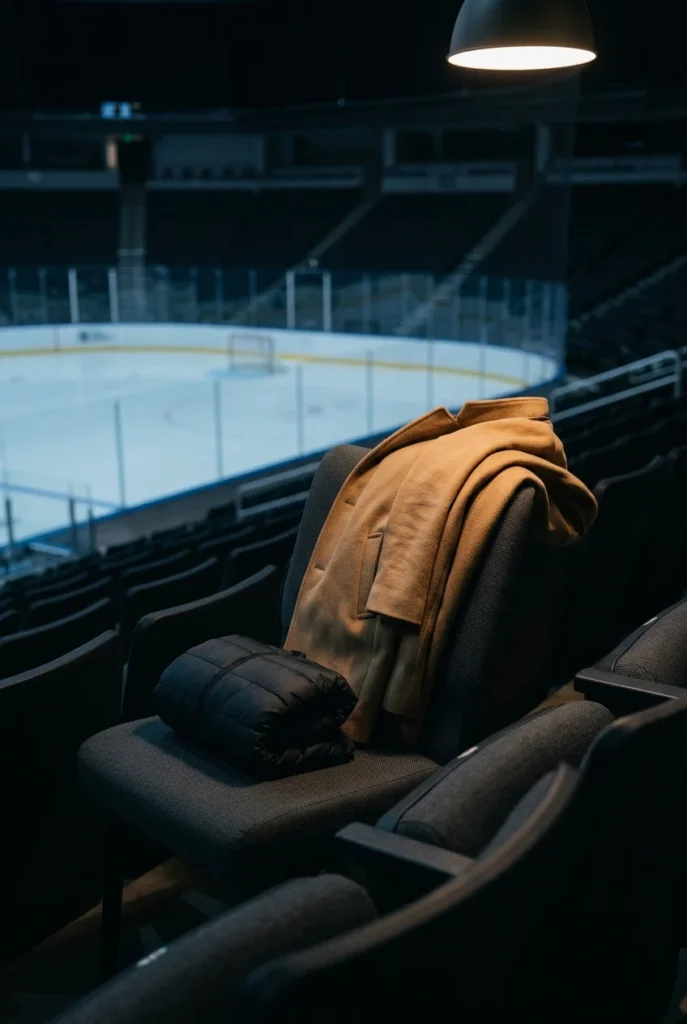
A denim jacket alone is not enough for an indoor game past October, and it’s a great mid layer under a wool coat.
Shoes for a Hockey Game
Warmth first, and then everything else takes care of itself.
Leather Chelsea boots are the best all around answer. They’re warm with a wool sock, they handle a wet parking lot, they’re easy to walk a long concourse in, and they look deliberate. If you already own a pair in brown, outfits that already work with brown boots will get you most of the way to a finished look before you’ve thought about the top half. <!– IMAGE 7 –>
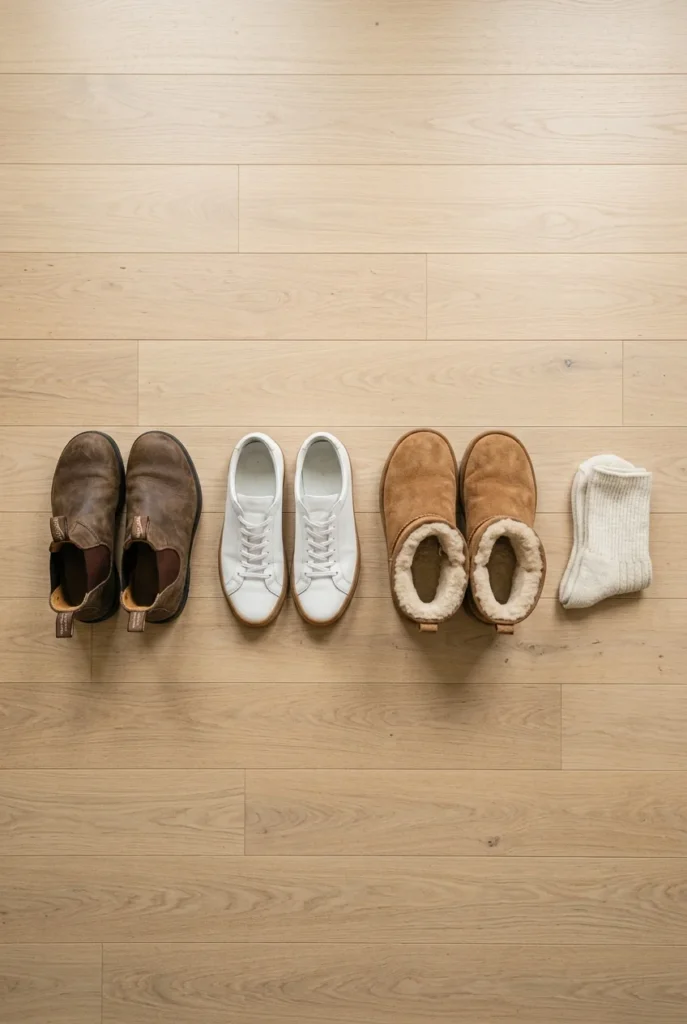
Clean white leather sneakers work in a warmer arena and in the upper deck, especially with a thick sock. They’re the right call for a weeknight game where you’re coming straight from somewhere else.
Shearling lined boots are the honest answer for a January game or a rec rink, and they get dismissed as sloppy more often than they deserve. How to style Uggs so they read intentional is mostly a proportion question: keep the leg line slim above them and let the boot be the only bulky thing.
What to skip: open toe anything, heels of any height on a concrete ramp, and shoes you bought last week. Concourses are long and you will walk more than you planned.
Thin socks undo an otherwise good outfit. Wool or a wool blend, every time.
The Bag Rule Nobody Gets Right
This is where most guides quietly fail you, and it’s the one that can actually get you stopped at a gate.
There is no single NHL bag policy. Each arena sets its own, and they differ more than you’d believe. Honda Center caps game-day bags at 4 by 6 by 1.5 inches for Ducks games, which is smaller than most phones with a case. Grand Casino Arena in Minnesota goes the other direction, allowing purses up to 12 by 12 by 6 inches, and explicitly does not permit standalone clear bags at all.
Read those two sentences again, because the popular advice is to buy a clear stadium tote, and at one of those buildings that tote gets you turned away.
So: check your specific arena’s policy page the day before. Search the arena name plus “bag policy” and read the actual venue site, not a ticket reseller’s summary.
Then dress for the answer. A small structured crossbody in the 6 by 8 inch range clears most policies and keeps your hands free, which matters more than it sounds like when you’re carrying a drink up a ramp. If your arena is one of the strict ones, go bagless: phone and card in a coat pocket, keys in the other. The small accessories that change a whole outfit is worth a read here, because when the bag has to shrink, the earrings and the scarf carry more of the look.
Also worth knowing: most arenas don’t offer bag check. There’s no fallback if you show up with the wrong one.
How to Wear a Jersey Without Looking Like a Costume
You don’t need one. Let’s start there, because plenty of women feel like they’re doing it wrong without one and they’re not. Look around a lower bowl sometime and count how many people are in plain sweatshirts.
If you want to wear one, the fit is the whole game. Jerseys are cut boxy and long, so left alone one will swallow your frame and read borrowed. <!– IMAGE 8 –>
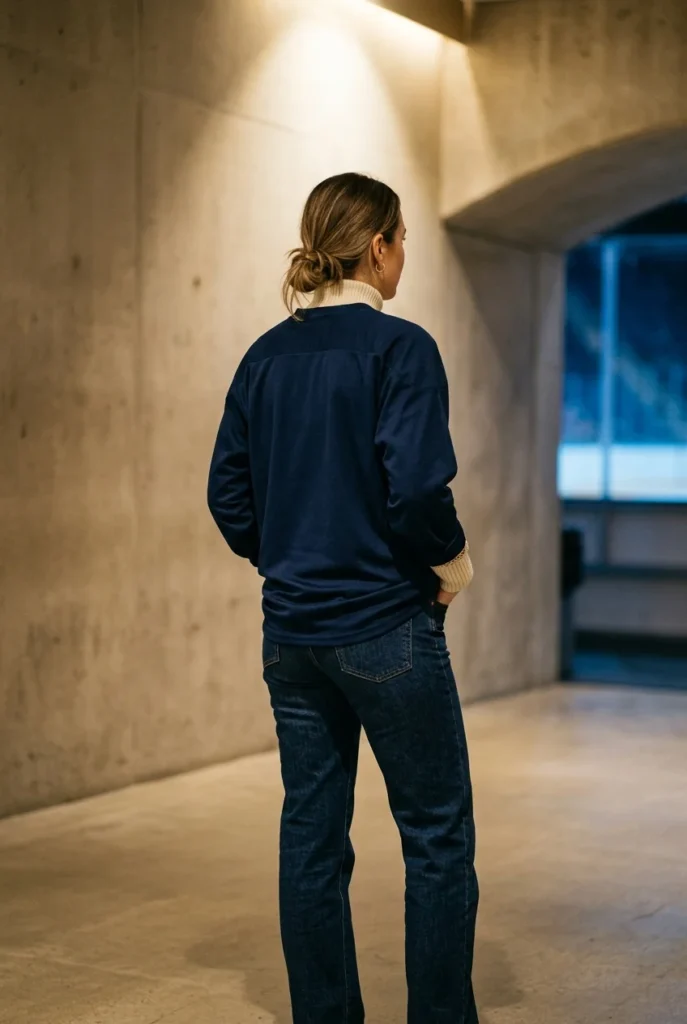
Three fixes, in order of how much they help:
Front tuck it. Tuck just the center front into your waistband and let the rest fall. Instantly gives you a waist and turns a boxy jersey into a shape.
Layer a turtleneck under it. Solves the sleeve gap, adds warmth, and the contrast at the neck and wrists makes it look styled rather than thrown on.
Slim the bottom half. Straight or slim denim under a boxy top. Two loose pieces together is where it goes wrong.
A vintage or throwback sweater is the elevated version and usually costs less than a current authentic. If you’d rather skip the jersey entirely, one accessory in a team color does the same social work. A beanie is the easiest. Nobody has ever been questioned for showing up in a plain sweater and a team hat.
Six Hockey Game Outfits From a 14 Piece Capsule
Here’s the capsule. Fourteen pieces, all of which likely already live in your closet: cream ribbed turtleneck, white long sleeve tee, gray crewneck sweatshirt, camel cable knit sweater, plaid flannel shirt, navy quilted vest, denim jacket, camel wool overcoat, black packable puffer, dark straight leg jeans, black fleece lined leggings, brown Chelsea boots, white leather sneakers, team beanie.
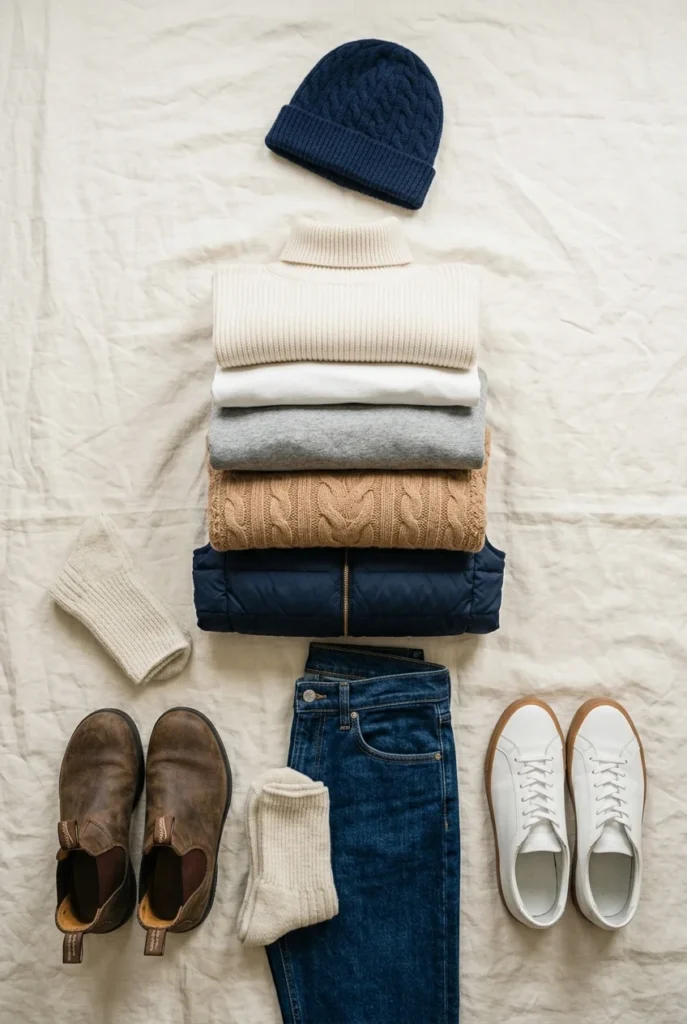
1. The First Game (upper deck, October). White long sleeve tee, dark straight leg jeans, gray crewneck sweatshirt tied at the waist, white sneakers, team beanie. You’ll be warm enough up there and the sweatshirt is there for the walk to the car.
2. The Glass Seats (the cold one). Cream turtleneck, fleece lined leggings, camel cable knit sweater, navy quilted vest over the sweater, camel wool overcoat, Chelsea boots with wool socks, beanie. Yes, all of it. You’re sitting at ice level for three hours.
3. Weeknight After Work. Cream turtleneck, dark jeans, camel sweater, wool overcoat, Chelsea boots, gold hoops. Reads polished enough that you don’t have to change, warm enough for a lower bowl seat.
4. Date Night at the Rink. Cream turtleneck, dark straight leg jeans, quilted vest, wool overcoat, Chelsea boots, one team color accent kept small. The vest is what makes this warm without going shapeless.
5. Family Game With Kids. White tee, flannel over it, fleece lined leggings, packable puffer, sneakers, beanie. Everything washable, nothing you’ll mind if a nacho lands on it, and the puffer folds into your lap when you’re wrangling a kid.
6. Deep January. Turtleneck, cable knit sweater, quilted vest, packable puffer over everything, fleece lined leggings, shearling boots, beanie and scarf. This is a rec rink outfit too.
Six outfits, fourteen pieces, and the only hockey specific item in the whole capsule is a hat.
Hockey Game Date Night, Without Overdressing
The instinct is to dress up, and the arena will punish you for it.
The move is to stay in the same warmth range as everyone else and win on fabric and fit. A cream turtleneck instead of a sweatshirt. Wool instead of fleece. Leather boots instead of sneakers. Gold hoops. You’re wearing the same five slots as the person next to you, just in better materials.
Keep the makeup and hair simple, because arena lighting is unflattering and you’ll be under a coat hood at some point. One thing done well beats three things competing.
And skip the heels. Concrete ramps, sticky floors, and a long walk to parking.
What Not to Wear to a Hockey Game
Short list, all of it learned the hard way by somebody.
Anything cropped at the ankle or midriff. Cold air finds gaps and sits in them.
Open toe shoes or sandals. Even in July, the arena is refrigerated.
Heels. Concourse ramps, concrete stairs, and standing up thirty times.
A parka in the 300 level. You will be miserably hot by the first intermission and there’s nowhere to put it.
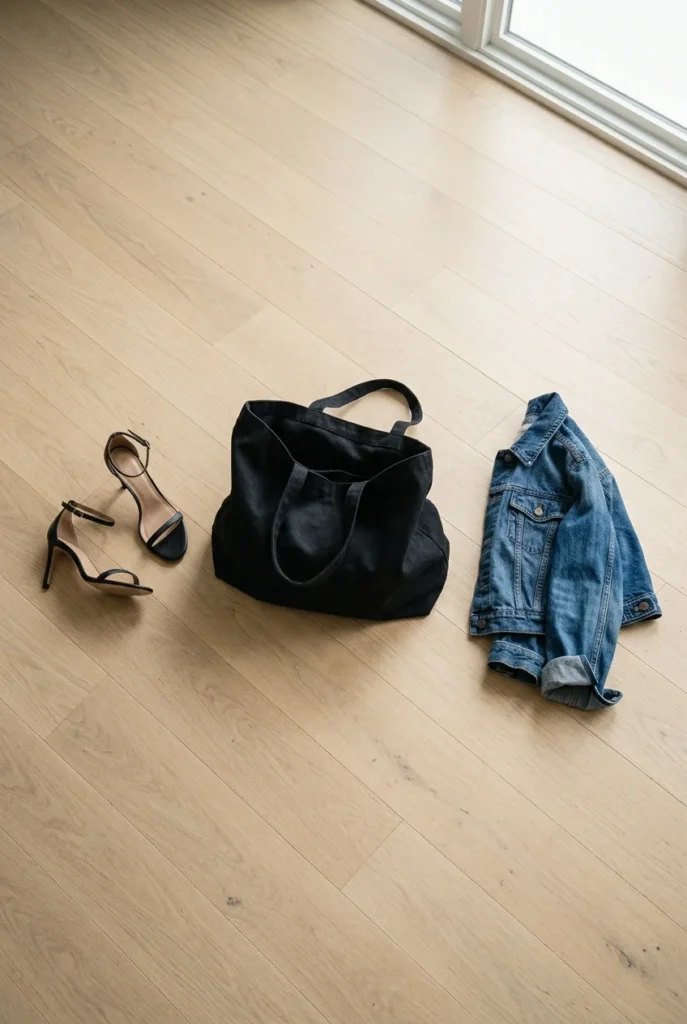
An oversized tote. See the bag section. Most arenas won’t let it in and none of them will hold it for you.
Brand new shoes. You’ll walk farther than you think between parking and your seat.
Thin socks. The whole outfit fails at the feet.
A full head-to-toe team kit if you’re not feeling it. One signal piece is plenty, and honestly it looks better.
Dressing for Your Proportions in a Cold Arena
Layering adds volume, and volume lands differently depending on your frame. A few adjustments that help.
If you’re petite (5’4″ and under): keep the coat length above the knee or well below it, not cutting across mid calf, which shortens the leg line. A cropped quilted vest works better than a long one. Tuck the base layer so the waist stays visible under the mid layer.
If you’re tall (5’9″ and over): you have room for a longer overcoat and a chunkier knit, which is genuinely useful here since length equals warmth. Watch sleeve length on jerseys, which run short on long arms, and layer a turtleneck underneath to close the gap.
If you’re curvy or midsize: a vest that ends at the high hip keeps the layers from stacking at the widest point. Straight leg denim balances a heavier top half better than a skinny cut. Open layers, a flannel or unbuttoned coat, create a vertical line that reads longer than a closed one.
If you’re over 40 or over 50: this is where fabric quality does the visible work. Wool over acrylic, leather over synthetic. You’ll be dressed the same as everyone else and it will read entirely differently.
Layering for a temperature you can’t predict is a skill that transfers. It’s the same logic as layering for genuinely changeable weather in Ireland, where you’re also dressing for four conditions in one afternoon.
What to Wear to a Hockey Game: Frequently Asked Questions
What should a woman wear to a hockey game? Full length pants, a long sleeve base layer, a mid layer like a sweater or quilted vest, closed toe boots or sneakers with wool socks, and one small item in a team color. Add a coat if you’re sitting in the lower bowl or at the glass. That combination works in almost any arena in the country.
How cold is it at a hockey game? Professional arena seating usually runs 58F to 65F, though glass side and first ten row seats can feel closer to 40F because cold air pools at ice level. Upper deck seats run 5 to 10 degrees warmer. Local rec rinks are much colder, often 32F to 40F.
Can I wear jeans to a hockey game? Yes, and they’re the most common thing in the building. Straight leg or slightly relaxed dark denim is ideal. Skip cropped or heavily distressed styles in cold seats, since open denim lets cold air straight through.
What shoes should I wear to a hockey game? Closed toe, warm, and already broken in. Leather Chelsea boots are the best all around choice. White leather sneakers work in warmer arenas and the upper deck. Shearling lined boots are right for January and rec rinks. Wool socks matter more than the shoe.
Do I need to wear a jersey? No. Plenty of people in every arena are in plain sweatshirts and sweaters. If you want to signal team support without buying a jersey, a beanie or scarf in team colors does the same job for a fraction of the cost, and a vintage sweater usually costs less than a current authentic.
What size bag can I bring into an NHL arena? It depends entirely on the arena. Some cap bags around 4 by 6 by 1.5 inches, others allow purses up to 12 by 12 by 6 inches, and some prohibit clear bags outright rather than requiring them. Check your specific venue’s official bag policy page the day before, and assume there is no bag check.
Will a wool coat hold up to arena seats and spilled drinks? Wool handles this better than most fabrics, since it resists surface moisture and brushes clean. Let a spill dry, then brush with a garment brush rather than rubbing it wet. Save dry cleaning for the end of the season, since over-cleaning wears wool faster than wearing it does.
The Short Version
Check your section number first. Glass seats and the first ten rows need everything you’ve got; upper deck needs about half of that. Fill five slots: base, bottom, mid, feet, and one small signal in a team color. Wear full length pants and wool socks. Check your arena’s bag policy before you leave the house, because there’s no national rule and no bag check.
Everything above came out of a fourteen piece capsule with exactly one hockey specific item in it, and that item was a hat.
Pull your five slots tonight and lay them out. Next time someone hands you a ticket, you’ll already be dressed.
Keep reading

20 Loungewear Outfits for Plus-Size Women That Still Look Put-Together
Soft pants are easy. Looking like you picked them on purpose is the hard part. Most loungewear outfits for plus-size women online...

20 Cozy Loungewear Outfits for Women Over 50
Soft pants were never the problem. The problem is the moment the doorbell rings, or a friend texts about coffee, and you...

20 Cozy Loungewear Outfits That Still Look Put-Together
Your closet is full, your laundry basket is full of sweatpants, and the only things you want to wear are the ones...