
What to Wear to Disneyland Without Buying Anything New
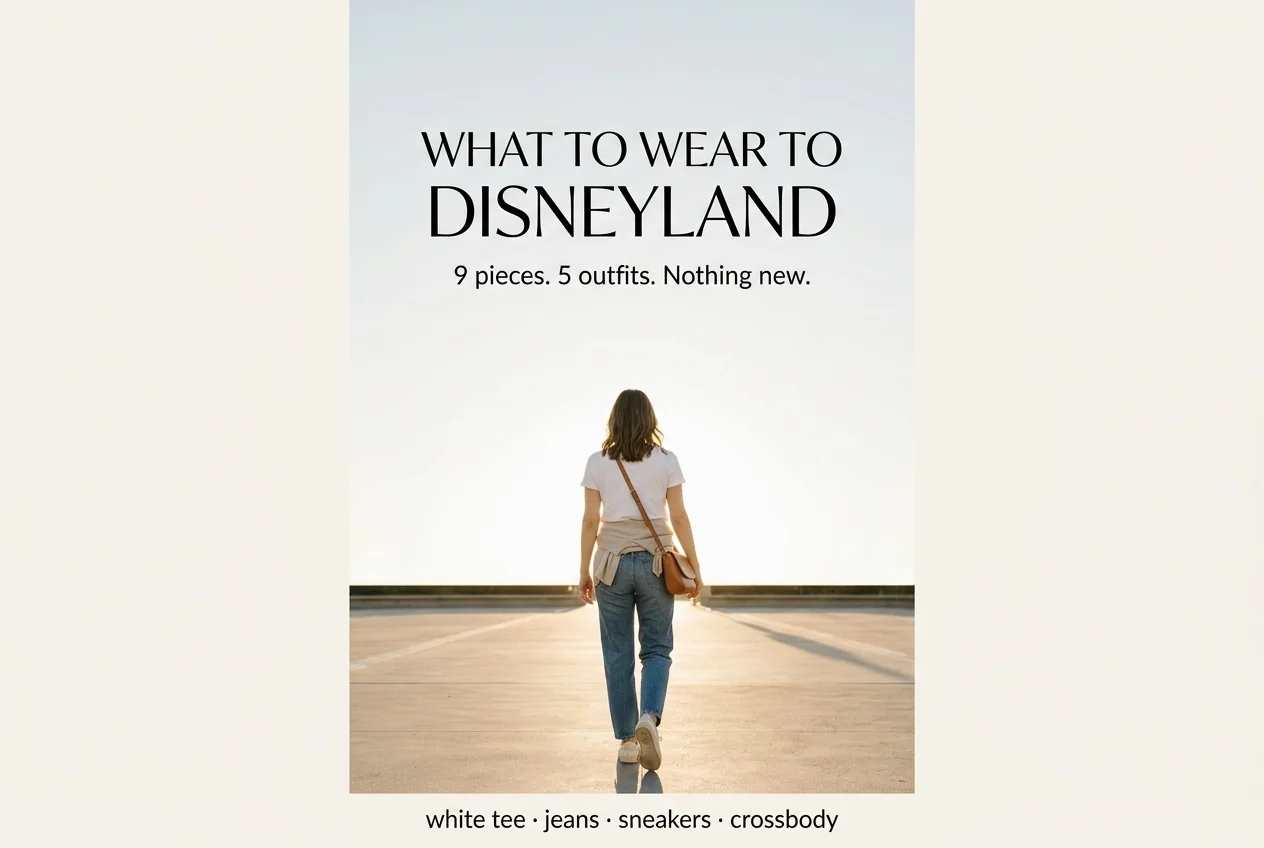
You will walk somewhere between eight and twelve miles. You’ll get warm by eleven, sweat through the afternoon, and be genuinely cold by the time the fireworks start. Figuring out what to wear to Disneyland is really one question wearing a costume: how do you dress for four different climates in a single day, on your feet the whole time, without carrying a duffel bag?
Here’s the part nobody selling you a park outfit wants to say. You almost certainly already own it. The nine pieces below are ordinary capsule wardrobe items, they make five full park outfits, and not one of them has a character on it.
The Real Problem With Most Disneyland Outfit Advice
Search this keyword and you’ll get five articles that are, underneath the styling, shopping lists. Buy these sneakers. Buy this tank. Buy the spirit jersey, the ears, the matching family set. It’s not bad advice exactly. It’s just answering a different question than the one you asked.
You asked what to wear. They answered what to purchase.
The gap matters because a park outfit is a genuinely hard styling problem and a genuinely easy shopping problem. Anyone can sell you a cute tee. Making one outfit survive a 23-degree temperature swing, 20,000 steps, a splash zone, and a sit-down dinner takes actual thinking about fabric, fit, and layer order.
We’ve worked this problem before for how to dress for an all-day outdoor event without buying a single new thing, and the logic transfers almost completely. Long day, unpredictable temperature, hard seating, a lot of walking, and photos you’ll keep. Disneyland just adds heat, more walking, and a dress code.
So this guide runs the other direction. Start with what’s hanging in your closet, apply a few rules that come from real Anaheim weather data, and build out.
The Anaheim Swing, and Why Your Outfit Has to Work Twice
Every guide tells you to bring layers. Almost none of them tell you why, which means you can’t tell how many layers, or when to shed them, or whether today is different.
So here’s the number that runs this whole article. Pulling Anaheim’s 30-year temperature normals (1991 to 2020), the gap between the average daytime high and the average nighttime low lands between 20 and 24 degrees Fahrenheit in every single month of the year. Not the summer months. Every month.
That consistency is the useful part. Anaheim’s absolute temperature changes a lot across the year. Its swing barely changes at all.
The Anaheim Swing Chart
| Month | Avg High | Avg Low | Swing | Layers to pack |
|---|---|---|---|---|
| January | 71F | 49F | 22 | 3 |
| February | 71F | 49F | 22 | 3 |
| March | 74F | 51F | 23 | 3 |
| April | 77F | 54F | 23 | 2 to 3 |
| May | 78F | 58F | 20 | 2 |
| June | 82F | 62F | 20 | 2 |
| July | 87F | 66F | 21 | 2 |
| August | 89F | 66F | 23 | 2 |
| September | 88F | 64F | 24 | 2 |
| October | 83F | 59F | 24 | 2 to 3 |
| November | 77F | 53F | 24 | 3 |
| December | 71F | 48F | 23 | 3 |
Read the swing column and the rule writes itself. You are always dressing for two temperatures, roughly 22 degrees apart, in the same outfit. Your base layer gets chosen for the high. Your outer layer gets chosen for the low. The middle layer is what you actually carry all afternoon, so it has to pack down to nothing.
That’s the whole system. Base for the high, outer for the low, and nothing in your bag that doesn’t compress.
If you’re flying in the morning of, the same logic applies to the trip itself, and what to wear on a plane so you land ready to walk covers the zones between the curb and the gate.
Does Disneyland Have a Dress Code? Here’s What’s Actually Enforced
Yes, and it’s shorter than the internet suggests. According to Disneyland’s official park rules and regulations, proper attire including shoes and shirts must be worn at all times, and clothing that drags on the ground isn’t permitted in the theme parks.
The rule that surprises the most adults: costumes and masks are not permitted for guests ages 14 and older. This is why Disney bounding exists as a whole subculture. You’re signaling a character through ordinary clothing in the right colors, which is entirely allowed, rather than wearing an actual costume, which isn’t.
Beyond that, the park reserves discretion to deny entry over attire it considers inappropriate. In practice, that discretion gets used on offensive graphics and on very revealing clothing, and it’s applied inconsistently enough that it isn’t worth testing on a day you’ve already paid for.
Two practical translations for your closet. Maxi skirts and wide-leg pants need to clear the ground, so check the hem with your park shoes on rather than your heels. And a graphic tee you’d think twice about at your kid’s school is a graphic tee you should leave home.
Nothing else about the dress code should change what you pack.
Start With the Shoes, Because Everything Else Is Negotiable
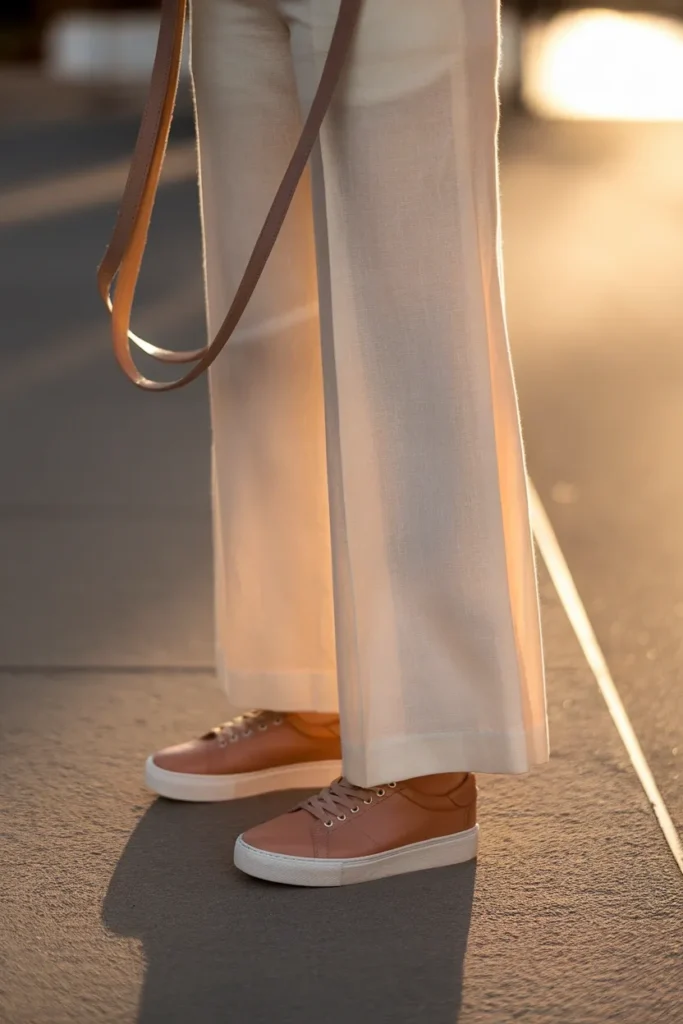
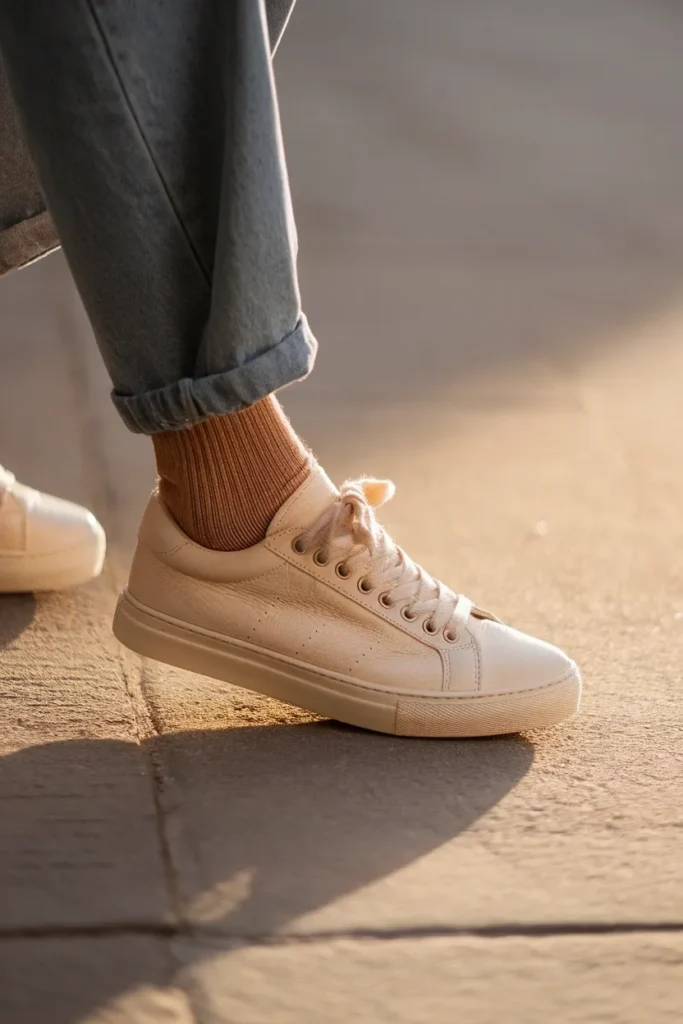
Pick the shoes first. Build the outfit around them. Every competitor agrees on this and they’re right, so the useful contribution here is narrower: what specifically to look for, and what to rule out.
Rule them out first. No shoe you bought in the last two weeks. No shoe you’ve worn fewer than five times. No sandal without a back strap. No slide, no mule, no clog, no ballet flat with a paper-thin sole. Nothing with a heel, including the block heels that feel fine for four hours and stop feeling fine at hour seven.
What actually works. A cushioned sneaker you’ve already broken in, with a roomy toe box and a real midsole. Broken in matters more than the brand does. A well-worn $70 pair beats a pristine $150 pair every time, because the blister comes from the seam that hasn’t softened yet.
The sock is half the shoe. Cotton socks hold sweat, sweat softens skin, and soft skin blisters. A thin merino or synthetic athletic sock solves most of it. Bring a spare pair in your bag and change at lunch, which costs you four minutes and saves the second half of your day.
One overlooked detail: wear the socks you’ll actually wear when you test the shoes. Sock thickness changes fit enough to matter over 20,000 steps.
For the dinner reservation after, or any day where you’re not covering ten miles, a pair of loafers for everything that isn’t a 10-mile day is the better call. Just don’t ask them to do both.
The 9-Piece Disneyland Park Capsule
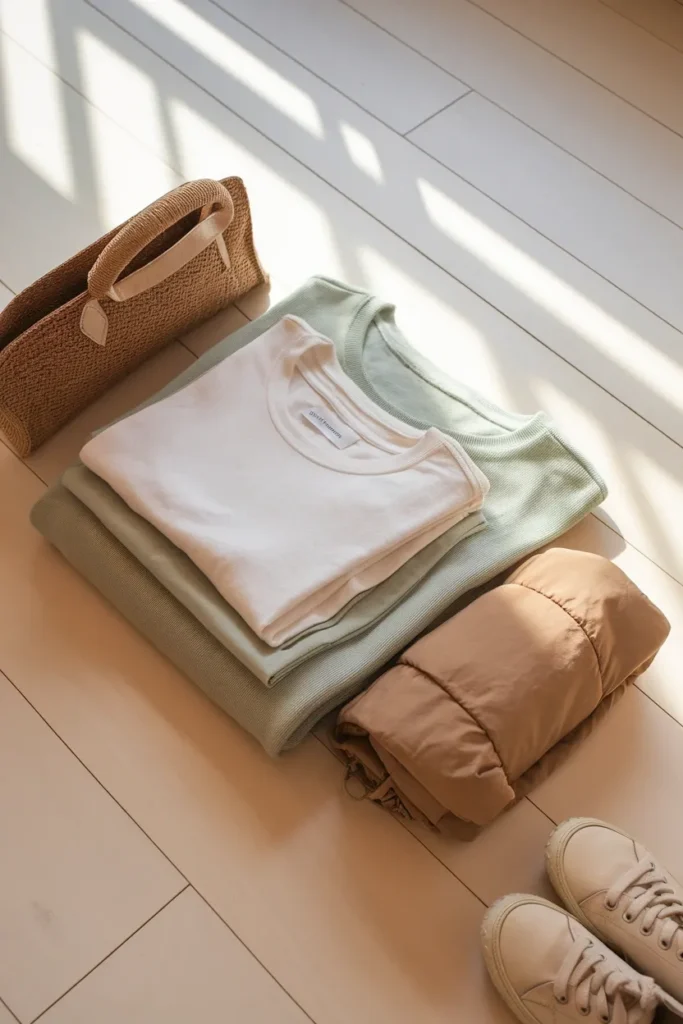
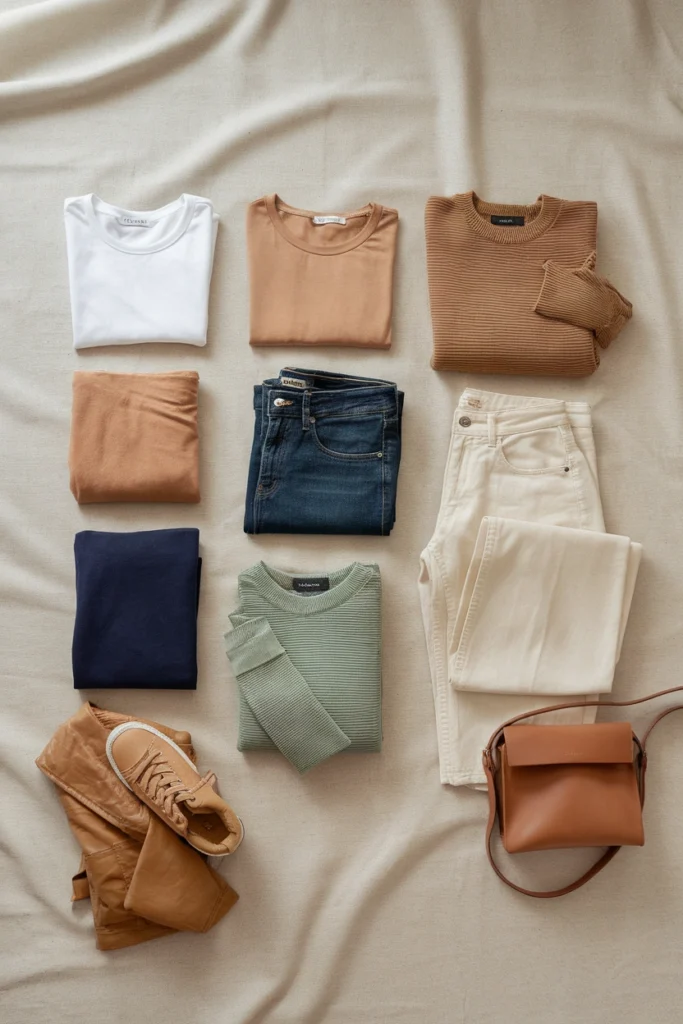
Here’s the framework. Nine pieces, five outfits, and every item is something a working capsule wardrobe already contains. Screenshot this one.
| # | Piece | Why it earns the spot |
|---|---|---|
| 1 | Soft white cotton tee | Base layer for the high. Breathes, photographs clean, goes under everything |
| 2 | Second tee in a neutral (oat, navy, sage) | Day two, or the swap after a splash ride |
| 3 | Relaxed straight-leg jeans | Structure without restriction. Survives sitting, walking, and a dropped churro |
| 4 | Wide-leg linen or cotton trousers | The hot-day alternative. Airflow that shorts can’t match |
| 5 | Knee-length or midi knit skirt | Full range of motion, no thigh chafe, reads polished in photos |
| 6 | Thin long-sleeve knit or overshirt | The middle layer. Sun cover at 2pm, warmth at 6pm |
| 7 | Packable jacket or denim jacket | The outer layer for the low. Must compress into the bag |
| 8 | Broken-in cushioned sneakers | Covered above. The whole day rests here |
| 9 | Crossbody bag or small backpack | Hands free, weight distributed, front-facing on rides |
Three notes that make the list work harder.
Everything is a neutral except one. Build the base in ivory, oat, camel, navy, or soft black, then let a single accent do the visual work. One dusty terracotta knit or one butter-yellow tee reads as intentional and photographs beautifully against pastel park architecture. Nine neutrals reads flat. Nine colors reads chaotic.
Pockets are a feature, not a bonus. A trouser or skirt with real pockets means your phone lives on your body instead of in a bag you have to open every ride queue.
Fabric beats silhouette on a hot day. A loose cotton trouser will outperform a tight cotton short, because airflow matters more than coverage. If you’re auditing what you already own, the capsule wardrobe tops that anchor every outfit you own is where the base layers get chosen.
Five Disneyland Outfits From Those Same Nine Pieces
This is outfit math, and it’s the reason the capsule approach beats the shopping-list approach. Nine pieces, five distinct looks, one bag.
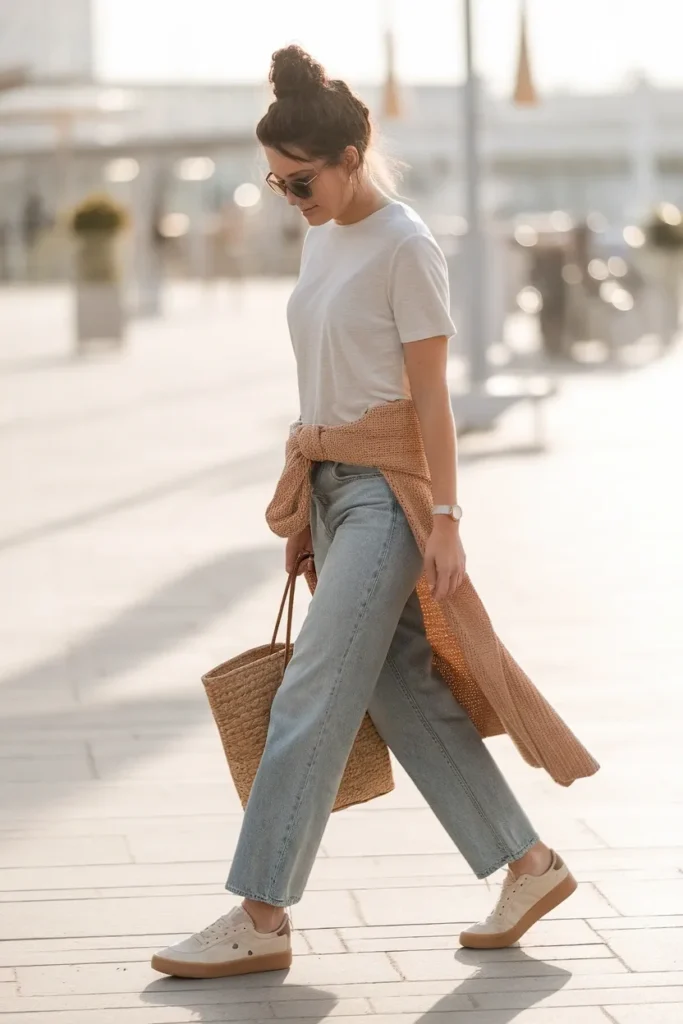
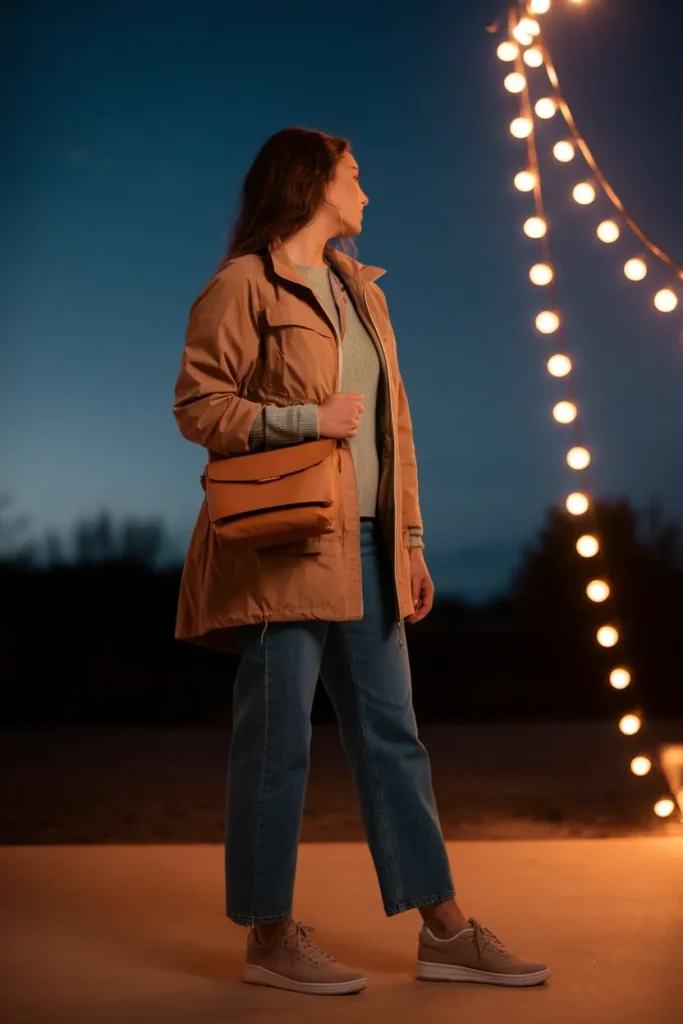
Outfit 1: The default. White tee tucked into straight-leg jeans, cardigan or overshirt tied at the waist, sneakers, crossbody. Works in every month on the chart. If you only read one line of this article, it’s this one.
Outfit 2: The hot day. Neutral tee, wide-leg linen trousers, sneakers, packable jacket in the bag for the evening. Airflow through the legs is what makes an 89-degree August afternoon survivable.
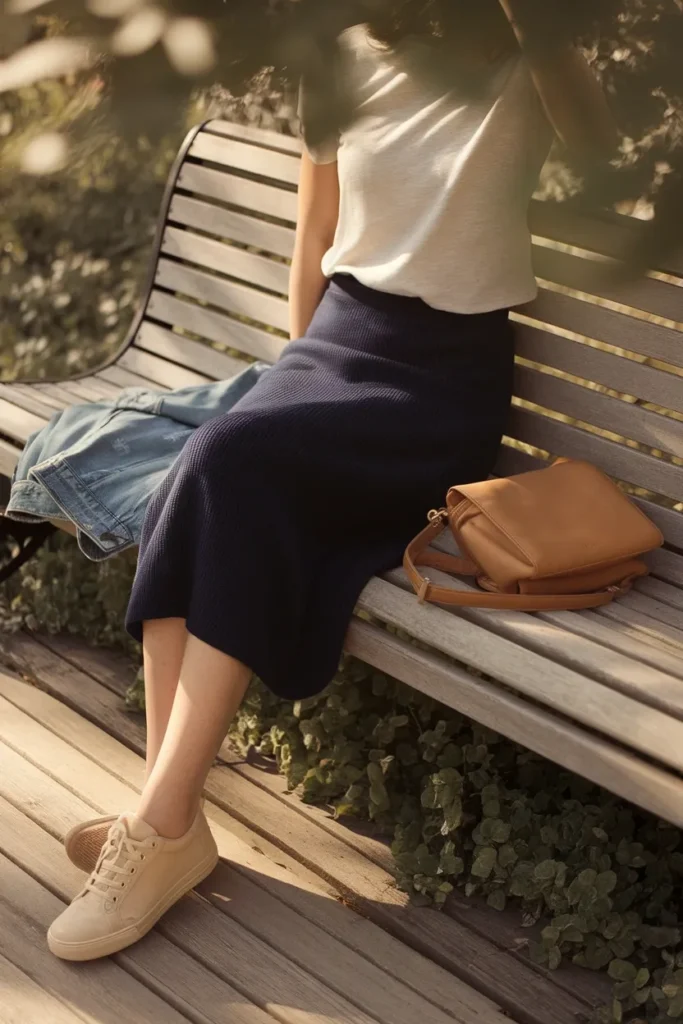
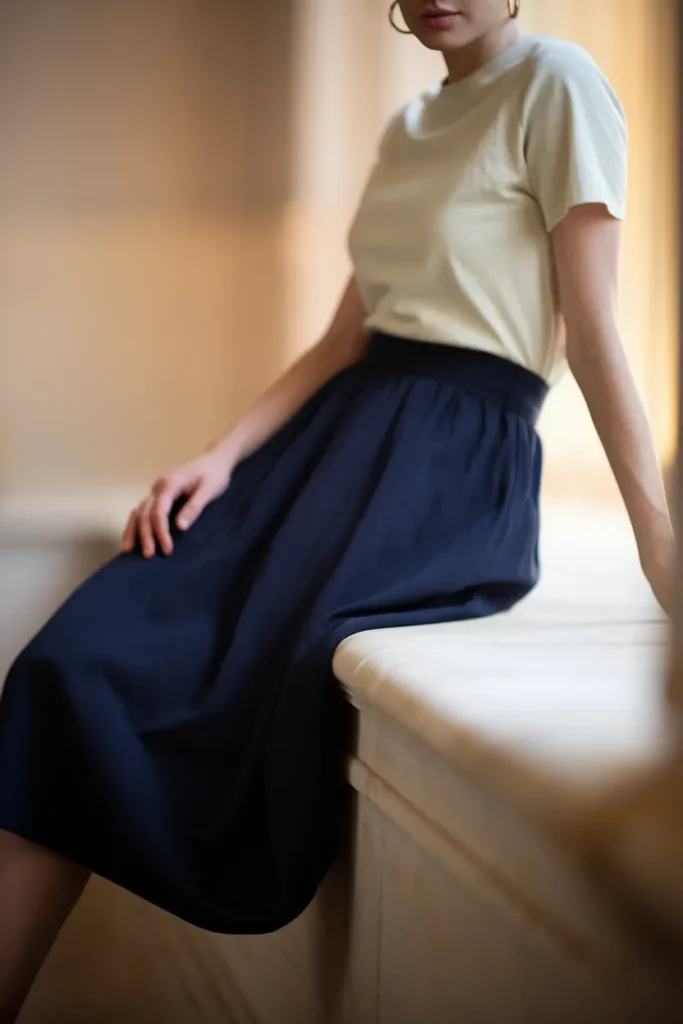
Outfit 3: The photo day. Midi knit skirt, white tee tucked, denim jacket, sneakers. Reads dressed without costing you a single degree of comfort, and the skirt moves better than jeans in a queue line.
Outfit 4: The cool morning. Long-sleeve knit over the tee, jeans, packable jacket, sneakers. Peel to the tee by noon, rebuild by six. This is the December through March default.
Outfit 5: The second day. Second tee, linen trousers, overshirt, sneakers. Different silhouette, zero new pieces, and nobody in your photos can tell it’s the same wardrobe.
Notice the pattern. The shoes never change, the bag never changes, and the base layer is always a tee. The variables are the bottom and the layer, which is exactly two decisions each morning instead of twelve.
What to Wear to Disneyland in Summer
June through September is the stretch where the outfit stops being a style question and becomes a physiology question. August peaks at an average high of 89F, and pavement plus crowd density pushes the number you actually feel well past that.
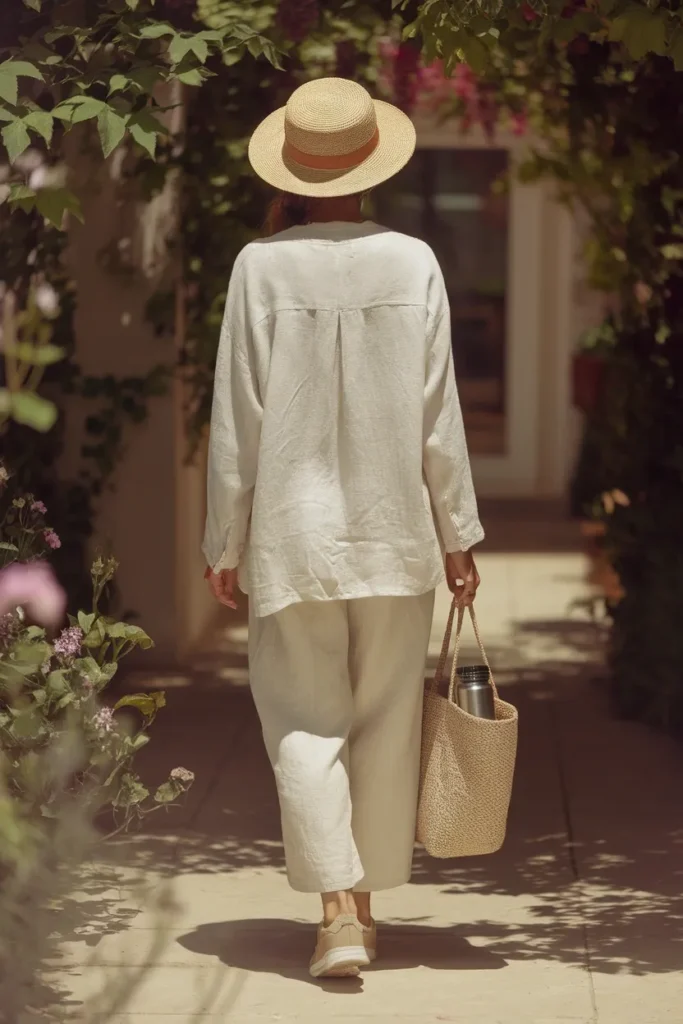
Fabric first, coverage second. Loose-woven cotton and linen move air. Polyester and rayon blends trap it against your skin, which is why a synthetic sundress can feel hotter than cotton trousers. Check the label, not the neckline.
Cover more, not less. A thin long-sleeve knit over a tee is cooler in direct sun than bare shoulders, because you’re blocking radiant heat instead of absorbing it. Long-sleeve linen shirts exist for exactly this reason in every hot climate on earth.
Chafe is the real summer failure. A skirt or dress without something underneath is a two-hour outfit at 89 degrees. Thin bike shorts under the skirt turn it into a twelve-hour outfit. This is the single highest-value summer tip in the article and nobody ranking for this keyword mentions it.
The hydration piece is a clothing piece. A bag with an outside bottle pocket means you drink more, because you drink what’s reachable. The CDC’s guidance on heat and your health is blunt about it: carry a water bottle, drink and refill throughout the day, and take breaks in shade. Your bag choice decides if that actually happens.
Sun protection you wear beats sun protection you carry. A packable hat with a real brim, sunglasses, and sunscreen applied before you leave the hotel. Reapplying at 2pm in a bathroom line is a plan that fails.
What to Wear to Disneyland in Fall, Winter, and Spring
Look back at the swing chart and something useful appears. September through December carries the biggest daily swings of the year, at 23 to 24 degrees. Fall and early winter are when layering stops being optional.
Fall (September to November). Highs run 88 down to 77, lows drop from 64 to 53. Start with the tee, add the long-sleeve knit, carry the jacket. September afternoons still feel like summer, and November evenings genuinely bite once the sun sets. Fall is also peak park season, so factor slower lines and more standing time into your shoe choice.
Winter (December to February). Highs hold near 71 and lows sit at 48 to 49. Southern California winter is a warm autumn day everywhere else, so a heavy wool coat is a mistake you’ll carry for nine hours. A packable jacket over a knit handles it. Add thin socks you can layer.
Spring (March to May). Highs climb 74 to 78, lows rise 51 to 58, and the swing narrows to 20 by May. Spring is the easiest month set to dress for and the most crowded, thanks to spring break. Jeans and a tee with a light jacket covers essentially every spring day.
The common failure across all three seasons is the outer layer. A structured coat looks great and becomes dead weight by noon. What you want is something that compresses into a bag and comes back out without looking slept in, which is a narrow category. The capsule wardrobe jackets that actually earn their hanger space breaks down which ones pass that test.
Fit Notes by Proportion, Because a 10-Mile Day Exposes Everything
Most park outfit advice assumes one body and one height. A 20,000-step day tests fit in ways a two-hour brunch never will, and the adjustments are specific.
If you’re petite (5’4″ and under). Wide-leg trousers need hemming to clear the ground, both for the dress code and because a dragging hem in a crowd is a genuine trip risk. A cropped or ankle-length trouser reads better with sneakers anyway. Midi skirts that hit mid-calf on a taller frame will hit lower on you, so check the length while standing on the escalator at home.
If you’re tall (5’9″ and over). The usual problem reverses. A midi skirt becomes a short skirt, which changes your chafe math, so bike shorts underneath move from optional to necessary. Check tee length too, since a tuck that works on a shorter torso can pull out every time you raise your arms.
If you’re curvy or midsize. Thigh contact is the variable that decides your day. Trousers and jeans with a bit of stretch in the weave will outperform rigid denim over ten miles. If you prefer skirts, a knit with weight to it drapes and stays put better than a thin woven one that rides.
If you’re plus-size. Prioritize the seam placement over the silhouette. An inseam that sits flat and a waistband that doesn’t roll matter more across a long day than any styling detail. Natural fibers with a small stretch percentage handle heat and movement together better than either pure cotton or full synthetic.
If you’re over 40 or over 50. Cushioning and arch support move up the priority list, and there’s no styling penalty. The sneaker silhouettes that support best are also the ones photographing well right now.
If you’re postpartum. Waistband pressure is the thing to solve. A skirt with a knit waistband or a trouser with a soft elasticated back will do more for your day than any other single choice here.
None of this is about hiding anything. It’s about which pieces stay comfortable when you ask them to work for twelve hours.
The Bag, the Layers, and the Small Things That Decide Your Day
The bag is a clothing decision, because you wear it for twelve hours.
Crossbody or small backpack, nothing else. A shoulder tote slides off on every ride queue and puts all the weight on one side. A crossbody you can swing to your front satisfies most ride-storage requirements without taking it off. If you carry more, a small backpack distributes better across a long day, and you’ll want it front-facing in crowds anyway.
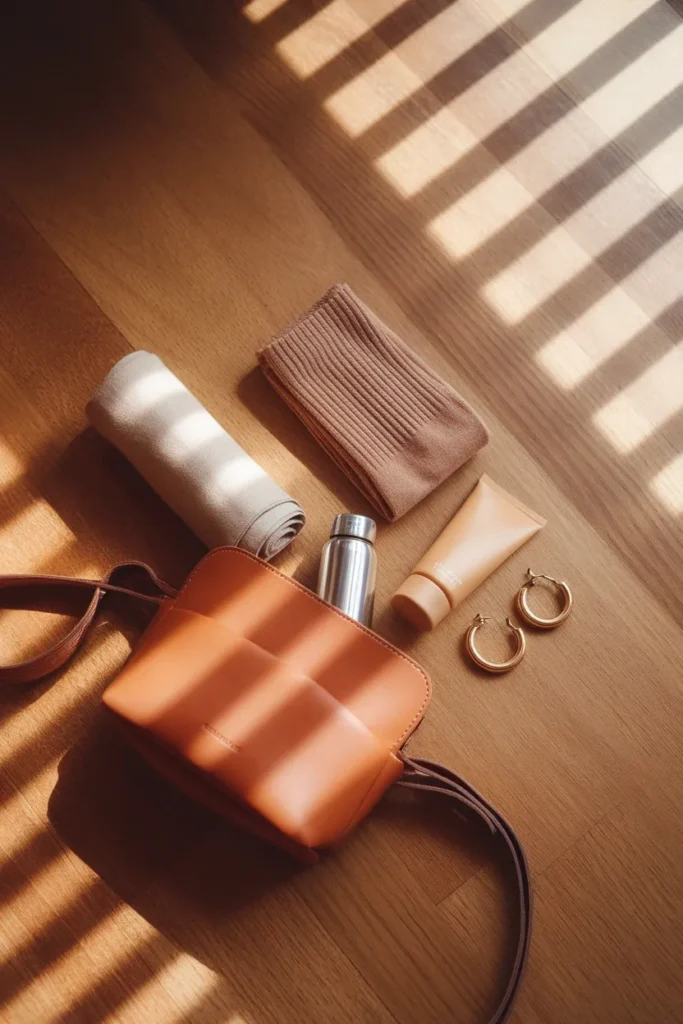
What earns space inside. Spare socks. A packable layer. Sunscreen. A refillable bottle. A thin scarf, which triples as sun cover, a picnic blanket on a curb, and warmth at the fireworks. That’s it. Everything else is optional and everything optional gets heavy.
What to leave. Anything you’d be upset to lose on a ride. Delicate jewelry with a clasp. A bag with an open top. Sunglasses you love, since sunglasses at a theme park have a survival rate you won’t like.
The layer order that actually works. Tee against skin, knit over it, jacket over that, and the jacket lives in the bag by 11am. Peel in that order and rebuild in reverse. Simple, but the thing people get wrong is starting in the jacket at 8am and then carrying it fully unpacked all afternoon instead of compressing it.
Accessories are where a nine-piece capsule stops looking like a uniform, and the small capsule wardrobe accessories that change an outfit covers which ones do the most work for the least weight.
The Cost-Per-Wear Test That Kills the Souvenir Tee Trap
Run the math on the character tee, because nobody else will.
A park-bought graphic tee typically runs somewhere in the $35 to $50 range, and its honest cost per wear is close to its price, because most of them get worn once at the park and then live in a drawer. A white cotton tee from Uniqlo or Old Navy sits in the $10 to $20 range and gets worn eighty times a year. One of those is a souvenir. The other is a wardrobe.
There’s nothing wrong with buying the souvenir. Just count it as a souvenir rather than as clothing, the same way you’d count the popcorn bucket.
If you want the park-day feeling without the drawer problem, the accessory does it better than the garment. A hair scarf, a pin, an enamel keychain on the bag. Small, cheap, genuinely reusable, and it photographs just as well in a group shot.
And if you do want a real piece from the trip, buy it in your palette. A sweatshirt in oat or navy that happens to be from the park gets worn all winter. The same sweatshirt in a color you own nothing else in gets worn once.
What Not to Wear to Disneyland
Short list, all of it earned.
- Brand-new shoes. Covered above, and still the most common mistake by a wide margin.
- Heels of any height. Including block heels, wedges, and platform sneakers.
- Anything white you’d mourn. Between sunscreen, churro sugar, and ride splash, light bottoms take damage. A white tee is fine because it’s replaceable. White linen trousers on a Splash-adjacent day are a gamble.
- Rompers and jumpsuits. They look great and they’re a full undress in a park bathroom, roughly six times a day.
- A structured coat. Warm for the first hour, dead weight for the next eleven.
- A hem that drags. Against park rules, and a real trip hazard in a crowd.
- Bags with open tops. Rides, crowds, and gravity.
- Strapless anything. You’ll spend the day adjusting it on rides.
Disneyland Outfit FAQs
What are the best shoes for Disneyland? A cushioned sneaker you’ve already broken in, with a roomy toe box and a real midsole. Broken in matters more than brand or price. Pair it with a thin merino or synthetic sock rather than cotton, and pack a spare pair to swap at lunch. Avoid anything without a back strap.
Are jeans a bad idea for Disneyland? No, as long as they’re relaxed or straight-leg with a little stretch in the weave. Rigid skinny denim over ten miles is where the complaints come from. In July and August, wide-leg linen or cotton trousers will be more comfortable than any denim.
Can you wear sandals to Disneyland, and will they survive the day? Only sandals with a back strap and a real footbed, and even then they’re a second-day shoe rather than a first-day shoe. Slides, flip-flops, and thin-soled sandals fail on the pavement well before evening. Most sandals also won’t survive repeated water rides looking the way they started.
Does Disneyland have a dress code for adults? Yes. Shoes and shirts are required at all times, clothing can’t drag on the ground, and costumes and masks are not permitted for guests ages 14 and older. The park also reserves the right to deny entry over attire it considers inappropriate, which in practice covers offensive graphics and very revealing clothing.
Is it okay to wear leggings to Disneyland? Yes, and they’re a solid choice in cooler months. Two adjustments make them better. Pick a thicker opaque pair rather than a thin athletic one, since you’ll be bending, sitting, and climbing into ride vehicles all day. And choose a pair with pockets if you own them, because pocket access matters more at a theme park than almost anywhere else.
Does the nine-piece capsule work for petite or curvy women? It does, with the fit adjustments in the section above. Petite frames should hem wide-leg trousers to clear the ground and check midi skirt length while standing. Curvy and midsize frames will want a little stretch in the weave on trousers and jeans, and a knit skirt with some weight rather than a thin woven one.
Is it worth buying a Disney shirt, or is there a cheaper alternative? Buy it if you want the souvenir, and count it as a souvenir rather than as clothing, because its cost per wear is usually close to its full price. A cheaper alternative that actually gets worn: a plain tee from your own wardrobe plus a small park accessory like a hair scarf or a pin. If you do want a garment from the trip, buy it in a neutral you already wear so it survives past the vacation.
Pack Two Decisions, Not Twelve
The point of dressing for a park day from a capsule isn’t minimalism for its own sake. It’s that at 6:45am, on four hours of sleep, with a Lightning Lane window opening, you want to make two decisions and leave.
Base layer for the high. Outer layer for the low. Shoes you’ve already trusted for a hundred miles. That’s the whole system, and it works in January and August alike, because the swing barely changes.
If you’re building the wardrobe those nine pieces come from, start with the tops and the jackets. They do the most work across the most occasions, and a park day is only one of them.
What’s the piece you always end up reaching for on a long walking day? Tell me in the comments, because the answers to this one are usually better than anything I’d have guessed.
Keep reading

20 Loungewear Outfits for Plus-Size Women That Still Look Put-Together
Soft pants are easy. Looking like you picked them on purpose is the hard part. Most loungewear outfits for plus-size women online...

20 Cozy Loungewear Outfits for Women Over 50
Soft pants were never the problem. The problem is the moment the doorbell rings, or a friend texts about coffee, and you...

20 Cozy Loungewear Outfits That Still Look Put-Together
Your closet is full, your laundry basket is full of sweatpants, and the only things you want to wear are the ones...