
What to Wear to a Wedding as a Guest (Without Buying a Dress You’ll Wear Once)
Figuring out what to wear to a wedding usually goes one of two ways. You either panic-buy something at 11pm that arrives in the wrong color, or you stand in front of a closet with eighty pieces in it and decide you own nothing. Both roads end in the same place: a garment worn for nine hours, dry-cleaned once, then moved to the back of the rail where it hangs for four years. There’s a third road. It starts with the invitation, runs through pieces you already own, and finishes with something you’ll wear again in October.
Start With the Invitation, Not the Store
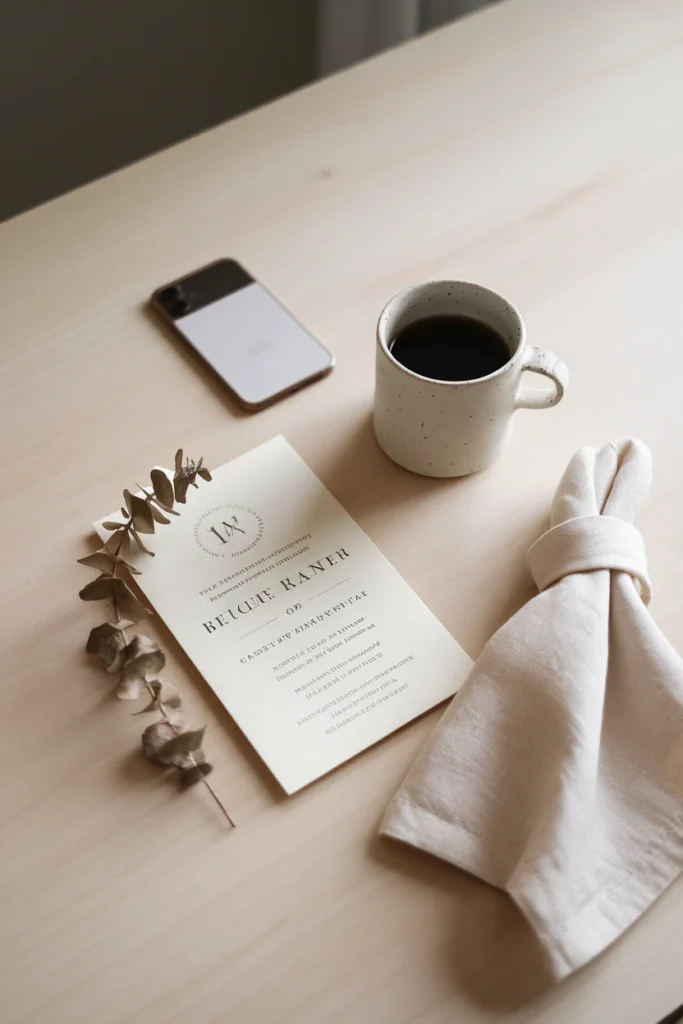
The invitation is doing more work than most guests realize. Read it twice before you open a single shopping tab.
Three things on that card tell you nearly everything.
The dress code line. If there’s a stated code, follow it. If the card says nothing at all, the ceremony start time and the venue fill the gap.
The start time. A ceremony beginning before 4pm reads daytime, which means lighter fabrics, softer colors, and lower heels. After 6pm, the whole thing shifts formal. Anything in between is the gray zone where most guests overthink and end up underdressed.
The venue name. Google it. A vineyard in Sonoma, a downtown loft, a country club ballroom, and a family backyard are four different outfits, and the venue photos will tell you more in thirty seconds than any dress-code chart will.
For the genuinely ambiguous invitations, the Emily Post Institute’s wedding guest attire guidance is the most useful reference I know of, largely because it anchors formality to the time of day and the setting rather than to a shopping category. Their framing holds up: the clothing should suit an occasion that is, underneath the party, a serious ceremony.
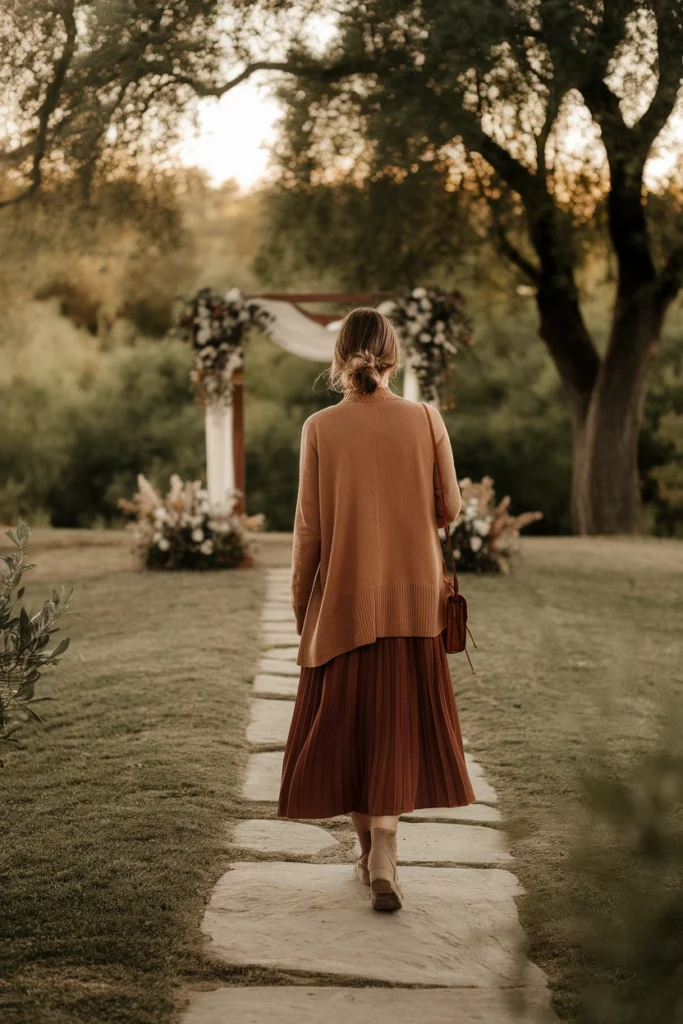
One more read of the card. Is there an outdoor component? An October ceremony on a lawn at 5pm in New England is a 52-degree evening by the time toasts start, and a bare-shouldered dress with no plan is a long night. Sort the layer at the same time you sort the dress, not the morning of. If your outerwear rail is thin, the six jackets that earn their hanger space covers which one actually works over occasion clothing, and it’s rarely the one people reach for.
The Dress Code Translator
Here’s the part the big wedding sites skip. They define the dress code, then send you shopping. This table does the opposite: it translates each code into pieces a capsule closet tends to already contain.
Screenshot it. That’s what it’s for.
| Dress code | What it actually means | Build it from | Skip |
|---|---|---|---|
| Casual | Sunday-best, not brunch | Midi skirt plus tucked silk-blend top, or a printed wrap dress. Flat sandals or loafers | Denim, sneakers, anything with a visible logo |
| Dressy casual | Elevated, still comfortable | Wide-leg trousers plus a drapey shell, blazer optional. Block heel or a polished flat | Anything strapless, floor-length |
| Semi-formal | A notch under cocktail | Midi dress in a fabric with drape. Or matching two-piece set. Low heel, structured clutch | Casual knits, canvas anything |
| Cocktail | The most common code, and the most misread | Knee to midi length, fabric with weight (crepe, satin-back, heavy jersey). Heel of any height. Real jewelry | Floor-length gowns, daytime cotton |
| Black tie optional | Long is welcome, not required | Floor-length column, or a dark midi in a formal fabric plus statement earrings | Prints that read casual, chunky shoes |
| Black tie | Formal, full stop | Floor-length gown or a formal jumpsuit in a fluid fabric. Evening clutch | Midi lengths, day fabrics like cotton and linen |
| White tie | Rare. Under 1% of US weddings | Full-length ball gown, gloves optional | Anything short. Genuinely anything short |
The one that trips people is cocktail. It’s the default American wedding code and guests routinely read it as “any nice dress,” which is how you end up in a cotton sundress at a hotel ballroom. Cocktail is about fabric weight more than hemline. A knee-length dress in heavy crepe reads correct. The same silhouette in poplin reads like an errand.
And black tie optional is not a trick. It means long is welcome and a dark, formal midi is equally fine. Choose based on what you’ll actually wear again, because in that category, the midi wins on rewear every time.
The 3-Wear Rule
This is the framework I’d hand a friend before she opened a single tab.
Before you buy anything for a wedding, the piece has to clear three wears. Not three ideas of wears. Three specific, scheduled, nameable ones.
Wear 1: the wedding. Obvious. Free.
Wear 2: a non-occasion outing within 30 days. Name it out loud. “Dinner with my sister on the 14th.” If you can’t name it, the piece fails. A satin midi skirt clears this easily under a knit. A beaded floor-length gown does not.
Wear 3: the opposing season, using a layer you already own. Your summer wedding dress needs to work in November with tights and a coat that’s already in your closet. If it needs a new coat to function, it fails.
Two out of three means rent it. Rental runs roughly $30 to $90 for a few days at the major services, which beats a $220 dress worn once and stored for four years. One out of three means borrow it or wear something you own.
The math is blunt. A $240 dress worn once costs $240 per wear. The same $240 spent on a crepe midi worn nine times over two years costs about $27 per wear, which is cheaper per outing than most of what’s currently hanging in your closet. Occasion pieces aren’t inherently bad value. Single-purpose ones are.
One structural note that saves real money: fabric decides rewear. Check the composition tag before the price tag. A crepe with some viscose or triacetate in it drapes, travels, and survives a nine-hour day. A stiff 100% polyester shell holds a shape for two hours and then holds a wrinkle. The composition and care information on that tag is federally required for a reason, and the FTC’s apparel labeling rules are why you can trust it enough to shop by it. Two seconds of tag-reading beats twenty minutes of reviews.
If the rewear idea is clicking and you want the full system behind it, a 30-piece year round capsule that works in every season is the same logic applied to an entire closet instead of one dress.
Five Wedding Guest Outfit Formulas That Aren’t a New Dress
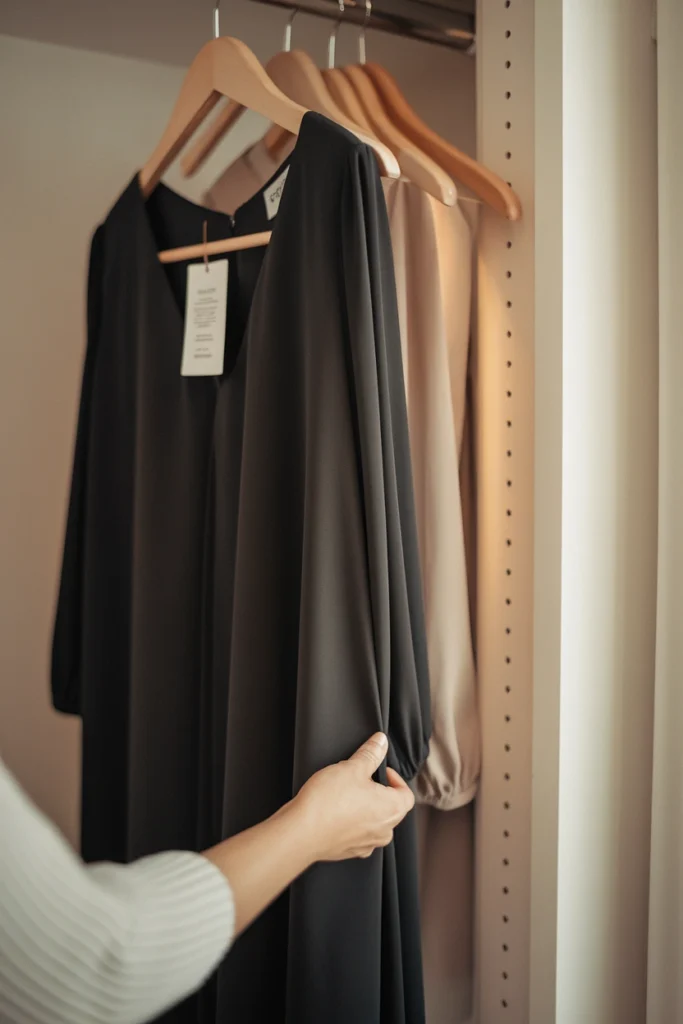
Pinterest’s most-saved wedding guest searches include a negation hook for a reason: a huge share of guests would rather not wear a dress at all. Here are five formulas that hold up, front-loaded with the one that works hardest.
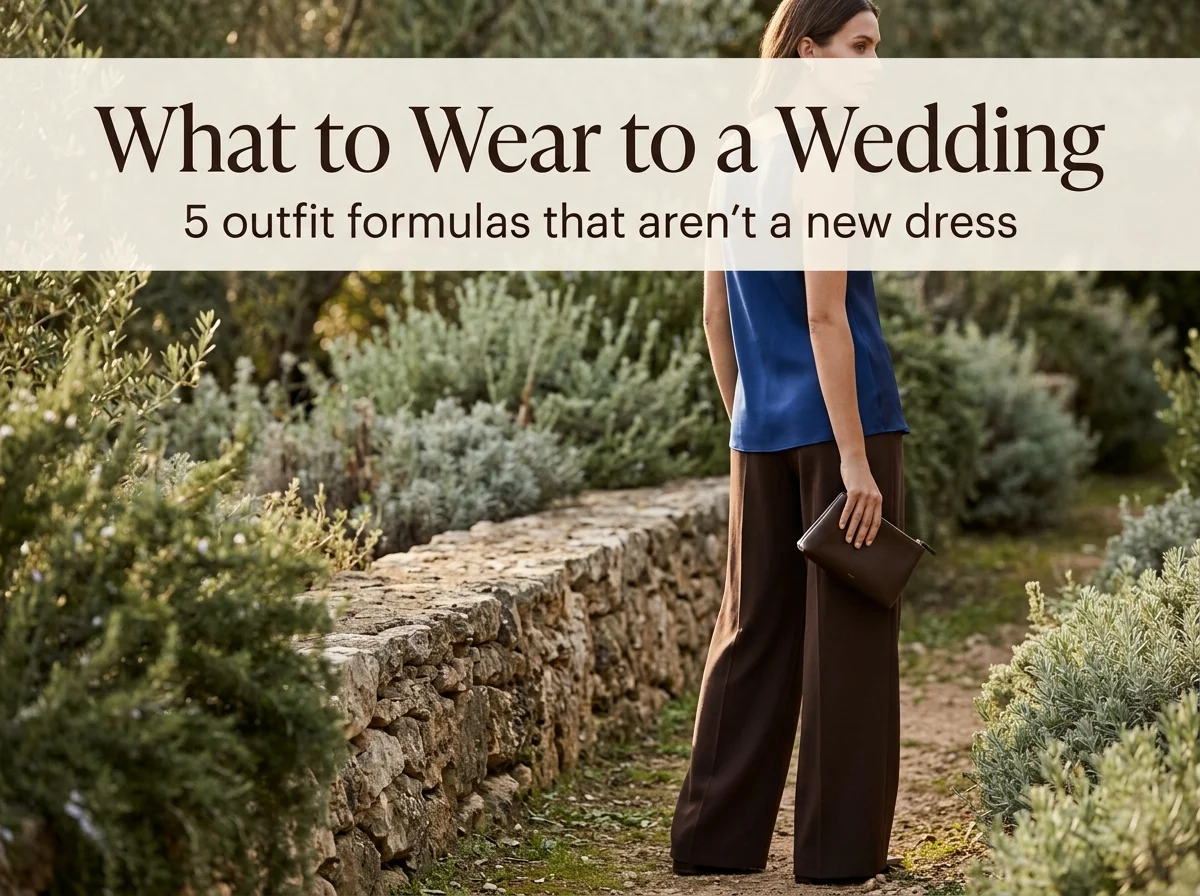
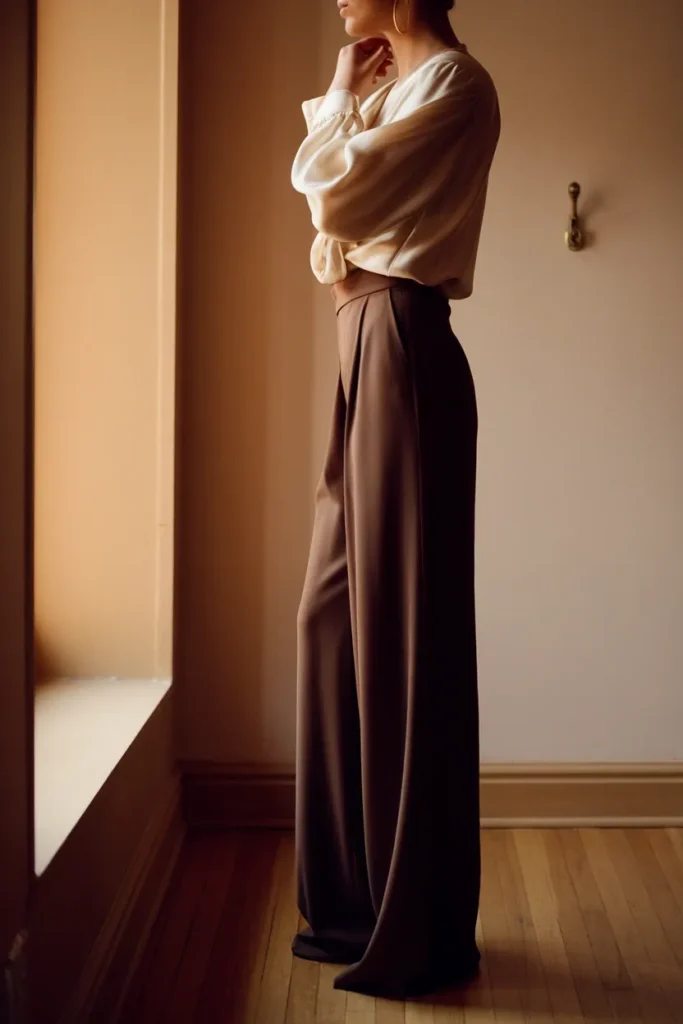
1. Wide-leg trousers plus a fluid shell plus a heel. The single best rewear ratio in occasion dressing. Espresso or navy trousers with a cream or blush silk-blend shell reads cocktail on Saturday and reads work on Tuesday, unchanged. Add a metallic sandal and one strong earring.
2. The two-piece set. Named as a 2026 wedding guest trend across multiple fashion desks this year, and the reason is practical: the top and skirt separate afterward and each half joins the everyday rotation. A taupe or sage set in a textured knit is the version that ages well.
3. Midi skirt plus tucked top. A satin or crepe bias skirt is one of the highest-mileage occasion pieces you can own. It goes formal with a shell and heels, then casual with a cotton tee and flat sandals a week later. Buy the skirt, not the dress.
4. The jumpsuit. Correct at semi-formal, cocktail, and black tie optional, provided the fabric is fluid rather than structured. It also solves the outdoor-venue problem completely, because grass and hemlines don’t interact well.
5. Tailored blazer over a slip dress. For fall and winter ceremonies specifically. The blazer does the formality, the slip does the movement, and both pieces live entirely separate lives Monday through Friday.
Every one of these leans on a top you probably already have, or should. Neckline height is the variable that decides whether a shell reads occasion or reads office, and the eight capsule wardrobe tops that anchor every outfit breaks down which heights to own before you buy anything new.
A quick tier note. If you’re pricing separates: Old Navy and Target land in the $25 to $50 range per piece, which is fine for a trouser you’ll wear hard, though the fabric will read a little flat under photography and the lining is usually where the corners get cut. Quince and Everlane sit around $60 to $110 with noticeably better drape. Reformation and Sezane run $150 to $350, which is real money, and their $250 satin midi skirt has a close cousin at Quince for roughly $70 that photographs almost identically.
Build the Look From Pieces You Already Own
Before you buy, run this. It takes eleven minutes and it kills a surprising number of purchases.
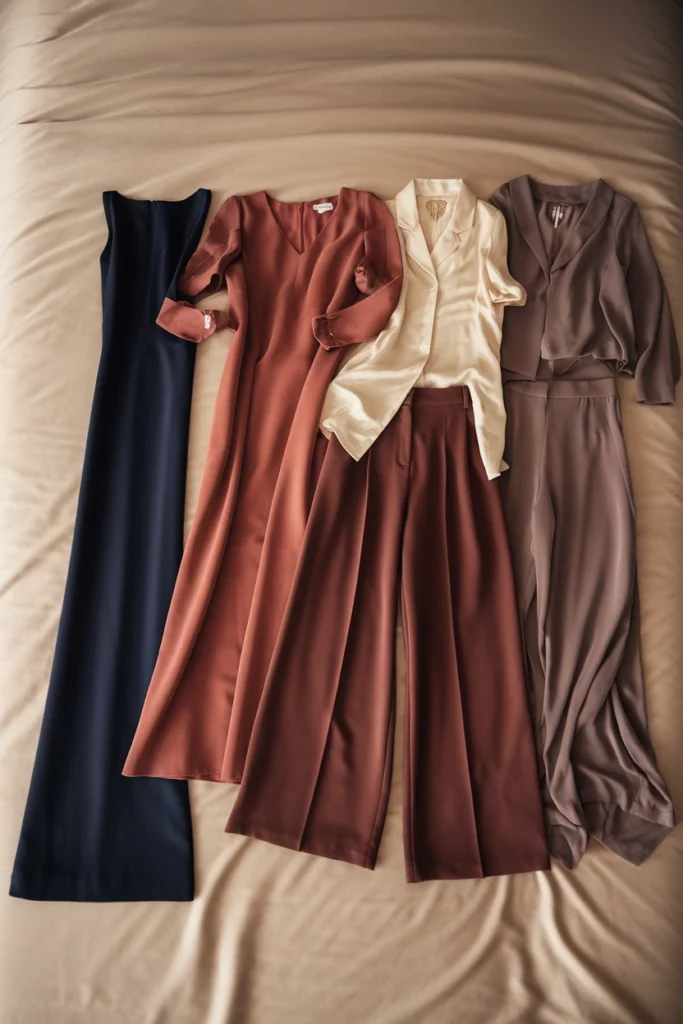
Pull every piece in your closet that could plausibly go to a wedding. Occasion-capable fabrics only: crepe, satin, silk blends, heavy jersey, fine knit, structured linen for daytime summer. Lay them on the bed.
Now sort into three piles.
Pile one: works as is. These need nothing. Be honest, not optimistic.
Pile two: works with one change. A hem shortened, a belt added, a different shoe. Tailoring a hem runs $15 to $30 in most US cities and it’s the highest-return money in this entire article.
Pile three: doesn’t work. Wrong fabric, wrong fit, wrong season. Put it back and stop considering it.
Most closets with eighty-plus pieces produce two or three items in pile two and are surprised by it. The dress you forgot about, the skirt you bought for a work event, the trousers you’ve only worn to the office.
Then the accessories do the rest of the lifting. An occasion outfit is usually 80% pieces you own and 20% finishing, and the finishing is where the whole thing either reads intentional or reads like separates that happened to be clean. One structured clutch, one strong earring, one shoe that suits the ground you’ll be standing on. That’s the whole kit. The small accessories that change everything goes deeper on the audit if you want to build the finishing layer properly rather than piecemeal.
One rule that matters more than it sounds like it should: pick one focal point. Statement earrings or a bold clutch or an interesting shoe. When all three compete, the outfit stops looking composed and starts looking assembled.
Color Rules Worth Following, and the Ones You Can Skip
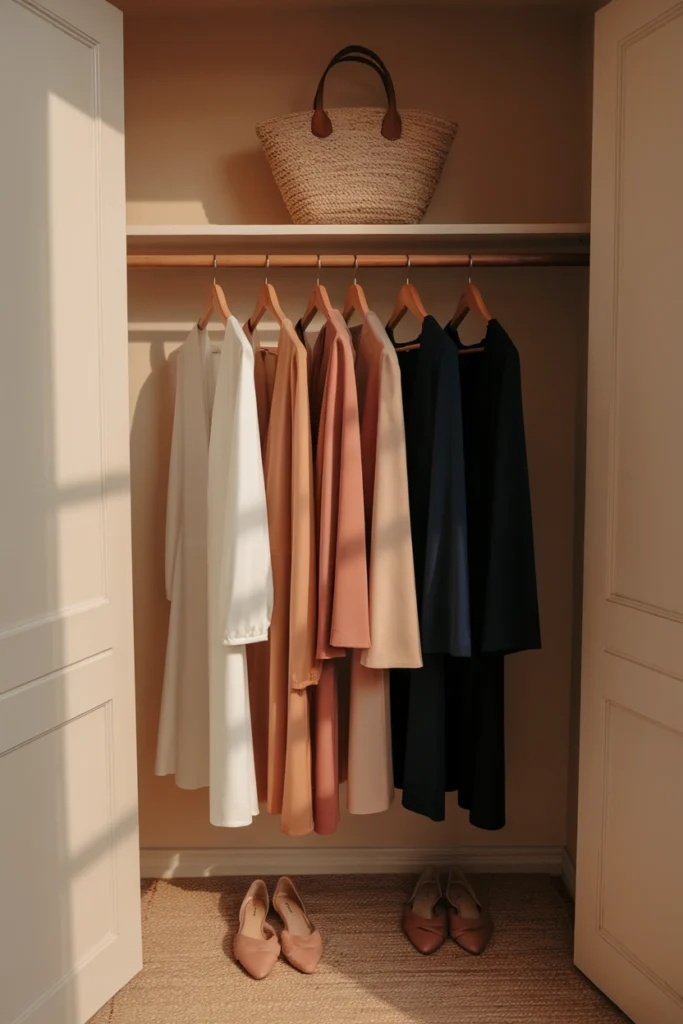
There are exactly two hard rules. Everything else is preference dressed up as etiquette.
Rule one: don’t wear white. Ivory, cream, champagne, blush that photographs white, and anything the camera will read as bridal. This one is real and it isn’t negotiable. Photographs flatten color and a pale blush at 5pm on a lawn can read ivory in a group shot.
Rule two: don’t wear the bridal party’s color if you know it. Showing up in the exact dusty blue the bridesmaids are wearing is an awkward twenty seconds you can avoid with one text.
Now for the rule people repeat that isn’t one.
Black is fine. It has been fine for a long time. It’s the standard for evening weddings in most of the US, it photographs beautifully, and the “bad luck” framing is a leftover from a mourning-dress convention that stopped applying decades ago. The only real caveats are daytime summer garden ceremonies, where black can read heavy against the setting, and a handful of cultural or religious contexts where black carries specific meaning. If the couple’s tradition is unfamiliar to you, ask. Asking is never rude.
Red is also fine, despite the internet insisting otherwise. The “don’t upstage the bride” argument doesn’t survive contact with an actual wedding where forty guests are wearing color.
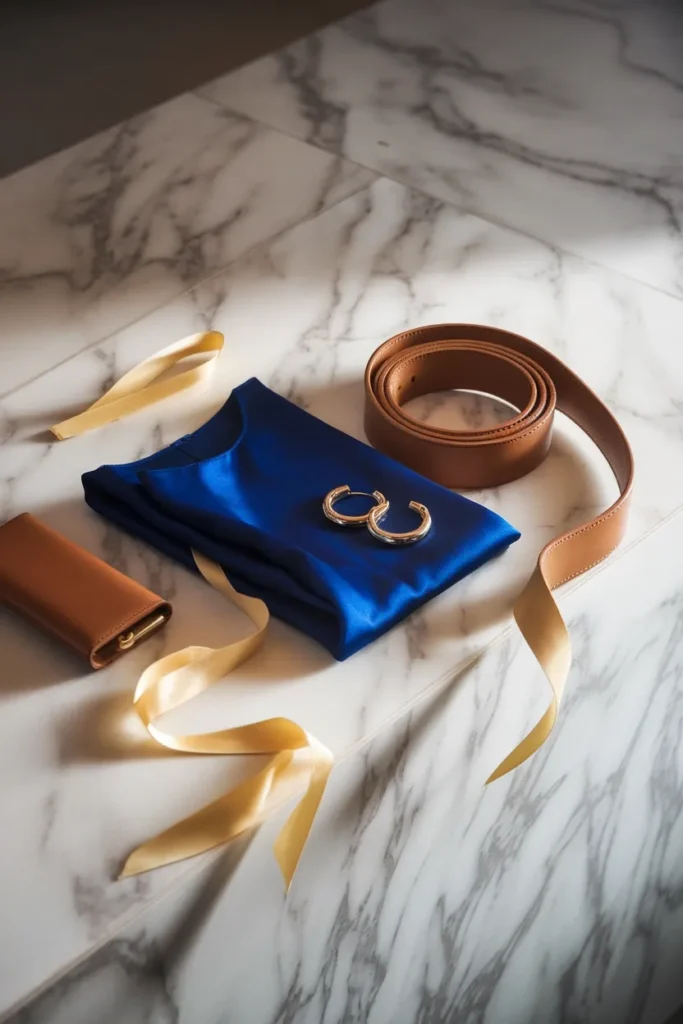
For 2026 specifically, cobalt blue has been the standout wedding guest color of the summer season, with butter yellow, rich browns, and deep greens all showing strongly across the trend coverage. If you build on a neutral base, one strong accent color is where the whole outfit gets its personality. A camel or espresso foundation with a cobalt shell, or an all-neutral look with a single butter-yellow clutch, does more than a busy print will.
Print, briefly: florals are safe and slightly expected, and a small geometric or a solid in a saturated color will photograph better in a crowd of them.
Shoes, Because the Venue Decides This One
This is where good outfits fall apart, and it’s entirely preventable. Match the shoe to the ground, not to the dress.
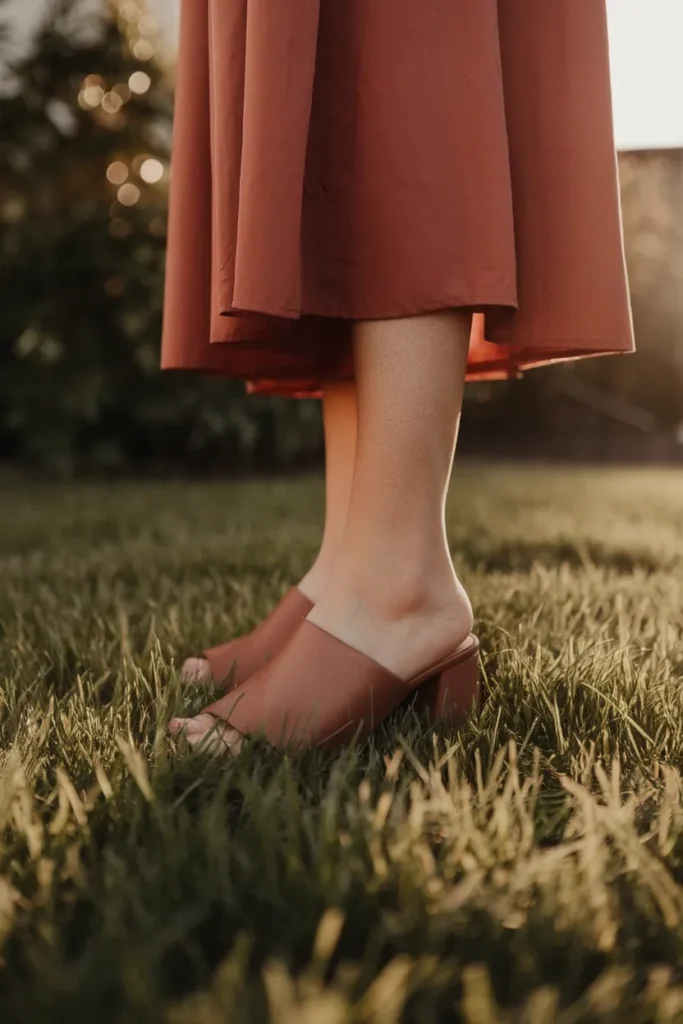
Grass, lawns, gardens, vineyards. A stiletto sinks. Not metaphorically, literally, and you will spend the cocktail hour walking on your toes. Block heels, wedges, and platform sandals distribute weight across a wider footprint and stay on the surface. A polished flat sandal is entirely acceptable at anything below black tie.
Sand and beach ceremonies. Flat sandals or barefoot, depending on how the couple has set it up. Bring the flats and change into them at the door.
Barn, rustic, and country venues. Uneven flooring and gaps between planks. Block heel or a heeled boot in fall. A thin heel and a barn floor is a genuinely bad combination.
Ballrooms, hotels, country clubs. Any heel height works. This is the one venue where the shoe is a pure style decision.
Historic buildings and cobblestone. Block heel, and give yourself extra time to walk.
Whatever you choose, do the two-hour test at home a week out. Walk around the house for two hours in them on a hard floor. Blisters that show up at hour two at home show up at hour one at a wedding, when you’re standing through photos.
And bring a backup. A pair of foldable flats in the car or the coat check turns hour six from an endurance event back into a party. Nobody photographs your feet at the reception.
What Works With Your Proportions
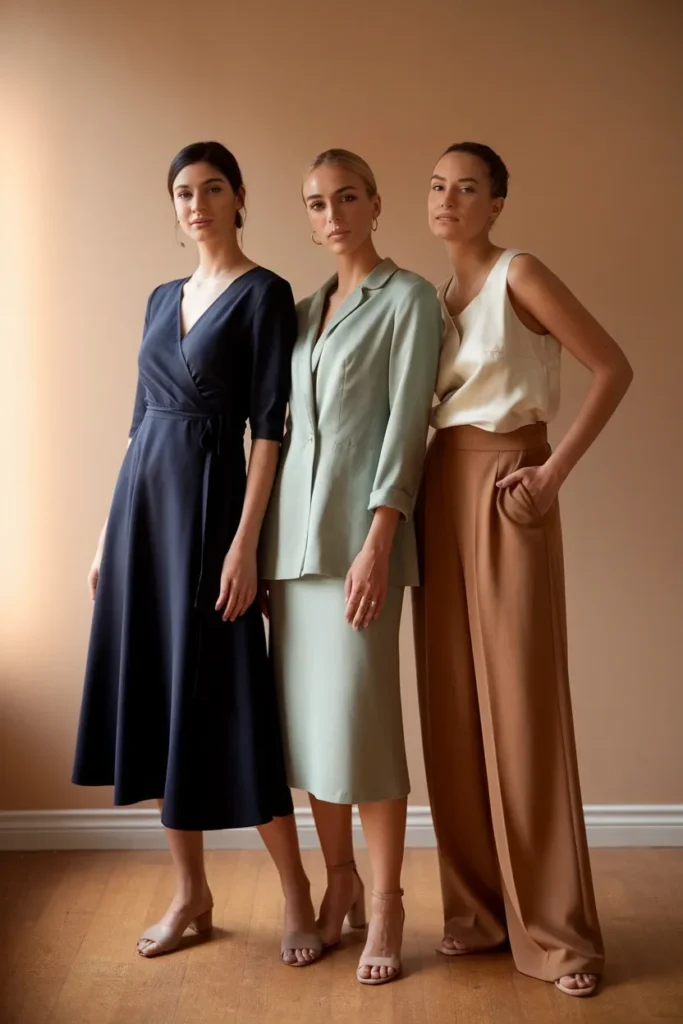
Skip the language about hiding things. The useful question is what sits well on your frame, and it comes down to where a garment breaks and how the fabric behaves.
Petite (5’4″ and under). A midi that hits at the narrowest part of your calf reads intentional. One that hits mid-calf cuts the leg line and reads like a hemming accident. Buy the length you need or budget the $15 to $30 to have it shortened. Monochrome from shoulder to shoe adds visible height without any effort.
Tall (5’9″ and over). You have the most range of anyone here. Longer hemlines, wider legs, and column silhouettes all work. Check the rise on trousers and the shoulder seam on blazers, because straight-size occasion wear is often cut short in both.
Curvy and midsize. Fabric with weight and drape holds a shape against your body instead of tenting away from it. Crepe, heavy jersey, and satin-back all work. A defined waist, whether from a belt, a wrap, or a seam, gives the eye a place to land. Wrap dresses earn their reputation here.
Plus-size. Same principle, and it matters even more: fabric weight over fabric volume. Look for a real lining and set-in sleeves rather than a raglan, which holds the shoulder line through a long day. ELOQUII and Nordstrom both carry occasion pieces cut properly rather than graded up from a straight size.
Rectangle frames. Definition comes from interrupting the vertical line, and the cheapest way to do it is a belt at your natural waist. A 14-piece capsule that creates curves on a rectangle frame covers the three interruption points in full.
Over 40 and over 50. Sleeve options widen your choices enormously. A three-quarter sleeve, a flutter, or a light bolero over a sleeveless dress keeps you comfortable in air conditioning and reads more polished than a wrap you hold all night.
Between sizes. Size up and tailor down. Always. A size-up crepe midi taken in at the waist for $25 fits better than a size-down anything, and it’s the single most reliable trick in occasion dressing.
The Wedding Kit That Fits in a Clutch
Nobody writes about this part, and it’s the difference between hour two and hour eight.
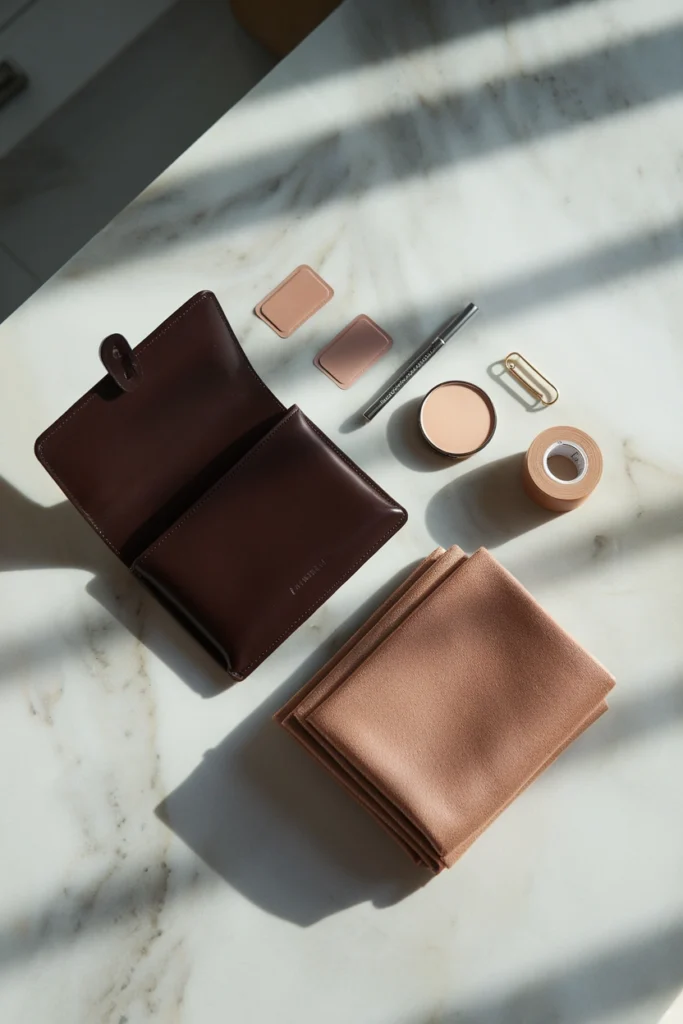
Six things, and they all fit:
Blister sticks or hydrocolloid patches. Two, applied before you feel anything. Preventive, not reactive.
A folded pashmina or thin wrap in the car. Church interiors and evening lawns run cold. A neutral wrap in camel or soft black rescues a sleeveless dress at 8pm and takes up no space.
Double-sided fashion tape. For a neckline that shifts when you sit, or a wrap dress that decides to open during the toasts.
A stain pen. Red wine, canapé grease, someone else’s champagne. Blot, don’t rub, and treat it inside ten minutes.
A small safety pin. Straps, hems, a bra band that migrates. Two grams of insurance.
Powder or blotting sheets. Outdoor summer ceremonies and photographs, mostly.
That’s it. It fits in a clutch with room for a phone and a lipstick, and it turns the day from something you’re managing into something you’re attending.
One more thing that isn’t in the clutch but belongs here: eat before you go. Ceremonies run long, cocktail hour is small plates, and dinner is often three hours after you arrived.
What It Costs, by Tier
Real numbers, stated as ranges because prices move and because a range is honest in a way a fixed figure isn’t.
Under $100 total. Old Navy, Target’s A New Day line, H&M, and Amazon Essentials cover a midi dress or a trouser-and-shell combination in the $25 to $50 per-piece range. The trade-off is fabric: thinner linings, more polyester, and a shell that wrinkles by hour four. Fine for a casual daytime ceremony. Less convincing under evening photography.
$100 to $250. Quince, Everlane, Madewell, J.Crew, and Banana Republic. This is the value sweet spot for occasion dressing. Quince’s silk and crepe pieces typically run $50 to $110 and punch above their price. J.Crew occasion dresses generally land in the $130 to $200 range. Drape improves noticeably here, which is exactly what photographs well.
$250 to $450. Sezane, Reformation, COS, and AYR. Better construction, better linings, and cuts that hold their shape through a long day. Reformation’s occasion dresses generally sit in the $200 to $350 band. Worth it only if the piece clears all three wears.
$450 and up. Investment territory, and honestly hard to justify for a wedding guest outfit unless you attend several a year. If you love a $500 piece, look at Quince or COS first, where a similar silhouette in a comparable fabric usually exists somewhere in the $80 to $200 range.
Rental. $30 to $90 for a multi-day rental at the major US services. This is the right answer for black tie and white tie, full stop. A gown fails the 3-Wear Rule almost by definition.
If you attend two or more weddings a year, the smartest spend is a single high-quality occasion dress in a neutral you can restyle, plus accessories that change its character. That’s the same logic behind ten dresses that cover a whole summer of outfits, applied to a smaller and more specific problem.
What to Wear to a Wedding Frequently Asked Questions
Can you wear black to a wedding?
Yes. Black is standard for evening weddings across most of the US, it photographs well, and the bad-luck association is a leftover from mourning conventions that stopped applying long ago. Two situations call for a second thought: a daytime summer garden ceremony, where black can feel heavy against the setting, and cultural or religious traditions where black carries specific meaning. If you’re unsure about the couple’s tradition, just ask.
What colors should you not wear to a wedding?
White and everything adjacent to it: ivory, cream, champagne, and pale blush that photographs white. That’s the firm one. Second, avoid the bridal party’s color if you know what it is, which takes one text to find out. Everything else, including red, is open. Cobalt, butter yellow, deep green, and rich brown have all been strong wedding guest colors through 2026.
What does cocktail attire actually mean for a wedding guest?
Knee-length to midi, in a fabric with real weight, styled with a heel and proper jewelry. It’s about fabric more than hemline. A knee-length dress in heavy crepe reads correct; the same shape in cotton poplin reads like a daytime errand. Wide-leg trousers with a fluid shell also satisfy cocktail, and rewear better than most dresses will.
What shoes should I wear to an outdoor wedding on grass?
Block heels, wedges, or platform sandals. A stiletto sinks into turf and you’ll be on your toes all evening. A polished flat sandal is fine at anything below black tie. Do a two-hour walk test at home a week beforehand, and leave backup flats in the car.
Does this work if I’m petite or between sizes?
Yes, with one adjustment each. If you’re 5’4″ or under, check where the midi hem lands; the narrowest part of your calf reads intentional, mid-calf doesn’t. If you’re between sizes, size up and tailor down. A hem or a waist taken in runs $15 to $30 in most US cities and it’s the highest-return money in occasion dressing.
Can I wear the same outfit to two weddings in one summer?
Absolutely, and different guest lists make it invisible. Even with overlap, change the accessories and the shoe and it reads as a new outfit. Swap a gold clutch for a woven one, change the earring, add a belt. This is the entire argument for buying one strong neutral occasion piece instead of three trend-driven ones.
Will a wedding guest outfit work year-round?
The right one will, and that’s the test. A crepe midi that works with sandals in July should work in November with opaque tights, a heeled boot, and a coat you already own. If it needs a whole new layer to function in the opposite season, it’s a single-season purchase, and you should price it accordingly.
Before You Open a Single Shopping Tab
Read the invitation twice. Translate the dress code into pieces rather than products. Pull everything occasion-capable out of your closet and sort it into three honest piles. Then, and only then, decide whether you need to buy anything at all.
Most of the time, you need one piece and a tailoring appointment. Sometimes you need nothing.
The wedding outfit that works isn’t the one that gets the most compliments on Saturday. It’s the one you reach for again on a Thursday in October and think, right, I forgot how much I like this.
Save this before the next invitation arrives. Which dress code trips you up most, and what’s the wedding you’re currently trying to solve? Tell me in the comments and I’ll help you build it from what you already own.
Keep reading

What to Wear on New Year’s Eve When Your Closet Is Full of Neutrals
Every December I get the same message from readers, and it always arrives around the 27th: what to wear on New Year’s...

What to Wear in Vegas: Day-to-Night Outfits That Pack Light
Figuring out what to wear in Vegas is less about glamour than it is about logistics. You’ll be outside in 100-degree sun...

What to Wear to Graduation as a Guest (Without Buying Anything New)
You have three weeks, one ceremony invitation, and a closet that suddenly feels useless. Figuring out what to wear to graduation as...