
How to Style Uggs Like It’s Actually Fashion
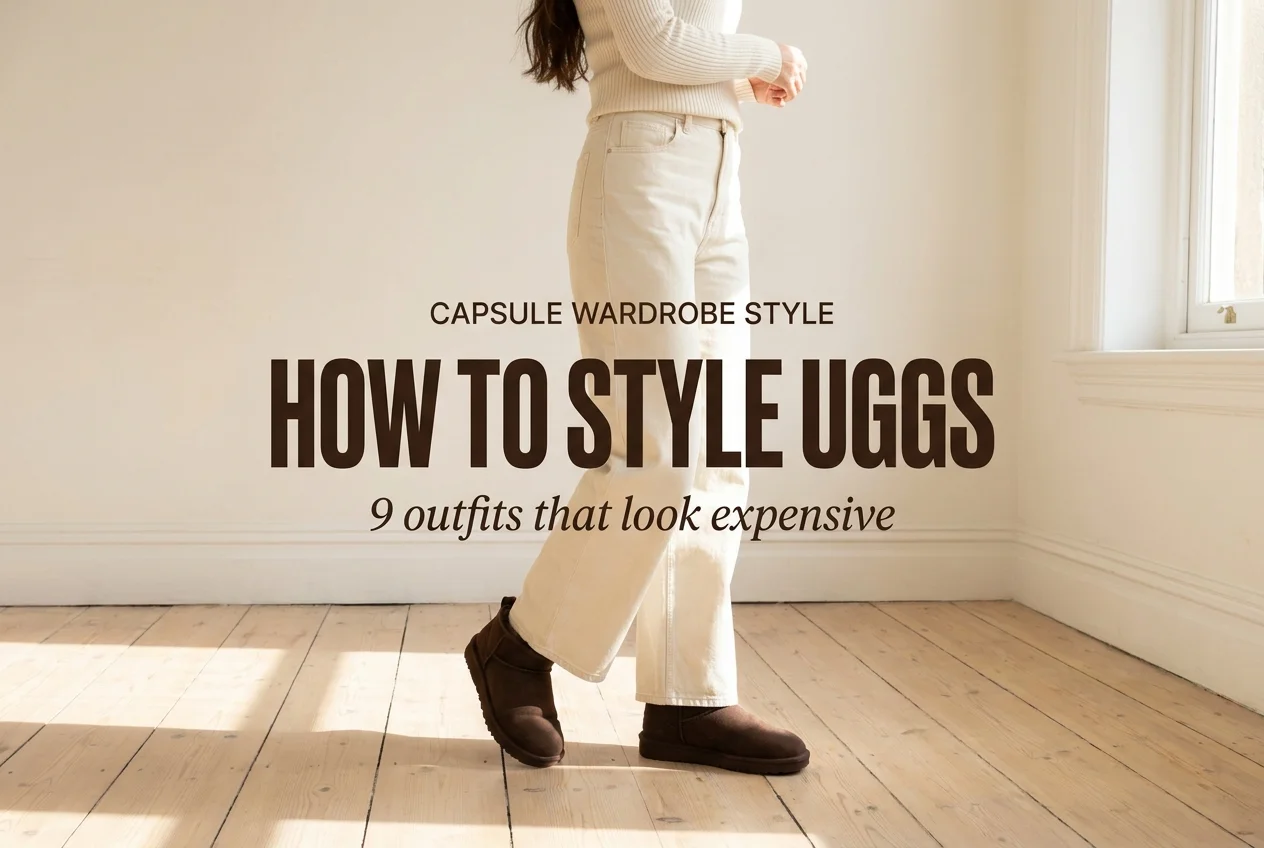
There’s a specific moment I want to talk about. You pull on the Uggs, glance in the mirror, and something goes wrong. The outfit was fine ten seconds ago. Now it reads like you quit halfway through getting dressed.
Learning how to style Uggs has almost nothing to do with finding cuter outfits. It comes down to four mechanical things most styling guides skip entirely: where your hem falls, how tall the boot is, whether the color temperature matches the rest of your outfit, and what shape your heel collar is in.
Fix those four and the same boots you already own start reading polished. Ignore them and no amount of nice sweaters will save the look.
Below you’ll get nine outfit formulas that actually work, a proportion table you can screenshot and keep in your camera roll, and the outfit math that decides whether a pair earns its hanger space or sits in the closet guilt-tripping you every October.
Why Your Uggs Keep Reading Frumpy (And the Four Things That Fix It)
Most advice on this topic tells you what to wear. Almost nobody tells you what’s going wrong, which is the part you actually need at 7:40 in the morning.
Here’s the diagnostic I run.
Failure point one: the collapsed heel collar. Sheepskin holds moisture. According to American Wool, the fiber can absorb more than 30 percent of its weight in moisture before it feels damp, which is exactly why the boots feel dry while the structure quietly gives out. Wear the same pair every day for a season and the back collar softens, folds inward, and starts slumping around your ankle. A slumped collar reads sloppy from twenty feet away no matter what you paired it with. Rotating two pairs, or just giving one pair a full day to dry out between wears, fixes most of it.
Failure point two: the hem is in the wrong place. More on this in the next section, because it deserves its own table. Short version: a hem that hits mid-shaft is the single ugliest place a hem can land.
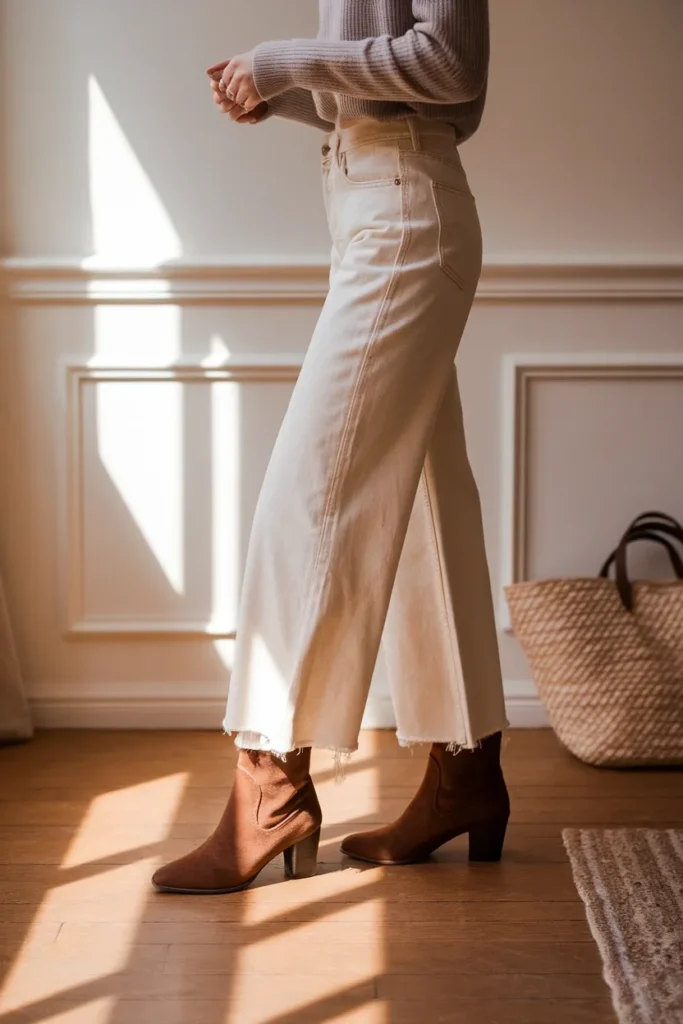
Failure point three: the color temperature is fighting you. Chestnut is a warm brown with orange in it. Pair it with a cool grey sweater and a blue-toned wash of denim and the whole outfit looks slightly wrong without you being able to name why. Warm boots want warm neutrals: cream, oat, camel, espresso, olive. Grey and black boots handle cool palettes better.
Failure point four: you’re wearing them like slippers when the outfit is asking for shoes. A sweat set and Uggs is a real outfit. A blazer and tailored trousers with the same sweat-set energy in the boot is not. Match the effort level.
The Ugg Proportion Rule: Match the Boot to the Hem, Not the Outfit
Every guide on the internet will tell you to wear Uggs with wide-leg jeans. Almost none explain why it works, so you can’t apply the logic when you’re standing in front of your own closet with a different pair of pants.
The rule is simple. Your hem and your boot shaft are competing for the same few inches of your leg, and only one of them gets to win.
When a hem covers the shaft almost completely and stops about an inch off the floor, your eye reads one continuous line from hip to floor. Long, clean, deliberate. When a hem stops partway up the shaft, your eye gets two horizontal breaks in the space of six inches, and horizontal breaks at the widest part of your calf shorten everything above them.
Here’s the whole thing in a table. Screenshot it.
| Boot | Best hem | What it does to your leg line | Watch out |
|---|---|---|---|
| Ultra Mini (ankle) | Full-length wide leg or straight, stopping about an inch off the floor | Longest, cleanest line of any Ugg. The break sits low and reads as one column. | If you’re petite and the hem puddles, get it hemmed. Puddling undoes the whole effect. |
| Classic Mini | Cropped straight, ankle-grazing, or a hem that stacks slightly on top | Neutral. Behaves like an ankle boot, so treat it like one. | Mid-calf hems. Worst possible landing spot on this boot. |
| Classic Short (mid-calf) | Slim straight, skinny, or leggings tucked in | Cuts at the widest part of the calf, so it shortens the leg more than the others. | Anything wide or voluminous. The shaft plus the fabric doubles the bulk. |
| Tasman / Tazz (slip-on) | Full-length straight, or a hem with a soft stack at the ankle | Reads like a loafer wearing a shearling collar. Surprisingly polished. | Cropped hems that expose bare ankle and the collar at the same time. Pick one. |
| Platform Ultra Mini | Full-length wide leg or straight, an inch off the floor | Adds height without adding shaft height, which is the best of both. | Short hems. The platform sole reads chunky when it’s fully exposed. |
If you’re petite, at 5’4″ and under, the ultra mini and the platform ultra mini give you the most usable leg line, and a hemmed full-length pant will do more for your proportions than any styling trick. If you’re tall, at 5’9″ and over, you have room to play with the classic short that shorter frames don’t, because a mid-calf break costs you proportionally less. If you’re curvy or midsize, the thing that matters most is that the pant’s volume and the boot’s volume don’t peak in the same place. Wide pant with a slim ankle boot works. Wide pant with a chunky mid-calf shaft fights itself.
How to Style Uggs With Wide Leg Jeans
This is the formula doing the heaviest lifting right now, and it works for a reason the proportion table already gave you.
Start with a full-length wide-leg jean in a mid or light wash. The hem should clear the floor by roughly an inch when you’re standing still, close enough that it covers the entire boot shaft but not so long that it drags and frays. If your jeans puddle, take them to a tailor. It usually runs under $20 and it’s the highest-return alteration in your closet.
Then keep the top half deliberately close to the body. An oversized pant with an oversized sweater and a chunky boot gives you volume in all three zones and the whole outfit loses its shape. A fitted rib knit, a tucked white tee, a slim mock neck: any of those restore the balance.
Three combinations I’d wear on repeat:
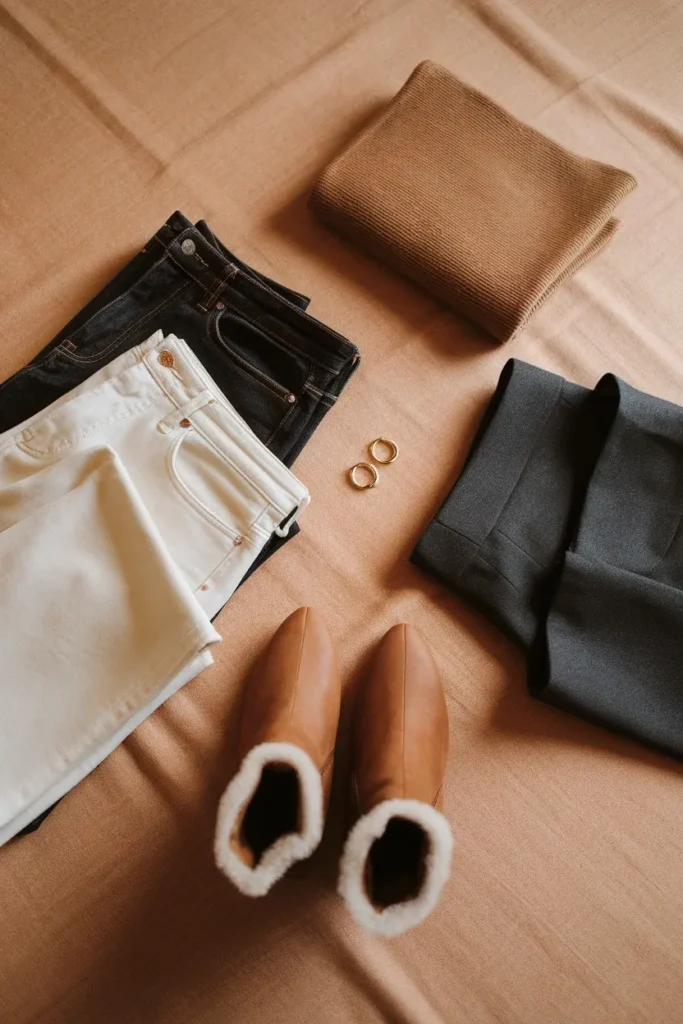
- Light-wash wide-leg jeans, cream fitted rib turtleneck, chestnut ultra minis, gold hoops
- Ecru wide-leg jeans, soft black fitted crewneck, black ultra minis, black leather crossbody
- Mid-wash wide-leg jeans, oatmeal fine-gauge sweater tucked at the front only, sand platform minis
The tuck matters more than it sounds like it should. A front tuck marks your waist and tells the eye where your proportions actually are, which is the difference between relaxed and shapeless. If you want the full breakdown on getting this silhouette right, I covered it in how to style wide leg jeans without losing your leg line.

Ultra Minis With Straight and Baggy Denim
Wide leg isn’t the only denim that works, and honestly the straight-leg version is easier to wear on a Tuesday.
A straight-leg jean gives you a narrower column, so the ultra mini peeks out at the ankle instead of disappearing under fabric. That small reveal is good. It reads intentional, like you chose the boot rather than defaulted to it.
Baggy denim is the trickier one. The volume sits higher on the leg and tapers or breaks unpredictably at the ankle, which means the boot has to be low enough to stay out of the way. Ultra minis: yes. Classic shorts: it fights. If your baggy jeans stack heavily at the ankle, roll them once to create a clean edge rather than letting the fabric bunch over the boot collar. I broke down the whole silhouette in the baggy jeans styling rules that keep the fit intentional, and the same logic applies here.
Two formulas worth stealing:
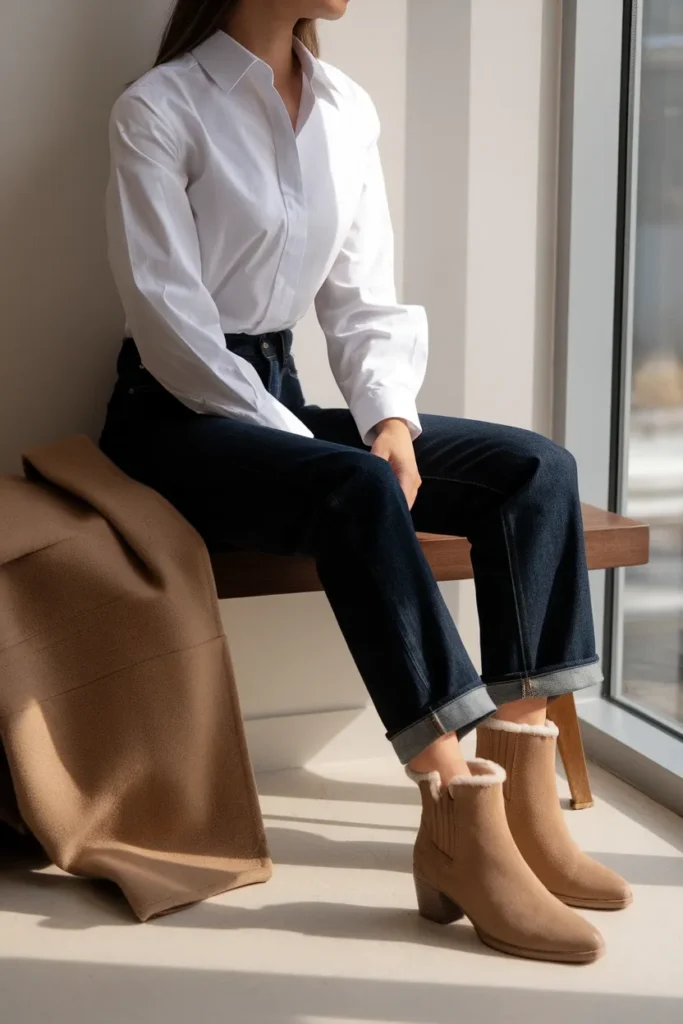
- Straight-leg dark denim, tucked white button-down, camel wool coat, sand ultra minis
- Baggy mid-wash denim rolled once, cropped cream sweatshirt, chestnut ultra minis, small crossbody
Color note: sand and chestnut both read warm, so they pair beautifully with cream, camel, and olive. If your denim skews cool and blue, grey or soft black boots will look more considered.
The Skirt and Dress Formulas That Keep Uggs Looking Deliberate
Skirts are where most people lose their nerve, and they shouldn’t. A skirt with Uggs is one of the easiest ways to make the boot read as a style choice rather than a comfort surrender.
Midi skirt plus ultra minis. A midi that hits at mid-calf or lower leaves a few inches of bare leg or opaque tights above a low boot. That gap is what keeps the outfit from looking like a costume. Satin bias-cut midis work especially well because the fluid drape contrasts with the boot’s density, and the contrast is what makes it look intentional.
Denim skirt plus tights plus ultra minis. Opaque tights in charcoal or soft black bridge the skirt and the boot into one continuous line, so the eye reads long rather than chopped. This is the cold-weather version of an outfit you already wear in September. If you want more on making a denim skirt work past summer, here’s styling a denim skirt through cold weather.
Sweater dress plus classic mini. Keep the dress hem above the knee or well below it. A hem grazing mid-calf with a mid-calf boot is the exact collision the proportion table warned about.
Maxi dress plus ultra minis. Barely any boot shows, which is the point. You get a full sweep of fabric interrupted by nothing. Works best in a heavier knit or a brushed cotton in fall, and it’s the outfit I’d pick for a long walk in November when the temperature can’t decide.
One rule across all four: if the skirt or dress is soft and drapey, the boot brings the structure. If the skirt is already structured, like a pleated wool midi, add something fluid up top so the whole outfit isn’t rigid.

How to Style Ugg Tasman and Tazz Outside the House
The slip-on styles get treated like house shoes, and that’s a waste of a genuinely useful piece.
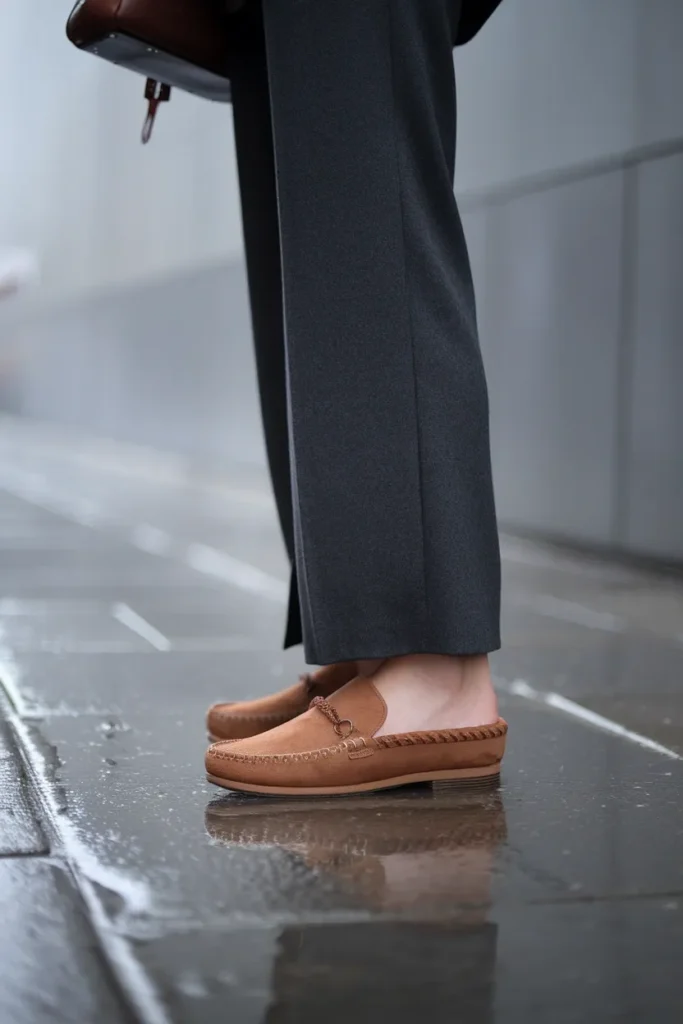
Think of the Tasman as a loafer with a shearling collar. The braided trim gives it a detail that reads as design rather than comfort, which means it can carry a more put-together outfit than the classic boots can.
What makes it work: a full-length straight pant that just skims the top of the foot, so the collar shows as a deliberate band of texture rather than a fluffy interruption. Wide-leg trousers in wool or a heavy twill are excellent here. So is a straight-leg jean with a clean hem.
What kills it: cropped pants that expose bare ankle above the collar. You get a stripe of skin, a stripe of shearling, and a stripe of shoe, and the eye reads three separate things instead of one. If you’re wearing them cropped, add a ribbed sock in a color close to your pant and let it close the gap.
The Tazz is the platform version, and it handles a slightly wider pant because the added height gives the shoe more visual weight to balance against.
Two combinations that go outside without apology:
- Charcoal wool wide-leg trousers, ivory fine-gauge knit, chestnut Tasmans, no visible sock
- Straight dark denim, striped long-sleeve tee, oversized denim jacket, sand Tazz
That second one leans on a piece most closets already have, and the layering rules are the same ones I use in denim jacket layering for transitional weather.
Layering Over Uggs: The Coat and Knit Combinations That Do the Work
The boot is the heaviest thing in the outfit. Whatever goes on top has to hold its own or the proportions tip.
Long coats beat short coats. A coat that hits below the knee, or a maxi wool style, creates a vertical line that runs past the boot and pulls the eye down the full length of you. A cropped puffer stopping at the waist does the opposite: it stacks a horizontal break at your hips onto the horizontal break at your ankles, and you end up looking compressed in the middle.
If you love a cropped jacket, lengthen everything else. Full-length pant, long sweater underneath the jacket so a few inches show below the hem, low boot. The layered hemlines create their own vertical rhythm and the crop stops working against you.
Knit weight is the quiet variable. A chunky cable sweater with a chunky boot is a lot of texture at both ends and not much in between. Either break it up with something smooth in the middle, like a slim wool trouser, or swap to a fine-gauge knit and let the boot be the only heavy thing.
The three outerwear pieces that carry Uggs best, in order: a long wool or wool-blend coat in camel or charcoal, a below-hip quilted or shirt jacket, and a trench for the 50-degree stretch of October when a wool coat is too much. If you’re deciding which coats deserve the closet real estate, which capsule wardrobe jackets layer over a chunky knit walks through the whole shortlist.

Outfit Math: How One Pair Earns Its Hanger Space
Here’s the part nobody else writes, and it’s the part that decides whether this purchase was smart or just cozy.
A pair of boots earns its place in a capsule the same way any other piece does. It has to multiply. Sitting there being cozy isn’t enough.
The 3-Pair Outfit Math Check
Before a pair earns its hanger space, it should clear all five:
- It works with at least three bottoms you already own and actually wear.
- It works with your two most-worn coats, not your aspirational one.
- It sits inside your neutral base instead of fighting it.
- You’d wear it to at least two different kinds of places, including somewhere past the driveway.
- Cost per wear lands under $2 by the end of the first full season.
That last one is easier to hit than people expect. A boot in the $150 range worn 80 days across a fall and winter comes out around $1.88 per wear. Worn 30 days it’s $5. The number isn’t the point. The habit of running it before you buy is the point, because it quietly kills the purchases that were never going to work.
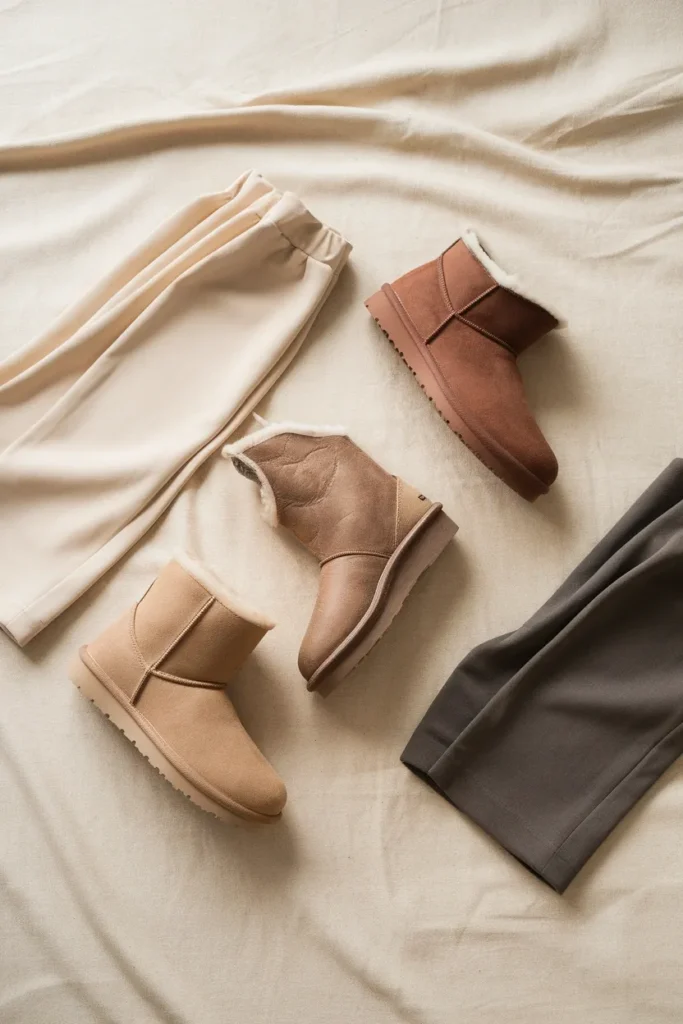
Where Uggs sit in a capsule: they’re a secondary shoe, not an anchor. Your anchor shoe is the one that goes with 70 percent of your outfits, usually a loafer, a clean sneaker, or an ankle boot. Uggs cover the cold, casual, high-comfort corner that anchor shoe can’t reach. One pair is almost always enough. Two only if the second is a genuinely different height or a different color temperature, and even then I’d think about it.
The color question resolves fast. Chestnut and sand pair with warm neutrals and read softer. Soft black and charcoal pair with cool neutrals and read sharper. Pick whichever matches the base you already built, which is the same logic behind building a year round capsule wardrobe that stretches across seasons.
Socks, Color, and Care: The Details That Decide Whether They Read Expensive
Small stuff, big difference.
Socks. Sheepskin is designed to be worn against bare skin, and it manages moisture well enough that sockless is genuinely comfortable in cold weather. The trade-off is that all that moisture goes into the lining, which is what softens the collar over a season. My compromise: bare feet on short days, a thin no-show wool sock on long ones. If your socks are visible, they should either match the pant or match the boot. A white athletic sock peeking above a chestnut collar undoes every other decision you made that morning.
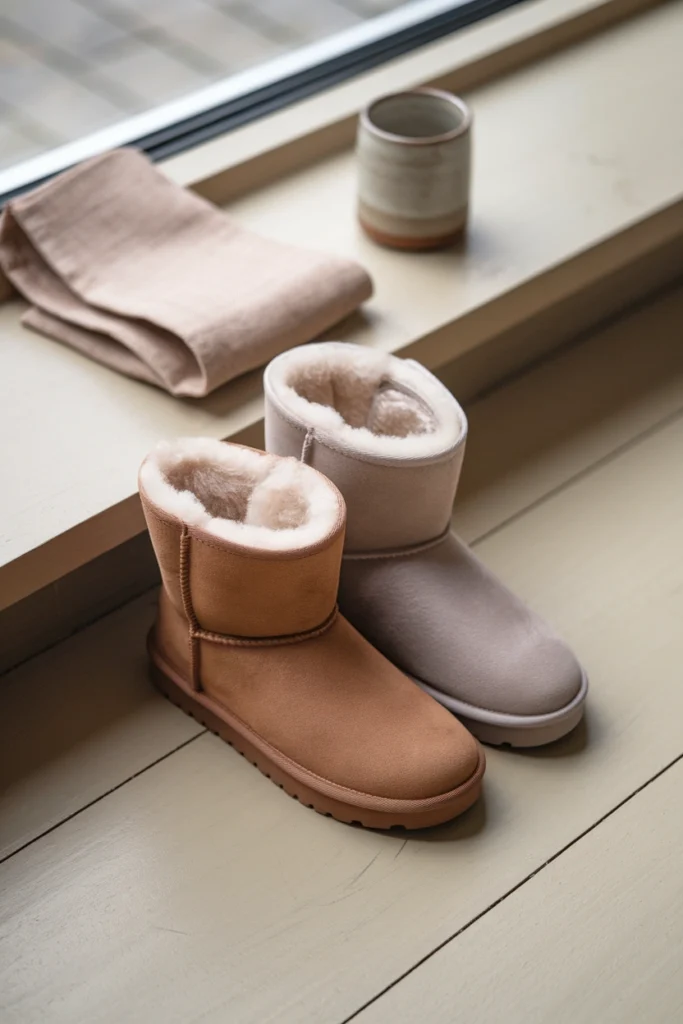
Color. Chestnut is the most versatile in a warm neutral closet. Sand is softer and shows dirt faster. Soft black is the sharpest and the easiest to wear with cool tones. Grey sits in between and pairs surprisingly well with navy. Whatever you own, the outfit should contain at least one other element in the same temperature family so the boot doesn’t float.
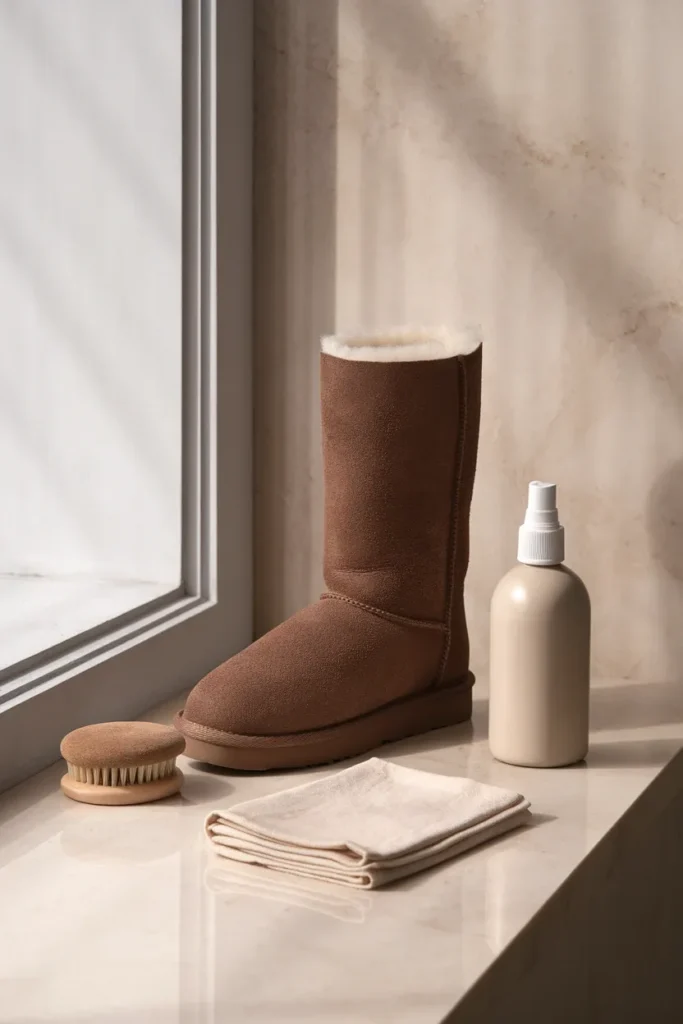
Care, which is really a style issue. A protective spray before the first wear and a re-spray midway through the season is the difference between boots that look two months old and boots that look two years old. UGG’s official sheepskin care and cleaning instructions are explicit about the rules that matter most: hand wash only, never a washing machine, stuff them with paper to hold their shape, and let them dry naturally away from direct heat or sunlight. Radiators are how good boots die.
Salt stains are the other seasonal problem. Blot them early with a barely damp cloth rather than scrubbing, because scrubbing crushes the suede nap and leaves a permanent shiny patch.
The finishing pieces do a surprising amount here. A structured bag next to an unstructured boot creates the contrast that makes the whole outfit look considered, and the capsule wardrobe accessories that pull a neutral outfit together covers which ones are worth owning.
What to Buy If You Are Starting From Zero
If you own none of this and you’re deciding where to put your money, here’s how I’d rank it.
Start with the ultra mini in chestnut or soft black. It’s the most versatile height, it plays well with the widest range of hems, and it’s the one that turns up in the most outfits. Expect it to land somewhere in the $150 range, though prices move, so check current pricing before you commit.
The Tasman is the better buy if you work from home. It costs less than the boots, usually landing in the $110 to $130 neighborhood, and it covers the school run, the coffee shop, and the desk without changing shoes.
Skip the classic short unless you’re tall. It’s the least flexible height for most frames, and it’s typically the most expensive of the group.
On dupes and price tiers: the sub-$50 shearling-look boots at Target and Amazon Essentials will get you through a season, and the trade-off is honest. The lining is usually synthetic rather than real sheepskin, so it doesn’t manage moisture the same way and it flattens faster underfoot. If you’re testing whether this style suits you at all, that’s a reasonable way to find out. If you already know you’ll wear them 60 or 80 days a year, the real thing costs less per wear.
For everything you layer on top, the mid tier is where the value sits. Quince, Uniqlo, and Everlane cover fine-gauge knits well. Madewell and J.Crew handle the denim. Old Navy and Gap are solid for the basic tees you’ll go through faster.
Frequently Asked Questions
Are Ugg boots still in style in 2026?
Yes, and the shape of that popularity has shifted. Interest has moved decisively toward the lower silhouettes, the ultra mini, the platform mini, and the Tasman and Tazz slip-ons, while the tall classic has faded. The styling has changed too. Uggs now get worn with tailored coats and wide-leg trousers rather than the leggings-and-hoodie formula they were locked into a decade ago.
Can you wear Uggs with jeans, and which cut works best?
Absolutely, and jeans are the strongest pairing available. Full-length wide-leg and straight-leg cuts work best because the hem covers the boot shaft and creates one continuous line. Skinny jeans work with the taller classic short, where you can tuck them in cleanly. The cut to avoid is anything that stops partway up the boot shaft.
What pants go with Ugg ultra minis?
Full-length wide-leg jeans, straight-leg denim, wool wide-leg trousers, and slim tailored pants all work. The rule is that the hem should stop within about an inch of the floor, covering the low shaft entirely. Cropped pants also work if you commit to the ankle being visible and skip the sock, but the full-length version is more reliably polished.
Do you wear socks with Uggs?
Sheepskin is built to be worn against bare skin and it handles moisture well, so sockless is comfortable and it’s what the boots are designed for. A thin wool no-show sock on long days extends the life of the lining without changing the fit. If a sock is going to be visible, match it to your pant color or your boot color and skip anything athletic or white.
Can you wear Uggs in the snow?
Light snow on a short walk, yes, especially with a water-repellent treatment applied beforehand. Deep snow, slush, or salted sidewalks, no. Classic sheepskin styles aren’t waterproof, and salt leaves permanent marks on suede. For real winter weather you want a treated or weather-rated style, and you should re-apply protectant a couple of times through the season regardless.
Do Uggs run big, and what if I am between sizes?
They run generously, and the sheepskin lining compresses noticeably over the first few weeks of wear. Most people do better sizing down from their usual sneaker size, and if you’re between sizes, the smaller one is usually right because the boot will loosen rather than tighten. If you plan to wear socks most days, stay at your true size instead.
Are Uggs worth it, or is there a cheaper alternative that holds up?
It depends entirely on wear count. Worn 60 to 80 days a season, a pair in the $150 range comes out under $2 per wear, which is strong value for a shoe. Worn a handful of times, it isn’t. The sub-$50 alternatives at Target and Amazon Essentials look similar on day one, and the honest trade-off is a synthetic lining that manages moisture less well and a footbed that flattens sooner. Good for testing the style. Less good if you already know you’ll live in them.
The Part That Actually Matters
None of this is about buying more. It’s about getting the pair you already own to stop undercutting outfits you otherwise like.
Start with the proportion table. Go look at what your current jeans do to your boot shaft, and if the hem is landing in the wrong place, that one alteration will change more than a new sweater would. Then run the outfit math before the next pair tempts you in October.
If you try one formula from this list, make it the wide-leg jean with a fitted knit and a low boot. It’s the one I’d put money on working for the widest range of frames and closets, and it takes about forty seconds to put together.
Which pair do you own, and what have you been wearing them with? Tell me in the comments, and if you want the rest of the system these outfits sit inside, the capsule wardrobe guides here will get you there faster than another shopping trip will.
Keep reading

How to Style a Jacket for Plus-Size Women: 10 Outfits That Work
A lot of jacket advice for bigger bodies is still written around hiding. Hide the hips, hide the arms, hide under something...

How to Style a Jacket for Women Over 50: 12 Outfits That Work
Your closet probably holds more jackets than you wear. There’s the blazer from an old job, the denim jacket you’re unsure about...

How to Style a Jacket: 10 Cozy Jacket Outfits for Fall and Winter
Your jacket is the first thing people see between October and March. It’s also the piece most of us grab last and...