
How to Style a Scarf: 10 Ways to Elevate a Simple Outfit
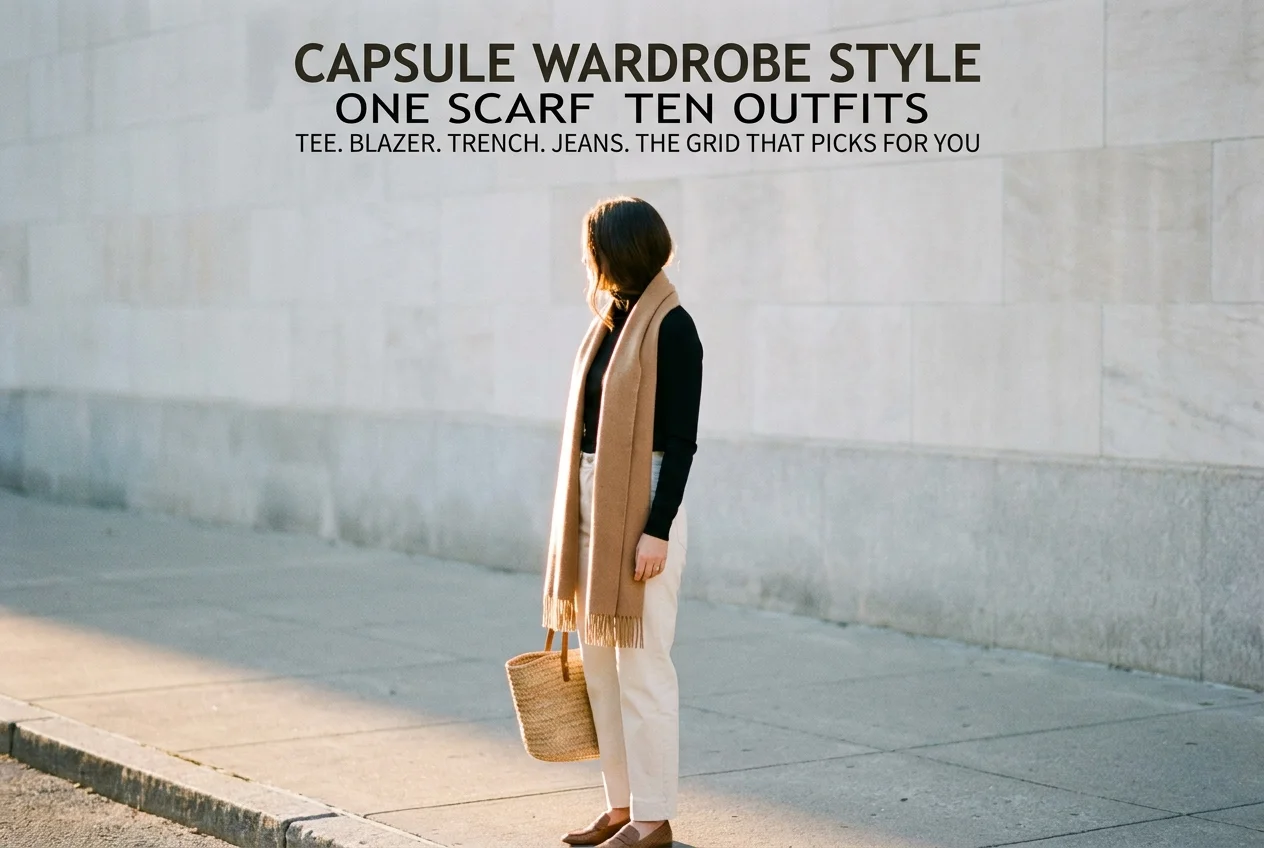
Learning how to style a scarf is the fastest way I know to make a three piece outfit look like you actually thought about it. Not a new coat. Not new jeans. A rectangle of fabric that’s probably folded in a drawer right now, doing nothing.
Most scarf tutorials get one thing badly wrong. They hand you nine knots and leave you at the mirror at 7:40 in the morning with no idea which one belongs on the shirt you’re already wearing. Tying isn’t the hard part. Choosing is.
So this guide does both. Ten ways to wear a scarf, and then a grid that tells you which one to reach for based on what’s already on your body.
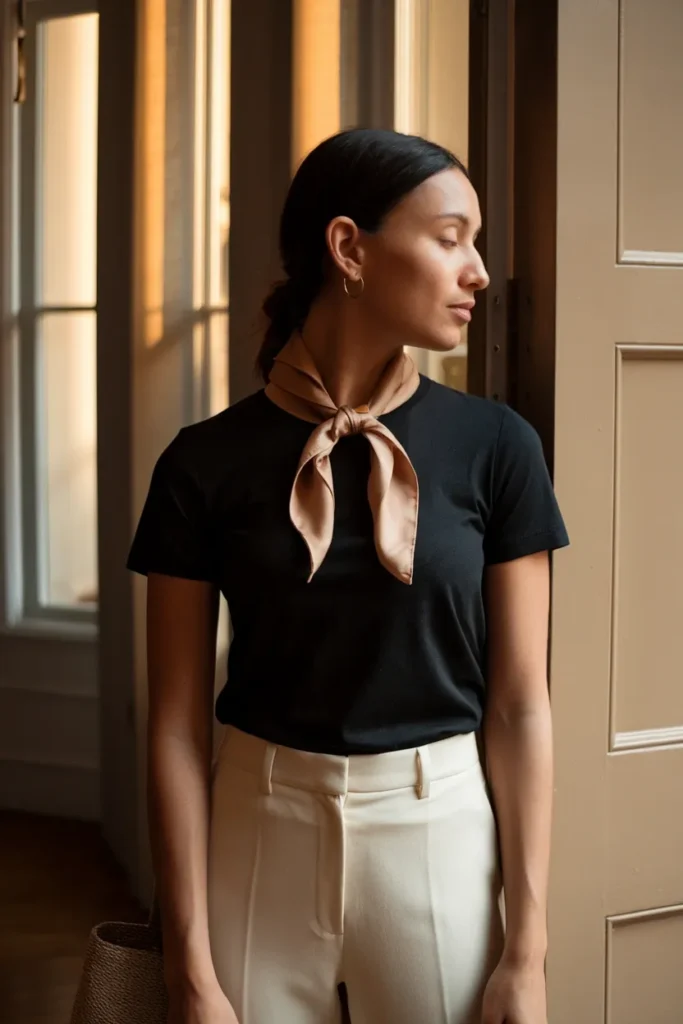
Before any knots: the three question test that picks your scarf in 60 seconds
Every method below works. That’s the problem. Ten good options is the same as no options when you’re already late.
Run these three questions instead. They take about a minute and they narrow ten down to two.
One: what’s the fabric weight? Silk and lightweight cotton hold a knot close to the skin and stay flat under a collar. Wool, cashmere, and anything brushed will bulk at the neck, so those belong draped, wrapped over outerwear, or tied at the hip. Fighting a heavy scarf into a small knot is how necks disappear.
Two: how long is it? Under about 40 inches you’re working with a square or a neckerchief, which means the action happens at the throat. Between 60 and 80 inches you have a rectangle that can loop, drape, or belt. Over 80 and it’s closer to a shawl.
Three: what’s your neckline doing? A crew neck gives you a hard horizontal line to sit against. An open button down gives you a V that wants to be filled or framed. A turtleneck is already busy at the throat, so move the scarf somewhere else entirely.
Answer those three and most of this list eliminates itself.
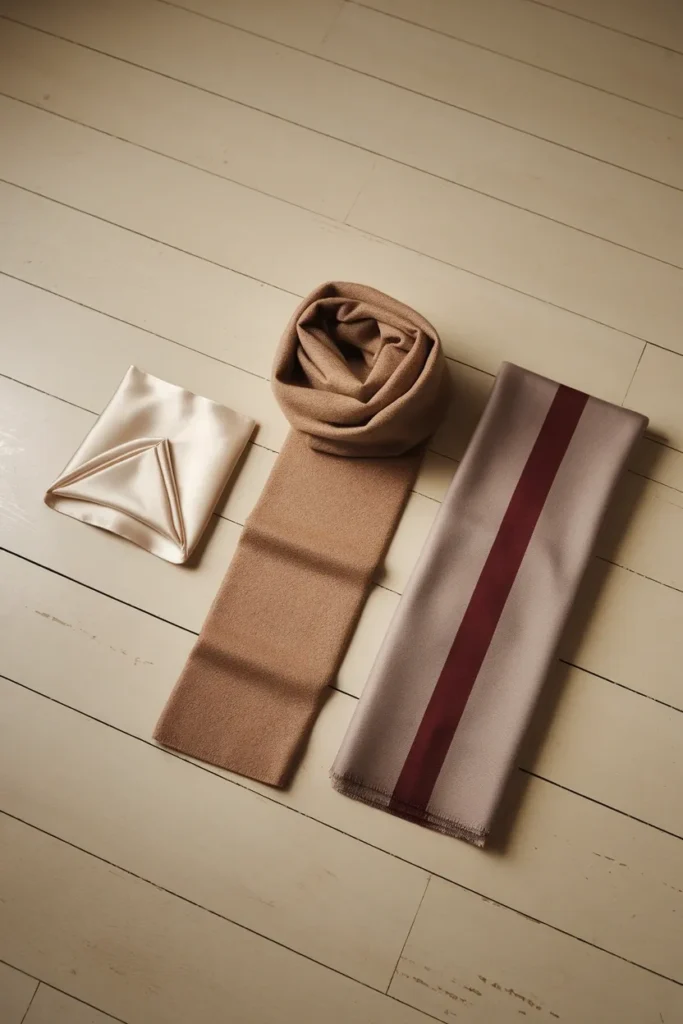
1. The Paris knot, the one that works on almost every neckline
If you only ever learn one, learn this.
Fold a long scarf in half lengthwise so it’s a narrow band. Drape it around your neck with the folded loop hanging on one side and the two loose ends on the other. Pass both ends through the loop and pull, then slide the knot up or down until it sits where you want it.
The whole thing takes about eight seconds once you’ve done it twice.
What makes it work so well is that it’s adjustable after the fact. Sitting high at the throat it reads polished and a little formal. Loosened four inches down it reads casual. Same scarf, same knot, two completely different outfits, which is exactly the kind of outfit math a small closet needs.
2. The loose drape that makes a plain tee look deliberate
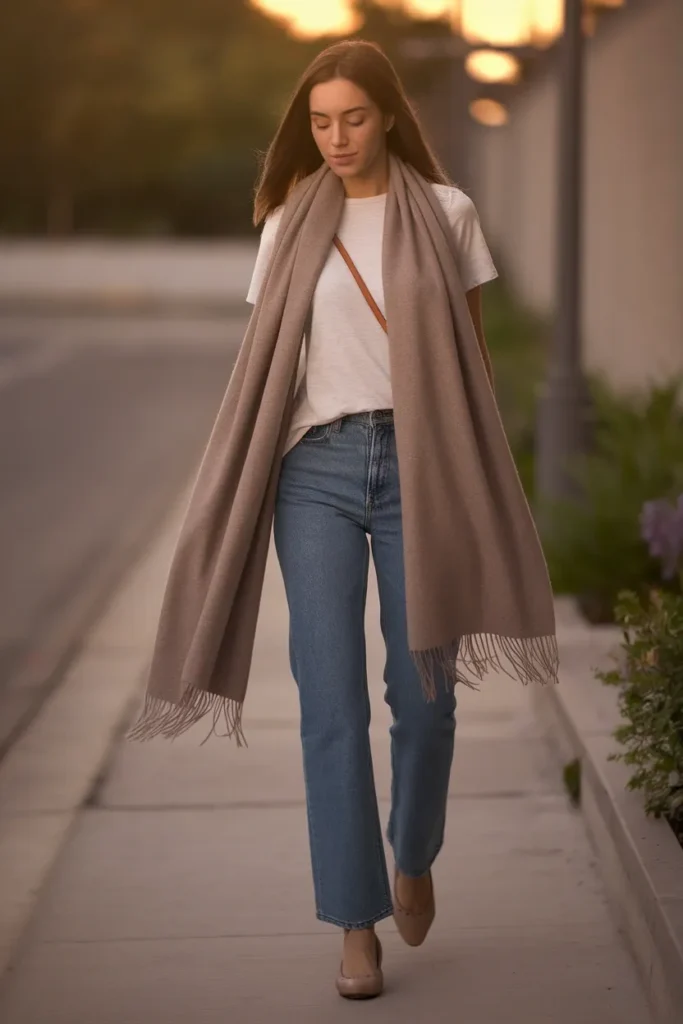
No knot at all. Long scarf, both ends hanging down the front, roughly even.
It sounds like nothing. It’s the single most useful thing you can do to a white tee and jeans, because it adds a vertical line down the center of your body and gives the eye somewhere to go on an otherwise flat outfit.
Two rules keep it from looking like you forgot to finish. Let the ends fall unequal by three or four inches, because perfectly matched ends read stiff. And tuck the drape inside a jacket or blazer rather than over it, so the scarf becomes part of the layering instead of sitting on top of it.
This is the method that turns the handful of tops that anchor every outfit you own into something that looks styled rather than default.
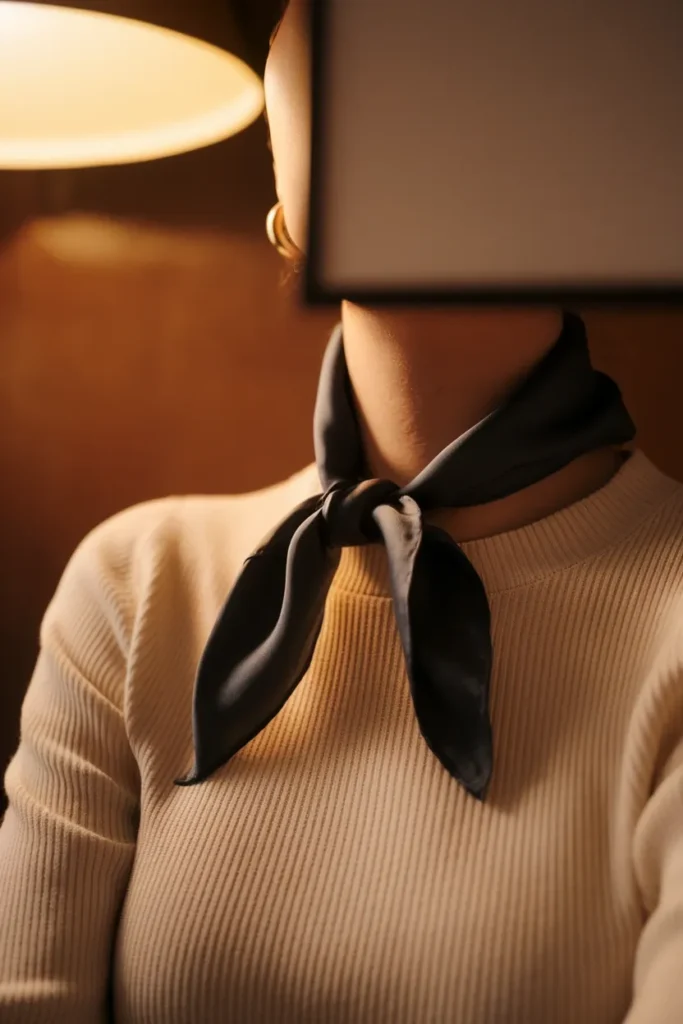
3. The neckerchief, for when a collar needs a focal point
Take a square scarf, fold it corner to corner into a triangle, then roll the long edge toward the point until you have a band with a small triangle left at the center. Tie it at the front of your throat, then rotate the knot to the side or the back and let the triangle sit forward.
Keep it snug. A neckerchief that sags looks like a scarf that slipped.
This is the one that works under structured outerwear where a bulky scarf would ruin the collar line, which is why it pairs so well with what to layer under a denim jacket between 40 and 70 degrees. A silk neckerchief adds a stripe of color at the throat and takes up almost no physical room, so nothing bunches at the shoulders.
4. Wear it as a belt, the method everyone started copying this year
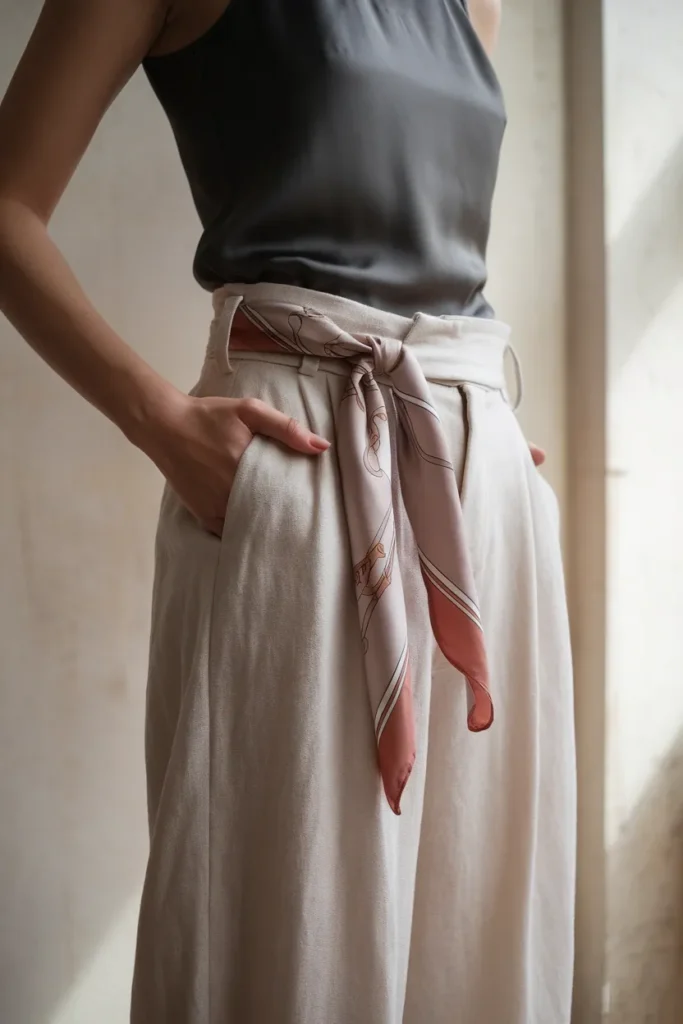
Thread a long scarf through your belt loops, or skip the loops entirely and tie it directly around the waist of a dress. Knot it off center, at the front of the hip rather than the middle, and let one end hang longer than the other.
It works because it puts pattern and color at the waist, which is the one place most neutral outfits have nothing happening.
A printed silk scarf over a plain tank and wide leg trousers does more than a printed shirt would, and you can untie it at lunch. Try it with nine white pants formulas that work all year if you want to see how much a single knot at the hip changes a monochrome outfit.
One caution. If the scarf is heavy wool it’ll sag and pull at the waistband within an hour. Belt with silk, cotton, or a light blend only.
5. Knot it on your bag strap to tie two neutrals together
Fold a small square into a narrow band and tie it around the base of a bag handle, or loop it once around a crossbody strap near the shoulder.
This is the lowest effort item on the list and it solves a specific problem. When your bag is brown and your shoes are black, a scarf that contains both colors sits between them and makes the mismatch look intentional. Pull one color from each and the whole outfit reads coordinated.
It’s also where a scarf you love but never wear at the neck finally gets used. Some prints are too loud against the face and perfect at arm’s length.
6. The shoulder drape that stands in for a jacket
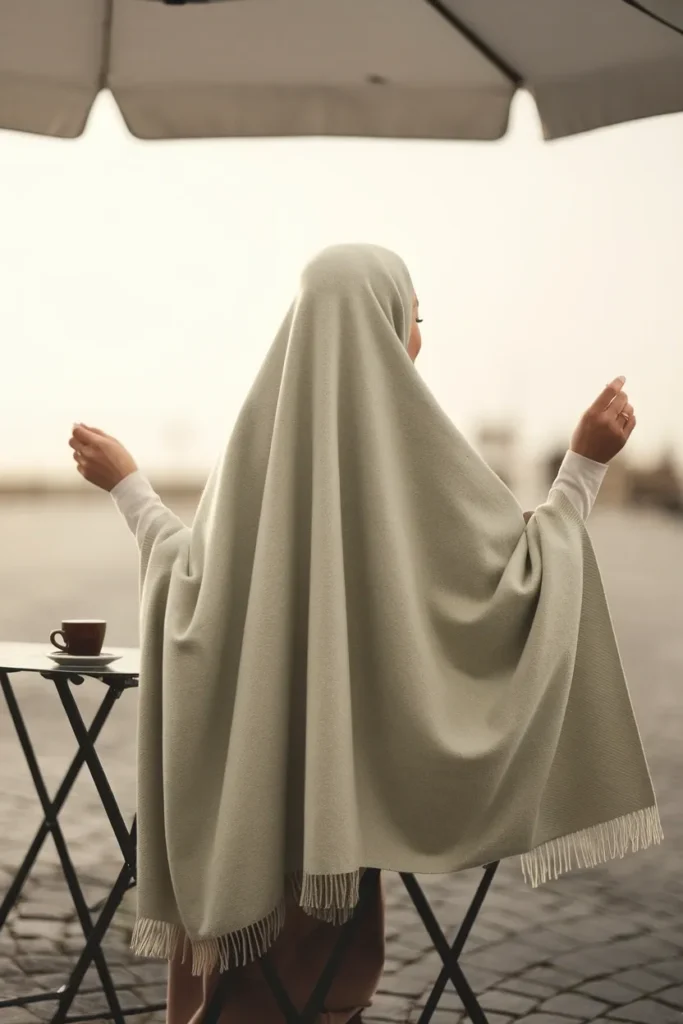
Take a large scarf or a light shawl, drape it over both shoulders like a cardigan you never put your arms through, and let the ends hang front. If it slips, cross the ends once at the chest and tuck them into a belt.
Between 55 and 68 degrees this genuinely replaces outerwear. That’s most of September, most of May, and every over air conditioned office in July.
The trick is committing to the drape rather than clutching it. Pull it back so it sits behind the shoulder seam of whatever you’re wearing, not perched on top of your upper arms.
7. Thread it through your hair for the five second upgrade
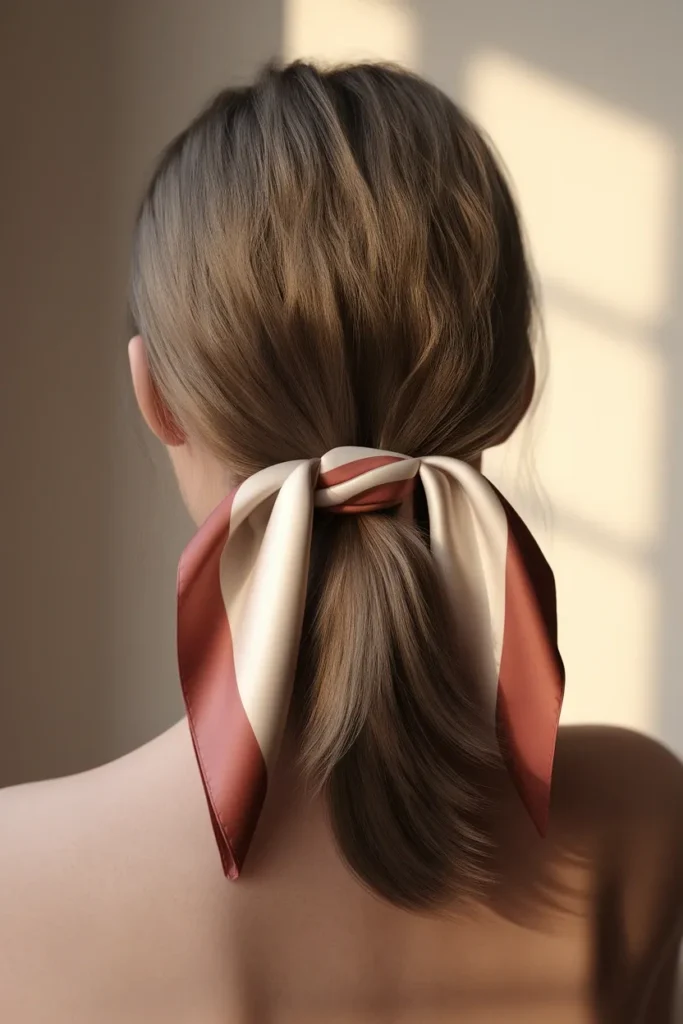
Two versions. Roll a square scarf into a band and tie it around a low ponytail, knot at the base, ends left loose. Or fold it wider and wear it as a headband with the knot underneath at the nape.
Hair is where a scarf costs you nothing. No bulk at the neck, no interference with a coat, nothing to adjust once you leave the house.
It reads best when the scarf picks up a color already somewhere in your outfit, even a small one. A rust scarf in your hair and rust in the stripe of your tee will look considered. A rust scarf with nothing to answer it will look like an accessory that wandered in.
8. The over the coat wrap that fixes a boxy silhouette
Wool coats and heavy scarves fight each other under the collar. So stop putting the scarf under the collar.
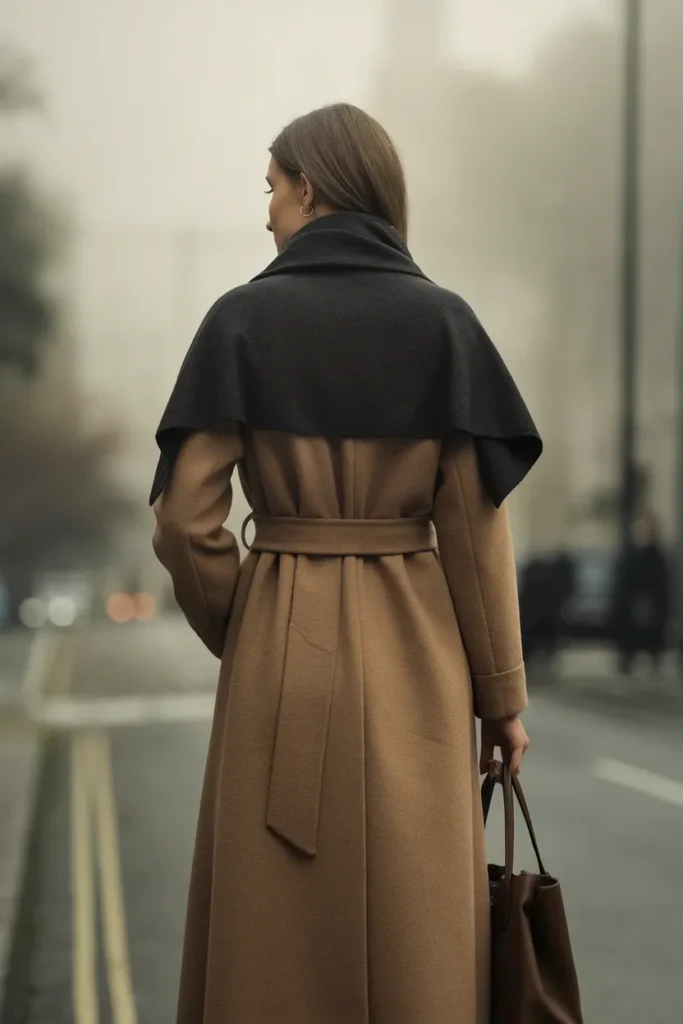
Drape a long wool scarf flat over the outside of a coat, both ends hanging front, then belt the coat over the top of it. The scarf gets pinned at the waist, the coat gets a defined middle, and the two ends fall in vertical lines on either side.
This is the single best fix for a coat that’s cut straight and reads shapeless on you. It’s also why a plain camel wrap earns its place among the six jackets that earn their hanger space rather than competing with them.
9. Fold it into a halter for warm evenings
A large square scarf, folded into a triangle, worn point down across the chest with the two side corners tied behind the neck and a second tie at the back.
This one has a narrower use case than the rest, and it’s worth being straight about that. It needs a square of at least 35 inches, it needs something underneath or a very secure knot, and it belongs to July and August rather than the whole year.
But it’s the only entry on this list that turns an accessory into an actual garment, which changes the cost per wear math on a scarf you’d otherwise pull out twice a season.
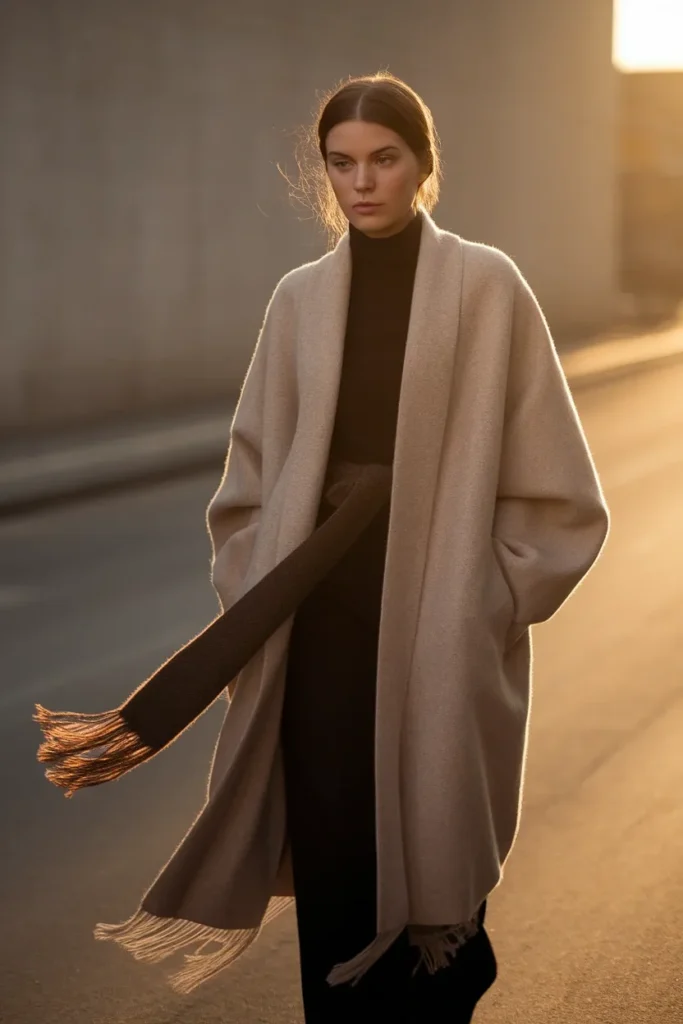
10. The tassel scarf at the hip, this year’s version of a statement belt
The fringed and tasseled scarf has been the accessory of 2026, showing up tied at the hips over an oversized coat, layered flat over a blazer, and belted at the waist of tailored trousers.
Tied at the hip over outerwear it does something the other nine methods don’t. It breaks up a long vertical block of coat with a horizontal line plus movement, and the fringe means it keeps moving when you do.
For a neutral closet this is the low risk way to take a trend. The shape is loud, the color doesn’t have to be. A tasseled scarf in oat, espresso, or soft black sits inside your existing palette and only the silhouette is new. That’s how a trend piece survives past October instead of becoming the thing you paid for once.
The Scarf Match Grid: which method to reach for, by what you’re wearing
Here’s the part the knot lists leave out. Screenshot this one.
| What you have on | Reach for | Why it works |
|---|---|---|
| Crewneck tee | Neckerchief or Paris knot | The high horizontal neckline needs something sitting against it, not floating below it |
| Open button down | Loose drape, inside the placket | Fills the V without hiding the collar you deliberately left open |
| Turtleneck | Belt it, or hair | The throat is already occupied, so move the color to the waist or the head |
| Blazer over a tee | Loose drape, tucked inside the lapels | Reads as a third layer instead of clutter on top of two |
| Denim jacket | Neckerchief | Keeps volume off the collar so the jacket line stays sharp |
| Wool coat | Over the coat wrap, belted | Adds a waist to a coat that doesn’t have one |
| Tank or sleeveless | Belt, or shoulder drape | Bare shoulders give you room to place color low or wide |
| Slip or midi dress | Hip tie, or hair | A neck knot competes with the dress’s own neckline |
Two seconds to read, and it removes the actual bottleneck, which was never the tying.
Scarf length and proportion, by height
Length advice usually gets given in inches, which is useless without a body attached to it.
If you’re petite, 5’4″ and under: a 60 to 65 inch rectangle is your workhorse. Anything past 75 inches loops twice and still hangs to your knees, which cuts your visible torso in half. Square scarves under 30 inches sit beautifully at the throat on shorter necks. When you drape, keep the ends above your hip bone so your leg line stays long.
If you’re 5’5″ to 5’8″: most standard scarves, 65 to 72 inches, work without adjustment.
If you’re tall, 5’9″ and over: go up. A 70 to 80 inch scarf keeps its proportion on a longer torso, where a 60 inch one can look like it shrank. Large squares, 35 inches and up, give you the drape you need at the shoulder.
If you’re curvy, midsize, or plus size: the variable that matters most is where the ends stop, not the width of the scarf. Ends landing at the fullest part of the bust draw a horizontal line right there. Let them fall past it, to the waist or below, and you get an uninterrupted vertical instead. Longer scarves give you more room to control that landing point, so size up rather than down. Skip stiff or heavily structured fabrics at the neck and choose something with real drape, silk, viscose, or a fine merino, because soft fabric follows your shape instead of standing away from it.
What the label actually tells you before you buy
This is the part where a scarf is either worth it or isn’t, and the tag answers it faster than the price does.
By US law, textile products have to carry a fiber content label listing the generic fiber names by percentage, along with the manufacturer and country of origin. The Federal Trade Commission’s Textile Fiber Rule is what requires it. So “silk feel” and “cashmere touch” on a hangtag mean nothing, while the sewn in label has to tell you the truth. Read that one.
What to look for: 100% silk holds a knot and stays put. Silk blended heavily with polyester slips all day. A wool or cashmere scarf will pill in the first season regardless of price, which is normal rather than a defect, and The Woolmark Company’s wool care guidance covers how washing temperature and agitation drive that. Cold water, minimal movement, dry flat.
On spend, a good silk square generally runs somewhere in the $40 to $90 range at mid tier US retailers like Madewell, Quince, and J.Crew, and quality above that is mostly about print and hand rolled edges rather than durability. Uniqlo and Target sit lower and trade off fabric weight. If you want the fuller breakdown of where accessories deserve budget and where they don’t, that lives in building an accessories capsule that fills the gaps.
Frequently asked questions
How long should a scarf be? Match it to your height rather than a standard number. Under 5’4″, aim for 60 to 65 inches. Between 5’5″ and 5’8″, 65 to 72 inches covers nearly everything. At 5’9″ and over, 70 to 80 inches keeps the proportion right. For square scarves, under 30 inches is a neckerchief, 30 to 35 is a versatile mid size, and over 35 can be worn as a shoulder drape or a halter.
How do you wear a scarf without looking bulky? Change the fabric before you change the knot. Bulk almost always comes from tying a heavy wool or brushed scarf into a small tight knot at the throat, which forces volume upward. Either switch to silk or fine cotton for neck knots, or keep the wool and move it: drape it flat over a coat, belt it at the waist, or wrap it at the shoulders where the volume has somewhere to go.
Can you wear a scarf if you’re curvy or plus size? Yes, and the adjustment is about length, not avoidance. Choose a longer scarf so the ends land past the fullest part of your bust rather than at it, which keeps the line vertical and unbroken. Fabrics with genuine drape, silk, viscose, fine merino, follow your shape. Stiff or bulky knits stand away from the body and add width you didn’t ask for.
What’s the difference between styling a square scarf and a long one? A square scarf works at the throat and in the hair. Fold it corner to corner into a triangle, then roll it into a band for a neckerchief, or leave it wide for a headscarf. A long rectangle works everywhere below the throat: draping, looping, belting, wrapping over a coat. If you own one scarf, a 30 to 35 inch square is the more versatile purchase. If you own two, make the second a 65 inch rectangle.
How do you wash a silk or wool scarf? Cold water, by hand, with minimal agitation, then dry flat and away from direct sun. Heat and movement are what felt wool fibers and dull silk. Check the sewn in care label first, because a blend behaves differently than a pure fiber, and never wring either one. Roll it in a towel to press out water instead.
Is an expensive scarf worth it? It depends on what you’re paying for. Above roughly $90, most of the increase goes to print exclusivity and hand rolled edges rather than durability, so a $60 silk square from a mid tier retailer will wear about as long as a $300 one. Where spending more does pay off is fiber content: a full silk or full cashmere scarf outlasts a blend by years. Track cost per wear if you’re unsure. A scarf you reach for weekly clears its price fast.
Can you wear scarves in summer? Yes, but change the weight and the placement. Skip the neck in real heat and use the scarf as a belt, in your hair, or on your bag strap. A lightweight cotton or silk square adds color without adding warmth. The halter fold is the one summer specific method here, and a shoulder drape is genuinely useful in over air conditioned offices and on planes.
Start with what’s already in the drawer
You don’t need to buy anything to use this. Pull out the scarves you already own, run the three questions on each one, and find its method on the grid. Most people discover they own one scarf that does everything and three that were bought for a neckline they no longer wear.
Then pick one method and wear it for a week straight until it stops feeling like a project. The Paris knot is the right place to start, because it’s forgiving and it goes with almost everything.
If you try one of these and it works, come back and tell me which one. The belt trick and the over the coat wrap are the two that surprise people most.
Keep reading

How to Style a Jacket for Plus-Size Women: 10 Outfits That Work
A lot of jacket advice for bigger bodies is still written around hiding. Hide the hips, hide the arms, hide under something...

How to Style a Jacket for Women Over 50: 12 Outfits That Work
Your closet probably holds more jackets than you wear. There’s the blazer from an old job, the denim jacket you’re unsure about...

How to Style a Jacket: 10 Cozy Jacket Outfits for Fall and Winter
Your jacket is the first thing people see between October and March. It’s also the piece most of us grab last and...