
How to Style Mom Jeans: The Flattering Fit Guide

You bought the mom jeans. They looked incredible on the model, they looked fine in the fitting room mirror, and now they’re folded on the chair in your bedroom because every time you put them on, something feels off. Not wrong exactly. Just off.
Here’s the thing almost nobody tells you: learning how to style mom jeans is mostly a proportion problem, and proportion is fixable in about four minutes. When I say flattering in this guide, I mean one specific thing, and it isn’t hiding any part of you. I mean the jean sits where your waist actually is, the leg ends where your leg looks longest, and the top you pair it with lands at a hemline that keeps the whole outfit reading as one clean vertical line. That’s it. That’s the whole game.

By the end of this you’ll have nine outfit formulas you can build from clothes you already own, a fit test that takes ninety seconds, and a clear answer on shoes, which is where most mom jean outfits quietly fall apart.
What Actually Makes a Jean a Mom Jean
The term gets thrown at any denim that isn’t skinny, which is exactly why so many women buy the wrong cut and blame themselves.
A true mom jean has four specs. A high rise, usually somewhere between 10 and 12 inches, sitting at or just above your natural waist. A relaxed, roomy seat and thigh. A leg that tapers from the knee down. And rigid or near-rigid denim, meaning 100% cotton or something close to it, with little or no elastane.
That last one is the spec everyone skips and the one that changes everything. Rigid denim holds a shape. It gives you structure through the hip instead of shrink-wrapping it, and it’s the reason a mom jean reads as intentional rather than sloppy. Cotton’s staple length and strength are what let a rigid denim hold that structure through years of wear, which you can read more about in Cotton Incorporated’s fiber measurement guide if you like knowing why your clothes behave the way they do.
Here’s the comparison nobody publishes, and it’s the single most useful thing on this page. Screenshot it before you shop.
| Cut | Rise | Leg shape | Typical stretch | Reads as |
|---|---|---|---|---|
| Mom | High, 10 to 12 in | Roomy hip, tapered ankle | 0 to 2% | Structured, retro, tidy |
| Baggy | Mid to high | Wide from hip to hem | 0 to 1% | Relaxed, streetwear |
| Boyfriend | Mid, 8 to 10 in | Straight, slouchy, often distressed | 1 to 2% | Borrowed, undone |
| Straight | Mid to high | Same width knee to hem | 1 to 3% | Classic, neutral |
If your pair is wide all the way down instead of tapering, you’re actually styling a baggy jean, and the rules change. The volume sits in a different place, so the top has to change with it. I walk through the looser leg rules in my baggy jeans guide if that’s the pair sitting on your chair.
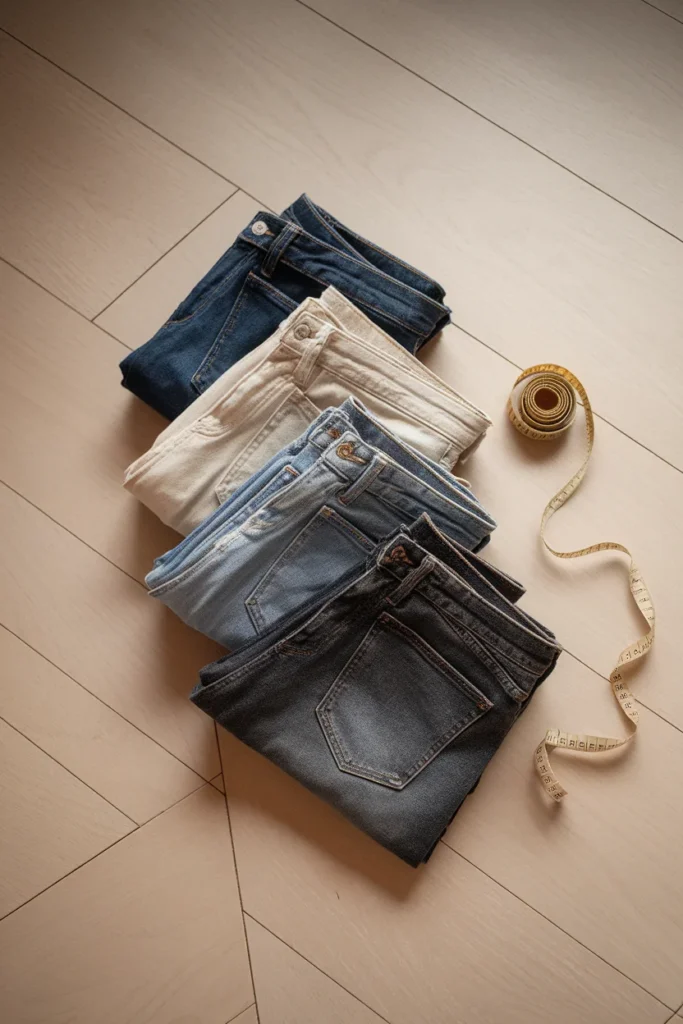
The Three Point Fit Check
Before you style anything, spend ninety seconds on this. It’ll save you a return.
Point one: the waistband gap. Fasten the jeans and slide a flat hand into the small of your back. One flat hand is right. Two hands means the waist is too big, and a gapping waistband is what makes a high rise look like it’s sliding down all day. You can tailor a waistband gap for very little at most alteration shops, so don’t rule out a pair that’s perfect everywhere else.
Point two: the hip and thigh pinch. Pinch the fabric at the widest part of your hip. You want about an inch to pinch. Less than that and the rigid denim will pull horizontal lines across the front, which is the thing that reads as “too small” from across a room. More than about two inches and the seat loses its shape and sags.
Point three: the ankle break. Stand in the shoes you’ll actually wear. The hem should hit at your ankle bone or slightly above it. This is non-negotiable on a tapered leg and I’ll explain exactly why in the shoe section.
One more habit worth building: flip the tag. Fiber content and care instructions are federally required on apparel sold in the US, which is why the fiber content and care label rules the FTC enforces are your fastest read on whether a pair is rigid or stretch before you ever get to the fitting room. Under 2% elastane behaves like rigid denim. Over 3% and it’ll relax about half a size by the afternoon, so buy your true size instead of sizing down.
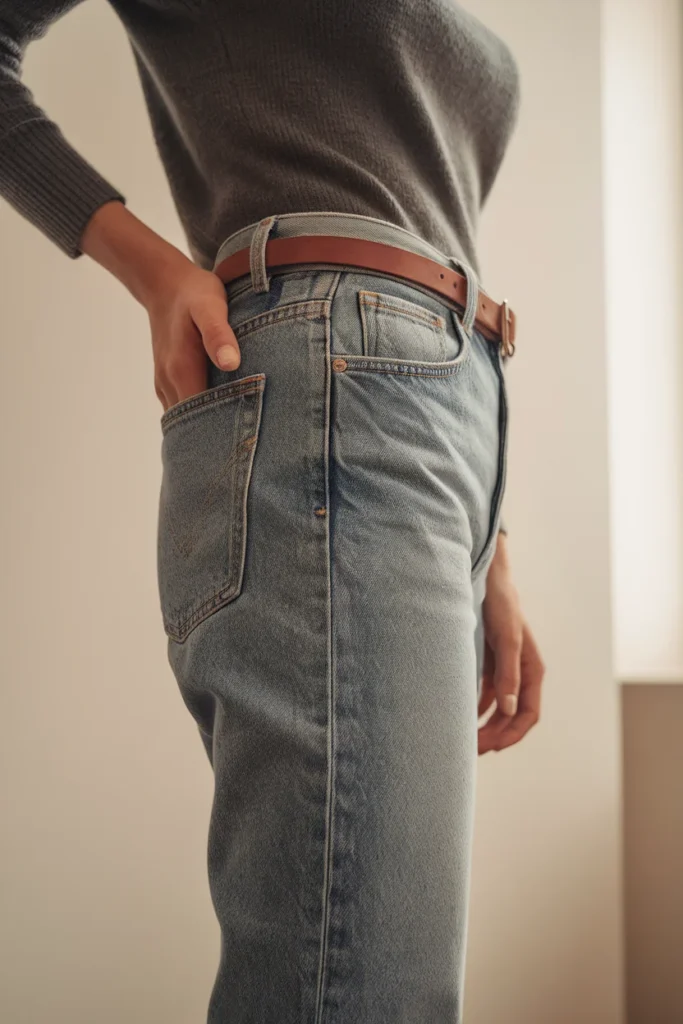
The Volume Rule
If you take one styling principle from this page, take this one.
A mom jean carries volume through the hip and thigh, then narrows sharply at the ankle. That’s a defined shape, and it only stays defined if the top half cooperates. So: pick one place to be voluminous, then keep everything else close.
Volume on the bottom means a fitted or tucked top. Think a ribbed tank, a slim knit, a tee with a front tuck, a bodysuit, a fitted button-down with the sleeves pushed up.
Volume on top means you commit to it fully. An oversized sweater, a slouchy cardigan, a men’s-cut button-down. Then you need a waist definition move, because a wide top over a wide hip erases the line entirely. A front tuck, a belt, or pushing your sleeves up to the forearm all work.
What doesn’t work is the middle ground. A top that’s slightly loose and hits at the widest part of your hip is the single most common reason a mom jean outfit looks tired. It splits you in half at the widest point and adds a horizontal line right where you don’t want one.
Hem placement is the actual lever here. On a high rise jean the top should end either above the waistband (cropped, or tucked in) or well below the hip, around mid thigh. The dead zone is anything landing between the waistband and the fullest part of your hip. Once you see it you cannot unsee it, and it turns half the closet into a solvable problem. Most of that solving happens with the capsule wardrobe tops that anchor every outfit you own, because four or five right-length tops will carry every jean you have.

Nine Ways to Style Mom Jeans From a Closet You Already Own
None of these require shopping. Each one is a formula, so swap the colors to what you actually have.
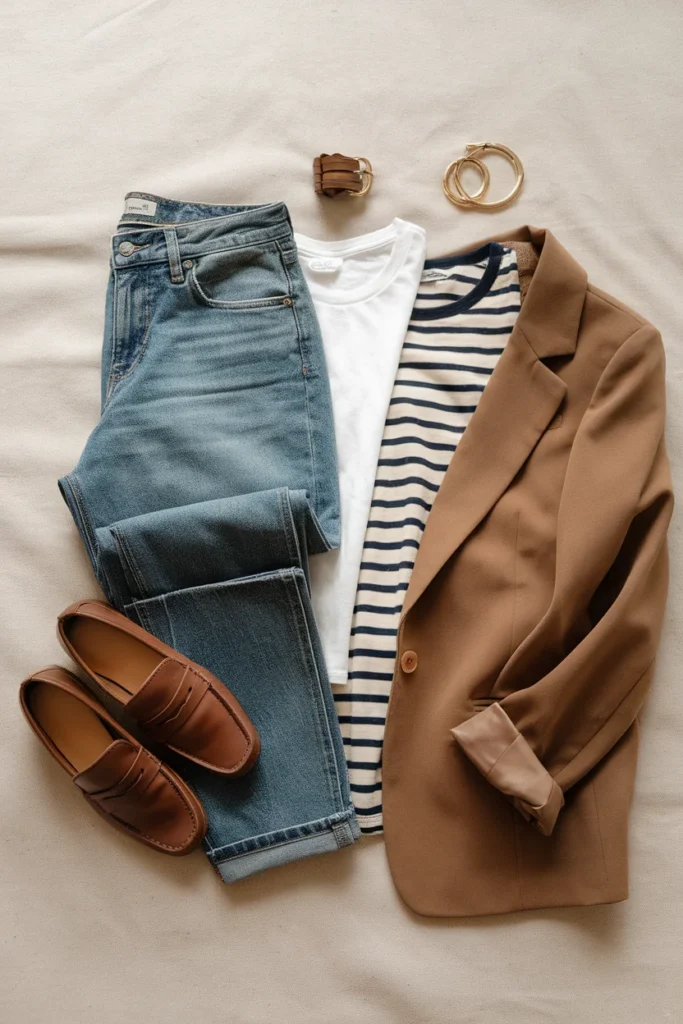
1. The white tee and loafer. Plain cream or white cotton tee, fully tucked, brown leather loafers, gold hoops. This is the outfit that made me stop overthinking mom jeans entirely, and it’s first on the list because it works on the widest range of people, seasons, and occasions of anything here. Add a belt if the waistband has any gap.
2. The tucked knit and blazer. Fine gauge knit tucked in, an oversized blazer in camel or black over the top, sleeves pushed to the forearm. This is the one that gets mom jeans into an office.
3. Striped tee, cardigan, ballet flats. Breton stripe, an open cardigan in oat or navy, flats. Easy, French-adjacent, takes four seconds.
4. Cropped sweater and ankle boots. The cropped hem does your waist definition for you, so you don’t need a belt or a tuck. Best cold weather formula on the list.
5. Button-down, half tucked, sneakers. Oxford cloth or poplin in white or pale blue, front-tucked, clean white leather sneakers. Weekend errands, school pickup, coffee.
6. Bodysuit and gold jewelry. A bodysuit solves the tuck permanently because it can’t come untucked. Layer a slim gold chain and hoops. This one goes to dinner.
7. All-in-denim, two washes apart. Denim jacket over a white tee with your jeans, as long as the two denims are clearly different washes. Light jacket over dark jeans, or the reverse.
8. Silk or satin camisole, tucked, with heels or heeled boots. The contrast between rigid denim and something fluid is what makes this read as deliberate rather than casual-by-accident.
9. Turtleneck, long wool coat, boots. Slim black turtleneck tucked, coat left open so it frames a long vertical line down the middle. This is the December outfit.
What Shoes to Wear With Mom Jeans
This is where most outfits go sideways, and the fix is a single measurement.
A tapered high rise jean creates a narrow opening at the ankle. Whatever you put below that opening either continues the line down or interrupts it. Interrupt it and your legs read shorter, no matter how good the outfit is above the waist.
The two inch ankle window. You want roughly two inches of visible ankle or slim shoe between where the hem ends and where the shoe’s bulk begins. That window is what keeps the vertical line intact.
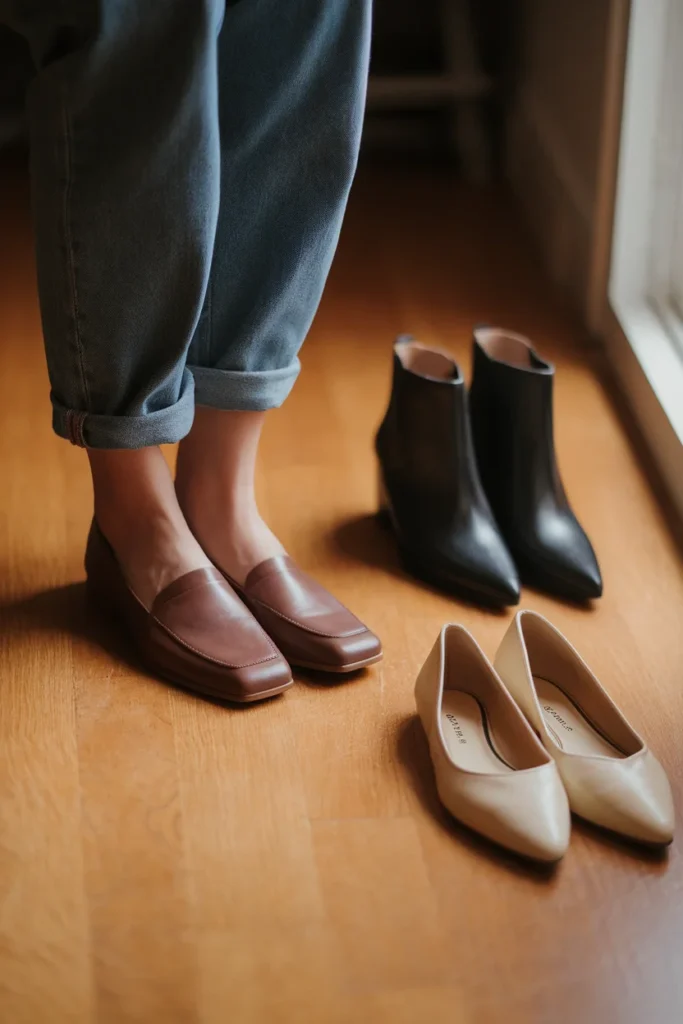
Shoes that work with almost any mom jean:
- Loafers. The single best pairing. Low profile, a bit of polish, no bulk. If you’re building one shoe that carries this jean across three seasons, this is it. Here are the loafers worth their hanger space in 2026.
- Ballet flats. Lowest profile of anything. Best with a cuffed hem.
- Pointed ankle boots. The point extends the line past the tapered hem. Excellent.
- Low profile leather sneakers. White or off-white, thin sole. Clean and easy.
- Heeled mules or slingbacks. For dinner, when you want the leg lengthened.
Shoes that need a hem adjustment first:
- Chunky sneakers. Not off the table, but the hem has to sit higher, at least an inch above the ankle bone, or the taper meets the bulk and everything below your knee turns into one wide block.
- Combat boots. Cuff the jean and let the hem sit on top of the boot shaft rather than bunching inside it.
- Knee high boots. Skip these with a true tapered mom jean. The taper is too narrow to tuck cleanly and the shaft fights it.
If the hem is too long, cuff it once with a clean one inch fold, or twice with a half inch fold for a tidier finish. Don’t roll it into a thick sausage at the ankle, because that’s bulk in exactly the place you’re trying to keep narrow.
How to Style Mom Jeans for Your Proportions
Same jean, different levers. None of this is about hiding anything, and all of it is about where the lines land on your specific frame.
Petite (5’4″ and under)
Your enemy is the horizontal break. Get the hem shortened so it hits above the ankle bone rather than at it, and always cuff or hem rather than letting it stack. Keep the top tucked so the waistband stays visible, because a visible high waistband is what gives you the long leg line. Monochrome from waist to shoe helps too.
Tall (5’9″ and over)
You have the most freedom here, and the most common mistake is a hem that’s suddenly too short. Look for a 28 to 30 inch inseam or buy a tall size. You can carry an untucked top at mid thigh in a way most people can’t, so use it.
Curvy and hourglass
Rigid denim is your friend, because it holds the waist-to-hip difference instead of collapsing into it. Check the waistband gap carefully, since a fit that’s right in the hip is often loose at the waist on an hourglass frame, and that’s a fifteen dollar tailoring fix. Tucked and belted is the strongest formula you’ve got.
Midsize and plus size
Look for a slightly less aggressive taper, since a very narrow ankle opening on a fuller leg fights you. A straight leg with a high rise gives you most of the mom jean look with an easier line. Everything in the volume rule still applies, and the cropped sweater formula is especially good because it defines the waist without requiring a tuck.
Over 40
Skip heavy distressing and choose a clean dark or mid indigo wash. The cut already carries the retro reference, so you don’t need the rips to say it twice. Loafers over chunky sneakers, and a blazer or long coat over the top, moves the whole thing from nostalgic to current.
If a tapered ankle just isn’t working for your frame after honest testing, that’s information, not failure. How wide leg jeans shift your proportions covers the cut that solves the same styling problem from the opposite direction.

Mom Jeans Through the Seasons
The cut is genuinely year round, which is a rare thing in denim and a big part of why a pair earns capsule space.
Fall, September through November. Peak mom jean season. Cropped knits, chunky cardigans, ankle boots, a trench over the top. This is the layering window where the high waist does its best work, because every layer you add has a defined waist to hang from.
Winter, December through February. Slim base layers only, since rigid denim has no give and a thick thermal underneath will make the fit miserable. Merino turtleneck, wool coat, tall socks folded over ankle boots.
Spring, March through May. Cuff the hem, go bare ankle, add a light jacket. A denim jacket over denim jeans is a spring staple as long as you keep the washes clearly different, which is the whole subject of styling a denim jacket without matching your jeans.
Summer, June through August. Rigid denim is warm, so this is where the ecru or light wash pair earns its keep. A linen tank tucked in, flat sandals, hair up. If it’s above 90F you’ll want the lightest weight denim you own, around 9 to 11 oz rather than a heavy 13 oz.

Wash and Color: Which Pair Earns Capsule Space
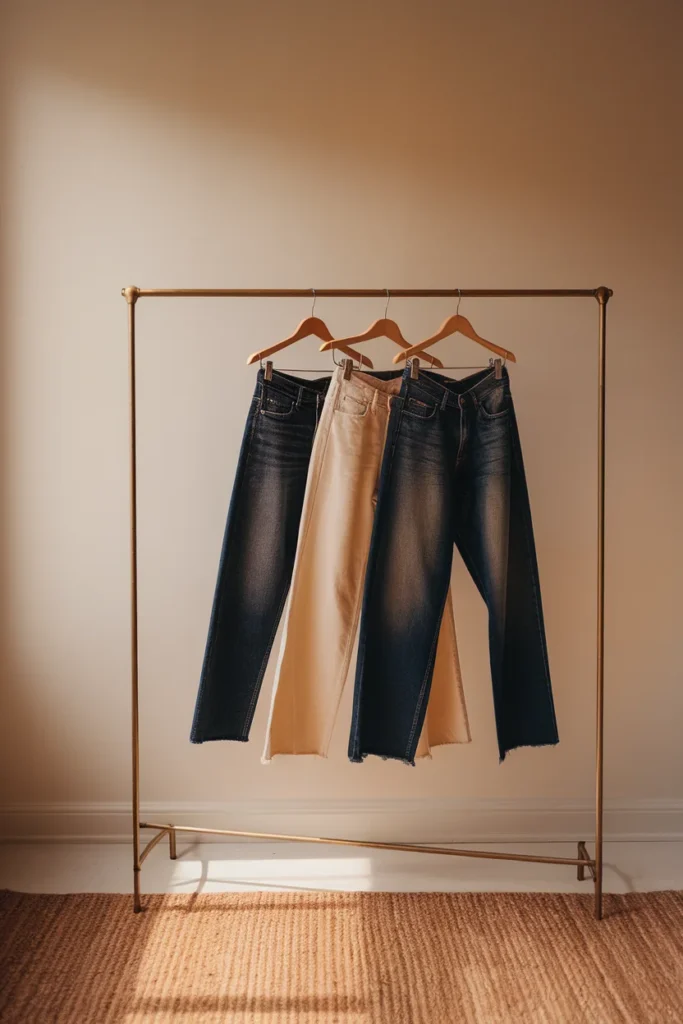
If you’re buying one pair, buy a clean mid to dark indigo with no distressing. It’s the most versatile denim color there is, it dresses up further than any other wash, and it doesn’t date.
Second pair, once you’ve worn the first enough to know you like the cut: ecru or off-white. It behaves like a neutral rather than like denim, which means it pairs with things your indigo pair doesn’t, and it doubles your outfit count more than a second blue would.
Third pair, and only if you actually reach for it: washed black. Reads sharper and more evening-ready than indigo, though true black denim fades unevenly, so wash it inside out and cold.
Light wash and heavily distressed pairs are the ones that sit unworn. They’re the most specifically “trend” reading of the options and they pair with the fewest tops. If you already own one, style it with solid neutrals only, since a busy wash plus a busy top is too much information at once.
The reason a neutral wash multiplies your outfits is the same reason a neutral palette works anywhere in a closet, and how to pair neutral colors so everything mixes is worth ten minutes if you’ve ever bought something you loved and then found nothing to wear it with.
Where to Buy Mom Jeans in the US
Prices move constantly, so treat these as ranges to orient by rather than quotes. Confirm current pricing before you buy.
Under $50. Old Navy, Gap, H&M, and Target’s Universal Thread line all carry high rise tapered denim in this range, typically $30 to $50. The trade-off is fabric weight. These lean lighter and often carry more elastane, so they’ll relax through the day and won’t hold their shape as long. Perfectly good for testing whether you like the cut before committing.
$50 to $150. This is the sweet spot for mom jeans specifically. Levi’s, Madewell, J.Crew, Everlane, Abercrombie, and Quince land roughly $70 to $140, and this is where you start getting genuine rigid denim with real structure. Levi’s is worth a specific mention because the cut originated in their archive, and their high rise tapered fits are the reference point most other brands are working from.
$150 to $400. Sezane, Reformation, and COS sit here, typically $150 to $250. You’re paying for fabric quality, better hardware, and a more considered fit through the seat. Worth it only if you’ve already confirmed you wear the cut weekly.
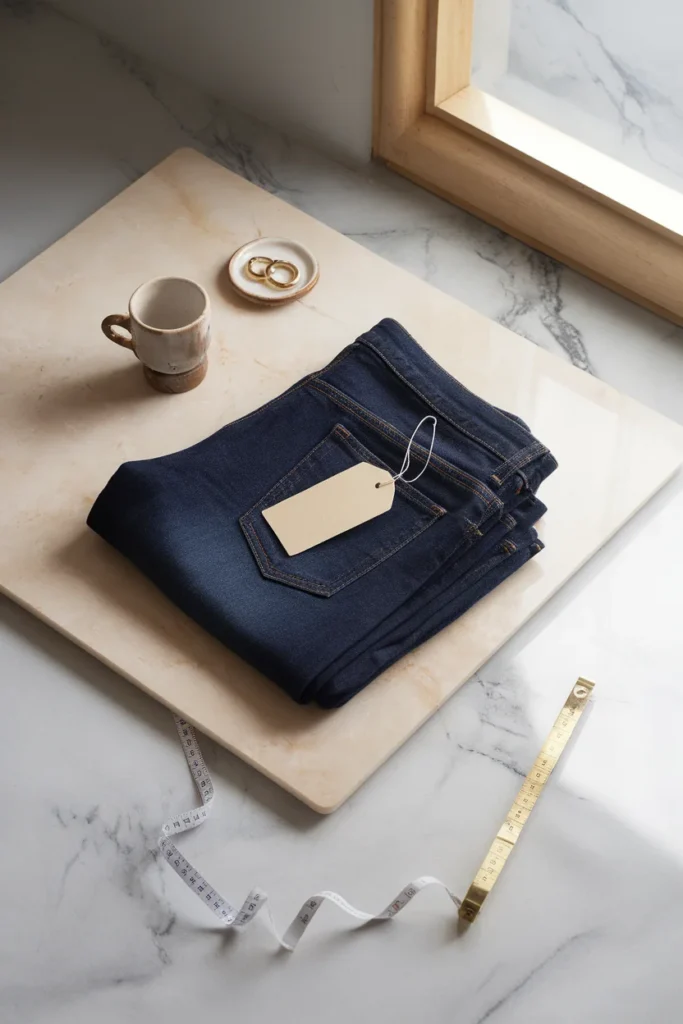
A note on the math. A $120 pair worn twice a week for two years is roughly 200 wears, which is about 60 cents per wear. A $35 pair worn six times before it loses its shape is closer to $6 per wear. Cost per wear is the only price argument that’s ever mattered in a capsule wardrobe, and it usually points toward the middle tier rather than either extreme.
If a $250 pair catches your eye, the honest mid-tier substitute is a rigid Levi’s or Madewell high rise at roughly a third of the price. The difference will be in the hardware and the hand feel of the denim, not in the silhouette.
Five Mistakes That Date a Mom Jean
- The mid hip top. Covered above, worth repeating, because it’s the most common one by a mile.
- Sizing down to avoid looking baggy. Rigid denim doesn’t forgive it. You get horizontal pull lines across the front and the jean loses the roomy hip that defines the cut.
- Heavy distressing with a dressy top. The rips and the silk cami are arguing with each other. Pick a lane.
- Letting the hem stack. A tapered leg that puddles at the ankle kills the line instantly. Hem it or cuff it.
- The wrong boot. A bulky boot under a tapered hem shortens your leg more than almost any other pairing. Pointed toe or a slim shaft solves it, and ankle boots built for a capsule wardrobe covers what to look for.
Frequently Asked Questions
Are mom jeans still in style in 2026? Yes, and they’ve moved past trend status into the standard denim rotation. The current version leans cleaner than the 2019 iteration: less distressing, darker and more uniform washes, and a slightly less extreme taper. Style them with loafers and a tucked knit rather than chunky sneakers and a crop top, and they read current rather than nostalgic.
What’s the difference between mom jeans and boyfriend jeans? Rise and leg shape. Mom jeans sit high, around 10 to 12 inches, and taper from the knee to a narrow ankle. Boyfriend jeans sit lower, around 8 to 10 inches, run straight and slouchy through the whole leg, and are usually distressed. Mom jeans read structured and tidy. Boyfriend jeans read relaxed and undone. The mom jean is the easier one to dress up.
What tops pair well with mom jeans? Anything that ends above the waistband or well below the hip. Fitted knits, tucked tees, bodysuits, cropped sweaters, and silk camisoles all work. Oversized shirts and slouchy sweaters work too as long as you front-tuck or belt them. The only thing to avoid is a top that ends at the widest part of your hip.
Should mom jeans be long or short? Short, relative to other cuts. The hem should hit at the ankle bone or slightly above it, in the shoes you’ll actually wear. A tapered leg that stacks or puddles at the ankle loses the clean line the cut depends on. If you’re petite, go higher still, about an inch above the ankle bone.
Can you wear ankle boots with mom jeans? Yes, and they’re one of the best fall pairings, with one condition: choose a pointed toe or a slim shaft. The point extends the line past the tapered hem. A chunky lug-sole boot under a narrow ankle opening creates a heavy block from knee to floor. If you’re wearing a chunkier boot, cuff the jean higher so there’s visible space between the hem and the boot.
Are expensive mom jeans worth it, or is a $40 pair fine? Start with the $40 pair if you’re new to the cut. Once you know you reach for them weekly, the $70 to $140 range is where the real jump happens, mostly in denim weight and shape retention. Above roughly $200 you’re paying for fabric hand and hardware, both real but with diminishing returns. Run the cost per wear math before you decide.
How long should a good pair of mom jeans last, and how should I wash them? A rigid pair worn a couple of times a week should hold its shape for two to three years. Wash cold, inside out, and only when they actually need it, roughly every eight to ten wears. Hang dry rather than tumble drying, since heat is what breaks down elastane and shrinks cotton unevenly. Dark and black washes especially should never see high heat if you want the color to stay even.
Start With One Pair and One Formula
You don’t need nine outfits tomorrow. Pull your mom jeans out tonight, run the three point fit check, and build the white tee and loafer version. Wear it once. If the proportions feel right, you’ve confirmed the jean works and everything else on this list is just variation.
If the fit check fails, that’s the most useful thing you’ll learn all week, because it means the problem was never your styling.
The whole point of a capsule wardrobe is that one right pair beats four almost-right ones. A mom jean that fits properly will carry a tucked tee in July and a turtleneck under a wool coat in January, and that’s exactly the kind of range that earns a piece its hanger space.
Which formula are you trying first?
Keep reading

How to Style a Jacket for Plus-Size Women: 10 Outfits That Work
A lot of jacket advice for bigger bodies is still written around hiding. Hide the hips, hide the arms, hide under something...

How to Style a Jacket for Women Over 50: 12 Outfits That Work
Your closet probably holds more jackets than you wear. There’s the blazer from an old job, the denim jacket you’re unsure about...

How to Style a Jacket: 10 Cozy Jacket Outfits for Fall and Winter
Your jacket is the first thing people see between October and March. It’s also the piece most of us grab last and...