
How to Style Cargo Pants for Women (Without the Combat Look)
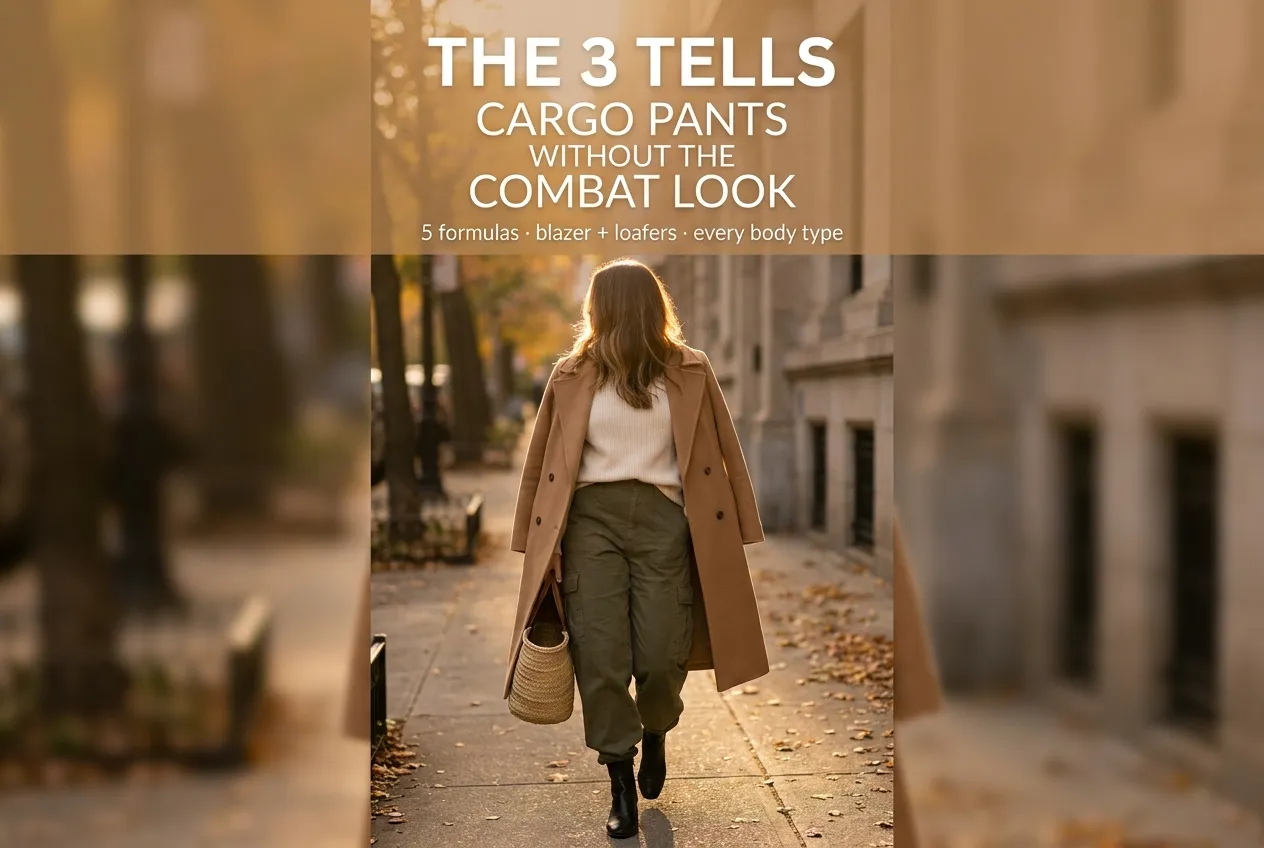
Most women who ask how to style cargo pants for women already own a pair. That’s the part nobody says out loud. The pants are in the closet, they fit fine, and every single time you put them on you catch your reflection and think: this looks like I’m about to rappel down something. So they go back on the hanger and you reach for jeans again.
Here’s what I’ve learned after wearing mine on repeat: cargo pants almost never read military because of the pants. They read military because of two or three other things you paired with them without thinking. Fix those, and the same pair you’ve been avoiding turns into the most-worn bottom in your closet.
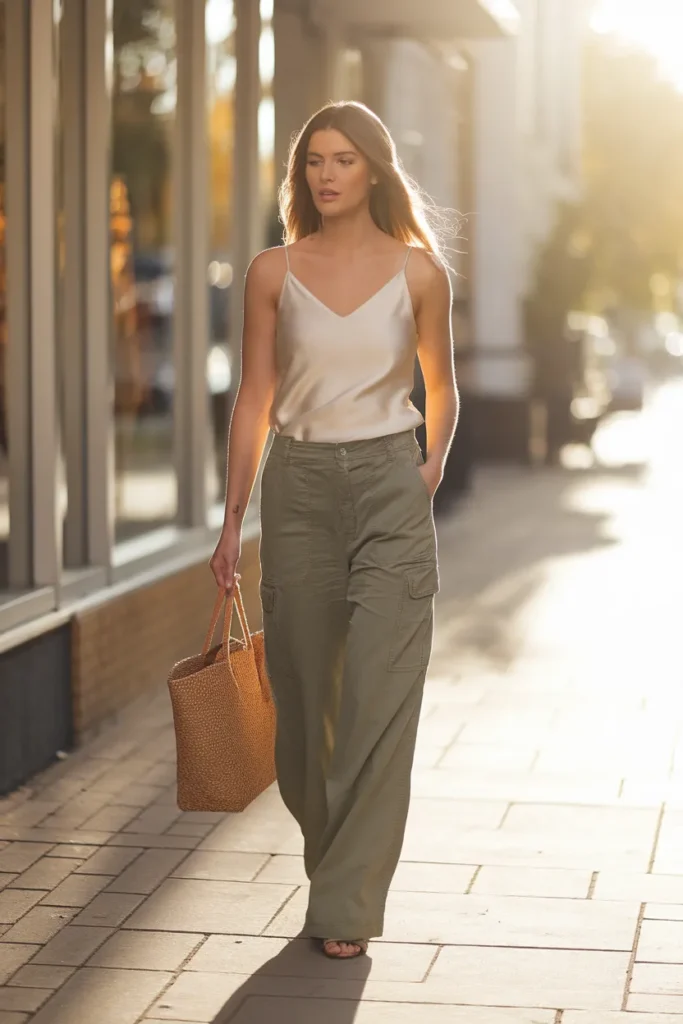
Why Cargo Pants Read “Combat” (The Three Tells)
Cargo pants have a real uniform history, and your eye knows it even when your brain doesn’t. The National Museum of American History keeps a woman’s desert Battle Dress Uniform in the Smithsonian collection, cotton and nylon, issued for carrying gear in the field during Operation Desert Storm. That silhouette is stored in everyone’s visual memory whether they’ve thought about it or not.
So when you put on cargos and something feels off, you’re not imagining it. You’ve accidentally rebuilt a uniform. It happens through three specific signals, and I call them the Three Tells.
Tell 1 is color. Olive drab, khaki, and sand are literal military-issue colors.
Tell 2 is the shoe. A lug-sole combat boot with a cargo pant is the actual uniform, reassembled.
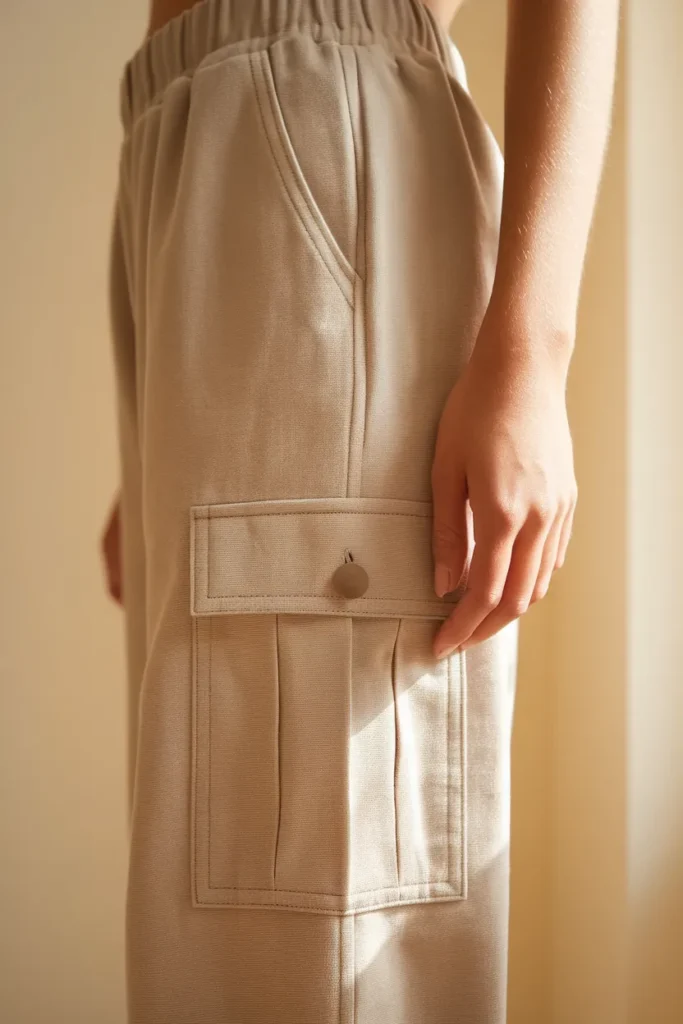
Tell 3 is pocket volume. Big patch pockets landing at your widest point add bulk exactly where a uniform adds bulk.
You almost never trip all three at once. You usually trip two, which is enough. Break one, and the outfit reads as fashion. Break two, and it reads as intentional style.
Run the check in the mirror before you leave. Look at the color, then the shoe, then where the pocket lands. If two of the three are pulling toward the uniform, change one of them, and it takes about ten seconds to spot which one is easiest to swap.
What makes this useful is that the fix is almost always the cheapest item in the outfit. Swapping a boot for a loafer costs nothing if both are already in the closet.
Tell #1: The Color Is Doing All the Work
Olive is the most-searched cargo pant color and also the highest-risk one. It’s genuinely beautiful with cream, camel, and soft black. It’s also the exact shade of a field uniform.
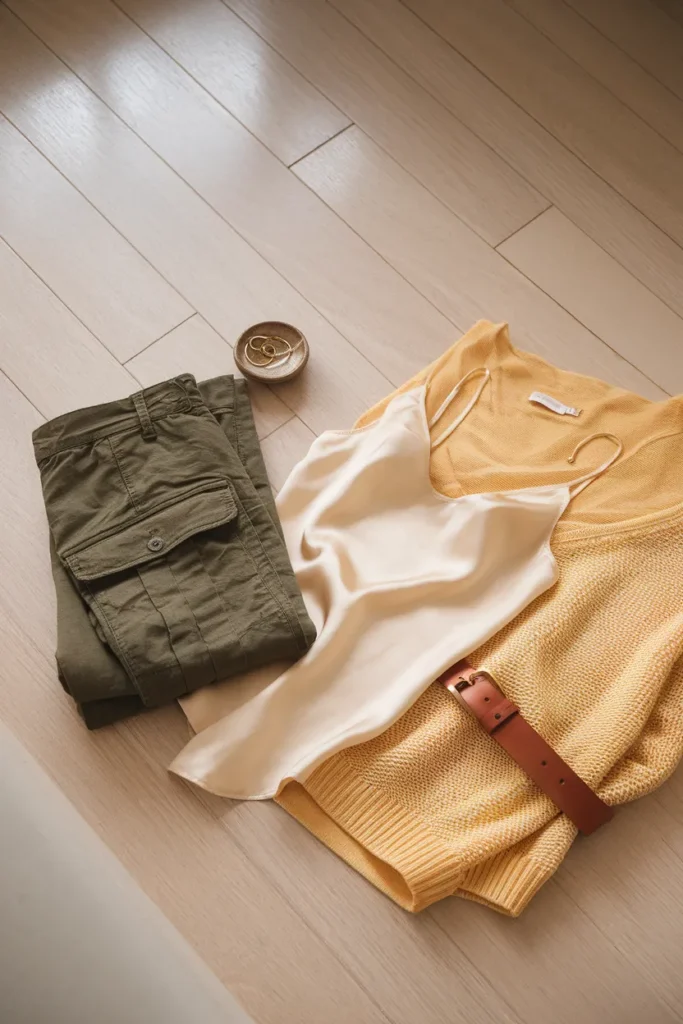
The fix isn’t giving up olive. It’s refusing to let olive be the only color story in the outfit. Pair it with something no army ever issued: butter yellow, blush, ivory silk, or a warm cognac leather.
I keep a simple ratio in mind. Roughly 60% neutral base, 30% the olive, 10% something soft or warm as the accent. That third piece is what breaks the uniform read, and it’s the piece most women skip. If color balance is the part you find hardest, this guide on how to pair neutral colors so every outfit looks pulled together walks through the ratios in detail.
Black cargo pants are the cheat code, by the way. Black was never standard field issue, so black cargos carry almost none of the military association. If you’re nervous about the whole category, start there.
Tell #2: Your Shoe Is Finishing the Uniform
This one surprises people. You can wear olive cargos with an olive top and still look styled, as long as the shoe refuses to play along.
Combat boots, tactical sneakers, and heavy lug soles complete the sentence the pants started. Swap in something with a slim profile and the whole outfit reorganizes itself.
My reliable four: a leather loafer, a ballet flat, a low pointed mule, and a clean white leather sneaker with a thin sole. Any of these creates instant contrast against the utility of the pant. A loafer in particular does something specific: it introduces a menswear-tailoring reference that cancels the field-gear reference. If you’re building a rotation, these are the best loafers for women, chosen the capsule way.
Heels work too, though not the way Pinterest suggests. A strappy stiletto with cargos can tip into costume. A block heel, a kitten heel, or a low western boot lands better and you can actually walk in them.
One exception worth knowing. A sleek black ankle boot with a narrow shaft is fine. It’s the chunky treaded sole that does the damage, not the boot itself.
Sock choice matters more than it should, too. A thick ribbed sock stacked above a boot reads outdoorsy and pulls the outfit back toward utility. A no-show sock, or a fine ribbed sock in the same color as the pant, keeps the leg line unbroken.
If you only own chunky boots right now, a ballet flat is the cheapest correction in this whole article. Target and Old Navy both run them in the $25 to $40 range, and one neutral pair covers every formula below.
Tell #3: Pocket Volume Sits at Your Widest Point
Here’s the tell almost nobody talks about, and it’s the one that determines whether the pants ever look right on your body.
Cargo pockets are a horizontal element. Wherever they land, they visually widen. On a uniform that’s the point, because the pocket needs to hold a map. On you, it just adds inches at whatever height it happens to sit.
Try this in your closet tonight. Put the pants on, stand at a mirror, and find where the top edge of the side pocket hits. If it lands right at the fullest part of your hip or thigh, that pair will always feel bulky, no matter what you wear on top. If it sits noticeably above or below that point, you’re fine.
The pants that photograph well on Pinterest are almost always ones where the pocket sits high on the thigh or low near the knee. That’s not an accident of styling. It’s the cut.
Bellows pockets (the ones that stand out from the leg with a pleat) add the most volume. Flat patch pockets add the least. Zip or slash pockets add almost none, and honestly barely count as cargo styling.
The Four Cargo Cuts, and Who Each One Suits
“Cargo pants” covers four genuinely different garments, and a lot of disappointment comes from buying the wrong one for what you actually wanted.
Wide-leg cargos fall straight from the hip with no taper. They’re the most current silhouette and the most forgiving through the thigh. They need a hem that clears the floor by about half an inch in your usual shoe, otherwise they drag and fray. Best with a fitted top, since the volume is already handled below.
Straight-leg cargos run the same width from knee to ankle. This is the quietest version and the one that dresses up most easily, because the line reads closer to a trouser than to field gear. If you’re buying one pair to do everything, buy this one.
Tapered cargos narrow toward the ankle. They’re the trickiest, because a taper plus a hip pocket creates a rounded shape through the leg. They work well on tall frames and on anyone who wants the pants to disappear under a long coat.
Parachute cargos have a drawstring or elastic hem that gathers at the ankle. They’re the most casual by a wide margin and the hardest to remove from the combat read, since the gathered cuff is a direct field-uniform reference. Lovely on a weekend, wrong for the office.
Fabric changes the answer too. A wide-leg in thin cotton behaves nothing like a wide-leg in mid-weight twill, even at the same measurements.
The Fit Guide: Rise, Leg, and Pocket Placement by Proportion
Fit is where most cargo pant regret starts, and it’s fixable at the point of purchase rather than the point of styling.
If you’re petite (5’4″ and under)
Look for a mid or high rise with the pocket sitting high on the thigh, and hem the pants properly rather than cuffing them. A cuff adds a horizontal line at the ankle and shortens the leg further. A straight or slightly tapered leg reads longer than a very wide one, though wide-leg works beautifully if the hem clears the floor by about half an inch with your usual shoe.
If you’re tall (5’9″ and over)
You have the most freedom here. Wide-leg and low-slung pockets both work on you, and a longer inseam means bellows pockets sit well below the hip. Watch the rise instead: a low rise can shorten your torso in a way that feels off-balance. Mid to high tends to sit best.
If you’re curvy or hourglass
Rise matters more than leg width. A high rise that sits at your natural waist keeps the pocket above the fullest part of the hip, which solves Tell 3 automatically. Look for a pair with some stretch in the twill (2% to 3% elastane) so the pocket doesn’t pull open across the hip.
If you’re midsize or plus-size
Flat patch pockets over bellows, every time. A straight leg with a defined waist gives the cleanest line, and a belt at the waist creates the vertical break that stops the outfit from reading as one column of utility fabric. Fabric weight matters too: a mid-weight twill holds its shape where a thin cotton clings.
If you’re rectangle or apple
A high-waisted pair with a belt creates definition the pants don’t have on their own. Pockets that sit low, near the knee, keep volume away from the middle entirely.
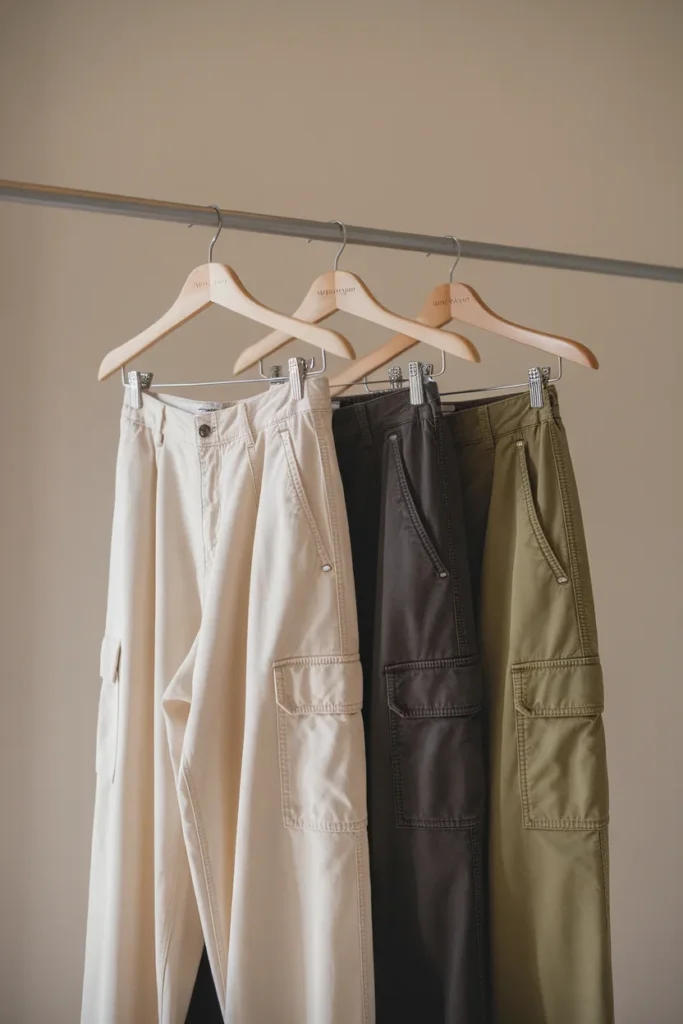
Formula 1: Soft Top, Structured Bottom
This is the one I reach for most, and it’s the fastest way out of the combat look.
The principle is fabric contrast. Cargo pants are stiff, matte, and technical. So put something fluid and soft against them: silk, fine-gauge knit, cotton jersey with actual drape, or a lightweight ribbed tank.
My exact combination on repeat: soft black cargos, a cream silk-blend camisole tucked at the front only, gold hoops, and a leather loafer. Takes about four minutes and works for coffee, school pickup, or a casual dinner.
Keep the top fitted or semi-fitted. Volume on top plus volume on the bottom is where outfits go wrong, and it’s the same balance rule that makes baggy jeans look deliberate rather than sloppy.
The front tuck is doing real work here. It marks your waist, breaks the vertical line of the pant, and takes about two seconds.

Formula 2: Structure on Top, Slouch Below
The inverse formula, and the one that dresses cargos up fastest.
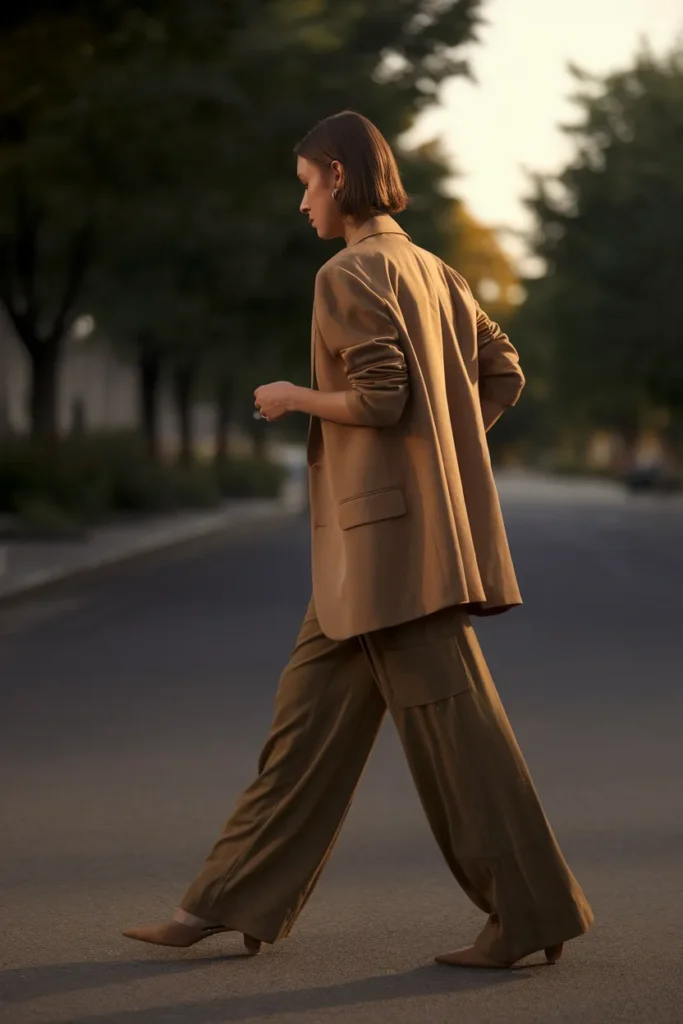
Put a genuinely tailored piece on top: an oversized blazer with real shoulder structure, a fitted trench, or a boxy wool jacket that holds its shape. Tailoring is the strongest anti-uniform signal in the entire wardrobe, because military field gear and tailoring occupy opposite ends of the same spectrum.
Camel is my favorite blazer color over olive cargos. Ivory over black cargos is the crispest version. Both look considered in a way that a hoodie never will.
Underneath, keep it simple. A white tee or a thin ribbed tank. The blazer is the statement and the pants are the texture, so nothing else needs to compete.
Sleeve length is the small detail that decides this one. Push the blazer sleeve up to just below the elbow. It softens the formality and stops the whole thing from reading like you’re heading to a meeting you don’t want to attend. If you’re deciding which outer layer to invest in first, here are the capsule wardrobe jackets that actually earn their hanger space.
Formula 3: The Monochrome Column
Want the fastest way to make cargo pants look expensive? Erase the contrast entirely.
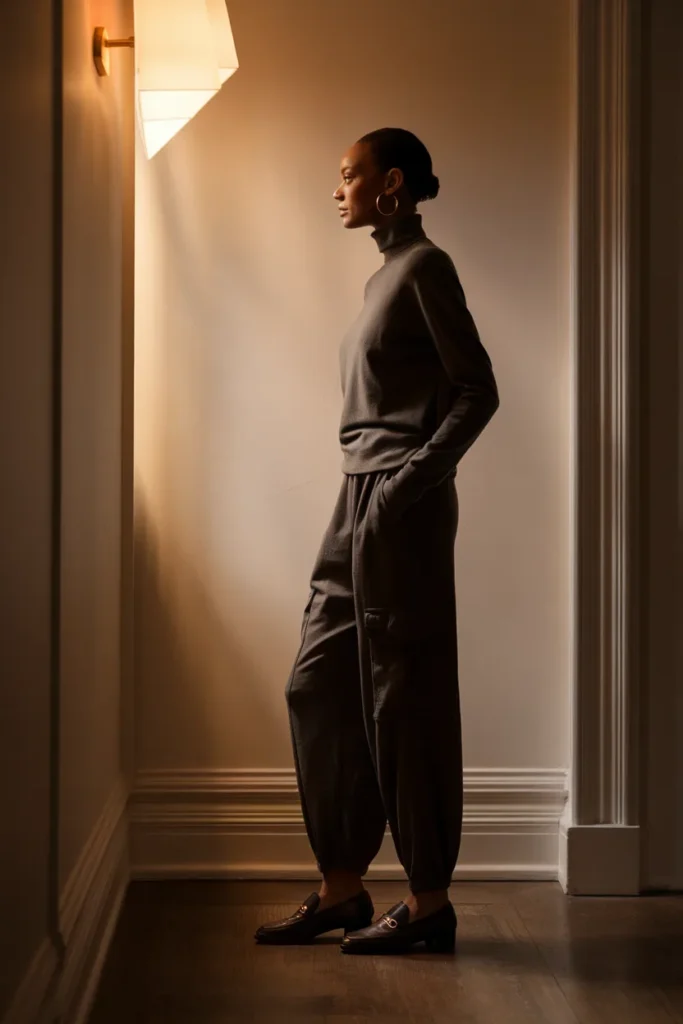
Wear one color from shoulder to shoe. Black cargos, black knit, black leather loafer. Or ivory cargos, cream sweater, bone-colored flat. The pockets are still there, but with no color break to interrupt the line, your eye reads a long single column instead of a top half and a bottom half.
Monochrome does something else useful: it makes the pocket detail read as texture instead of function. Same pants, completely different message.
Add one metal. Gold hoops, a slim watch, or a thin chain necklace. That’s the whole outfit.
A small caution on tone matching. Two blacks that don’t quite match (a faded black cotton against a true black wool) break the column and undo the effect. If the shades are off, put the darker piece on the bottom, where the eye forgives it.
Texture is what keeps monochrome from going flat. Matte twill against a ribbed knit against polished leather gives the eye three things to read even though the color never changes.
This formula also handles the awkward in-between weather in early fall and late spring better than almost anything else, because you can layer a second piece in the same color without the outfit getting visually busy.
Formula 4: Cargo Pants That Pass at the Office
“Business casual cargo pants outfit” is one of the highest-volume live Pinterest searches in this category, so plenty of women are trying to make this work. It can work, with three rules.
Rule one: black, charcoal, or deep navy only. Save olive for the weekend. Color is what your coworkers register first.
Rule two: flat pockets, no flaps, no drawstring hems. The more hardware, the more casual. Toggles and cord ends are what push a pant out of office territory.
Rule three: at least one genuinely formal piece. A blazer, a silk blouse, or a fine merino knit. One is enough. Two starts to look like you’re overcompensating.
Shoes seal it: loafers, pointed flats, or a low block heel. A sneaker undoes all three rules at once.
Read your office honestly, though. A tailored black cargo works in creative, tech, and most hybrid environments. It won’t fly in law, finance, or anywhere with a written dress code, and no amount of styling changes that. If your workplace runs formal, a business professional wardrobe built to mix and match is the more useful starting point.

Formula 5: Fall Layering Without the Bulk
Cargo pants are structurally a fall piece, which is why “cargo pants fall outfit women” is a live Pinterest topic with its own indexed page.
The risk in fall is bulk on bulk. Heavy pants plus a chunky sweater plus a puffer equals a shape with no waist and no line.
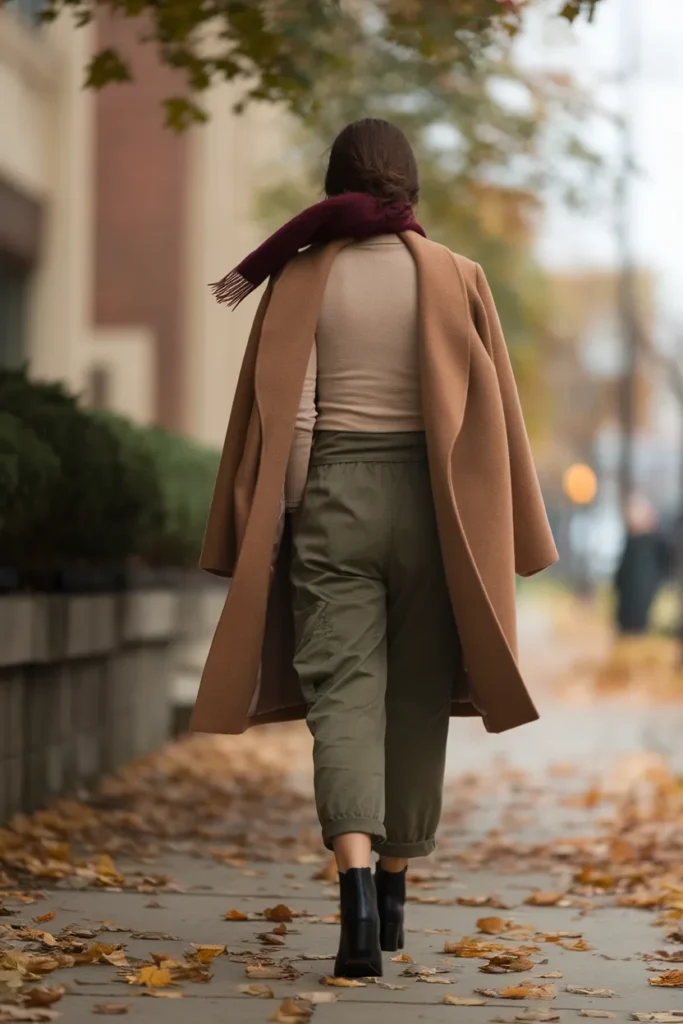
So layer thin to thick, and keep one layer fitted. A ribbed long-sleeve, a fine merino crewneck, then a trench or a wool coat left open. Three layers, only one of them heavy.
Leave the outer layer unbuttoned. That open vertical line down the front is what keeps the whole stack from reading as a block.
Boots finish it, and the shaft height matters more than you’d think. A sleek ankle boot with a narrow shaft keeps the leg line going. Here are the best ankle boots for a capsule wardrobe if you’re choosing one pair to do the most work.
Add a scarf in the accent color from Tell 1. Rust, burgundy, or oatmeal against olive is my favorite fall combination in the entire closet.
Summer Cargo Pants Without Overheating
Cargo pants get shelved in July, usually for the wrong reason. It’s rarely the pants that are too warm. It’s the twill weight.
A lighter cotton or a cotton-linen blend changes the whole equation. Look for something you can see a little light through when you hold it up, and skip anything with a lining or a heavy waistband facing.
The summer formula is simpler than the fall one. One relaxed cargo, one sleeveless top, one flat sandal or a leather slide. That’s the entire outfit.
Ivory and sand cargos come into their own here, and this is the one context where sand doesn’t read military, because the rest of the outfit is so light that nothing else supports the uniform reference.
Roll the hem once if the pant is long. A single clean roll at the ankle looks deliberate in summer in a way it doesn’t in winter, and it moves air.
Cargo Pant Outfit Math: One Pair, Nine Outfits
Here’s the part the outfit galleries never get to. One pair of cargo pants, three tops you already own, three shoes you already own, and you have nine distinct outfits before buying anything.
Screenshot this one.
| Leather loafer | White sneaker | Ankle boot | |
|---|---|---|---|
| Cream silk cami | Dinner out | Weekend errands | Fall evening |
| White cotton tee | Casual Friday | School pickup | Travel day |
| Fine merino knit | Office (in black) | Coffee run | Layering base |
That’s the mix-and-match ratio that earns a pair its hanger space. Nine wears from one purchase, and the cost per wear drops fast. A pair in the $60 to $90 range hits under $10 per wear inside two months of normal rotation.
Add one blazer to that grid and you’re at eighteen outfits. Add a scarf and you’ve covered three seasons.
Notice what the grid rewards. Every top in it is a plain color with a simple neckline, and every shoe is a neutral. Pieces with no opinion of their own are what generate this kind of multiplication, which is the whole argument for a neutral base.
Try building your own version on paper before you shop. If you can’t fill nine cells with things you own, the gap you’re looking at is a top or a shoe, not another pair of pants.
This is the test I apply before any new bottom comes home. If it can’t produce at least nine outfits from clothes already hanging in the closet, it goes back.
Where to Buy Cargo Pants That Don’t Look Tactical
Price tier matters less here than cut and fabric weight, which is good news.
Under $50: Old Navy runs cargos in the $35 to $50 range, and Target’s Universal Thread line typically sits around $30 to $40. The trade-off at this tier is fabric weight. Thinner twill wrinkles faster and the pocket edges can go soft after a few washes. Size up if you’re between sizes, since the lighter fabric has less structure to hold the shape.
$50 to $150: this is the sweet spot. Gap tends to run $60 to $80, Uniqlo around $40 to $60, Quince roughly $50 to $80, and Madewell and J.Crew typically land in the $90 to $140 range. Madewell’s cuts tend to have the flattest pockets in this tier, which solves Tell 3 without any styling effort.
$150 and up: COS, Sezane, and AYR sit in the $150 to $300 range with heavier twill and cleaner construction. If you’re eyeing a pair over $250, the honest note is that a Quince or Gap pair in the same silhouette gets you most of the way there for a third of the price. Save the investment budget for a coat.
Treat all of these as ranges, not promises. Prices move with season and sale cycles.
Fabric, Care, and Cost Per Wear
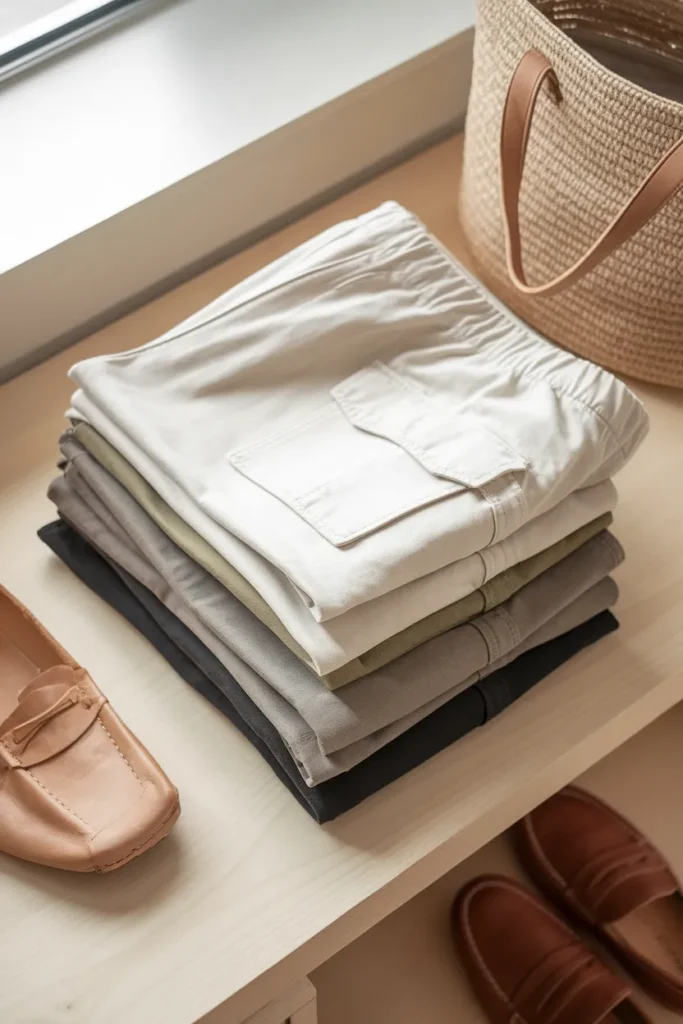
Fabric weight is the single best predictor of whether a pair will look expensive or cheap, and you can assess it in the store in about five seconds.
Hold the pants up by the waistband. If the legs hang straight down with a little weight to them, the twill is substantial. If they billow or cling, the fabric is thin.
Mid-weight cotton twill is the reliable choice for three-season wear. Ripstop is lighter and more technical, which pushes the pant toward the tactical read. Cotton blended with a small amount of elastane holds shape through a full day of wear without bagging at the knee.
Wash them less than you think. Cargos are structurally similar to jeans and don’t need washing after every wear. Cold water, inside out, and hang to dry keeps the color from fading toward that washed-out surplus shade.
Check the label rather than guessing. Manufacturers are required by the FTC’s Care Labeling Rule to have reliable evidence behind the care instructions they print, so the tag is genuinely worth reading before the first wash.
On cost per wear: a well-cut pair worn twice a week for a season lands somewhere under $5 per wear at almost any price tier. That’s the number worth tracking, not the sticker.
Frequently Asked Questions
What tops go with cargo pants?
Soft, fluid fabrics work best because they contrast with the stiffness of the twill. Silk camisoles, fine-gauge knits, ribbed tanks, and cotton tees with real drape all work. Keep the top fitted or semi-fitted, since volume on both halves is what makes an outfit read shapeless. A front tuck marks your waist in about two seconds.
How do you dress up cargo pants?
Two moves handle almost every occasion. Add one genuinely tailored piece on top (a blazer or a silk blouse), and swap the sneaker for a loafer, pointed flat, or low block heel. Black or charcoal cargos dress up far more easily than olive or khaki, so start there if the occasion matters.
Can you wear cargo pants to work?
In creative, tech, and most hybrid offices, yes, with three conditions: black, charcoal, or navy only, flat pockets without flaps or drawstring hems, and at least one formal piece such as a blazer or silk blouse. In law, finance, or anywhere with a written dress code, no. Read your office honestly rather than hoping.
Are cargo pants still in style in 2026?
Yes, and the silhouette has settled rather than disappeared. The extremely baggy, heavily pocketed version has moved toward a cleaner straight or wide leg with flatter pockets. Live Pinterest topic pages for cargo pants outfits, olive cargo pants, and business casual cargo pants are all actively indexed, which is a reasonable signal of ongoing interest.
What shoes look best with cargo pants?
Anything with a slim profile. Leather loafers, ballet flats, pointed mules, thin-soled white sneakers, and sleek ankle boots with a narrow shaft all work. Avoid chunky lug soles and combat boots, since those complete the military reference the pants already start.
What body type looks good in cargo pants?
All of them, with the right cut. The variable that matters is where the pocket sits relative to your widest point. If you’re curvy or hourglass, a high rise keeps the pocket above the fullest part of the hip. If you’re petite, look for pockets set high on the thigh and hem rather than cuff. If you’re midsize or plus-size, flat patch pockets and a defined waist give the cleanest line.
Can I wear cargo pants after 40?
Yes, and it’s one of the fastest-growing searches in this category. The version that works past 40 tends to be a tailored straight leg in black or a soft neutral, with flat pockets, paired with a blazer or fine knit and a loafer. Skip the drawstring hem and the oversized flap pocket, which read younger.
Start With the Pair You Already Own
You probably don’t need to buy anything to fix this.
Pull out the cargos sitting in the back of your closet. Check where the pocket hits. Swap the chunky boot for a loafer or a flat. Add one soft top and one color that isn’t olive, khaki, or sand.
That’s it. Three tells, and you only have to break one.
Try one formula this week, the soft top with a front tuck is the easiest place to start, and see whether the pants come off the hanger more than once. If they do, you’ve just added a bottom to your rotation without spending a dollar.
Which formula are you trying first? The office one tends to surprise people most.
Keep reading

How to Style a Denim Jacket: The Layer That Goes With Everything
Learning how to style a denim jacket is less about finding new outfits and more about fixing the three or four small...

How to Style a Denim Skirt: 8 Outfits You Can Build From What’s Already in Your Closet
Learning how to style a denim skirt gets easier when you start one step earlier than most guides admit. Start with the...

How to Style Flared Jeans Without Looking Stuck in 2015
If you’ve got a pair of flared jeans hanging in the back of your closet that you never quite reach for, this...