
The Capsule Wardrobe Template That Starts With Your Real Closet
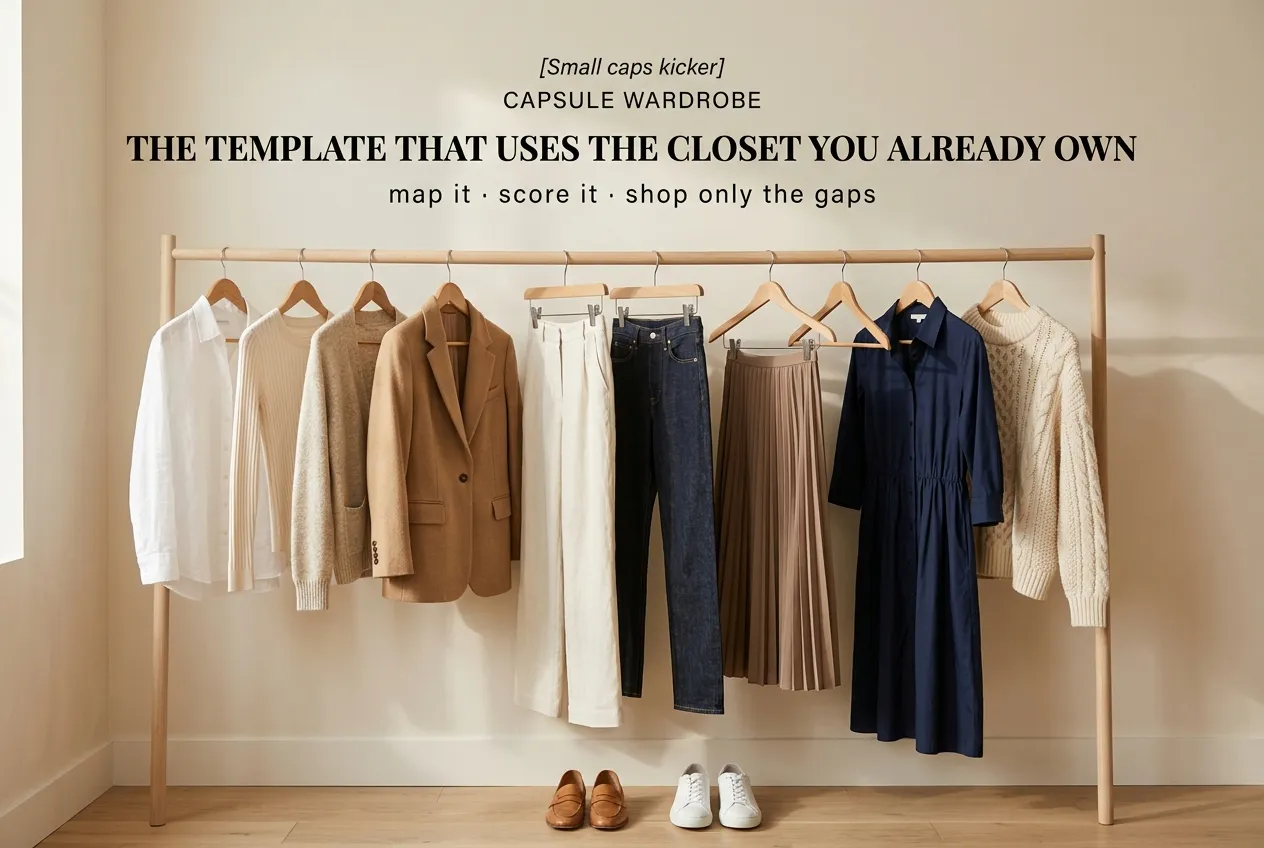
You’ve downloaded a capsule wardrobe template before. Maybe three. There was a tidy list of thirty pieces, a suggested color palette, and a quiet assumption underneath all of it: that you were starting from an empty closet. You aren’t. You have eighty-one things on hangers and a drawer of tee shirts you keep meaning to sort, and the template asked you to buy a camel trench you already own in a slightly different camel.
So this one works backward. You’ll map what’s actually hanging in your closet onto a simple grid, score each piece by how hard it works, and let the holes in the grid tell you what to buy. It takes an evening. You’ll finish with a capsule that fits your real life instead of somebody else’s spreadsheet.
What a capsule wardrobe template actually is
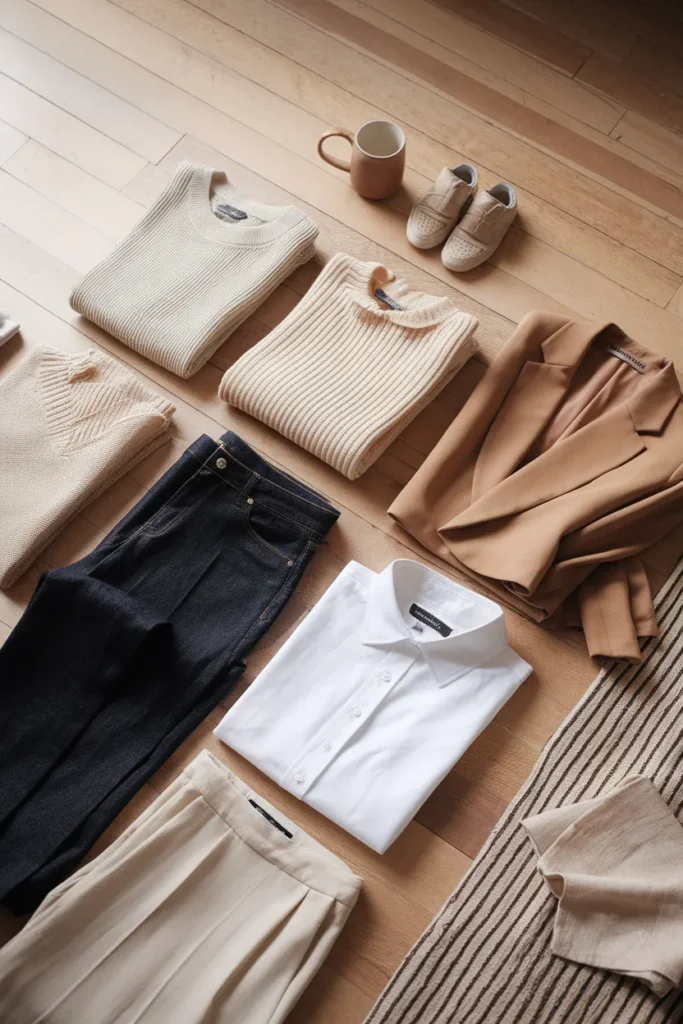
A capsule wardrobe template is a structure, not a shopping list. It tells you how many pieces to hold in each category and how those categories should relate to each other, so that any top you grab works with any bottom you grab.
The idea is older than the current wave of interest. Susie Faux popularized the phrase in 1970s London, and Donna Karan built the most famous version of the format when she showed seven interchangeable workwear pieces in 1985. Seven. That’s the whole ancestry of every thirty-item printable you’ve saved.
What separates a template from a list is the relational part. A list says “own a white button-down.” A template says “own one crisp white button-down that works under the blazer, over the slip dress, and knotted at the waist with the denim.” Same garment, completely different instruction.
Most readers want a number, so here’s an honest one. Somewhere between twenty-five and forty pieces per season, excluding underwear, sleepwear, and gym clothes, covers a normal American life with real weather in it. Fewer if you work from home. More if you have a dress code and a commute. If you’d rather run one wardrobe instead of four, a thirty piece year round capsule that carries across all four seasons is the version to borrow from.
The number matters less than whether the pieces talk to each other.
Why most capsule wardrobe templates fail
They fail for a reason that has nothing to do with the template’s quality. They fail because they’re written for a closet that doesn’t exist yet.
You open the PDF. It lists a black turtleneck, and you own a charcoal one that’s close enough. It lists ankle boots, and you own three pairs, and now you’re wondering whether any of them count. Twenty minutes in, you’re negotiating with a document instead of editing a closet. Most people quit right there, which is why the same women download a new template every January.
There’s a second failure, quieter and more expensive. A template built as a shopping list encourages buying. You get a fresh thirty-item wish list and a strong feeling of momentum, and the thing you already own in a marginally different shade goes to the donation bag. That churn adds up: the EPA estimates textile generation at around 17 million tons a year in US municipal solid waste, with discarded clothing as the main source.
A capsule is supposed to reduce buying. A template that starts from zero does the opposite.
So we invert it. Your closet becomes the input. The template becomes the diagnostic.
The 3×4 Closet Map: your capsule wardrobe template, reversed
Here’s the framework. Four columns, three rows, twelve cells. Screenshot it.
| Anchors (tops) | Bottoms | Layers | Shoes | |
|---|---|---|---|---|
| Everyday | 4 to 5 | 2 to 3 | 2 | 2 |
| Polished | 2 to 3 | 2 | 1 to 2 | 1 to 2 |
| Weather | 1 | 1 | 2 | 1 |
Anchors are the pieces you build outward from: tees, knits, button-downs, and any dress that functions as a complete outfit on its own. Bottoms are jeans, trousers, and skirts. Layers are blazers, cardigans, and jackets. Shoes are shoes.
The rows are the part competitors skip. Everyday is what you wear when nobody’s grading you. Polished is work, dinner, the school thing where you’ll be photographed. Weather is the row that keeps the whole capsule from collapsing in November: the coat, the boot, the heavy knit.
Add it up and you land between twenty-two and thirty pieces. That’s your target, not your rule.
The map’s real job isn’t the total. It’s showing you, on one screen, exactly which cell is empty. Most women discover they’ve been buying Everyday Anchors for six years while the Polished Bottoms cell has been sitting at zero.
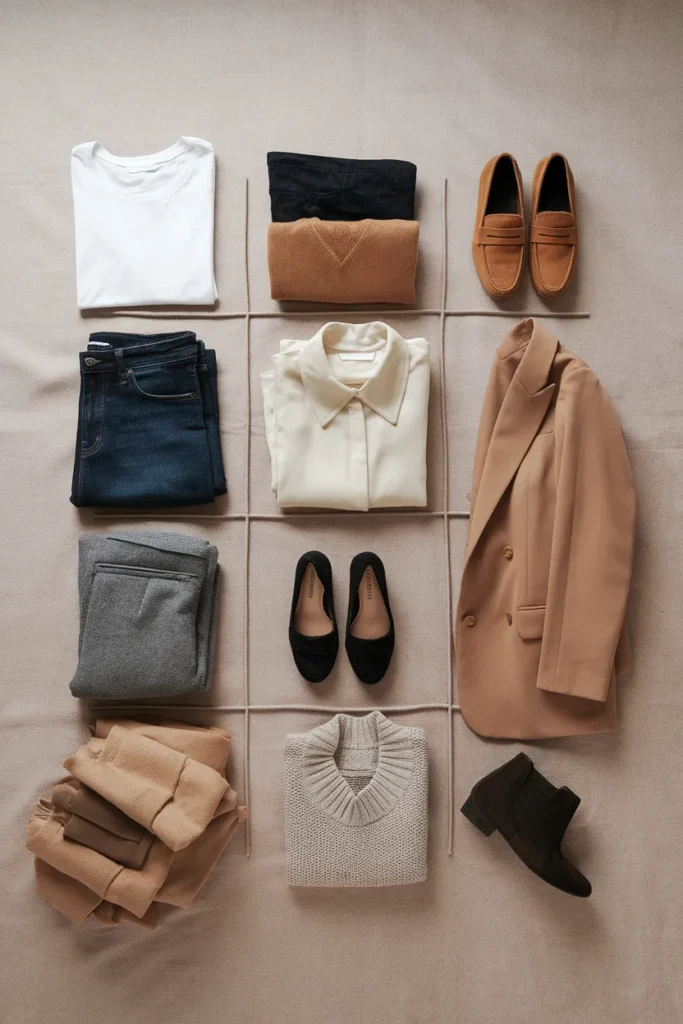
Step 1: Pull your real rotation, not your aspirational one
Don’t start by emptying the closet. Start with the last three weeks.
Go through your camera roll and your memory and write down everything you actually wore since the start of the month. Not what you meant to wear. What went on your body. Most women land somewhere around twelve to eighteen pieces, which is a startling number when you’re standing in front of eighty.
That list is your real rotation, and it’s the most honest data you’ll get about your own style. Whatever’s on it, you like it, it fits, and it survives your actual week.
Now put those pieces in the map first, before anything else. They go in as confirmed. You’re not auditing them. They earned their spot by being worn.
Two things usually happen next. One cell fills up immediately and overflows, which means you’ve been buying the same thing repeatedly. And at least one cell stays empty, which is the exact reason mornings feel hard.
Everything still in the closet and not on the list goes in a separate pile. That pile is the audit, and it’s Step 2.
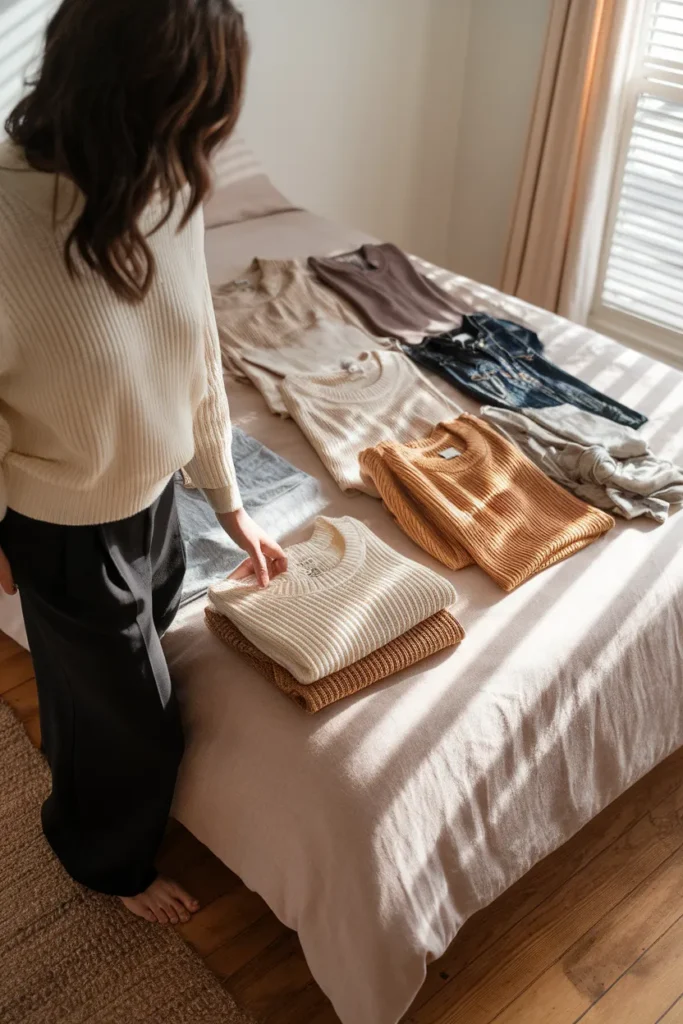
Step 2: Score every piece with outfit math
Take one item from the audit pile. Ask a single question: how many pieces already confirmed in my map does this work with?
Count honestly. Count only combinations you’d leave the house in.
- Pair Score of 0 to 2: it doesn’t earn hanger space. Donate, sell, or move it out of the closet.
- Pair Score of 3 to 5: conditional. Keep it if it’s the only thing filling an empty cell. Otherwise it’s clutter with a good reason attached.
- Pair Score of 6 or higher: confirmed. Add it to the map.
The scoring takes about fifteen seconds per piece, so a sixty-item pile runs fifteen minutes. It’s faster than agonizing, and it’s dramatically more accurate, because the number does the deciding instead of your guilt about what something cost.
Two rules keep the math clean. A piece only scores against confirmed items, never against other audit-pile items, or you’ll talk yourself into keeping a whole ecosystem of things you never wear. And accessories don’t score, they multiply, which is why the five belt styles that stretch a small capsule further belong in a separate line at the bottom of the map rather than in a cell.
One warning. Emotionally loaded pieces will score low and you’ll want to argue. That’s fine. Keep them, put them somewhere other than the daily closet, and stop making yourself walk past them every morning.
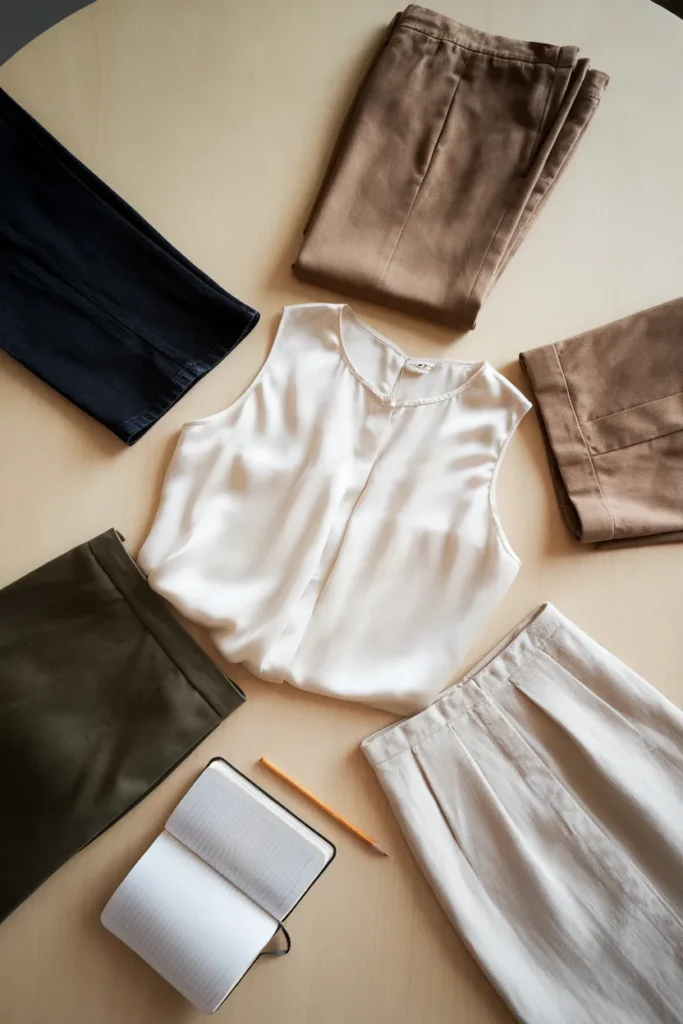
Step 3: Fill the grid and read the holes
Every confirmed piece now goes into a cell. Some cells will be over the recommended range. Some will be at zero.
Read the over-full cells first, because they’re the cheaper lesson. Six Everyday Anchors when the map says four or five means two of them are redundant, and the two lowest Pair Scores are the ones to release. You bought the same striped tee three times because it was the safest thing on the rack, and now you know.
Then read the zeros. Every empty cell is a morning that doesn’t work. An empty Polished Bottoms cell means you own no trousers you’d wear to a client meeting, which is exactly why you keep wearing the same dress to everything. An empty Weather Layer cell means October ambushes you annually.
Write the zeros down in order of how often that row comes up in your week. That ordered list is your shopping plan, and it’s usually three to six items long rather than thirty.
That’s the entire method. Real rotation in, score the rest, fill the grid, buy the holes.
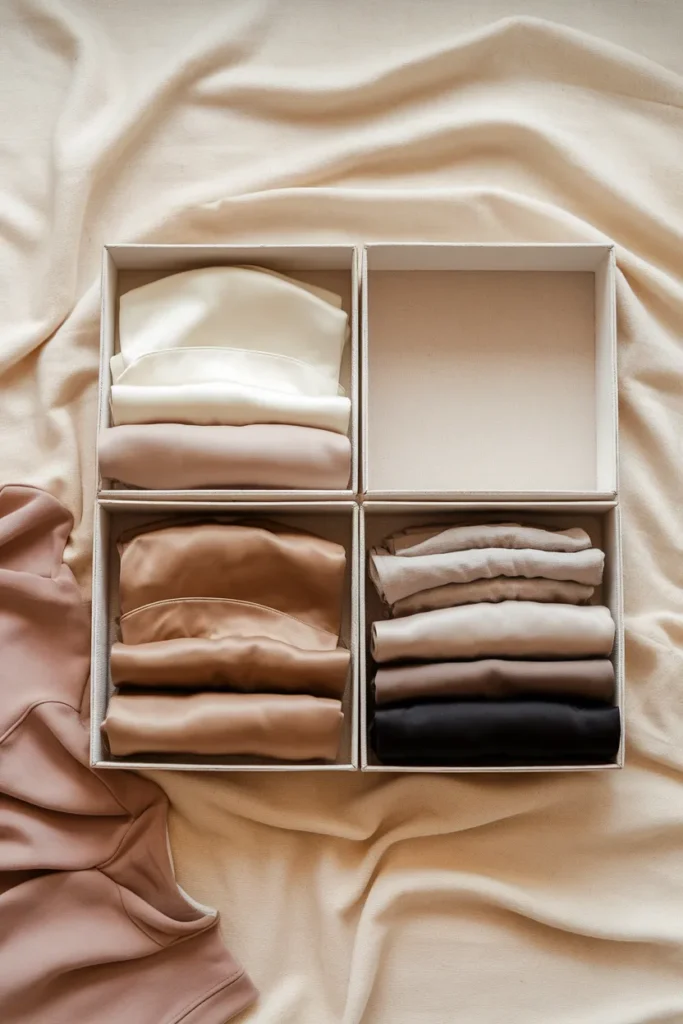
Choosing your neutral base and one accent
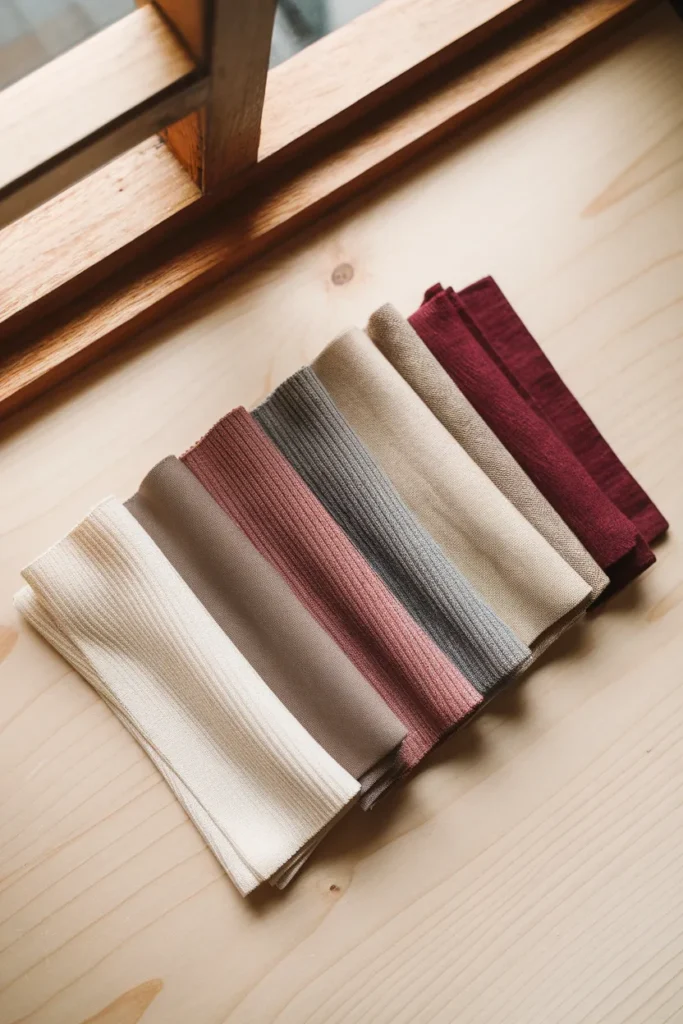
Cohesion comes from color discipline more than from piece count. Pick two neutrals to carry the bulk of the map, one lighter and one darker, then one accent.
Workable base pairs: cream with soft black, oat with espresso, ivory with navy, taupe with charcoal. Any of those four will let almost every top meet almost every bottom without a decision.
The accent is where personality lives. One color, used across roughly ten to fifteen percent of the map, is enough to keep the whole thing from reading like a hotel lobby. Burgundy, butter yellow, sage, and tomato red all sit comfortably against every base pair listed above.
Where people go wrong is treating the accent as a category rather than a thread. One accent knit plus one accent bag reads intentional. An accent in every cell reads like you gave up. If you want more color than a single thread allows, how to add color without losing the cohesion you just built walks through the ratio in detail.
Test before you commit. Hold your two candidate neutrals next to each other in daylight, near a window rather than under a bulb. If one makes the other look slightly dirty, they’re not a pair.
The named formulas, and when each one is worth borrowing
You’ll see four formulas repeated everywhere. All four are useful. None of them is a whole wardrobe, and the top-ranking articles rarely tell you which situation each one suits.
| Formula | What it is | Best for | Where it breaks |
|---|---|---|---|
| Project 333 | 33 items including shoes and accessories, worn for 3 months | A hard reset when you’ve lost perspective | Punishing in a four-season climate |
| 5-4-3-2-1 | 5 tops, 4 bottoms, 3 shoes, 2 layers, 1 extra, roughly 15 pieces | Packing for a trip of a week or two | Too thin for a full season at home |
| 10×10 | 10 pieces, 10 days of outfits | Testing whether a capsule suits you at all | It’s a challenge, not a wardrobe |
| 70/30 | 70 percent timeless, 30 percent personality | A shopping filter you can use in a store | Says nothing about what to own |
Use them as tools, not identities. Run a 10×10 in a slow week to find out whether you actually enjoy a small closet. Use 5-4-3-2-1 to pack. Use 70/30 at the register, where it does the most good.
The 3×4 map is the layer underneath all of them. Fill the map, then apply whichever formula fits the month you’re having.
Template variations by life category
One map rarely covers one life. The row structure flexes, and the flexing is the point.
If you work in an office, shift weight from Everyday to Polished. Take one Anchor and one Bottom out of the top row and add them to the middle. Your Polished Bottoms cell should hold at least two trousers rather than one trouser and a wish. A fifteen piece work capsule built for mix and match shows what that redistribution looks like in practice.
If you’re home with kids, Everyday expands and Polished shrinks to two total pieces you can reach in ninety seconds. Prioritize machine-washable knits over anything requiring care, and count one pair of clean white sneakers as non-negotiable.
If you work from home, the trap is a closet that’s all one row. Keep the Polished row stocked anyway, even at the minimum, or the one week you need it will turn into a panic purchase.
If you’re traveling, collapse the map to a single column set: two Anchors, two Bottoms, two Layers, two Shoes, plus one dress. That’s the 5-4-3-2-1 logic with your own confirmed pieces in it.
What to buy first when the map shows a gap
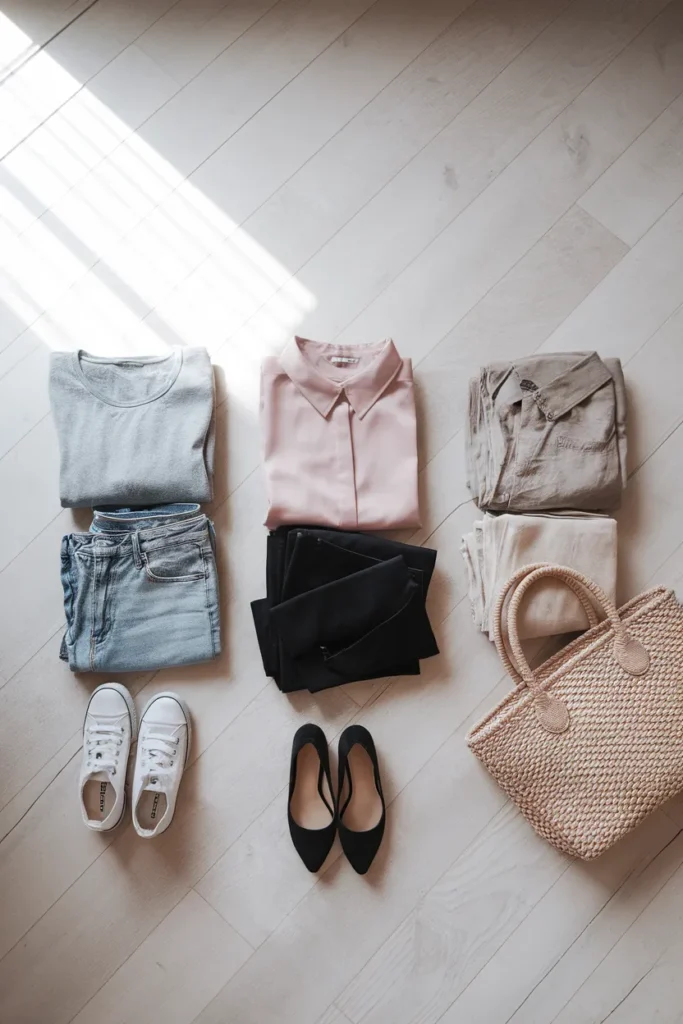
Buy in order of row frequency. If you’re in the Everyday row six days a week and Polished one, the Everyday hole gets your money first, no matter how much more fun the other purchase sounds.
Then match spend to wear rate. Rough guidance that holds up across price tiers:
- High wear, low visibility (tees, basic knits): mass tier is fine. Old Navy, Target’s Universal Thread, Uniqlo, roughly $12 to $40. Expect to replace cotton tees annually, since the fabric weight at this tier won’t survive much more.
- High wear, high visibility (jeans, trousers, everyday knit): mid tier earns it. Madewell, J.Crew, Quince, Everlane, roughly $50 to $140. Madewell denim typically runs in the high nineties to high one hundred thirties.
- Structural pieces (blazer, coat, boots, loafers): spend the most here, because construction is visible from across a room and cheap tailoring shows immediately. Contemporary tier, roughly $150 to $400.
If a piece in that last group is $300 or more, look for the mid-tier version before you commit. Quince and Everlane both make credible substitutes for contemporary tailoring at a third of the price, with the honest trade-off being lining quality and how the shoulder holds after a year. For the shoe cell specifically, which loafers actually earn a slot in the shoe column covers where the construction difference actually shows.
Prices shift with season and sale cycles, so treat every range here as a bracket rather than a quote.
Fit notes for different proportions
A template is only as good as how the pieces sit on you, and the standard printable ignores this entirely.
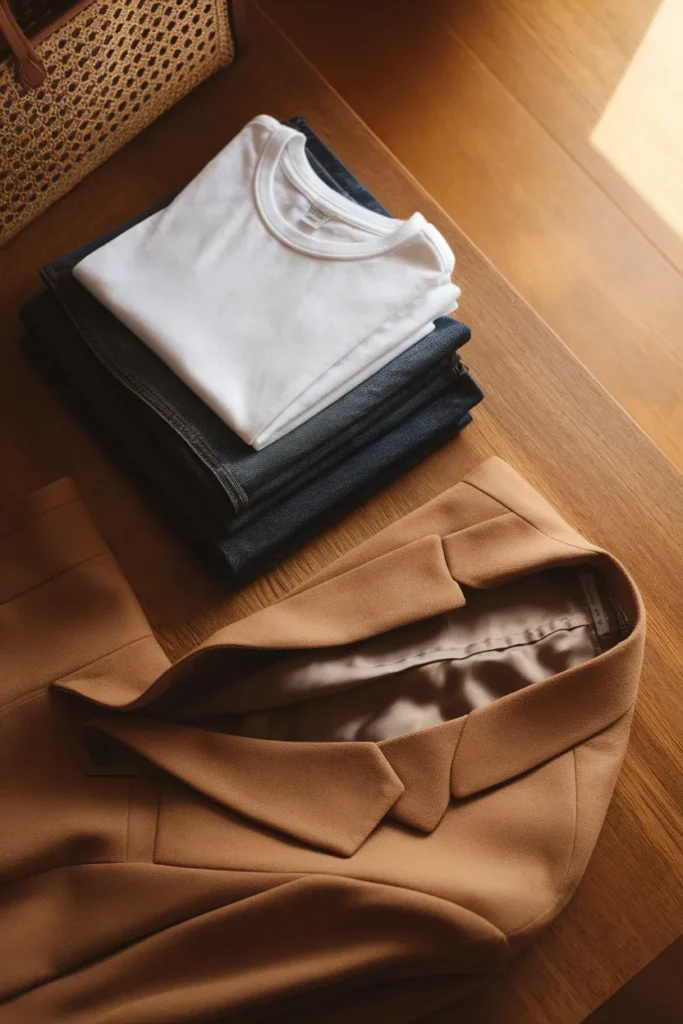
If you’re petite, at five feet four and under, the length of the layer matters more than its cut. A blazer ending at the widest part of the hip shortens the leg line, so look for one hitting just above. Cropped wide-leg trousers work better than full-length ones that need hemming, since hemming a wide leg changes the proportion of the whole trouser.
If you’re tall, at five feet nine and over, the fight is sleeve and rise. Prioritize brands with a tall line for the Bottoms cells specifically, because a short rise undermines every top you tuck into it.
If you’re curvy, buy the Anchors and Layers for the widest measurement and have the waist taken in. A blazer that fits your bust and hangs straight will always read more polished than one straining at a single button.
If you’re midsize or plus, check the Bottoms cells for stretch content rather than nominal size. A trouser with three to five percent elastane holds its shape through a day of sitting where rigid wool won’t.
If you’re over forty or postpartum, proportions may have shifted from what you learned to shop for. Re-measure before applying any template, since a map built on outdated numbers fails invisibly.
How to keep the template alive across seasons
A capsule dies when it becomes a museum. The maintenance is quarterly and takes under an hour.
At each season change, pull the Weather row and swap it. Nothing else moves. That’s the entire advantage of building the map with a Weather row in the first place: the other eight cells carry across the year, and only four pieces rotate.
Then run a short re-score. Any piece you didn’t wear once in the previous season gets re-scored against your current confirmed map. Scores drop over time as other things leave. A cardigan that scored 7 last spring might score 3 now, and that’s your signal.
Add slowly. One in, one out is a strict rule and most people can’t hold it, so try one in, one scored. New piece arrives, you score one existing piece, and if it comes in under 3 it leaves. That keeps the closet honest without demanding sainthood.
For a worked example of a tightly bounded capsule doing real range, how a sixteen piece capsule covered a full week of cruise dress codes shows the same math under pressure.
Five mistakes that break a capsule wardrobe template
- Starting with a purge. Emptying the closet first destroys your reference data. Score first, remove second.
- Building around the pieces you love instead of the ones you wear. Those two lists overlap less than anyone expects.
- Counting a dress as a top. It’s an Anchor and a Bottom at once, which means it scores differently. Give dresses their own line at the bottom of the map.
- Ignoring the Weather row until it’s cold. Coats and boots are the most expensive cells and the worst ones to panic-buy.
- Treating the target number as a rule. Twenty-two to thirty is a range, and a range with a real winter in it runs higher.
Capsule wardrobe template FAQ
How many pieces should be in a capsule wardrobe? Twenty-five to forty per season for most American climates, excluding underwear, sleepwear, and gym clothes. The 3×4 map lands between twenty-two and thirty. Fewer if you work from home, more if you have both a dress code and a real winter.
What is the 5-4-3-2-1 rule? Five tops, four bottoms, three pairs of shoes, two layers, and one extra such as a dress or swimsuit, adding up to roughly fifteen pieces. It was built for travel and it’s excellent there. It’s too thin for a season at home.
What is the 333 method, and does it include accessories? Thirty-three items worn for three months, and yes, it includes shoes, outerwear, and accessories. Underwear, sleepwear, and workout clothes are generally exempt. Treat it as a reset exercise rather than a permanent structure.
Does a capsule wardrobe template work if I’m petite, curvy, or plus size? Yes, though the pieces filling each cell change. The map is proportion-neutral because it counts function rather than cut. Adjust lengths, rises, and stretch content to your own measurements, and re-measure if your body has changed recently.
Is it worth investing in expensive capsule pieces? Spend where construction shows and wear rate is high: blazers, coats, boots, and trousers. Tees and basic knits don’t reward the spend. A useful check is cost per wear, which is price divided by realistic annual wears. A $250 coat worn eighty times a winter costs less per wear than a $30 top worn twice.
How often should I rotate my capsule? Swap the Weather row quarterly and leave the rest alone. Re-score anything unworn from the previous season. That’s roughly an hour, four times a year.
Can I use a capsule wardrobe template for work? Yes. Shift one Anchor and one Bottom from the Everyday row into the Polished row, and make sure the Polished Bottoms cell holds at least two options. A single pair of work trousers is the most common reason a work capsule feels repetitive.
Start with what’s already on the hanger
The best capsule wardrobe template isn’t the one with the prettiest layout. It’s the one that accounts for the eighty-one things already in your closet, because those are the clothes you have to get dressed in tomorrow morning.
So try the map this week. Write down what you wore since the first of the month, score the rest of the pile, and see which cells come up empty. Most women find three or four holes and a lot of duplication, and fixing that costs a fraction of starting over.
If you’d like the map as a printable page you can fill in by hand, the 30-Piece Capsule Wardrobe Checklist is free and comes with a new outfit formula each week.
Keep reading

How to Make a Capsule Wardrobe Vision Board (That Actually Guides You)
A capsule wardrobe vision board is supposed to make getting dressed easier. Most of them do the opposite. You save four hundred...

7 Day Cruise Capsule Wardrobe: One Bag, Every Occasion Covered
A 7 day cruise capsule wardrobe sounds like a contradiction. One week, four dress codes, two climates, and a closet roughly the...

The 30-Piece Year Round Capsule Wardrobe That Works in Every Season
Every January the internet hands you a winter capsule. By April it’s a spring capsule. By July, summer. That’s four closet rebuilds...