
Italy Capsule Wardrobe: What to Wear in Tuscany, Rome & Amalfi
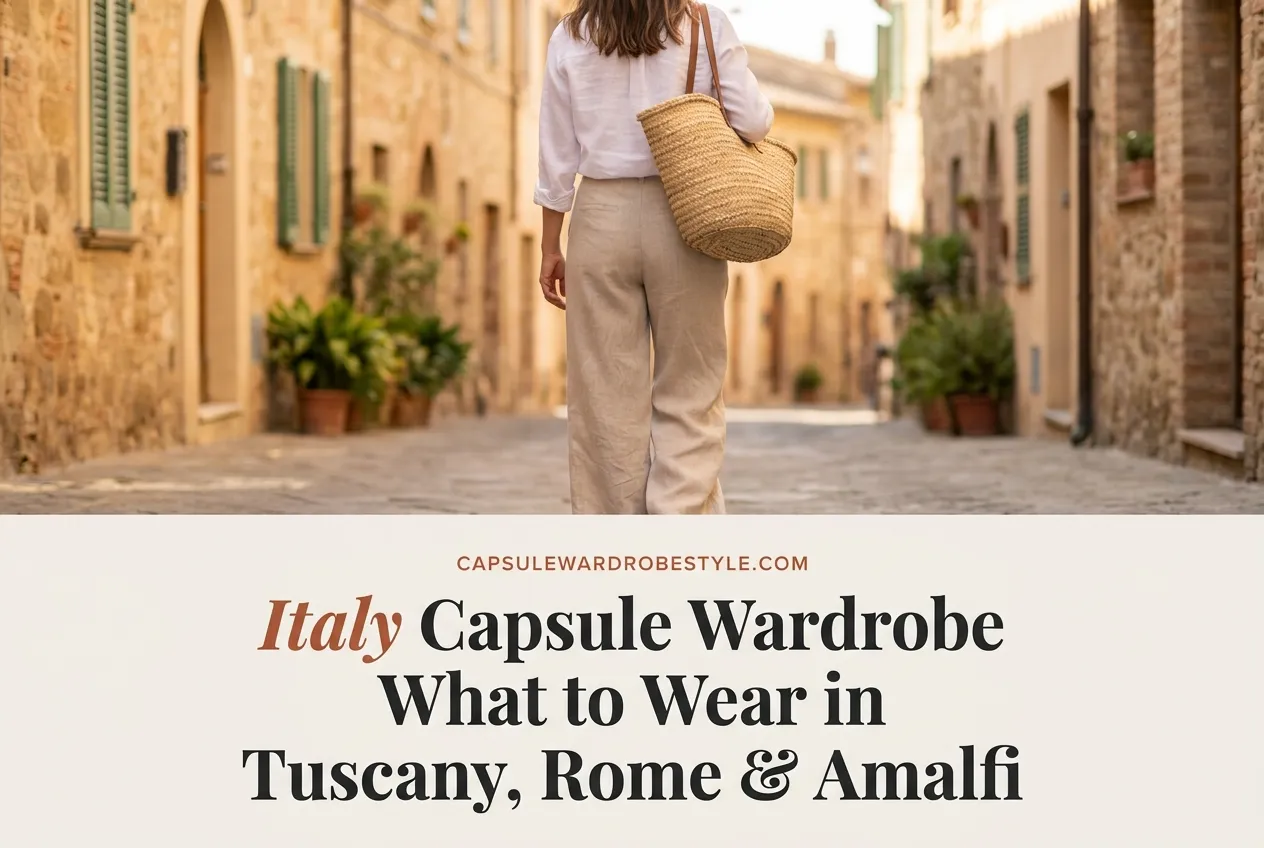
Picture this. It’s 9pm in Trastevere, the air still warm off the cobblestones, and you’re at a corner table with a glass of wine and zero idea what you’re wearing tomorrow because your suitcase is a wrinkled mess of pieces that don’t go together. An Italy capsule wardrobe fixes that before you ever leave home. The promise here is simple: 12 pieces, more than 30 outfits, one carry-on, and a look that reads “lives here” instead of “just landed.” I packed only this capsule for a 10-day trip across Rome, Florence, and the Amalfi Coast last June and never once ran out of outfits.
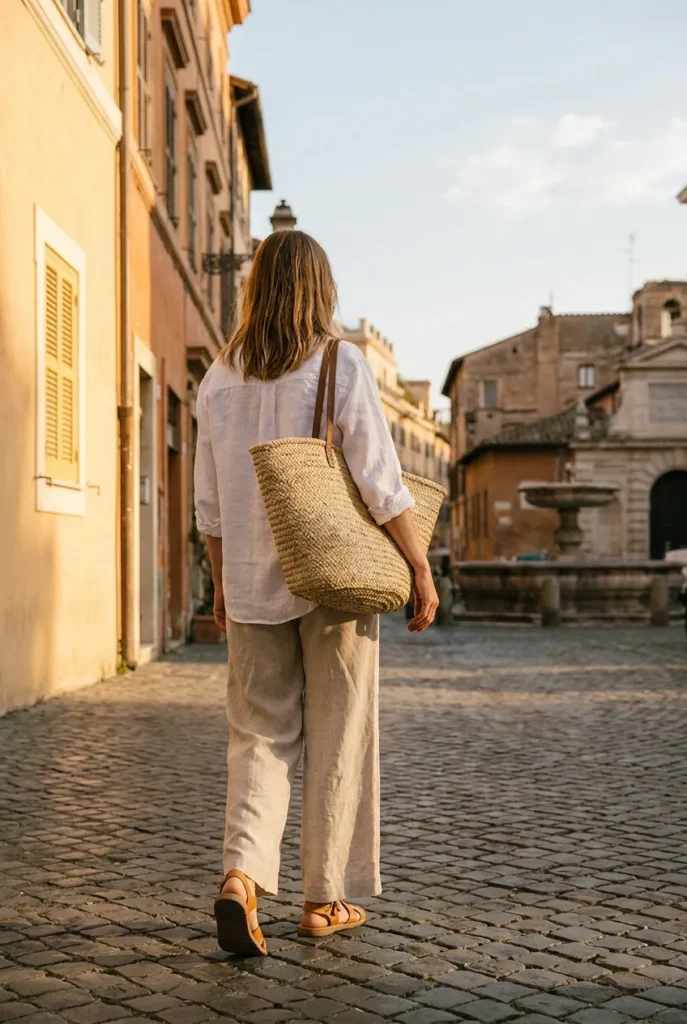
Here’s what most packing guides get wrong. They hand you a list and walk away. They never show you how the pieces actually work together, which is the whole point of a capsule. So we’re doing both: the list and the outfit math, plus the two things that quietly ruin Italy trips, churches you can’t enter and shoes that wreck your feet by day three.
What an Italy Capsule Wardrobe Actually Is (and Why 12 Pieces Beats 30)
A capsule wardrobe is a small set of pieces in one cohesive color story, chosen so almost everything mixes with everything else. For travel, that math gets even better. Fewer pieces, more outfits, lighter bag.
The reason 12 beats 30 isn’t minimalism for its own sake. It’s that every extra “just in case” piece you pack is a piece you have to carry up four flights of a Florence walk-up with no elevator. Ask me how I know.
When pieces share a palette, you stop packing outfits and start packing components. A white tee works with the linen trousers, the jeans, the midi skirt, and under the dress as a layer. One top, four bottoms, no thought required at 7am.
That’s the difference between a suitcase full of clothes and a real Italy packing capsule. One looks like effort. The other does the work for you.
Italy Summer Weather, Region by Region (So You Pack for Reality)
Italy in summer is hot, but not the same hot everywhere. Packing for one average temperature is how people end up sweating in the wrong fabric or shivering on a ferry at dusk.
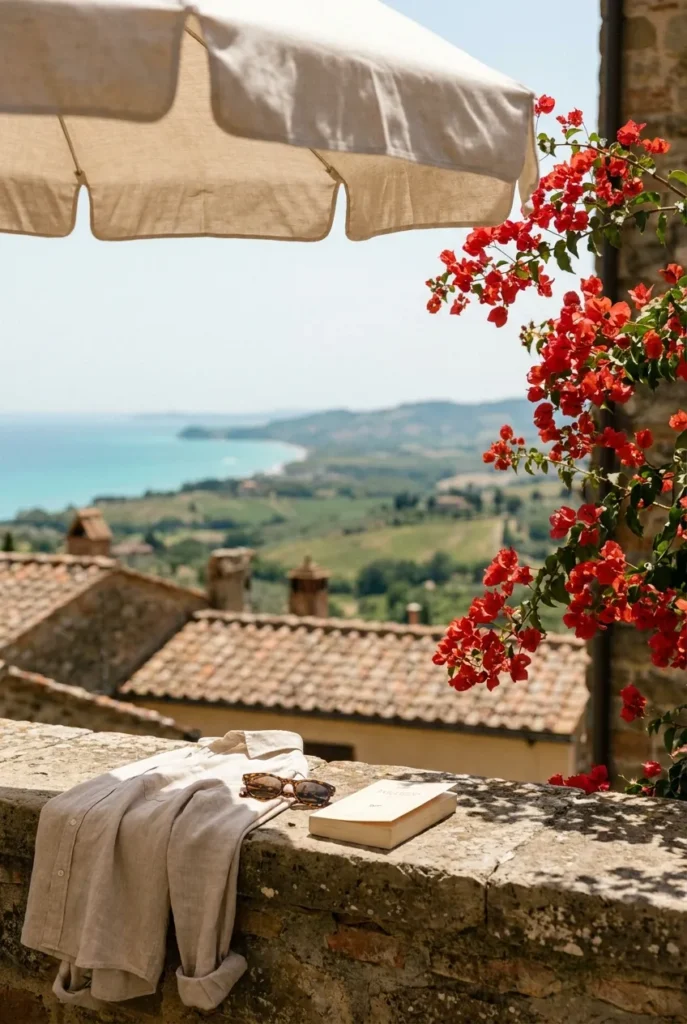
Rome, Florence, and the inland cities
Expect roughly 85°F to 95°F in June through August, with pavement and stone radiating heat well into the evening. These are linen-and-cotton cities. Anything synthetic clings and shows sweat fast.
Tuscany and the countryside
Similar daytime highs, often a touch hotter inland, but the evenings can drop into the 60s. A light layer for an outdoor dinner under the vines earns its hanger space here.
The Amalfi Coast, Capri, and the islands
Slightly more forgiving by day thanks to sea breeze, usually 78°F to 90°F, but ferries, open boats, and clifftop terraces at night get genuinely cool. Salt air also means you’ll want pieces that rinse and dry overnight.
The takeaway: pack breathable fabrics first, then add exactly one real layer. Not three. One.
The 12-Piece Italy Summer Capsule (Your Carry-On Packing List)
This is the core list. Build it from your own closet where you can, and read the dupe notes before you buy anything new. I tested four versions of the linen trouser across Quince, J.Crew, Madewell, and Everlane before settling on the weight that travels best.
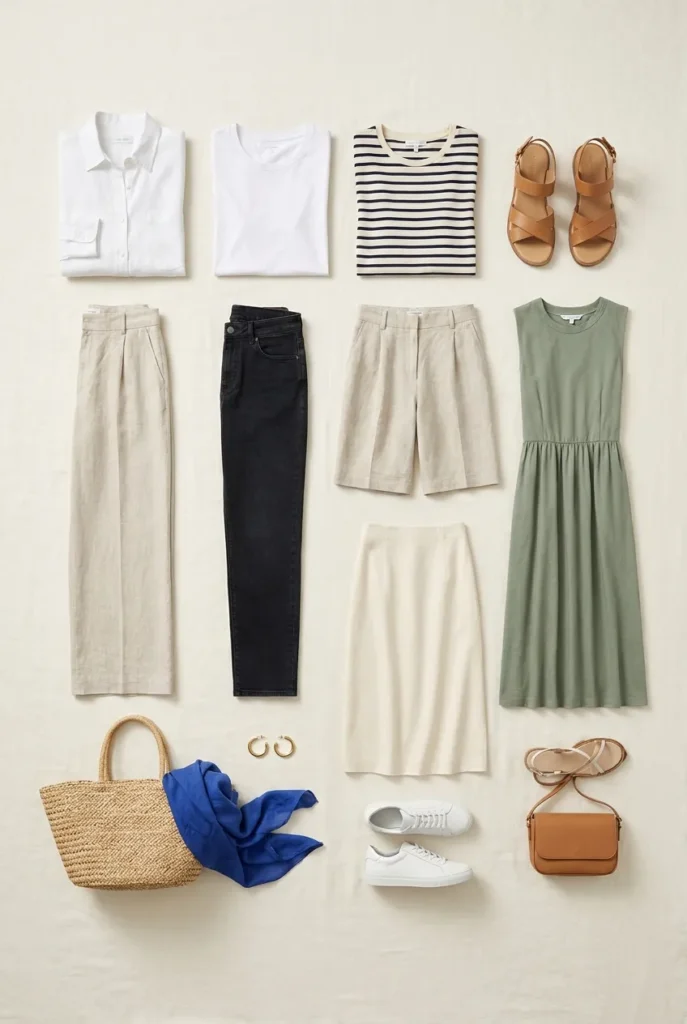
The 12 core pieces:
- White linen-blend button-down (your church layer, your beach cover, your dinner shirt)
- White cotton tee (the workhorse)
- Breton stripe tee (instantly European, hides nothing fussy)
- Oat linen wide-leg trousers (cool, covers the knee, reads polished)
- Dark slim jeans (city dinners, cooler evenings)
- Knee-length linen shorts or tailored bermuda (heat days that still pass a church door)
- Neutral midi dress (one-and-done outfit, sage or cream)
- Midi skirt (or a second dress if dresses are more your thing)
- Lightweight linen overshirt or fine cardigan (the one real layer)
- Tan walking sandals (the all-day pair)
- White leather sneakers (museums, train days, miles of marble)
- Dressy flat sandals or ballet flats (dinner without heels on cobblestones)
Add these small things that don’t count against the 12 but pull it together: a leather crossbody, a woven tote, a scarf or pashmina, sunglasses, and one slim belt.
Price-tier note: linen trousers run a wide range, roughly $50 to $90 at the mass-to-mid tier (Old Navy, Gap, Quince) and $98 to $148 at the contemporary tier (Madewell, J.Crew). If you splurge on one Sezane linen shirt at $120-ish, a Quince or Uniqlo linen-blend at $30 to $50 covers the same job, with a slightly crisper hand that wrinkles a touch more. Worth knowing before you pay triple.
For the broader version of this packing logic across multiple countries, here’s what to pack for Europe in summer without overpacking.
The Italy Outfit Math: 12 Pieces, 30+ Outfits
Here’s the part no competitor gives you. A capsule isn’t a list, it’s a multiplication problem. Below is the framework I use, screenshot it for your trip.
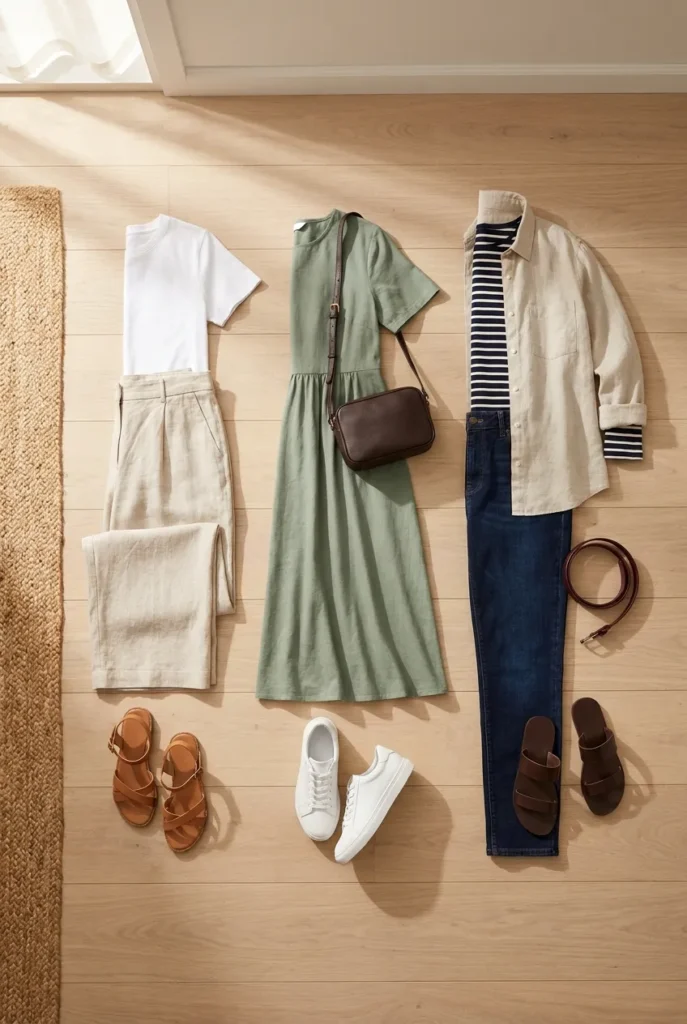
The rule is one piece, three jobs. Each top should pair with at least three bottoms or layers. Each bottom should work for both day and night with only a shoe swap. Here’s how the core pieces map to real Italy days:
| Occasion | Top | Bottom | Layer | Shoe |
|---|---|---|---|---|
| City sightseeing | White tee | Linen trousers | None | Walking sandals |
| Museum / train day | Breton tee | Dark jeans | Overshirt | White sneakers |
| Church visit | Linen button-down | Linen trousers | Shirt is the cover | Walking sandals |
| Hot afternoon | White tee | Linen shorts | None | Sandals |
| Dinner in the city | Silk-feel tee or button-down | Dark jeans | None | Flat sandals |
| Coastal lunch | Breton tee | Midi skirt | None | Flat sandals |
| Evening on the coast | Midi dress | (dress) | Overshirt | Flat sandals |
| Travel home | White tee | Linen trousers | Overshirt | Sneakers |
Count it out and you’ll pass 30 combinations fast, because every swap of shoe, layer, or accessory reads as a new outfit. Add a scarf and the midi dress goes from beach to dinner. That’s the whole trick.
This same math powers a beach vacation capsule wardrobe of 10 pieces if your trip leans more coast than city.
What to Wear in Rome, Florence & the Cities
Cities are where you’ll feel the heat most and where you most want to blend in. Italians in summer lean toward neutral, well-fitted, and covered-enough, not loud and not barely-there.
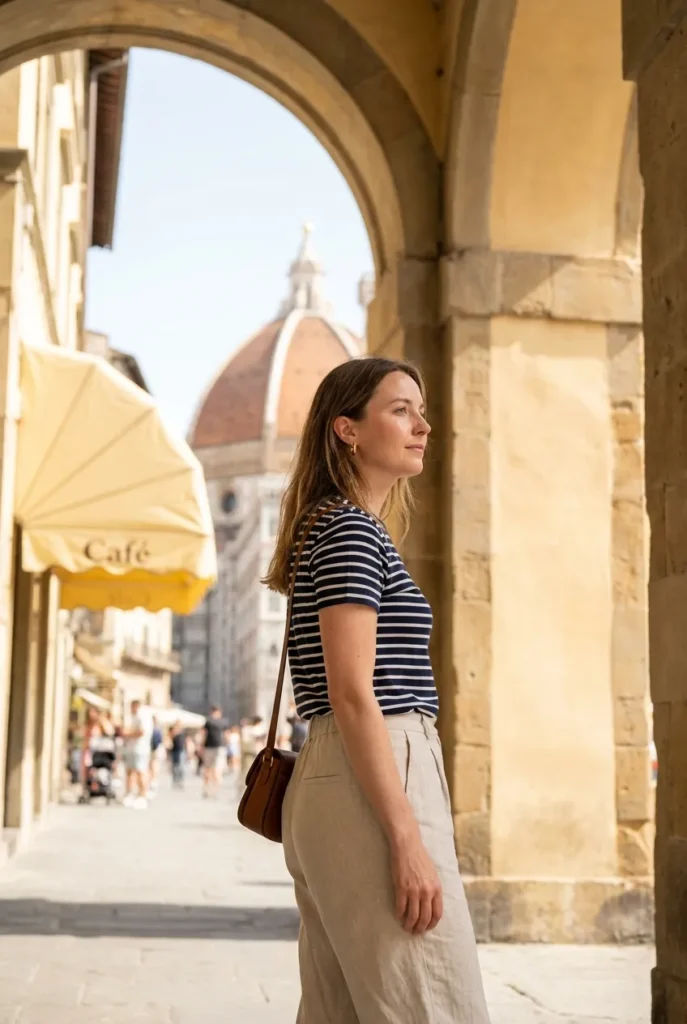
For daytime, the linen trousers plus a tucked tee plus sandals is the uniform. It photographs well, survives heat, and walks for hours. Swap to the button-down when you’re hitting churches.
For evenings, dark jeans read dressier than you’d think against warm stone and golden light. Add the flat sandals and a swipe of lip and you’re set for dinner without dragging heels across uneven pavement.
A crossbody worn across the front, not dangling off one shoulder, keeps your hands free and your bag where you can see it. The State Department’s Italy travel information page flags petty theft in crowded tourist areas, and a zip-top crossbody is the easy, stylish answer.
What to Wear in Tuscany and the Countryside
Tuscany is softer, slower, and a little dressier at dinner than you’d expect for the countryside. Days are for wandering hill towns, evenings are for long tables outdoors.

The midi dress earns its keep here. It’s one decision, it’s cool, and it photographs beautifully against stone and vine. For daytime exploring, the linen shorts and a tee handle the heat, then the overshirt goes on when the temperature drops after sundown.
Footing matters in hill towns. Loose gravel and steep lanes are no place for delicate heels. Sandals by day, flats by dinner.
If your trip is dinners and aperitivo more than monuments, lean into the quiet, expensive-looking neutrals in old money summer outfits for hot-weather elegance.
What to Wear on the Amalfi Coast (and Capri)
The coast is the one place you can let color in. Think a tomato-red or cobalt accent against all that blue water and white-washed stone. It’s also where breezy and rinse-friendly fabrics matter most.
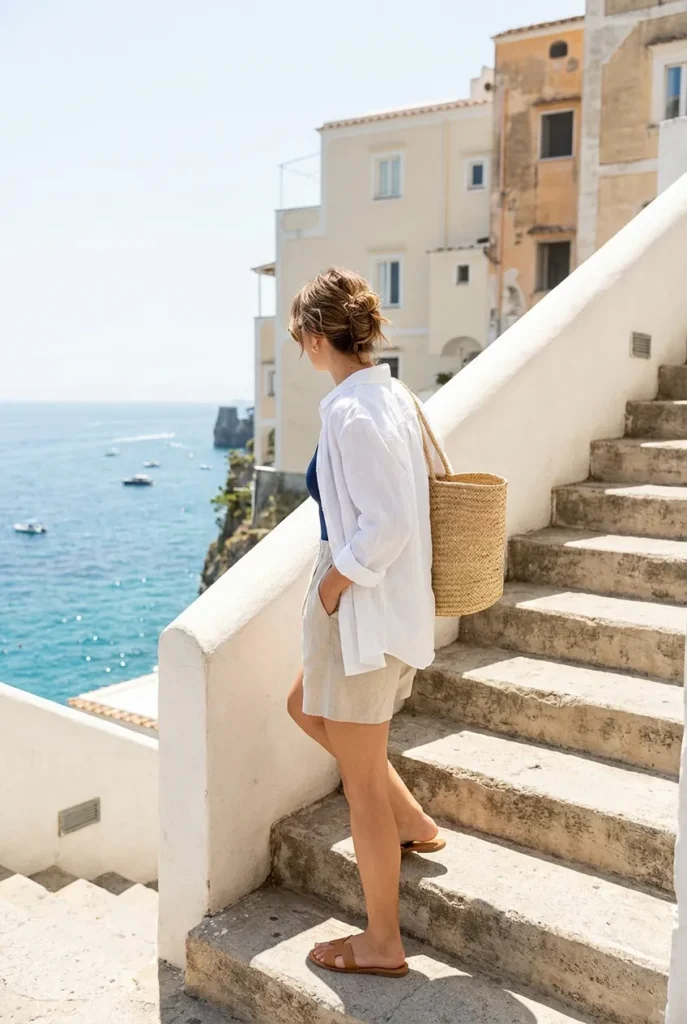
By day, the button-down doubles as a beach cover and a sun shield. The midi dress takes you straight from a lunch terrace to a boat. Keep a scarf in the tote, because open ferries and clifftop dinners get breezy fast.
For evenings, this is where the one allowed pop of color does the most work. A cobalt scarf or a tomato-red flat against neutrals looks intentional, not loud.
The Church Dress Code Problem, Solved With One Packable Piece
This is the one that catches people off guard. You can be turned away from St. Peter’s Basilica, the Duomo, and most major churches if your shoulders or knees are bare, even in a heat wave. The guards do not care that it’s 94°F.
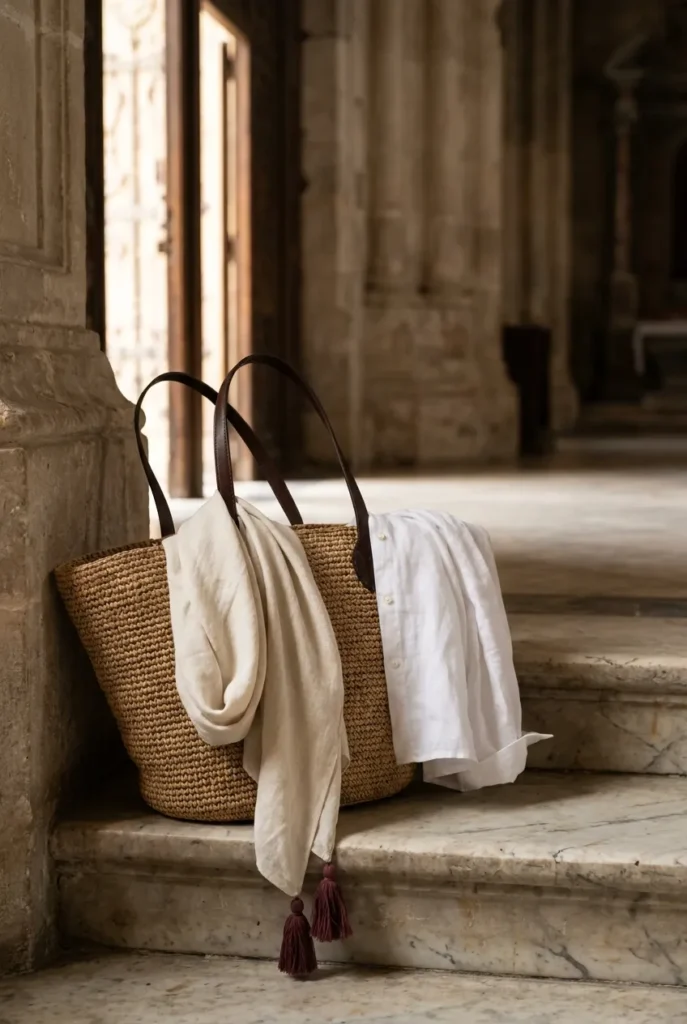
The fix is one lightweight piece you already packed: the linen button-down, or a large scarf. The official Vatican Museums guidance requires covered shoulders and knees, and a scarf tied as a wrap or the shirt thrown on solves both in five seconds. Capris or linen trousers clear the knee rule outright, which is exactly why they’re in this capsule.
Keep the cover-up in your tote on church days. Throw it on at the door, take it off in the heat once you’re back outside. Done. For more on staying cool while staying covered, here are modest summer outfits that stay cool and covered.
Best Shoes for Italy’s Cobblestones (Tested, Not Guessed)
Italian streets are beautiful and brutal. Centuries-old stone, uneven gaps, and slick polished marble inside every basilica. After three days on Florence cobblestones last June, the cute heeled sandals went straight to the bottom of my bag and never came out.
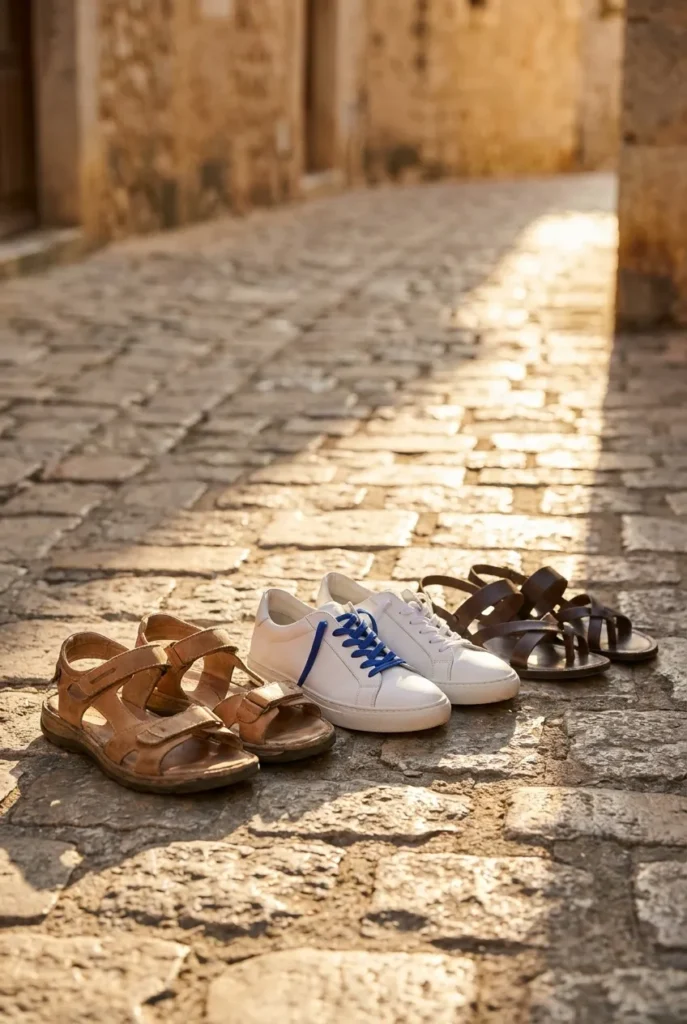
Your three pairs, each with a job:
- Walking sandals for all-day heat, ideally with a cushioned footbed and a back strap so they stay put on uneven stone.
- White leather sneakers for museum marathons, train days, and the Vatican’s miles of marble, where closed-toe is smarter anyway.
- Flat dinner sandals for evenings, low enough to handle pavement without a twisted ankle.
Break every pair in at home first. Blisters on day one will color the whole trip, and there’s no cure for them on a 20,000-step day.
The Right Bag for Italy (and How Not to Look Like a Tourist)
Your bag does two jobs in Italy: hold your day’s things and not announce that you’re a visitor worth pickpocketing. A zip-top leather crossbody worn in front handles both. A roomy woven tote covers beach and market days.
What gives tourists away isn’t the bag itself, it’s the giant backpack worn on the chest, the bright logo prints, and the all-athleisure look. Neutral, fitted, and a little covered reads local. For the deeper “blend in” psychology, the State Department’s traveler guidance is a practical, non-fashion read.
What NOT to Wear in Italy
A short, honest list. None of this is about rules for their own sake, it’s about comfort, churches, and not standing out for the wrong reasons.
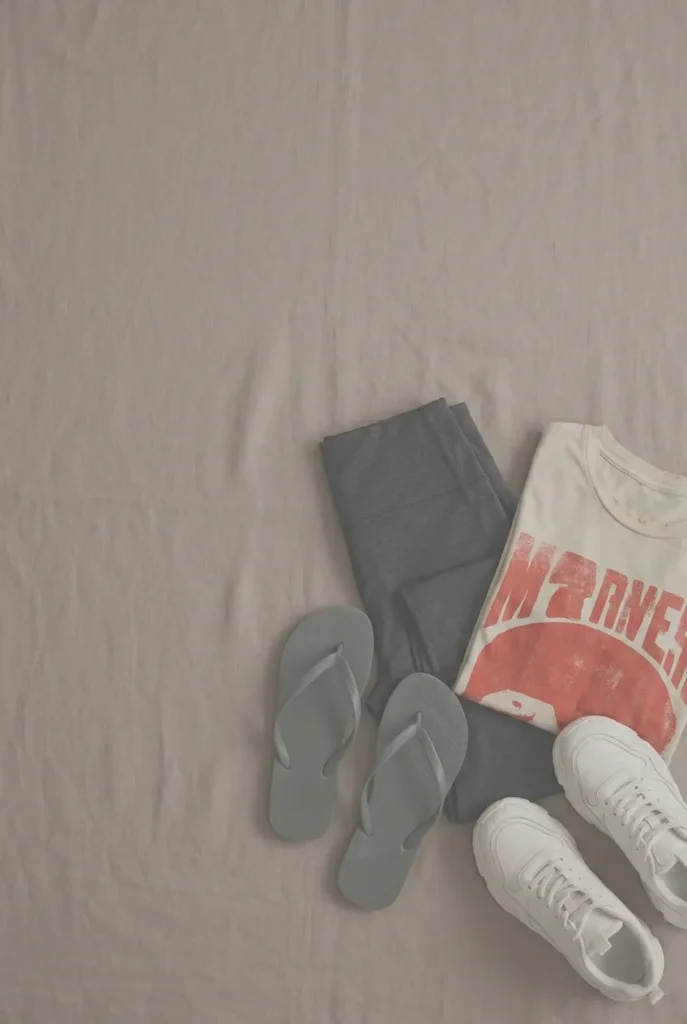
- Athletic everything. Leggings and gym shorts as daywear read very tourist and get you stopped at churches.
- Flip-flops in cities. Fine at the beach, rough on cobblestones and a little sloppy for dinner.
- Bare shoulders on church days. Covered above, but worth repeating.
- Brand-new bright white sneakers as your only shoe. They’ll be gray by day two and offer no church-to-dinner range.
- Heavy fabrics and synthetics. They trap heat and wrinkle worse than linen ever will.
Build Your Italy Capsule From Your Own Closet First
Before you buy a single new piece, shop your own closet. Most readers already own 8 of these 12. The white tee, the jeans, a midi dress, sandals, you have these.
Lay the 12 categories on your bed and fill what you can. Only then buy the gaps, and buy for cost per wear, not for the trip alone. A linen trouser you’ll wear all summer at home is a smarter spend than a single-use “vacation outfit.” If you want a layering refresher for those cool coastal nights, here are light summer layering formulas for cool evenings.
FAQ
What is the 5-4-3-2-1 packing rule?
It’s a simple cap for a short trip: 5 sets of socks and underwear, 4 tops, 3 bottoms, 2 pairs of shoes, and 1 dress or hat or swimsuit. Versions vary slightly. For Italy in summer I bend it toward more tops and lighter fabrics, since heat means you’ll change more often.
What is the 3-3-3 rule for a wardrobe?
You choose 3 tops, 3 bottoms, and 3 pairs of shoes, then mix them into as many outfits as possible. It’s a great gut-check for travel because if 9 pieces can dress you for a week, you’ve proven your capsule works before you pack it.
What is the 3-5-7 rule in packing?
One common version is 3 bottoms, 5 tops, and 7 days of socks and underwear, sized to a roughly week-long trip. Think of it as a starting ratio, not a law. The Italy capsule above runs leaner on bottoms because neutrals stretch further.
What should I wear in Amalfi, Italy?
Breezy, rinse-friendly pieces with one pop of color. A linen button-down over a swimsuit by day, a neutral midi dress with flat sandals for dinner, and a scarf in your tote for cool ferry rides and clifftop evenings.
Does this Italy capsule work for petite or curvy figures?
Yes, with fit tweaks. Petite frames do well with a cropped or rolled linen trouser and a higher-waist midi so the proportions don’t swallow you. Curvy figures may prefer a defined-waist midi dress and a slightly structured linen for shape. The pieces are the same, the cuts flex to your proportions.
Can I really fit all this in a carry-on?
Yes. Twelve pieces in light fabrics, rolled into packing cubes, plus three pairs of shoes, leaves room for the small extras. The linen and cotton compress far better than denim-heavy packing, which is part of why the palette is built around them.
Can I wear this capsule somewhere other than Italy?
Absolutely. It’s a neutral warm-weather travel capsule at heart, so it works for Greece, Portugal, the south of France, or a beach week back home. Only the church-cover habit is Italy-specific, and that piece is useful everywhere.
A Few Last Thoughts Before You Pack
The whole point of an Italy capsule wardrobe is to stop thinking about clothes once you land and start thinking about the gelato line instead. Twelve pieces, one palette, three pairs of shoes, and a scarf that doubles as your church pass. That’s it. That’s the trip.
Pull the 12 categories tonight, shop your own closet first, and fill the gaps with pieces you’ll still love in August at home. Save this guide to your travel board so it’s there when the suitcase comes out, and tell me which region you’re most excited for. I always want to know.
Keep reading

What to Wear for Family Pictures Without Buying Everyone New Clothes
Your session is in eleven days and you’ve already spent two evenings with forty tabs open. I know that feeling. Deciding what...

What to Wear on a Rainy Day: Outfits That Stay Cute and Dry
Figuring out what to wear on a rainy day comes down to about four decisions you make before you ever pick an...

What to Wear in Nashville: Outfits With a Little Twang
Deciding what to wear in Nashville trips people up for one reason nobody warns you about, and it isn’t the cowboy boots....