
Old Money Summer Outfits: The Quiet Luxury Capsule for Hot Weather
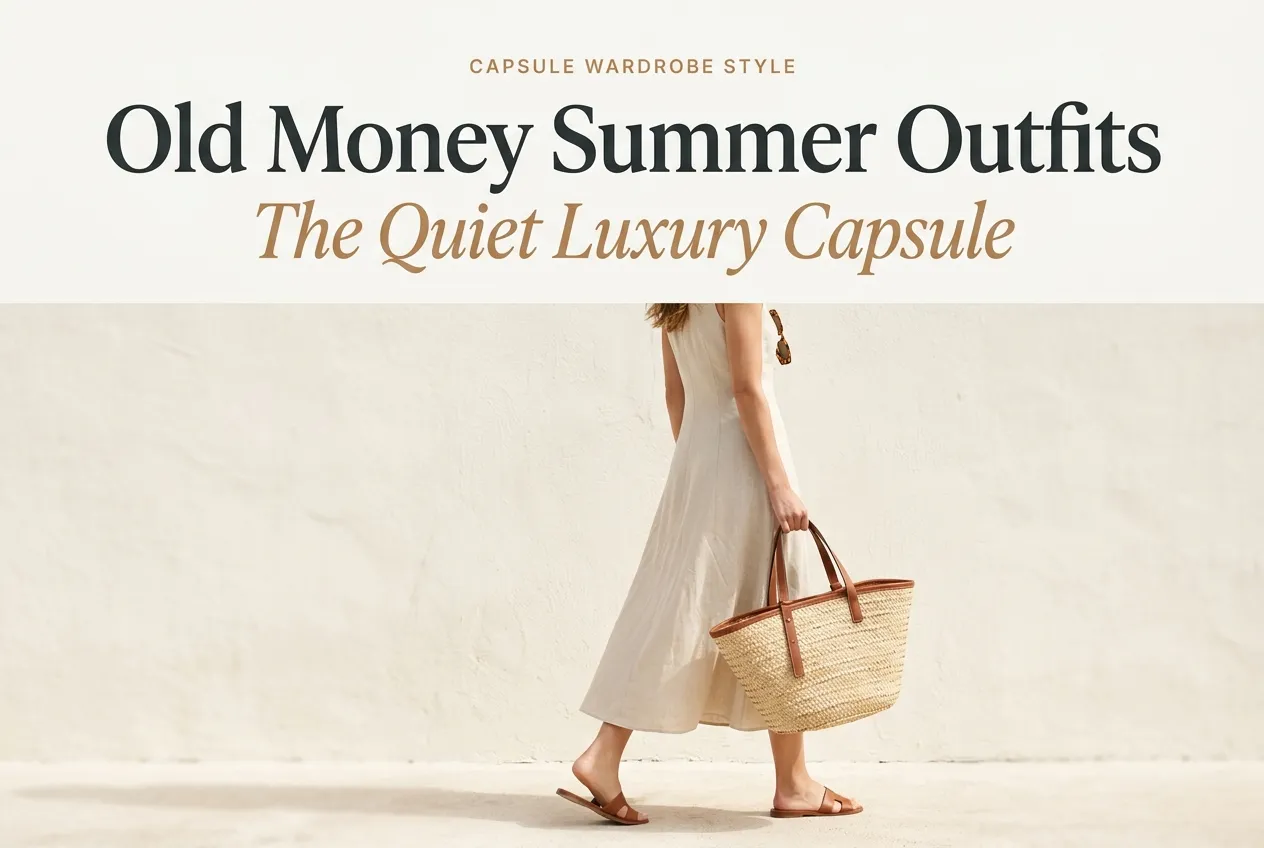
You scrolled Pinterest at midnight last Sunday and saved fourteen pins of women who looked impossibly composed in cream linen on what was clearly a 90-degree afternoon. Tortoiseshell sunglasses. A woven tote. Trousers that fell exactly right. You closed the app, walked to your closet, and pulled out a wrinkled rayon top you bought in a hurry last June. Sound familiar?
Old money summer outfits aren’t actually about money. They’re about three boring decisions made consistently: better fabric, fewer colors, and pieces that earn their hanger space across a whole season. I rotated a 12-piece old-money-leaning summer capsule for 90 days last July through Charleston humidity, a wedding in the Hudson Valley, and two long flights, and I wore the same nine hero pieces in 22 different combinations without anyone noticing repeats. That’s the goal of this guide.
You’ll get the color palette that does the heavy lifting, the nine pieces every old money summer capsule needs, three named outfit formulas you can screenshot for the morning, a body-type breakdown, a real fabric-and-heat guide that nobody else on page one is giving you, and a US retailer ladder so you can shop at Quince or Target instead of a Mayfair boutique.
What Old Money Summer Style Actually Means
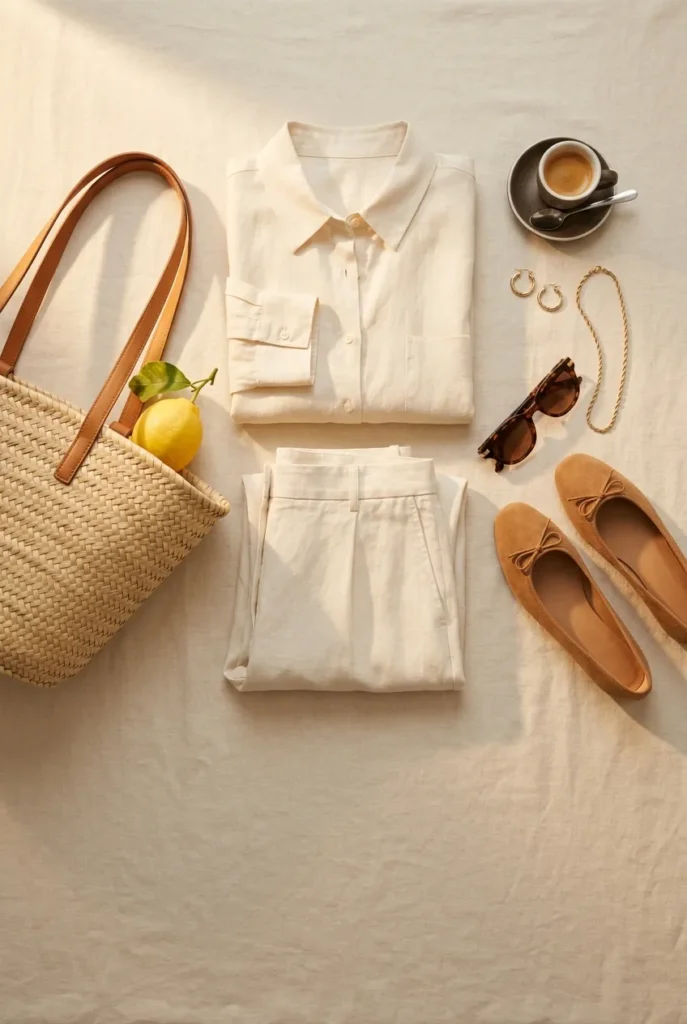
Strip the label off and you’re left with a small set of choices anyone can copy. Natural fibers over synthetics. A neutral base instead of a primary palette. Construction that holds its shape after the third wash. Tailoring that fits your actual proportions, not the model’s. Accessories that look like they belong to a person, not a season.
The aesthetic borrows from Hamptons summers and Italian coastal towns, but the engine underneath is just a well-edited closet. Vogue has been tracing the rise of quiet luxury as a counter to logo-driven dressing, and old money summer outfits sit in that same conversation. The clothes are designed to recede so the wearer can come forward.
If you want the philosophical foundation before you start shopping, read the honest guide to looking expensive on a real budget first. It’s the year-round framework. This guide is the summer translation.
The Color Palette That Reads Quietly Expensive
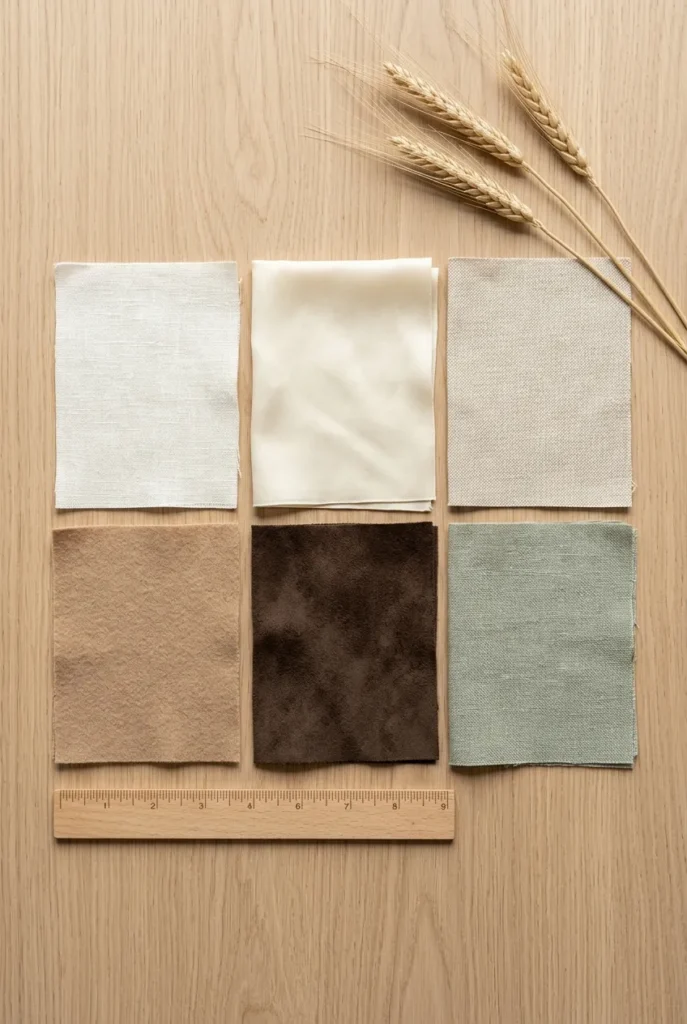
A closet that reads old money in summer almost always lives inside a six-color range. Ivory. Cream. Oat. Camel. Soft black or espresso for grounding. One muted accent (sage, dusty terracotta, butter yellow, or a faded navy) for variety. That’s it. The palette does roughly 70 percent of the work before you choose a single shape.
Here’s the working ratio I recommend, what I call the 60-30-10 split. Sixty percent of your summer pieces sit in the neutral base (ivory, cream, oat). Thirty percent shift to a mid-tone (camel, taupe, soft black). Ten percent carries the accent color you actually feel like yourself in. That ten percent is where personal style lives. Everything else is scaffolding.
Skip white-white if your skin runs warm. It can pull cool and washed-out in direct summer light. Reach for ivory or cream instead, both of which sit half a step warmer and read more expensive in photos. If you run cool-toned, pure white works beautifully and you can lean into it.
The 9 Pieces Every Old Money Summer Capsule Needs
These nine pieces are the ones I rotated for 90 days. They mix into more than 20 outfits between them, hold up in heat, and read polished from the first wear to the fortieth. I’ve listed each one with a price range and a fabric note, because fabric is where old money summer outfits live or die.
- The ivory linen shirt. Loose fit, slightly oversized through the body, sleeves long enough to roll twice. Look for a 5.5 to 7 ounce linen weight, which drapes without going sheer. Madewell and Quince typically run $50 to $130. Old Navy carries a $35 version that does the job for a season or two.
- Ecru or oat wide-leg trousers. Linen or linen-cotton blend, high waist, full-length break. The 100 percent linen version wrinkles more but breathes harder in 85-degree heat. The blend holds shape better between washes. J.Crew, Banana Republic, and Quince sit in the $98 to $138 range, Target’s A New Day line usually lands under $40.
- A white tee in heavier cotton. Not a basic. A 6 to 8 ounce supima or pima cotton in a relaxed boxy cut. Everlane and J.Crew typically run $30 to $50. The weight matters because thin tees pull cheap immediately under summer light.
- A midi linen dress. Slip-style, square neck, bias cut, or shirt-dress with a self-belt. Floor-skimming reads too much for daytime, mid-calf is the sweet spot. Reformation runs $128 to $258, Quince and Sezane offer linen midis between $50 and $160.
- A second neutral dress in cotton poplin. Different fabric so you have something for the afternoon when linen wrinkles look lived-in instead of polished. Boden, Banana Republic, and Anthropologie typically run $98 to $180.
- Tan or cream leather ballet flats. Cream nubuck reads expensive. Tan suede is more forgiving on dusty days. Skip glossy patent. Madewell and J.Crew sit at $98 to $158, Amazon and Target both carry passable lookalikes for $30 to $50, though the suede tone goes orange faster.
- Leather slide sandals. Flat or low block heel, cognac or natural leather, single strap or T-bar. Madewell, J.Crew, and Sam Edelman cover $98 to $148. The under-$50 versions exist but the leather often runs plastic in direct sun.
- A woven straw or rattan tote. Big enough for a paperback, sunglasses, and a water bottle. Leather handles dress it up, jute handles keep it casual. The natural straw color reads more old money than the bleached white. Look at Madewell, J.Crew, and Anthropologie for $98 to $148, or HomeGoods and Target for $25 to $40.
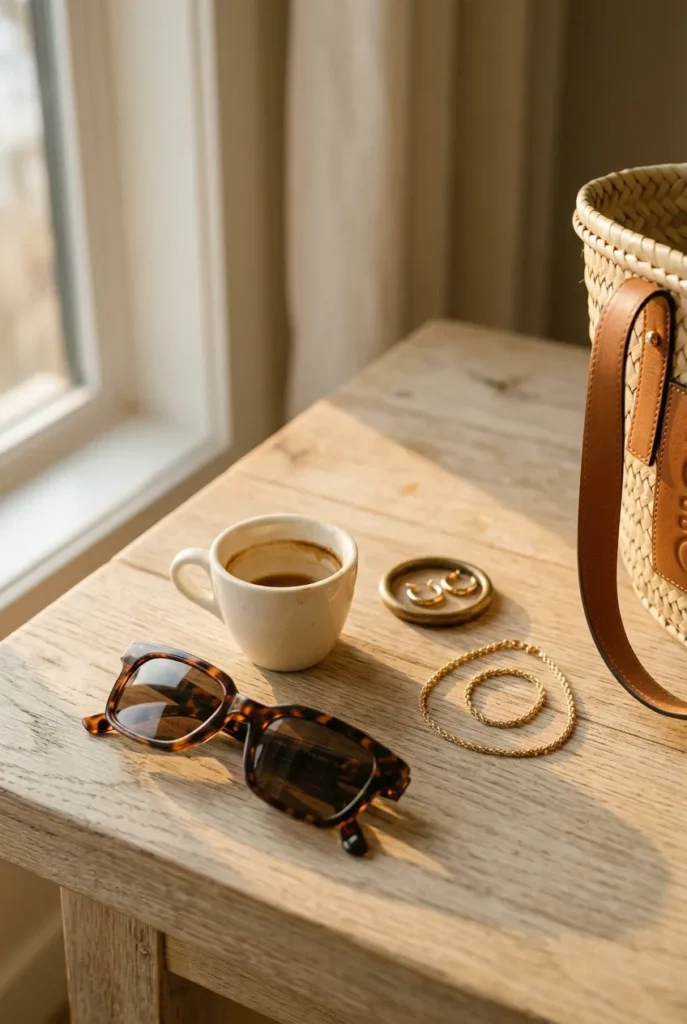
- Tortoiseshell sunglasses and small gold hoops. Square, oval, or cat-eye, whichever fits your face. Skip oversized aviators. Quay Australia and Le Specs sit at $55 to $89. The earrings are the smallest investment you make and the one nobody removes mid-day, so spend the $40 to $80 on real gold-filled instead of plated.
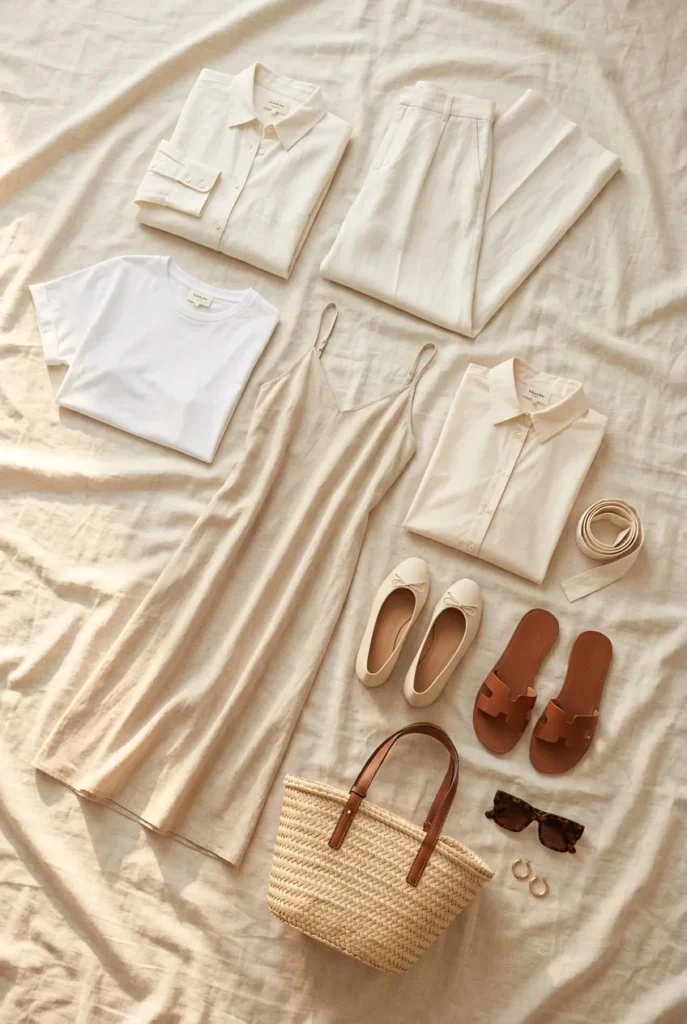
A quick callout on accessories before we move on. The mistake most readers make is collecting accessories like souvenirs, one per trip. Old money summer outfits use three or four pieces on heavy rotation: one tote, one crossbody, one set of earrings, one watch. That’s it. The repetition is the point.
Three Old Money Summer Outfit Formulas to Screenshot
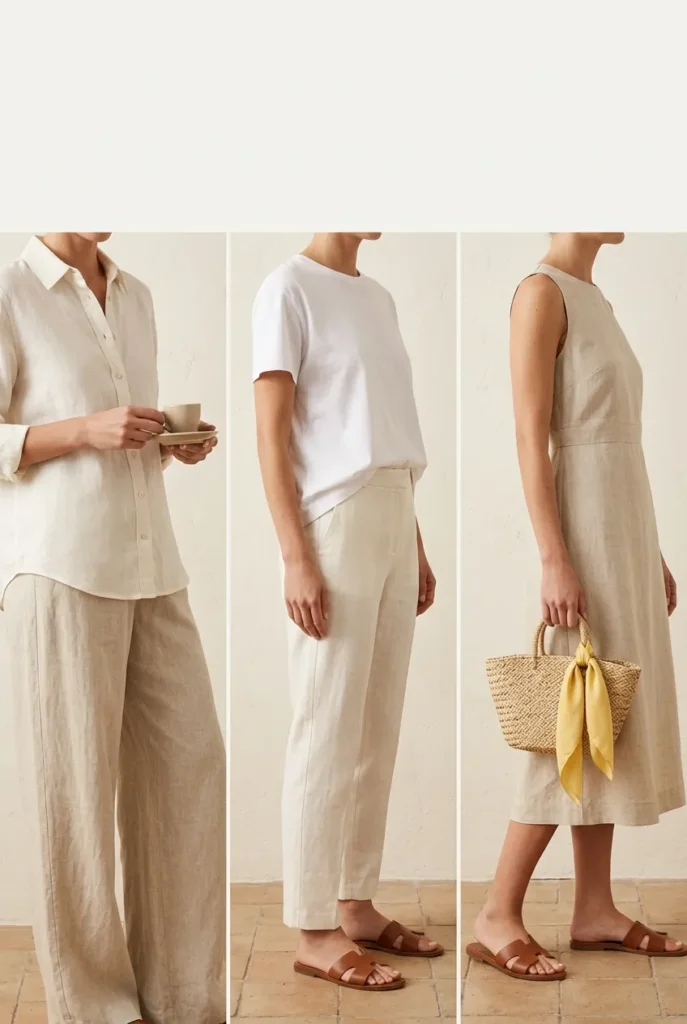
This is the original framework. Screenshot these three formulas, save them to a board, and you have a year of summer outfits without ever standing in front of your closet wondering. I call this the Old Money Summer Formula, and it’s three equations that build everything else.
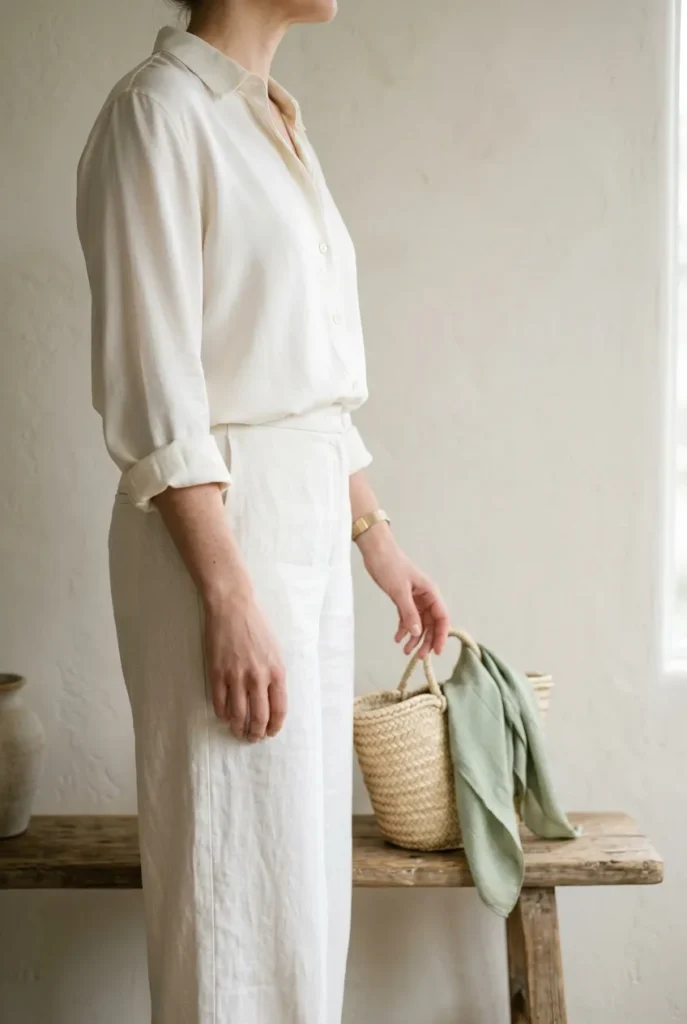
Formula 1: The Tonal Linen Equation. Linen shirt + linen trousers in the same color family + leather slides + woven tote. Both pieces sit within two shades of each other (ivory shirt with oat trouser, cream shirt with camel trouser). Roll the sleeves twice. Tuck the front of the shirt into the trouser, leave the back loose. This is your default 88-degree outfit.
Formula 2: The Polished Casual Equation. White boxy tee + ecru trousers or denim cutoff + ballet flats + small gold hoops + tortoiseshell sunglasses. The tee has to be the heavier cotton from piece three, not a thin one. This is your grocery run, your school pickup, your coffee with a friend. It reads finished without trying.
Formula 3: The Soft Power Equation. Midi linen dress + leather slides + woven tote + thin gold watch + small earrings. One piece, one bag, one shoe. Done. This is your wedding-adjacent, dinner-on-a-patio, day-into-evening look. The dress does the work.
These three formulas alone cover roughly 80 percent of your summer wear days. You add seasonal variation through the accent color (a sage scarf, a butter yellow tee, a dusty terracotta sandal), not through new outfits.
Old Money Summer Outfits for Every Body Type
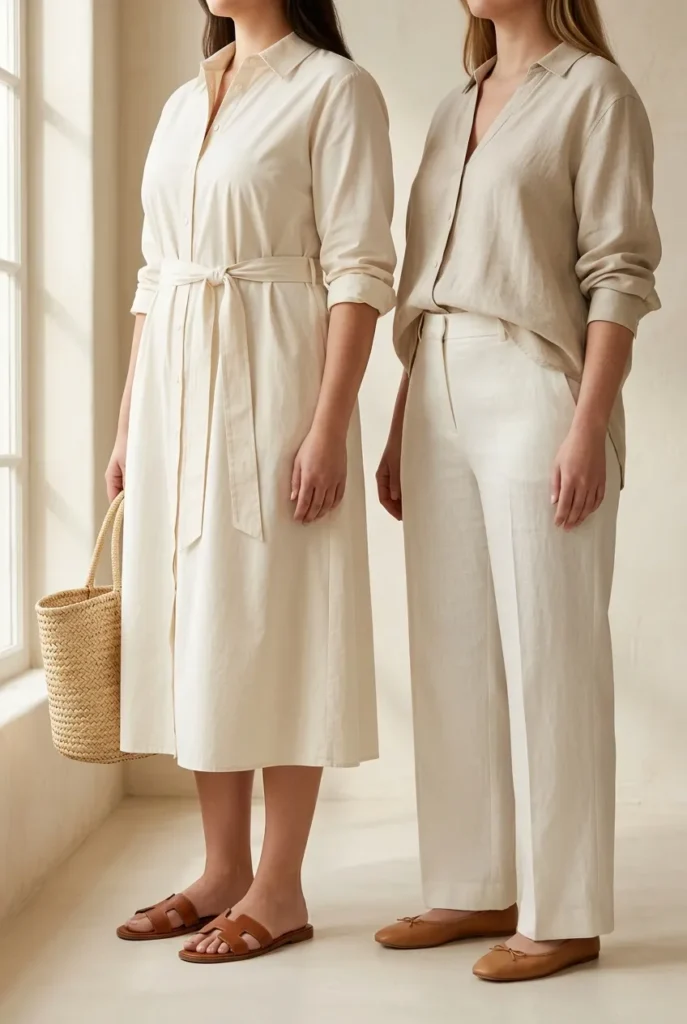
The top results on Google all style this look on one figure, which is why most readers click off after the third pin doesn’t fit. Here’s the body-type adaptation nobody else is giving you.
Petite (5’4″ and under). Choose cropped wide-leg trousers (ankle length, not full-break) so the proportions don’t swallow you. A linen midi dress should hit at mid-calf rather than near-the-ankle. Look for ballet flats with a low vamp to lengthen the leg line. Petite-specific lines at Madewell, J.Crew, and Banana Republic are worth the small markup. If you want a deeper dive, our petite capsule guide walks through fifteen pieces tailored to shorter frames.
Tall (5’9″ and over). Lean into the full-break trouser and floor-grazing midi dress that everyone else avoids. Both work beautifully on a long frame. Watch sleeve length on the linen shirt and consider sizing up specifically for arm length, then having the body taken in at a tailor for $15 to $25.
Curvy and hourglass. A self-belt midi dress in cotton poplin defines the waist where a slip dress lets it disappear. The linen trousers should sit at the natural waist, not below. A V-neck or open-collar shirt opens the neckline and balances bust to hip.
Midsize and plus-size. The wide-leg trouser does heavy work here, especially in a heavier linen-cotton blend that drapes instead of clinging. Quince, Old Navy, Universal Standard, and Banana Republic carry the cuts in extended sizing. The boxy tee in a heavier cotton skims rather than pulls. Avoid the bias-cut slip dress unless you size up by one and tailor.
Apple shape. Empire-waist or A-line midi dresses, V-neck linen shirts worn loose, and trousers that sit at the high waist. Skip belted dresses at the natural waist, look for fabric structure (cotton poplin over rayon).
How to Dress Old Money in Hot Weather (Without Wilting by Noon)
This is the section every competitor skips. Hot weather changes the math on fabric, and old money summer outfits are an exercise in fabric choice first, silhouette second. The CDC notes that loose, light-colored, breathable clothing is the baseline for working safely in hot environments, and old-money summer dressing happens to follow the same physics: looser cuts, lighter colors, natural weaves.
Here’s the working table I use, what I call the Heat Index Fabric Table.
| Temperature | Best fabrics | Avoid |
|---|---|---|
| 70 to 80°F | Linen, cotton poplin, silk-cotton blends | Heavy denim, polyester blends |
| 80 to 90°F | Lightweight linen (5 to 6 oz), cotton voile, cotton lawn | Rayon, jersey knits, anything 100% polyester |
| 90°F and above | Loose linen only, cotton gauze, breathable cotton lawn | Silk (sweat-stains permanent), structured cotton, denim |
A few non-obvious rules that hold up across summers. Color matters as much as fabric: ivory and oat reflect heat, soft black absorbs it. A loose linen trouser is cooler than a fitted cotton short, because air flow does more for body temperature than fabric coverage in direct sun. Natural fiber dye holds better in heat, which is why old money summer outfits read so consistent across photos: the colors aren’t fading by August.
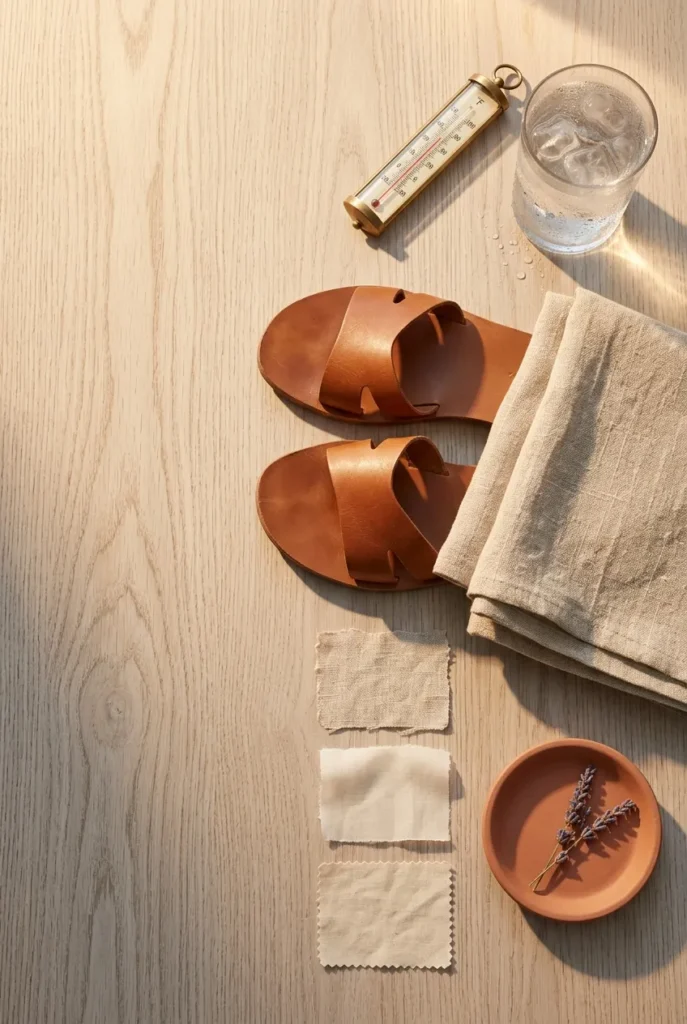
For your shoes, leather breathes. Synthetic uppers, even expensive-looking ones, will leave your foot wet by 2 p.m. Cognac and natural-tan leather sandals hold up better than dyed black or white, both of which stain faster in summer.
Casual Old Money Summer Outfits for Everyday Wear
Not every day is a wedding. Most old money summer outfits live in the casual territory between the grocery store and a friend’s backyard, and this is where the aesthetic actually pays off. The trick is keeping the polish without looking dressed up.
For the school run or coffee, lean on Formula 2: the white boxy tee, ecru trousers or a tailored short, ballet flats, small hoops, sunglasses tucked into the neckline. Total time to assemble: under three minutes. The look reads composed because the proportions and the palette do the work.
For weekend errands, swap the trousers for a denim cutoff in a mid-blue (not light, not black) and add the linen shirt open over the tee as a layer. Roll the shirt sleeves once. Slide your feet into the cognac slides. This is the casual end of the coastal grandmother aesthetic, and it scales from a Saturday at the farmer’s market to a dinner on a porch.
For travel days, the midi linen dress wins. It packs flat, it’s cool, it photographs well, and it doesn’t read like you’re trying. Add the slides, the tote, the sunglasses, and you’re a single piece away from looking pulled together at airport security and at dinner on the same day. If you’re building a wardrobe specifically for a longer trip, a European summer capsule wardrobe you’ll actually wear walks through the 12-piece version.

Where to Shop Old Money Summer Pieces in the US
This is the part the European-leaning competitor articles never give you. Here’s the US retailer ladder, mapped to the nine hero pieces, so you can shop at your actual budget.
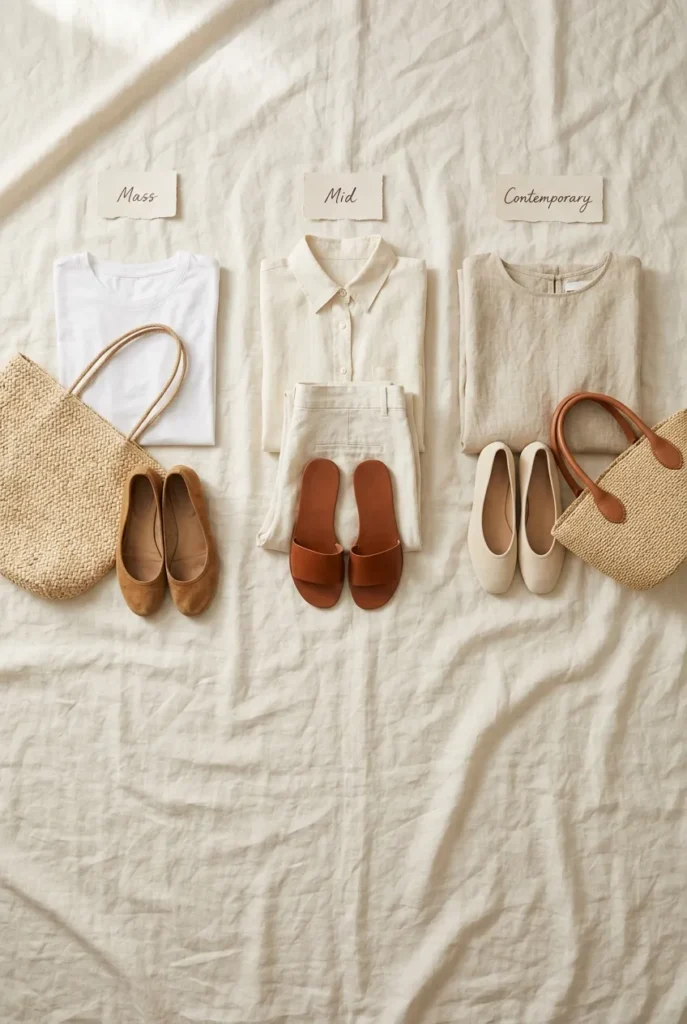
Mass tier ($10 to $50 per piece): Old Navy for the linen shirt and basic tee. Target’s A New Day for trousers and the cotton midi dress. H&M for the woven tote. Amazon Essentials for the boxy white tee.
Mid tier ($50 to $150 per piece): Quince leads here for linen across the board (the $50 to $80 linen shirt outperforms the $130 version at Madewell on my own wear test). J.Crew and Banana Republic for trousers and dresses. Madewell for ballet flats and slides. Anthropologie for the cotton poplin shirt-dress.
Contemporary tier ($150 to $400 per piece): Sezane for the linen midi dress and the linen shirt (worth the markup for cut and color). Reformation for the slip-style midi. AYR or Frank & Eileen for the elevated white button-down. COS for trousers with sharper tailoring.
Investment tier ($400+): Toteme trousers, The Row linen if you’re aspirational-shopping for one piece. Massimo Dutti positions just below this tier and works for the linen shirt and the midi.
A practical rule from 90 days of wearing this capsule: spend the most on the linen trouser and the midi dress, where fabric and cut show. Spend the least on the boxy tee and the woven tote, where the high-low gap is invisible to anyone but you. If you put $300 anywhere, put it on the trouser.
Frequently Asked Questions
How do you dress old money in hot weather?
Pick your fabric first, your silhouette second. Loose-fitting lightweight linen (5 to 6 ounce weight) in ivory, oat, or camel reflects heat and breathes harder than fitted cotton. Skip rayon, polyester blends, and anything described as “silky” but priced under $50. Cognac leather slides, a woven tote, and tortoiseshell sunglasses round it out. The looser the cut, the cooler you stay, even when more skin is technically covered.
What is the 3-3-3 rule capsule wardrobe?
The 3-3-3 method asks you to pull three tops, three bottoms, and three pairs of shoes from your closet and wear only those nine pieces for a week. It tests how well your wardrobe actually mixes and exposes the pieces that don’t earn their hanger space. For an old money summer capsule, your three tops are the linen shirt, the white boxy tee, and a midi dress (counted as a top-and-bottom in one piece). Your three bottoms are the linen trouser, the cotton midi, and the denim cutoff. Your three shoes are the ballet flat, the slide sandal, and a low-heel sandal.
What is the 3-3-3 rule for packing?
Same structure, applied to travel. Three tops, three bottoms, three pairs of shoes for a trip, then a fourth bonus piece (a dress or a blazer) for occasions. For a 10-day summer trip you can build 20+ outfits this way if every piece sits in the same color palette. The 3-3-3 packing rule is the spiritual cousin of the capsule wardrobe rule and works because constraints force mixing.
What should a capsule wardrobe wear in warm weather?
Loose linen and cotton in neutral colors, in pieces designed to mix rather than stand alone. The minimum effective summer capsule for warm climates is around 9 to 12 pieces: two pairs of trousers, one pair of shorts or a denim cutoff, two midi dresses, three tops, and your shoes plus a tote. The pieces have to share a color family or the math falls apart.
Are old money summer outfits casual or dressy?
Both. The same nine pieces can read casual (white tee, denim cutoff, ballet flats) or dressy (midi linen dress, slide sandals, gold hoops). That’s the entire point of the capsule structure. The level of polish comes from accessories and fabric choice, not from owning two separate wardrobes.
Can I do old money summer outfits if I’m curvy or plus-size?
Yes, and the fabric and cut rules matter more, not less. Heavier linen-cotton blends drape rather than cling. Wide-leg trousers in extended sizing at Old Navy, Quince, Universal Standard, and Banana Republic give the silhouette without compromising fit. A belted poplin midi dress defines the waist where a slip dress doesn’t. The look is shape-friendly when you choose the right fabric weight.
How much should I budget for an old money summer capsule?
A workable 9-piece capsule shops at roughly $400 to $600 at the mid tier (Quince, J.Crew, Madewell sale, Banana Republic). The mass tier brings it under $300 if you accept that two or three pieces may not survive past a single summer. The contemporary tier (Sezane, Reformation) pushes you toward $1,200 to $1,600 for the same nine pieces, with longer wear life on the linen pieces specifically.
The Bottom Line on Old Money Summer Outfits
You don’t need a trust fund. You need nine pieces in six colors, three formulas you can recite by Monday, and the discipline to walk past the cute polyester top on the Target endcap when it’s 92 degrees out. Old money summer outfits are a wardrobe philosophy disguised as an aesthetic, and once you have the framework, you stop shopping and start dressing.
Save the three formulas. Screenshot the fabric table. Buy the linen trouser. The rest builds itself.
Keep reading
Winter 2026 Fashion Trends Worth Your Closet Space
Every winter fashion trends 2026 roundup you have read so far has handed you a shopping list. Five trends here, twenty-three there....
Fall 2026 Fashion Trends: The Looks Worth Adding to Your Capsule
Every fall fashion trends 2026 roundup you’ve read this month has the same problem. It tells you satin is back, hands you...
Whimsigoth Outfits: Witchy, Romantic Style You Can Build From Your Fall Capsule
The first time whimsigoth outfits showed up in your feed, you probably saved four of them and then wore none. That is...