
Styling Tips: A Step-by-Step Capsule Wardrobe Guide
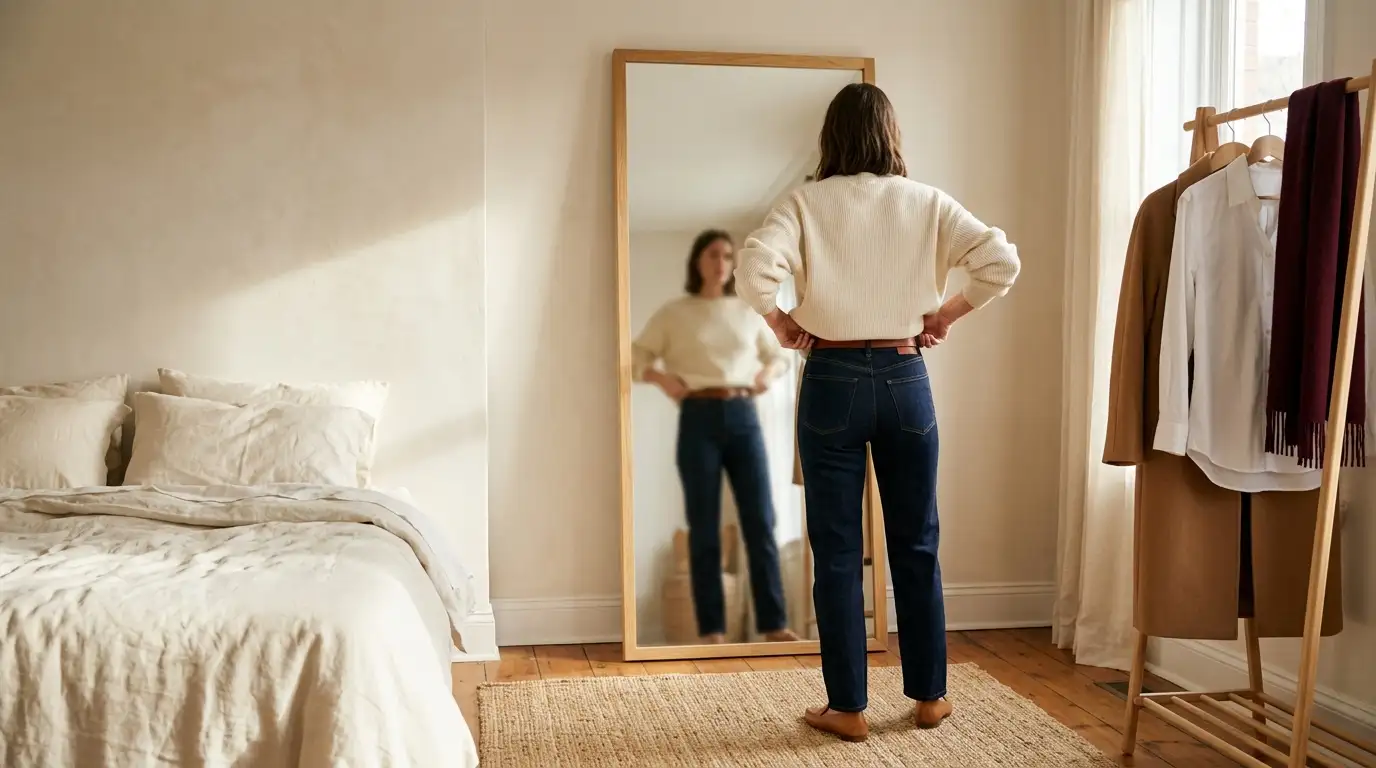
Most closets aren’t missing clothes. They’re missing a few styling tips that turn the same jeans, sweater and loafers into outfits that look planned.
I know that closet well. I stood in front of mine for years, packed tight, saying I had nothing to wear. Then I built a 30-piece capsule and learned the pieces were never the problem. The way I put them together was.
These are the exact steps I run, in order, every time an outfit feels off. You start with what already works and lock in a color plan. Then you balance proportions and add the small moves people notice without knowing why: a half-tuck, a hem that meets the right shoe, one third piece.
No shopping list. No rules about hiding your body. Just nine steps you can try tonight with what’s already on your hangers, plus a five-point Mirror Check to save for busy mornings.
Grab your favorite jeans. Let’s start.
Step 1: Pull Your Five Most-Worn Pieces First
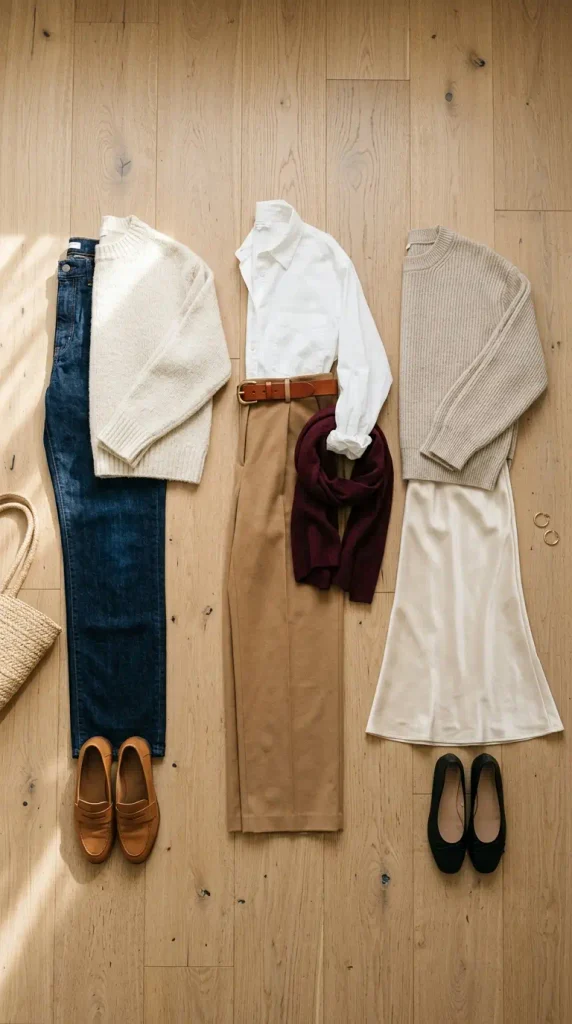
Before you change anything, find out what already works. Open your closet and pull the five pieces you reach for most, the ones that always seem to be in the laundry. Lay them on your bed.
Now look for the repeat. Maybe it’s soft knits, a high-rise jean, or anything in camel. That pattern is your real style, and every step after this one builds on it instead of on the things you bought and never wore.
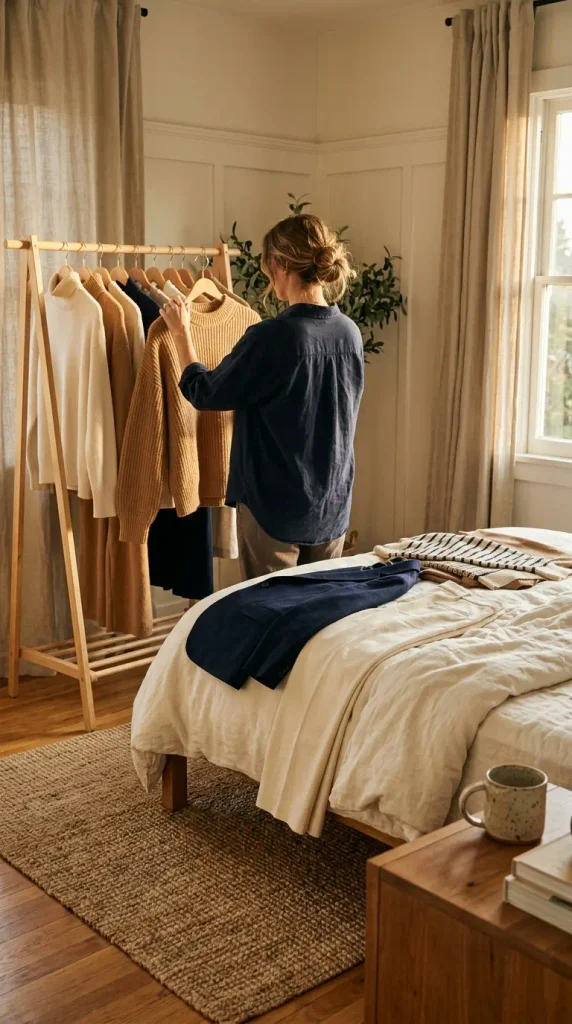
Then flip it. Pick one piece you always skip and wear it once this week with two of your favorites. You’ll know by lunch whether it stays.
Pull your five most-worn pieces and lay them on the bed.
Name what they share: a color, a fabric, or a fit.
Wear one skipped piece with two favorites this week. Keep it or let it go.
Restyling what you own is the cheapest closet upgrade there is, and it keeps clothes in use longer. That matters more than it sounds: according to EPA’s textile waste data, the US generated an estimated 17 million tons of textiles in 2018, and 11.3 million tons of it went to landfills.
Step 2: Choose Three Colors Before You Choose Clothes
Color is the fastest fix on this list. Most outfits that feel busy simply have too many colors in them.
Use the three-color rule. Pick one base color for most of the outfit, one support color, and one small accent. Think of it as a 60-30-10 split: trousers and coat at 60, a knit or shirt at 30, a bag, shoe or scarf at 10.
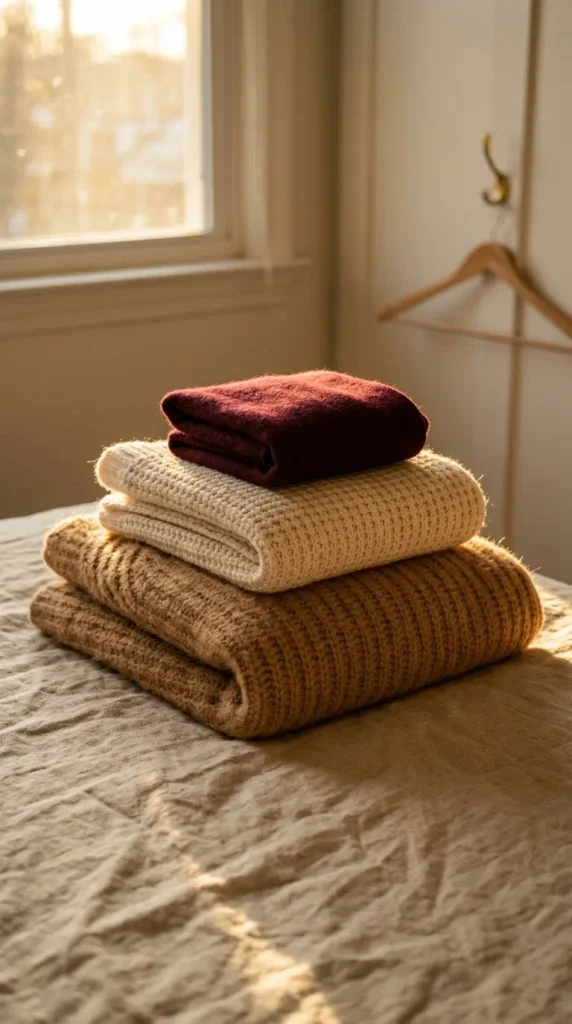
Denim counts as a neutral, so jeans rarely use up a color slot. For the accent, burgundy and cognac are easy wins. Icy blue is a fresh choice, too, since Pinterest flagged it as a 2026 trend.
For ready-made pairings, these outfit color combinations that look expensive give you twelve ready-made sets.
Step 3: Balance Loose and Fitted
Here’s the proportion rule stylists repeat more than any other. If one half of your outfit is loose, keep the other half fitted or at least clean.
An oversized knit looks intentional over straight-leg jeans. The same knit over baggy trousers can swallow you. Wide-leg trousers want a tucked tee or a close-fitting knit on top.

A second trick sits inside this one. Aim for the top half to end about one-third of the way down your body, so the leg line takes the other two-thirds. A tuck or a cropped knit does that in seconds.
| If your top is | Pair it with |
|---|---|
| An oversized knit | Straight-leg jeans or slim trousers |
| A fitted tee or bodysuit | Wide-leg trousers or a full midi skirt |
| A boxy blazer | Slim trousers, or a dress with a belted waist |
| A long cardigan | A slim knit underneath and a belt over the top |
Step 4: Tuck, Cuff, and Push Up Your Sleeves
Small moves, big difference. These four take seconds and change how finished an outfit reads.
A front half-tuck shows your waist and creates that one-third line from Step 3. Cuffing jeans once at the ankle bone lets a loafer or ballet flat show. Pushing sleeves to the forearm makes heavy knits look lighter, and a collar peeking out of a crewneck adds polish for free.
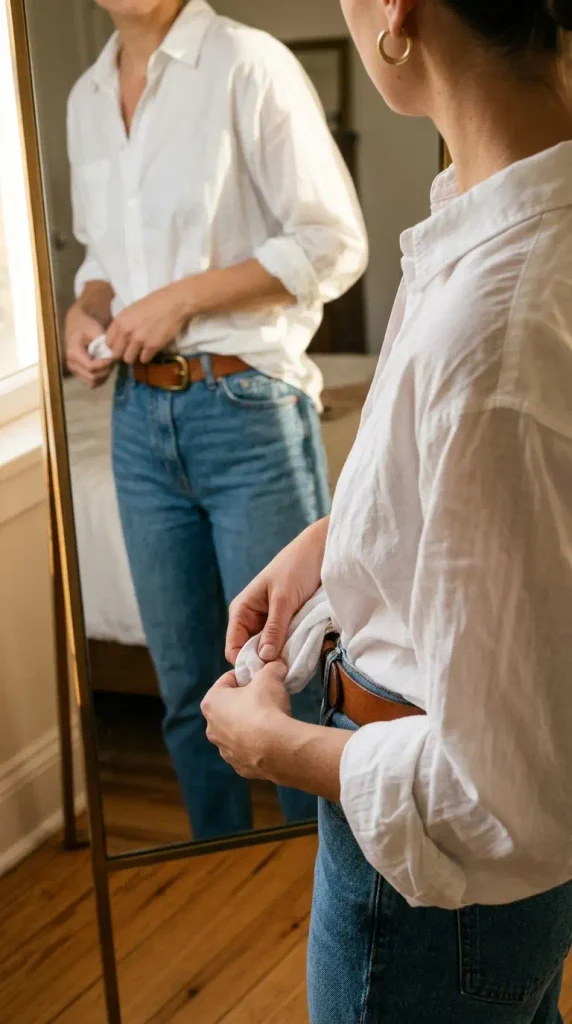
Confession: my half-tuck took a lot of tries in the mirror before it stopped looking like an accident. What finally worked was tucking only the center front few inches, then pulling a little fabric back out so it softly blouses.
Try these four moves tonight
The same four moves work on almost any shirt, and these button-down shirt outfits from one capsule show them in action.
Step 5: Match the Shoe to the Hem
Most outfits that look “off” are really a shoe problem. The hem and the shoe have to agree.
Wide-leg trousers should nearly brush the floor with your shoes on, so pick the shoes first and hem to them. Cropped straight jeans want a bit of ankle with flats, loafers or sneakers. Full-length jeans pair best with ankle boots that slip under the hem, and a midi skirt works with knee boots or ballet flats.
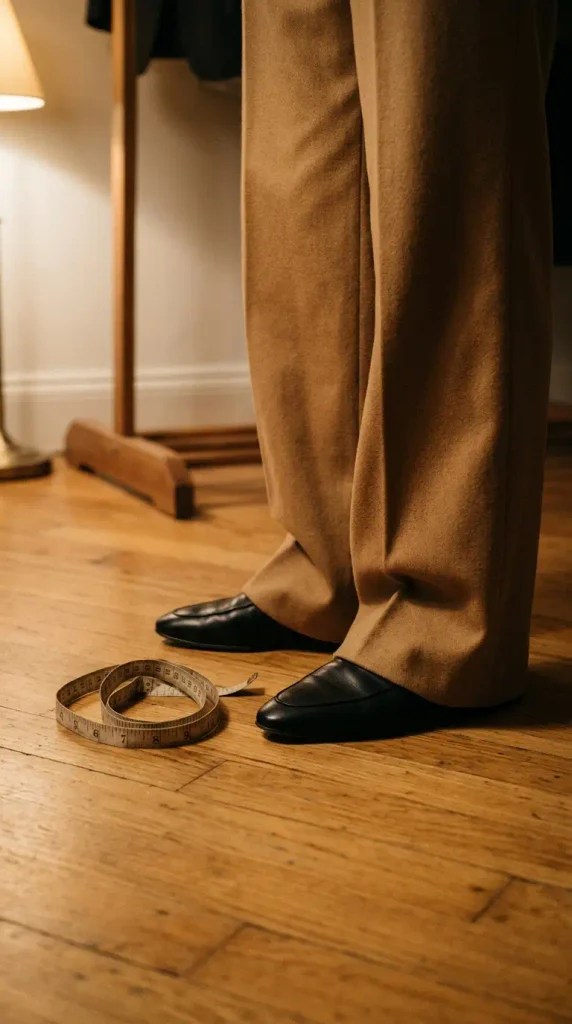
The first time I checked this on purpose, I swapped shoes three times before I left the house. Now I take new trousers to the tailor with the shoes I’ll wear them with most.
Hem wide-leg trousers in the shoes you’ll wear most.
Show a little ankle with cropped jeans and flats.
Tuck ankle boots under full-length jeans.
Wide-leg hems puddling over flat sneakers.
An unplanned gap between boot and hem.
Long jeans bunched over chunky shoes.
For eight shoe and hem pairings laid out side by side, see these capsule wardrobe shoe outfits by hem length.
Step 6: Add One Third Piece
Two pieces make clothes. Three make an outfit.
A tee and jeans is fine. Add a blazer, a belt, a cardigan over your shoulders or a scarf, and it suddenly looks considered. The third piece can also carry your accent color from Step 2, so it does two jobs at once.
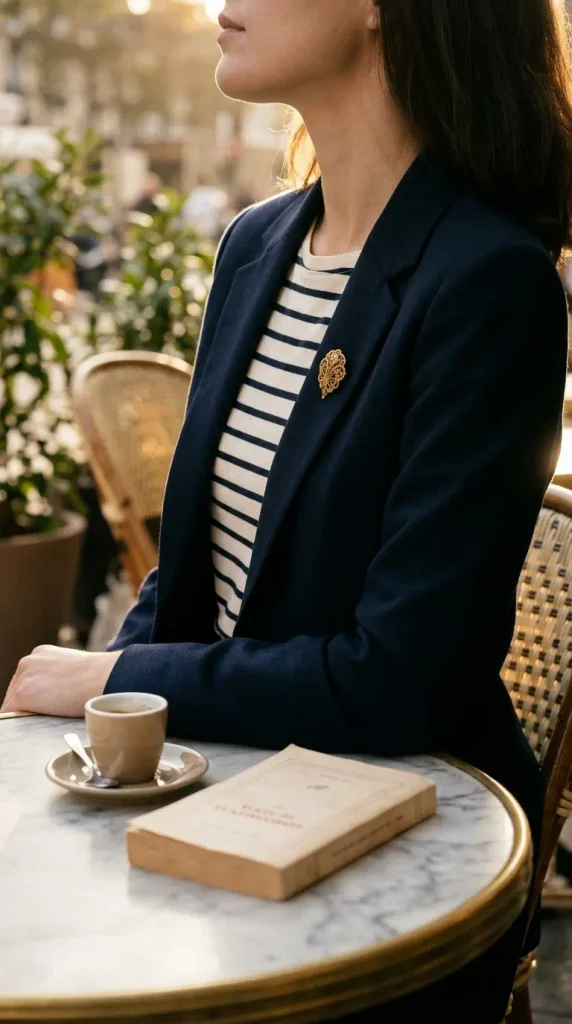
Pick one, not three. A brooch is a fun option right now, since Pinterest’s 2026 forecast called out vintage pins as a statement accessory.
If you want to build a small set of third pieces, start with these best accessories for a capsule wardrobe.
Step 7: Mix Textures So Neutrals Never Look Flat
All-neutral outfits fail for one reason: every piece has the same surface. Cotton tee, cotton chinos, canvas sneakers. Nothing catches the light.
The fix is contrast in feel, not color. Pair matte with a little shine, smooth with ribbed, crisp with soft. Try a ribbed oat knit with a satin skirt, or denim with suede loafers and a wool coat.
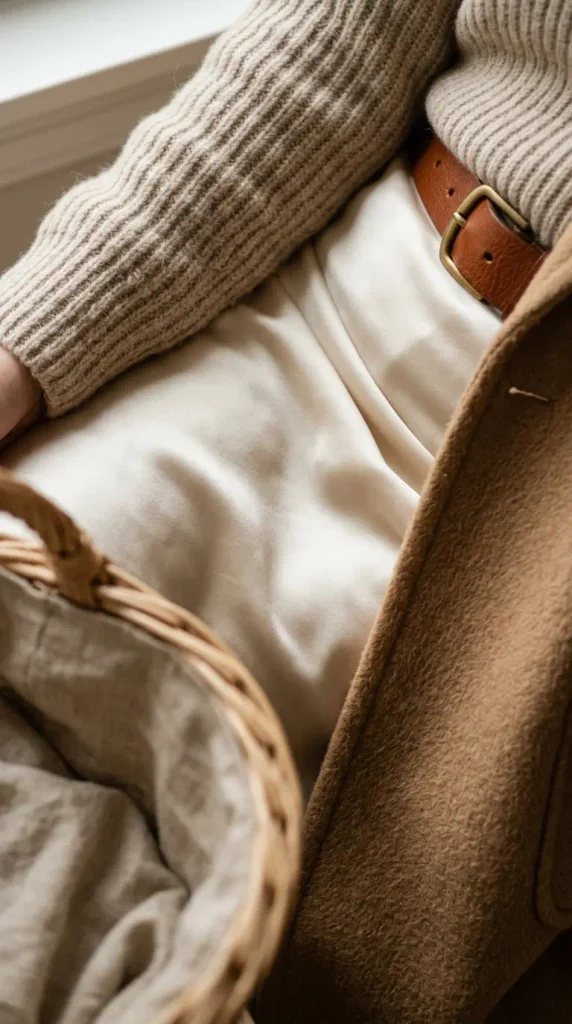
Aim for at least two textures in every outfit. Make it three when the whole look is one color.
Oat cotton tee, oat chinos, tan canvas sneakers. Same color, same matte surface, and the outfit reads tired.
Oat ribbed knit, cream satin midi skirt, camel wool coat, cognac leather loafers. Same palette, four surfaces, and the outfit looks expensive.
Step 8: Adjust the Formula for Your Proportions
None of these steps change for different bodies. Only the measurements do.
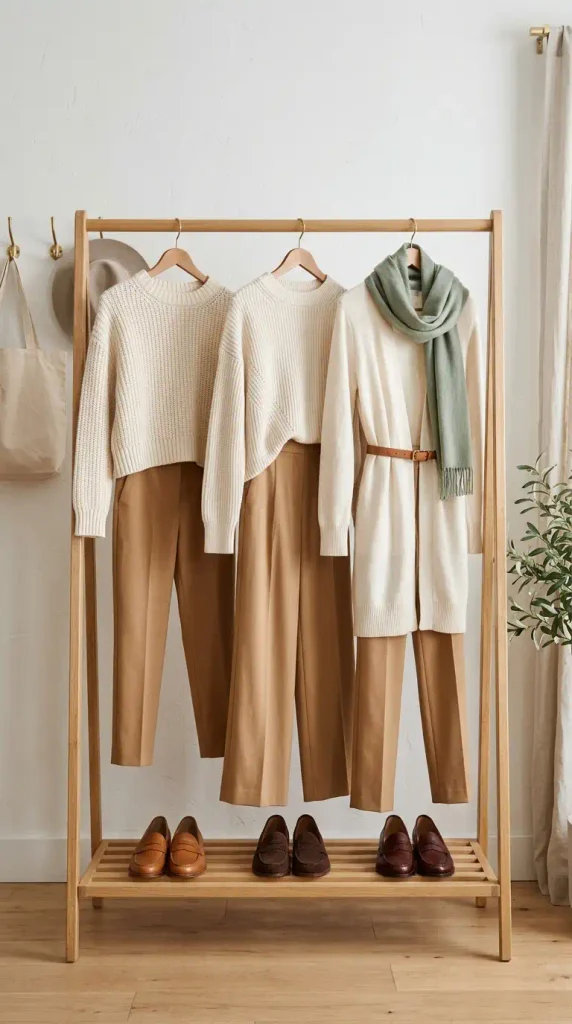
Keep one base formula: a knit, trousers, a loafer and a third piece. Then tune the lengths. Measure yourself, and use those numbers instead of a size label when you shop online.
| Proportion | Try this | Why it works |
|---|---|---|
| Petite (5’4″ and under) | Front tuck, ankle-length trousers, shoe close to the trouser color | Keeps one long, unbroken leg line |
| Tall (5’9″ and over) | Longer knits, full-length wide-leg trousers, belt at the hip if you like | Uses your length instead of cutting it |
| Curvy or hourglass | A belt or wrap at the waist, fabrics with drape | Builds the outfit around a defined waist |
| Plus-size or midsize | Fit the shoulder seam first, then tailor hems and sleeves | A jacket that fits at the shoulder hangs clean everywhere else |
| Fuller bust | Open collars, V-necks, single-breasted blazers worn open | Gives the neckline room and keeps buttons from pulling |
Treat the table as a starting point, not a rulebook. If a choice outside your row makes you feel good, wear it.
Step 9: Care for Clothes Like They’re Part of the Outfit
A pilled sweater undoes every step above. Care is the quiet half of styling.
Steam shirts and skirts before you wear them, not after you notice the creases at work. Run a sweater comb over knits once they start to fuzz. Fold heavy knits instead of hanging them, so the shoulders don’t stretch into points.
[IMAGE PROMPT: Step 9] A vertical 4:5 warm, editorial, photorealistic lifestyle photo of hands holding a handheld garment steamer aimed at a cream button-down hanging on a wooden hanger from a brass hook, the steam rising away from the fingers. Close-up from a side angle at chest height, low warm lamplight in the evening, cream, warm wood and soft black palette, careful and practiced mood, a sweater comb and a folded oat knit on a wooden shelf below. No text, no logos, no watermarks in the image. [ALT TEXT]: Hands steaming a cream button-down on a wooden hanger, an outfit styling tip for clothing care
I didn’t own a steamer for years, so I hung shirts in the bathroom during a hot shower. It does a decent job on cotton and almost nothing for linen.
html
<div style="border-left:5px solid #b5533c; background:#fbf1ee; padding:16px 18px; margin:24px 0; border-radius:6px; box-sizing:border-box;">
  <p style="margin:0 0 6px; font-weight:700; color:#8f3e2e; font-size:15px;">⚠️ Heads Up</p>
  <p style="margin:0; color:#2f2a26; font-size:16px; line-height:1.6;">Point steam at the fabric, never toward your hand, and hold the garment by the hanger, not the hem. Let the steamer cool fully before you put it away. If a label says dry clean only, the label wins over any tip here.</p>
</div>
When in doubt, read the tag. The FTC’s Care Labeling Rule guide explains that manufacturers and importers must attach care instructions to clothing sold in the US, so that label is your most reliable guide.
The Mirror Check: Five Points Before You Walk Out
Save this one. It turns all nine steps into a check you can run in under a minute, right before you grab your keys.
html
<div style="border:2px solid #8c6a4f; border-radius:12px; overflow:hidden; margin:26px 0; box-sizing:border-box;">
  <div style="background:#8c6a4f; padding:18px 20px; box-sizing:border-box;">
    <div style="font-size:13px; letter-spacing:1px; color:#ffffff; opacity:0.85; font-weight:700;">CAPSULEWARDROBESTYLE.COM</div>
    <div style="font-size:clamp(20px,3.4vw,26px); color:#ffffff; font-weight:800; margin-top:4px;">🪞 The Mirror Check</div>
    <div style="font-size:15px; color:#ffffff; margin-top:4px;">Five points, under a minute</div>
  </div>
  <div style="display:flex; align-items:flex-start; gap:12px; padding:14px 20px; background:#f7f3ee; box-sizing:border-box;">
    <span style="flex:0 0 auto; width:30px; height:30px; background:#5a4232; color:#ffffff; border-radius:50%; display:flex; align-items:center; justify-content:center; font-weight:700; font-size:15px;">1</span>
    <p style="margin:0; color:#2f2a26; font-size:16px; line-height:1.55;"><strong style="color:#5a4232;">Colors:</strong> three or fewer, with one small accent.</p>
  </div>
  <div style="display:flex; align-items:flex-start; gap:12px; padding:14px 20px; background:#ffffff; box-sizing:border-box;">
    <span style="flex:0 0 auto; width:30px; height:30px; background:#5a4232; color:#ffffff; border-radius:50%; display:flex; align-items:center; justify-content:center; font-weight:700; font-size:15px;">2</span>
    <p style="margin:0; color:#2f2a26; font-size:16px; line-height:1.55;"><strong style="color:#5a4232;">Proportion:</strong> one half loose, one half fitted.</p>
  </div>
  <div style="display:flex; align-items:flex-start; gap:12px; padding:14px 20px; background:#f7f3ee; box-sizing:border-box;">
    <span style="flex:0 0 auto; width:30px; height:30px; background:#5a4232; color:#ffffff; border-radius:50%; display:flex; align-items:center; justify-content:center; font-weight:700; font-size:15px;">3</span>
    <p style="margin:0; color:#2f2a26; font-size:16px; line-height:1.55;"><strong style="color:#5a4232;">A visible line:</strong> a tuck, a belt or a pushed sleeve.</p>
  </div>
  <div style="display:flex; align-items:flex-start; gap:12px; padding:14px 20px; background:#ffffff; box-sizing:border-box;">
    <span style="flex:0 0 auto; width:30px; height:30px; background:#5a4232; color:#ffffff; border-radius:50%; display:flex; align-items:center; justify-content:center; font-weight:700; font-size:15px;">4</span>
    <p style="margin:0; color:#2f2a26; font-size:16px; line-height:1.55;"><strong style="color:#5a4232;">Hem meets shoe:</strong> no bunching and no gap you didn't plan.</p>
  </div>
  <div style="display:flex; align-items:flex-start; gap:12px; padding:14px 20px; background:#f7f3ee; box-sizing:border-box;">
    <span style="flex:0 0 auto; width:30px; height:30px; background:#5a4232; color:#ffffff; border-radius:50%; display:flex; align-items:center; justify-content:center; font-weight:700; font-size:15px;">5</span>
    <p style="margin:0; color:#2f2a26; font-size:16px; line-height:1.55;"><strong style="color:#5a4232;">Third piece:</strong> exactly one, and it earns its place.</p>
  </div>
</div>
If one point fails, fix only that point. Most mornings it’s the shoe.
Styling Tips FAQ
What is the 3-3-3 rule in fashion?
The 3-3-3 rule usually means picking three tops, three bottoms and three pairs of shoes, then mixing them into as many outfits as you can. It’s a quick way to test a mini capsule before a trip or a busy week. Some people confuse it with Project 333, a longer challenge that limits you to 33 items for three months. Both teach the same lesson: fewer pieces push you to style better.
What makes a woman look wealthy without spending much?
Fit, fabric and restraint do most of the work. Clothes that fit at the shoulder and hem, natural textures like wool, cotton and leather, and a calm palette of camel, cream, navy or black read as expensive at any price. Skip visible logos, keep accessories to one or two, and make sure everything is steamed and pill-free. Care is the cheapest luxury there is.
How can I get better at styling my own clothes?
Practice with what you own before you buy anything. Pull your most-worn pieces, follow the steps in order, and run the Mirror Check before you leave. Take a quick mirror photo of every outfit you like for two weeks. Patterns jump out fast, and you’ll start seeing which colors, lengths and shoes you keep returning to, which is your personal style showing itself.
What color makes you look expensive?
Camel, cream, ivory, navy and soft black are the colors that most often read as expensive, especially worn head to toe in one shade with mixed textures. The trick isn’t the exact color, it’s the restraint. A tonal outfit in one family looks deliberate. Add a single accent, like burgundy or icy blue, and keep it small so the base color still leads.
Do these styling tips work for petite women?
Yes. The steps stay the same; only the lengths change. Petite women (5’4″ and under) usually get the most from a front tuck, ankle-length trousers and a shoe close to the trouser color, which keeps one long leg line. Hem trousers in the exact shoes you’ll wear, and pick shorter jackets or crop longer knits with a tuck instead of letting them hit mid-thigh.
How many clothes do I need for this to work?
Fewer than you think. Ten to fifteen pieces in one color family are enough to run every step: two or three bottoms, four or five tops, one or two layers, and two or three pairs of shoes. The steps work in a full closet too, but a smaller set makes the patterns easier to see and the outfits faster to build.
Can I use these steps year-round?
They work in every season. In summer, swap knits for linen shirts and tanks, and let sandals meet a cropped hem. In fall and winter, the third piece often becomes a coat or a scarf, and texture matters even more because dark neutrals flatten fast. The color rule, proportion balance and Mirror Check never change.
Conclusion
You don’t need a new closet to look put-together. You need an order of operations: favorites, color, proportion, the small moves, the right shoe, one third piece, texture, your own measurements and good care.
If I were starting over, I’d learn Step 5 first. Fixing the shoe and hem changed more of my outfits than any purchase I made that year.
Try one of these styling tips a day this week with what’s already on your hangers. Then save this guide to your Pinterest style board, so the Mirror Check is right there the next time an outfit feels off.
Keep reading

16 Cute Workout Outfits for Plus-Size Women
A lot of activewear is cut for straight sizes first and stretched up later. You feel it the second you move. Your...

16 Cute Workout Outfits You’ll Actually Want to Wear
Most workout drawers hold the same outfit twelve times. Black leggings, a tee that stretched out in the wash, and a sports...

Classy Outfits for Plus-Size Women: The Capsule Behind the Aesthetic
Scroll any board of classy outfits for plus-size women and the same pieces keep showing up. A long camel coat. Black wide-leg...
One Comment