
How to Style Brown Boots: Outfits for Fall and Winter
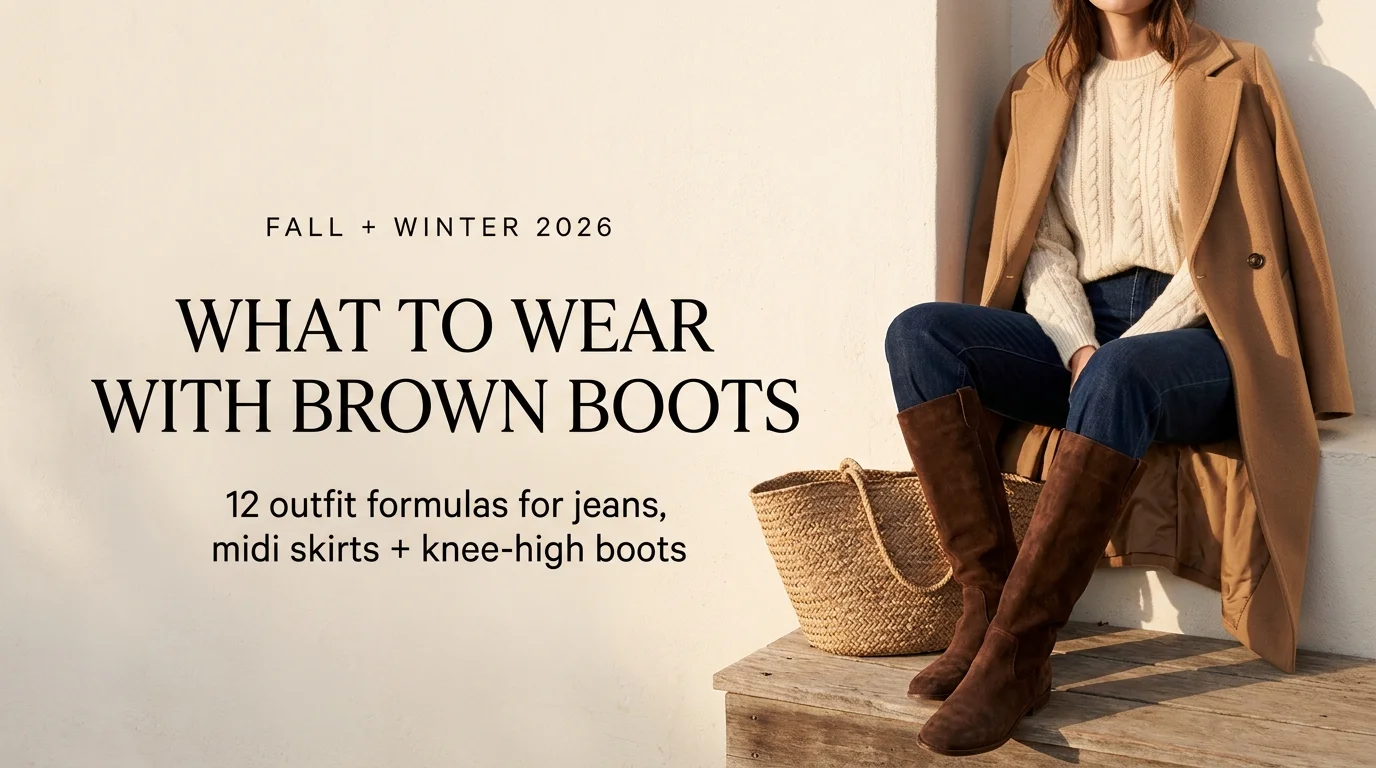
If you’ve been standing in your closet wondering what to wear with brown boots, the boots probably aren’t the problem. Brown reads as a color to most of us, not a neutral, so your brain files it next to burgundy instead of next to black. That one small misfile is why a great pair sits untouched through two whole seasons while you reach for the same black ankle boots every single morning.
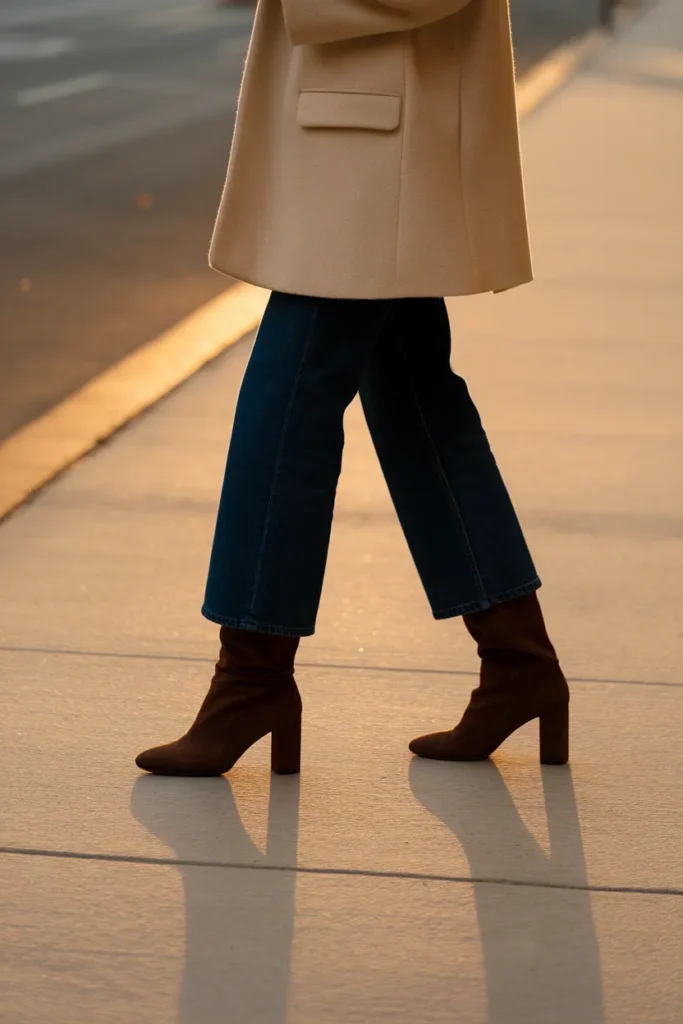
Here’s the good news. Brown boots pair with more of your closet than black boots do. They soften a hard outfit, they make inexpensive fabric look better than it is, and they carry a neutral base straight through from September into March.
So here’s the full answer to what to wear with brown boots: the colors that work, a hem-matching rule you can screenshot, twelve outfit formulas with real pieces, and the one label detail that separates boots lasting five winters from boots lasting one.
Why Brown Boots Outwork Black Boots in a Capsule Wardrobe
Black boots do one job beautifully. They disappear. That’s useful when you want the eye to travel up, and it’s why most of us buy black first.
Brown does something else. It adds warmth at the exact point where an outfit usually goes cold, which is the bottom four inches. A cream sweater with black jeans and black boots reads a little severe by February. Swap the boots to espresso and the whole column softens without you changing a single other piece.
There’s a practical argument too. Most capsule wardrobes are built on a neutral base of cream, oat, camel, navy, and olive. Every one of those colors sits closer to brown than to black on the wheel. So your brown boots quietly agree with more of what’s already hanging up.
If you’re still deciding which pair to buy first, I’d start with a shaft height you’ll actually reach for. I go deeper on that in this guide to the ankle boots that actually earn their hanger space, which covers heel height, shaft circumference, and the sole construction worth paying for.
What Colors Go With Brown Boots (and the Two That Need Help)
Ask almost anyone what to wear with brown boots and you’ll hear that brown goes with everything. That’s close enough to be useless at 7:40am, so here’s the actual breakdown.
The five that always work
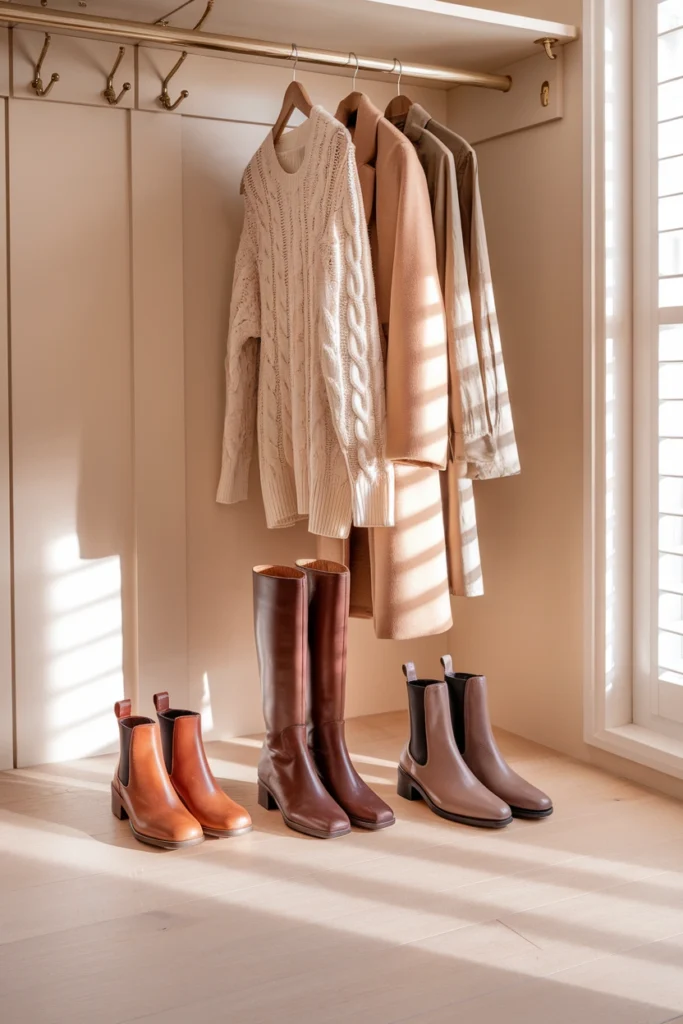
Cream and ivory. The single highest-contrast pairing that still reads soft. A cream knit above espresso boots is the most reliable outfit in this entire article.
Camel and tan. Tonal, expensive-looking, and very hard to get wrong. Keep at least two shades of separation between your camel and your brown or the outfit goes flat.
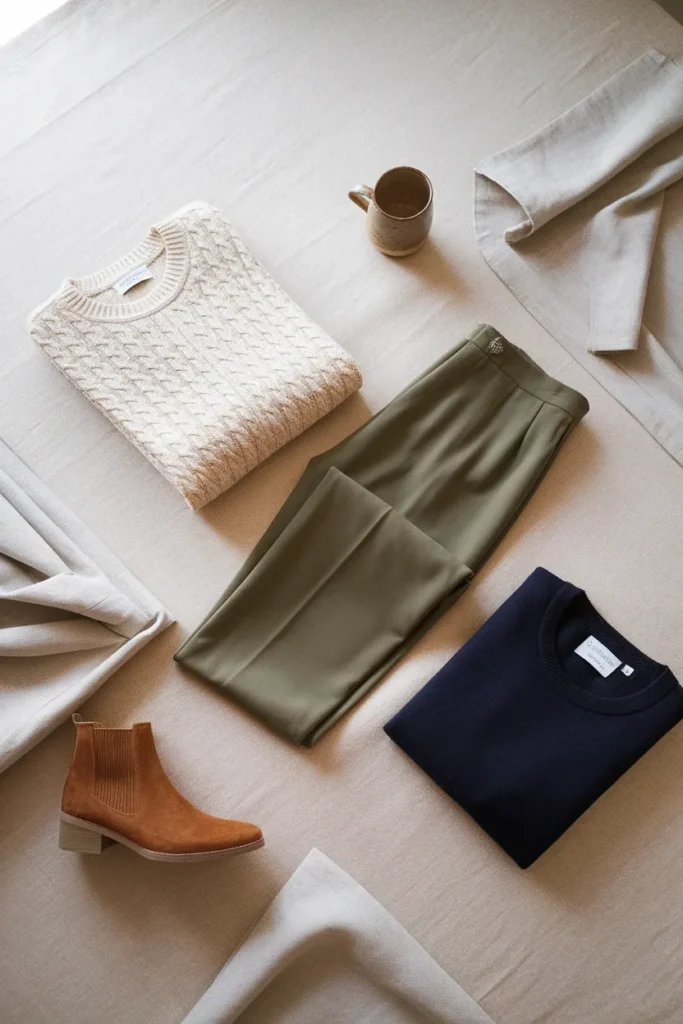
Olive and sage. Both sit in the same warm, slightly muted family as brown. Olive trousers with cognac boots is the combination stylists reach for when they want something that looks considered rather than matched.
Navy. Underrated and genuinely excellent. Navy is cooler than brown, so the pairing has a little friction to it, which is what makes it interesting instead of safe.
Brown on brown. Tonal dressing is the fastest route to looking polished. Vary the texture: suede boots, a smooth leather belt, a wool trouser. Same family, different surfaces.
The two that need a bridge piece
Black and gray both work, they just need one signal that you meant it. More on the black question below, because it deserves its own section.
Match your undertone, not just the shade
This is where most people go wrong. Brown isn’t one color, it’s three, and each one wants a different half of your closet.
| Boot shade | Undertone | Pairs best with |
|---|---|---|
| Cognac, tan, caramel | Warm | Cream, olive, camel, rust, mid-wash denim |
| Chocolate, espresso | Deep neutral | Almost anything: black, gray, navy, ivory, white |
| Taupe, greige, mushroom | Cool | Gray, soft black, dusty blue, white, pale denim |
If you only ever buy one pair, buy espresso. It’s the only brown that behaves like a true neutral, which means it never fights whatever you grabbed in the dark.
The Three-Inch Rule: Match the Boot Shaft to Your Hemline
Here’s the framework I wish someone had handed me years ago. Screenshot this one.
The rule: leave at least three inches of visible leg (or tights) between your hemline and the top of your boot, or cover the boot top completely. Never let the two meet at the same point.
When a hem stops exactly where a boot shaft starts, it creates a hard horizontal line right at the widest part of the calf. The eye stops there. The leg looks chopped, and no amount of styling above the waist fixes it. Three inches of gap gives the eye somewhere to travel. Full coverage removes the break entirely. Both read as intentional. The narrow miss never does.
| Boot shaft | Hems that work | Hems to skip |
|---|---|---|
| Ankle or Chelsea (about 5 to 6 in) | Cropped straight denim, full-length wide leg that skims the boot top, midi with opaque tights | Anything hitting mid-calf |
| Mid-calf (about 10 to 12 in) | Mini skirts, slim denim tucked in, shorts with tights | Midi skirts and cropped wide leg |
| Knee-high (about 14 to 16 in) | Midi skirts and dresses, mini, straight or slim denim tucked in | Wide leg trousers, ankle-length hems |
| Over-the-knee | Mini, sweater dresses, leggings | Anything falling below the boot top |
The wide-leg exception catches almost everyone. Wide-leg denim over knee-high boots creates a shapeless column because the fabric has nowhere to sit. Wide-leg over ankle boots is lovely, as long as the hem grazes the boot rather than pooling on the floor. If your wide legs are the wrong length for this, getting the hem right on wide leg jeans is worth ten minutes with a tailor.
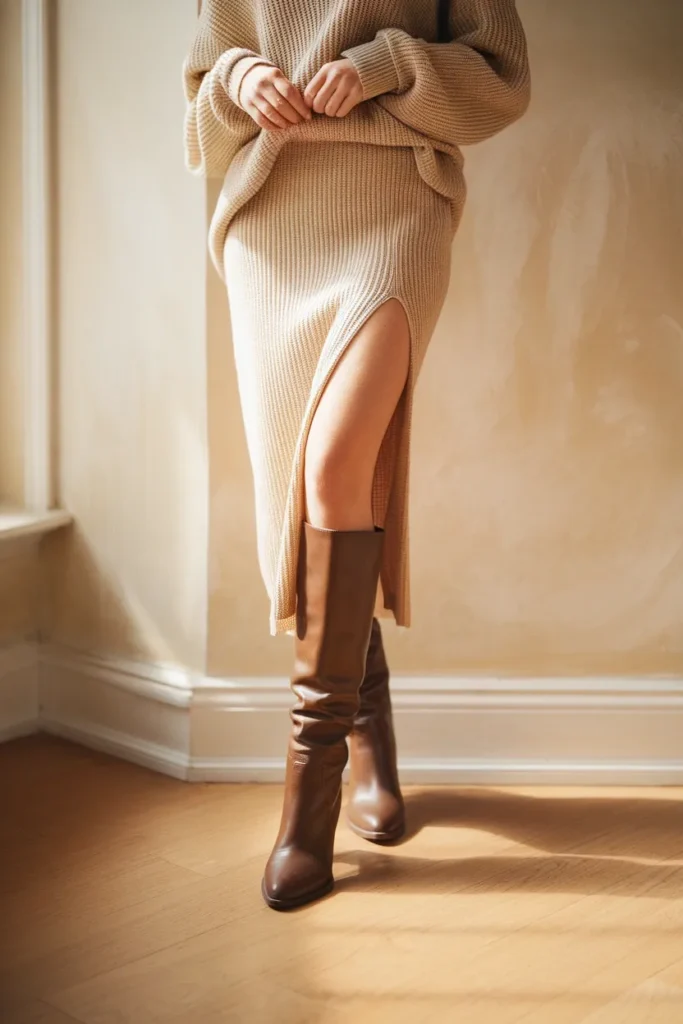
Brown Boots With Jeans: 4 Outfit Formulas
Denim is where most of us start, and it’s where brown pulls furthest ahead of black.
1. The reliable one. Dark straight-leg denim, cream cable knit tucked loosely at the front, camel wool coat, espresso knee-high boots with the denim tucked in. This works from October through March and reads more expensive than the sum of its parts. Everlane and Madewell both make straight-leg denim in the $98 to $148 range that holds its shape past the third wash.
2. The relaxed one. Mid-wash baggy jeans, plain white tee, espresso leather or suede jacket, cognac ankle boots. The trick here is the hem: it should graze the top of the boot, not swallow it. If your baggy denim tends to overwhelm you, how to style baggy jeans without losing your waistline covers the tuck that fixes it.
3. The winter-white one. Ecru or off-white straight jeans, oatmeal turtleneck, taupe or cognac suede knee-high boots. Wearing pale denim in January looks deliberate in a way that dark denim never quite manages. Quince and Uniqlo both do a decent ecru straight leg in the $50 to $90 range.
4. The bridge one. Black straight jeans, tan barn jacket, brown Chelsea boots, brown leather belt. The belt is what makes it work. Without it, the brown boots look accidental. With it, black and brown read as a deliberate pairing.

Brown Boots With Dresses and Skirts: 3 Outfit Formulas
5. The sweater dress. A ribbed midi sweater dress in oatmeal or sage with espresso knee-high boots and a thin brown belt at the natural waist. The belt is doing structural work, not decorative work. Without it a knit midi hangs straight down and loses your shape entirely.
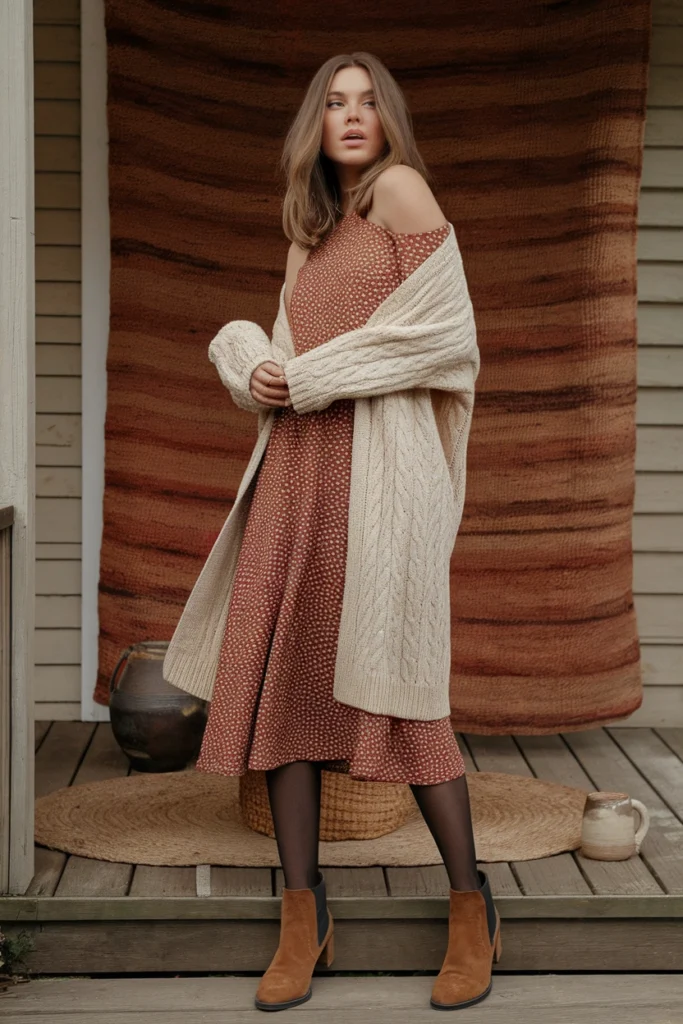
6. The print midi. A floral or small-print midi dress, chunky cream cardigan, opaque tights, cognac ankle boots. This is the one that takes a summer dress into November, and it’s the highest cost-per-wear move in the whole article. One dress, two seasons.
7. The pleated skirt. An olive or sage pleated midi, fitted cream knit tucked in, brown riding boots. Pleats plus a low block heel is a combination that looks correct in almost every setting, from school pickup to a weekday meeting. If you’d rather do this in denim, a denim skirt you can wear from September to April follows the same proportions.
Brown Boots With Trousers and Workwear: 3 Outfit Formulas
8. The office one. Charcoal wide-leg trousers, ivory silk shell, brown blazer, low brown ankle boots that read almost like a loafer. Brown boots in a workplace look more considered than black, provided the leather is clean and the heel is under two inches.
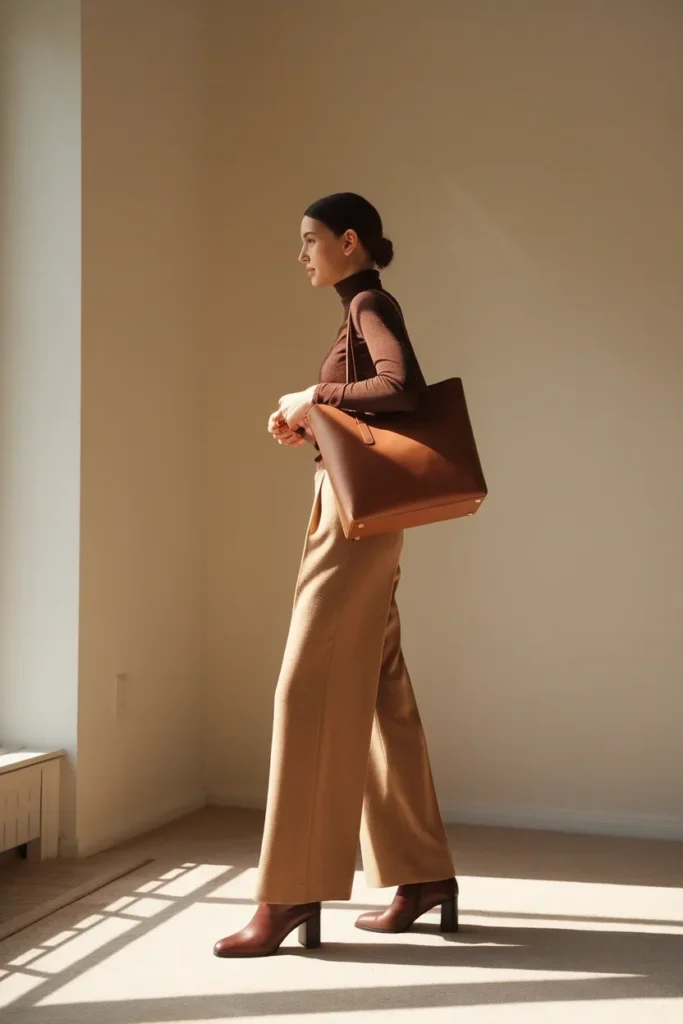
9. The tonal column. Camel trousers, espresso fine-gauge turtleneck, espresso boots. Three related browns stacked vertically. Vary the fabric weight so it doesn’t flatten: a crisp wool trouser, a soft merino knit, a suede boot.
10. The navy one. Navy trousers, cream knit, cognac ankle boots, gold hoops. Navy and brown is the pairing most people skip and shouldn’t. It’s warmer than navy with black and sharper than navy with tan. The jacket you throw over it matters as much as the trousers, and the six jackets that carry a whole capsule covers which ones do the most work.
Brown Boots With Leggings: 2 Formulas That Don’t Look Like Errands
Leggings plus boots earned a bad reputation, and it was mostly a proportion problem rather than a leggings problem.
11. The long layer. Black leggings, a long espresso cardigan hitting mid-thigh or lower, brown knee-high boots. The boot shaft covers the leggings hem completely, which satisfies the three-inch rule through full coverage. Add a crossbody with a brown strap so the color repeats above the waist.
12. The tucked sock. Olive leggings, oversized oatmeal sweater, brown Chelsea boots, and a cream wool sock folded over the boot line. The sock breaks the leg at a deliberate point rather than an accidental one, which is the whole difference between this and looking like you’re mid-errand.

Can You Wear Brown Boots With Black?
Yes. The old rule against it came from menswear tailoring, where matching your belt to your shoes was a genuine formality signal. It was never about whether the colors look good together, and it hasn’t applied to womenswear in a long time.
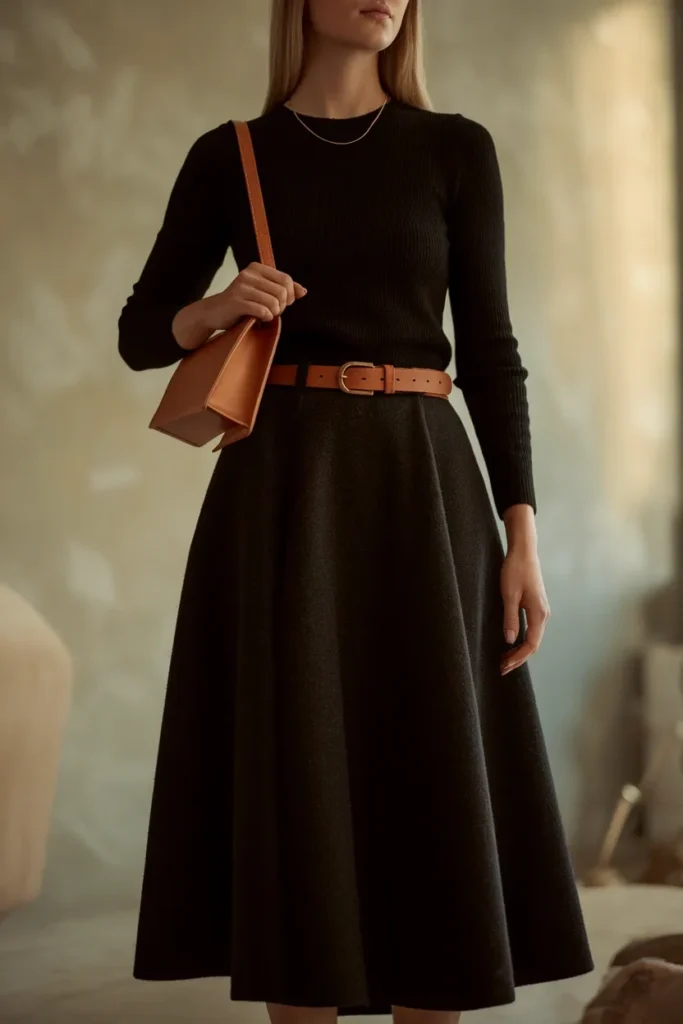
What makes it work is repetition. Brown boots below an entirely black outfit look like you got dressed in the dark. The same boots with one more brown element above the waist look styled.
Pick any one of these:
- A brown leather belt at the waist
- A brown or cognac bag
- A camel or brown coat over the top
- A brown scarf or brown-framed sunglasses
One is enough. Two is better. Three starts to look like a theme.
Depth matters as well. Espresso against black is nearly seamless because they’re close in value. Cognac against black is a much louder contrast, so it needs the bridge piece more urgently. If you’re building out the small pieces that do this job, the small accessories that pull a neutral outfit together is the place to start.
What Tights to Wear With Brown Boots
Tights are where this combination most often falls apart, and the fix is simple.
Opaque black tights work with espresso and chocolate boots. They read as a continuous dark leg line. Skip them with cognac, where the contrast gets jarring.
Opaque brown or coffee tights are the most flattering option with any brown boot, because they extend the boot’s color up the leg and make you look taller. Harder to find, worth the search.
Sheer black tights are the safest choice with cognac or tan boots. The sheerness softens the color clash into something intentional.
Cream or oatmeal tights with brown boots is a strong look if the rest of the outfit stays tonal. It’s not a beginner move, but when it lands it lands hard.
Skip gray tights with warm-toned brown boots. The cool gray and warm cognac fight each other and neither one wins.
How to Buy Brown Boots Worth Keeping (Read the Label First)
This is the part nobody tells you, and it’s the reason two boots at the same price wear so differently.
“Genuine leather” is a much looser term than it sounds. Under the FTC’s leather labeling rule, a material made from ground or shredded leather fibers has to be disclosed either as imitation leather or with an actual percentage breakdown, in wording along the lines of “Bonded Leather Containing 60% Leather Fibers and 40% Non-leather Substances.” Fully synthetic uppers have to say so too, using terms like “Not leather,” “Simulated leather,” “Vinyl,” or “Plastic.”
And if a cheaper split leather has been embossed to look like something it isn’t, the rule calls for that to be spelled out as well, in the style of “Top Grain Cowhide With Simulated Pigskin Grain.”
Read the tag. It’s a thirty-second check that tells you whether a boot will develop a patina over five winters or crack across the flex point in one.
Three more things I check before buying:
- Sole attachment. A stitched welt can be resoled. A glued sole cannot, and once it separates the boot is finished.
- Shaft circumference. Listed in inches on most US retailer sites. Standard knee-high shafts run around 14 to 15 inches, wide-calf styles around 16 to 18.
- Heel height and shape. A block heel between 1.5 and 2.5 inches is the range you’ll actually walk in.
On price, here’s the honest landscape. Target’s Universal Thread and Old Navy sit in the $35 to $50 range, and they’re a reasonable way to test a shade before committing, though the uppers are usually synthetic and the soles usually glued, so plan on a season or two. The mid tier is where the value lives: Madewell, J.Crew, and Everlane generally run $148 to $268 for real leather with better construction, and Quince tends to undercut them at $100 to $160. Contemporary labels like Sezane land around $250 to $350.
Above that you’re in Toteme and Khaite territory at $900 and up, where you’re buying design rather than durability. If you love the look of a $900 chocolate suede knee-high, Quince and Madewell both make a close cousin for under a quarter of the price, and the suede on the mid-tier pair will look nearly identical after a season of wear. The same reasoning applies to outerwear, which I’ve broken down in choosing a wool coat that lasts more than one winter.
Prices shift with season and sale cycles, so treat these as typical ranges rather than today’s number.
Suede and Leather Care That Buys You Extra Seasons
A good pair of brown boots should outlast several trend cycles, and most of what shortens their life is avoidable.
According to Iowa State University Extension, the essentials are straightforward: brush suede frequently with a soft brush to lift surface soil before it sets, wipe smooth leather with a damp cloth, and if the boots get soaked, let them air dry away from any heat source. Radiators and hair dryers are what crack leather, not the rain itself.
For storage, keep them somewhere cool and ventilated, and never in a plastic bag. Plastic traps moisture and invites mildew, and dry heat does the opposite damage by pulling the oils out.
The tip most people ignore: don’t try to remove stains at home. Extension’s guidance is explicit about taking a stained suede or leather item to a professional cleaner as soon as possible, because old stains often can’t be lifted safely later. A $20 professional clean in November beats replacing a $200 boot in January.
Brown Boots and Your Proportions
Fit advice should be about what works with your frame, not about hiding anything.
If you’re petite (5’4″ and under): keep your boot color close to your hem or tights color so the leg line stays unbroken. On knee-highs, check that the shaft ends just below the knee rather than at the widest point of the calf, since a shaft designed for a taller frame will sit high and shorten the leg.
If you’re tall (5’9″ and over): you can carry a mid-calf shaft that visually shortens most people. Look for knee-high shafts of 15 inches or more so the proportion stays right.
If you’re curvy or have fuller calves: shaft circumference matters more than size. Wide-calf styles run roughly 16 to 18 inches, and a stretch panel at the back gives you a couple of inches of flexibility without gapping.
If you’re over 40 or over 50: a block heel between 1.5 and 2.5 inches with a slightly squared toe reads current without any of the trend risk, and you can stand in it for an entire evening.
Frequently Asked Questions
Can you wear brown boots with black pants? Yes, and it’s one of the better-looking combinations once you know the trick. Repeat brown somewhere above the waist so the pairing reads intentional: a brown belt, a cognac bag, or a camel coat. Espresso boots blend most easily with black. Cognac creates more contrast, so it needs that bridge piece more than a darker brown does.
What color shirt goes best with brown boots? Cream and ivory are the most reliable, followed by oatmeal, olive, and navy. If you want something with a little more energy, rust and burgundy both sit in brown’s warm family. The shade to be careful with is a cool bright white against cognac boots, where the temperature clash can look accidental rather than crisp.
Are brown boots still in style for fall and winter 2026? Very much so. Chocolate and espresso brown have been running strongly across boot releases this season, and brown has largely taken over the slot black used to hold as the default fall boot neutral. It’s also a color that survives trend cycles well, which matters more than any single season’s momentum.
Do brown boots work for petite women? Yes, with attention to shaft height. Keep the boot color close to your hem or tights so the leg reads as one continuous line, and check that a knee-high shaft ends just below your knee rather than at the fullest part of your calf. Many brands list shaft height in inches, so measure your own leg once and shop by that number.
Are expensive brown boots worth it, or is there a good cheaper option? The mid tier is where the real value sits. Madewell, J.Crew, and Everlane typically land in the $148 to $268 range with real leather and better construction, and Quince often runs $100 to $160 for comparable material. Above roughly $400 you’re mostly paying for design rather than added durability. Below $50 you’ll get the look for a season or two, with a synthetic upper and a glued sole.
How long should a good pair of brown boots last? A well-made leather pair with a stitched sole can run five to ten years with regular brushing, proper drying, and one resole along the way. Glued-sole synthetic boots usually give you one to two seasons before the sole separates or the upper cracks at the flex point. That gap is what makes cost per wear the number worth tracking rather than the sticker price.
Can I wear brown boots year round, or just fall and winter? Ankle boots in a lighter tan or taupe carry easily into spring with a midi dress or cropped denim, and they work well through a mild fall. Knee-high and over-the-knee shafts are genuinely seasonal and want cold weather. So one pair of tan ankle boots plus one pair of espresso knee-highs covers roughly eight months of the year between them.
Start With One Pair and One Formula
Figuring out what to wear with brown boots doesn’t mean building twelve outfits by tomorrow. Pick the formula closest to what’s already hanging in your closet, wear it this week, and notice how it feels. That’s usually enough to shift a pair of brown boots from the back of the shelf to the front.
If you take one thing from all of this, make it the three-inch rule. Once you can see the hem-to-shaft gap, you’ll spot it in every outfit photo you scroll past, and you’ll stop buying boots that fight the hemlines you already own.
Which pair are you starting with, the ankle boots or the knee-highs? Tell me in the comments, and if you’re rebuilding your fall capsule from the ground up, start with the pieces that anchor everything else.
Keep reading

How to Style a Jacket for Plus-Size Women: 10 Outfits That Work
A lot of jacket advice for bigger bodies is still written around hiding. Hide the hips, hide the arms, hide under something...

How to Style a Jacket for Women Over 50: 12 Outfits That Work
Your closet probably holds more jackets than you wear. There’s the blazer from an old job, the denim jacket you’re unsure about...

How to Style a Jacket: 10 Cozy Jacket Outfits for Fall and Winter
Your jacket is the first thing people see between October and March. It’s also the piece most of us grab last and...