
How to Style a Denim Dress: 8 Seasons-Spanning Outfits
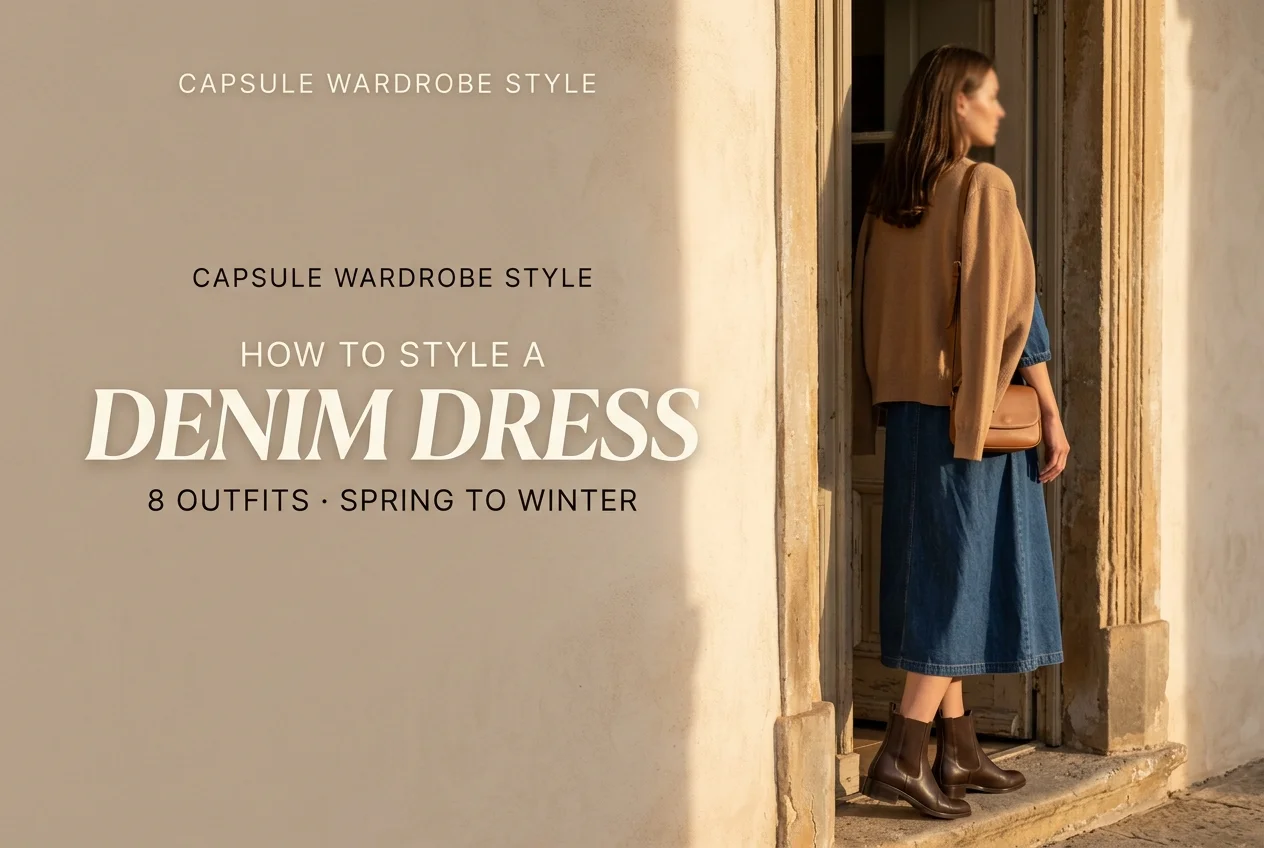
Figuring out how to style a denim dress is less about the dress and more about the six inches above and below it. Same dress, six months apart, unrecognizable outfit. That is the entire trick, and it is why one good denim dress can pull more weight in a small closet than three trend dresses ever will.
Below are 8 outfit formulas that carry a single denim dress from a 68 degree April afternoon to a 28 degree January morning. You also get the three specs to check before you buy one, because most denim dresses that end up unworn were the wrong dress, not the wrong styling. And there’s a table at the end you can screenshot.
Why the Denim Dress Is a Capsule Anchor, Not a Novelty
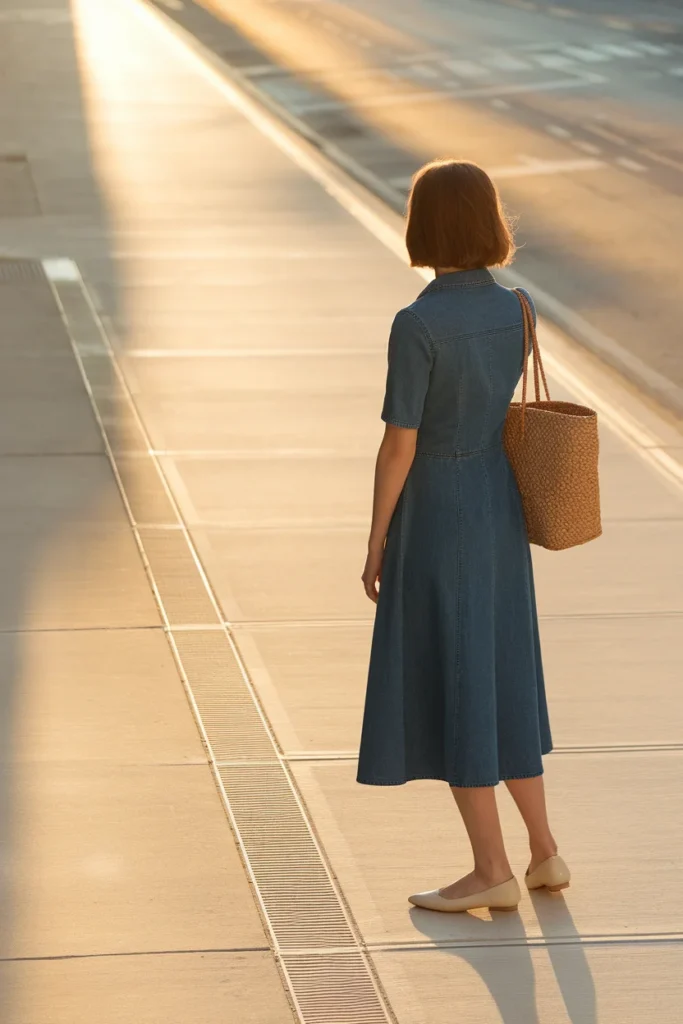
Most dresses do one job. A denim dress does eight, because denim is a neutral that behaves like a fabric instead of a color. It sits next to cream, camel, black, olive, burgundy, and butter yellow without arguing with any of them.
That flexibility is what earns hanger space. In a closet built on mix-and-match ratios, a piece that only works with two other things is dead weight, no matter how much you liked it in the fitting room.
Here’s the part most style guides skip. A denim dress is a one-piece outfit that already has structure built in, which means it solves the morning decision problem the way separates cannot. Zip it, add shoes, done. On the mornings you have four minutes and no opinions, that matters more than versatility does.
It also layers in two directions at once. You can add underneath it (tee, turtleneck, long-sleeve) and over it (blazer, cardigan, coat, jacket), which is unusual. A sweater dress only layers over. A slip dress mostly layers under. Denim takes both, and that dual capacity is the mechanical reason it stretches across seasons.
If you already know the appeal of denim as a base, you probably know the trap too. It’s the same one that shows up when you’re working out how to style a denim skirt without it reading juvenile: styled lazily, denim skews cute and young. Styled with one deliberate hard element, it reads polished. Every formula below has that hard element built in.
Buy the Right Weight and Wash First, Everything Else Follows
Before styling, the buy test. Three specs decide whether your denim dress is a nine-month piece or a six-week piece.
Spec 1: Weight, roughly 8 to 12 oz
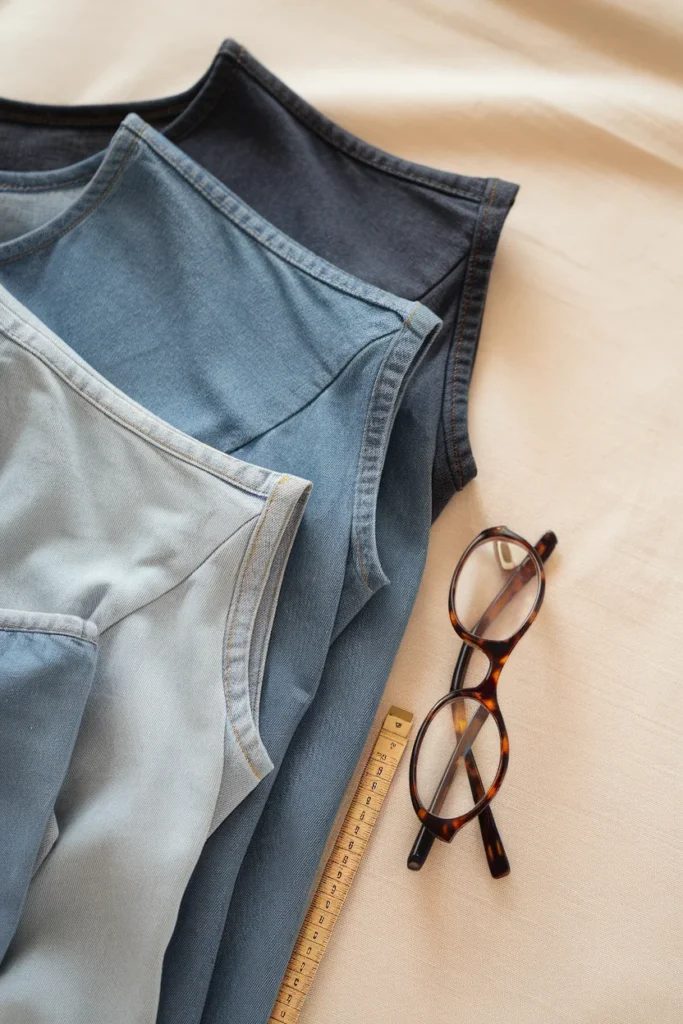
Lightweight chambray (under 6 oz) reads summery and drapes soft, which is lovely in July and useless in November. Heavy rigid denim (14 oz and up) holds shape beautifully but fights every layer you try to put underneath. The 8 to 12 oz range is the sweet spot: enough body to hold a clean line, enough give to fit a thin turtleneck under it.
Most brands do not print the ounce weight. Use the drape test instead. Hold the skirt out from the hem. If it falls straight down like a curtain, too heavy for layering. If it collapses into your hand like a t-shirt, too light for fall.
Spec 2: Stretch under 3 percent
Check the fiber content on the label. Above about 3 percent elastane, denim bags out at the seat and hips within a few wears and never fully recovers. Between 1 and 2 percent gives you comfort without the sag. One hundred percent cotton is the most durable option and the least forgiving on day one, since it needs three or four wears to mold to you.
While you have the label in your hand, read the care instructions too. Under the FTC’s Care Labeling Rule, US manufacturers are required to attach complete regular-care instructions to the garment and make them legible at the point of sale. A denim dress that says dry clean only is a denim dress you will wear twice.
Spec 3: Wash
Mid-wash indigo is the workhorse. It reads casual enough for Saturday and clean enough for a relaxed office, and it pairs with warm and cool neutrals equally well. Dark indigo and washed black skew dressier and take tailoring cues better. Very light or heavily distressed washes are the most limiting, and they photograph flat, which matters if you’re pinning your own outfits.
Price reality, checked August 5, 2026: Old Navy denim dresses list around $49.99 and hit the teens on clearance. Quince’s distressed denim maxi shirt dress runs $69.90. Madewell’s denim dresses sit between roughly $89.50 on sale and $168 full price. You do not need to spend past the mid tier here. The sub-$50 options usually trade away fabric weight and seam finishing, so expect a thinner hand and a shorter life, which is a fair trade if the shape is right.
Outfit 1: White Tee Underneath, Sneakers, Big Tote
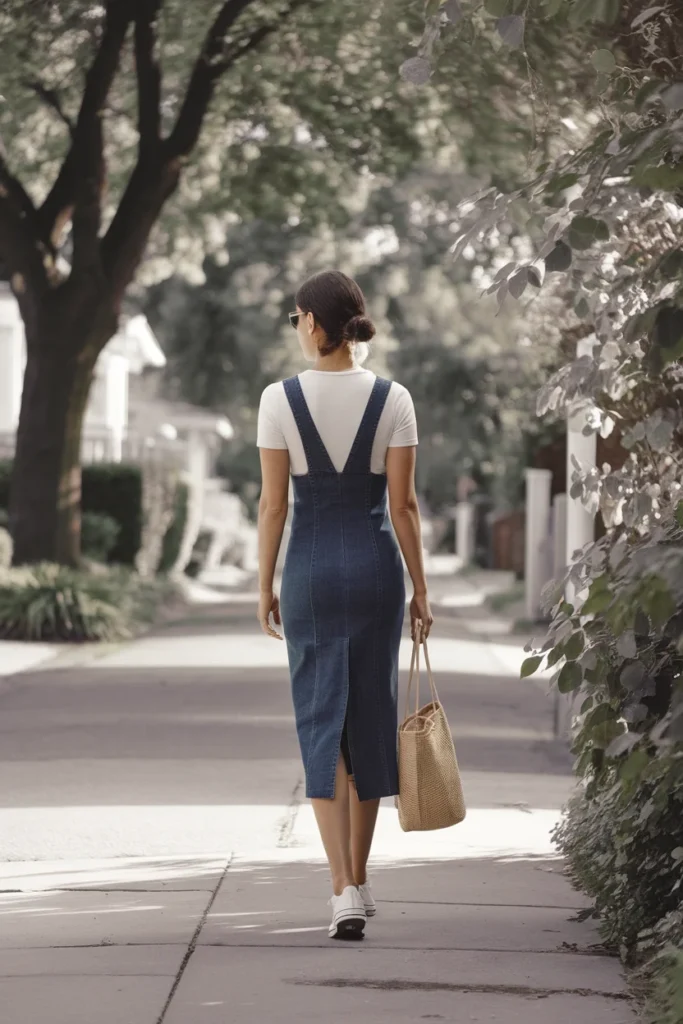
Start here, because this is the one you’ll actually wear most. A plain white crewneck tee under a sleeveless or pinafore denim dress, white leather sneakers, and a woven or canvas tote.
The tee does two things at once. It makes a sleeveless dress wearable in 55 degree weather, and it breaks up the denim block so the outfit reads layered instead of flat. Keep the tee fitted through the body. Anything slouchy bunches under the dress and creates bulk at the waist that shows through.
Sneaker note, since this is where the outfit usually goes wrong. Low-profile leather sneakers in white or cream keep it clean. Chunky trainers and running shoes drag the whole thing toward errands. If your sneakers have visible mesh panels or bright logos, swap them.
Push it slightly more polished by swapping the tote for a small leather crossbody and adding a thin gold chain. Same outfit, different register.
Season range: spring and summer, and early fall in the South.
Outfit 2: Belt It, Add Ballet Flats and Gold Hoops
A belt is the highest-leverage change you can make to a denim dress, and it costs nothing if you already own one. A shirt-dress or straight-cut denim dress hangs as a column. Adding a belt at the natural waist creates a defined line and instantly moves the outfit from casual to considered.
Belt choice matters more than belt price. A 1 to 1.5 inch leather belt in tan, cognac, or black with a simple brass or matte silver buckle does the job. Wide corset belts and heavily hardware-ed belts pull focus and date the look fast.
Ballet flats in cream, bone, or black finish it. The flat’s low vamp and slim silhouette contrast the denim’s bulk, and that contrast is what reads expensive. Gold hoops, small to medium, add the metallic note that keeps the whole thing from going flat.
On proportions: if you’re petite at 5’4″ and under, belt slightly higher than your true waist and let the skirt fall to mid-calf rather than the widest part of the calf. If you’re tall at 5’9″ and over, a lower slung belt at the hip works and keeps the torso from looking cropped. Curvy and hourglass proportions usually do best with the belt right at the narrowest point, wherever that actually sits on you.
Season range: spring through early fall.
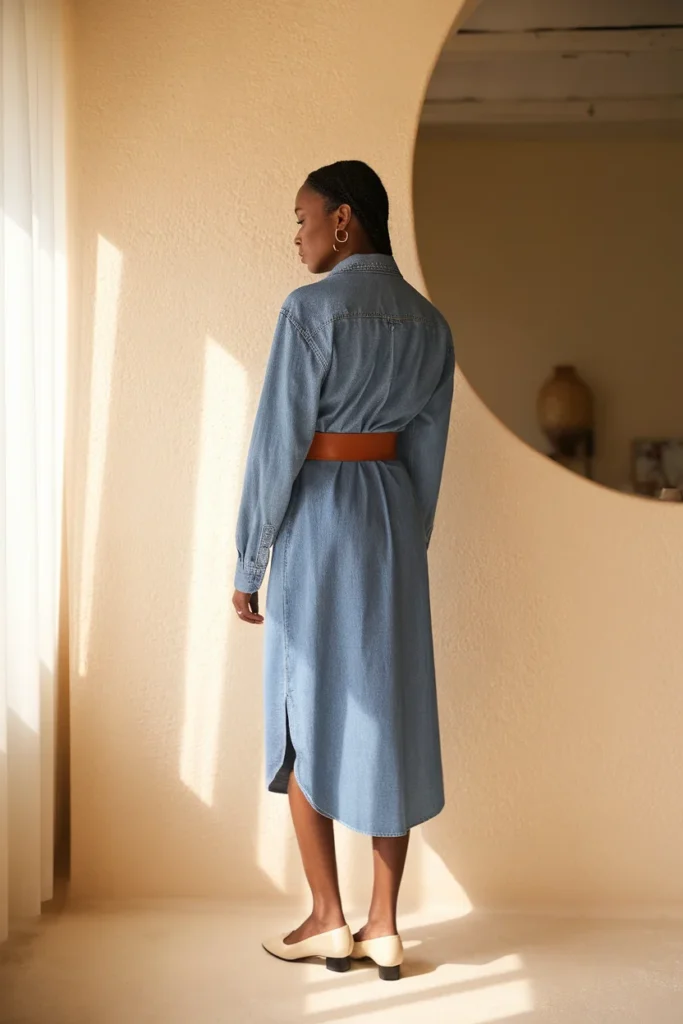
Outfit 3: Fine-Knit Turtleneck Underneath, Ankle Boots
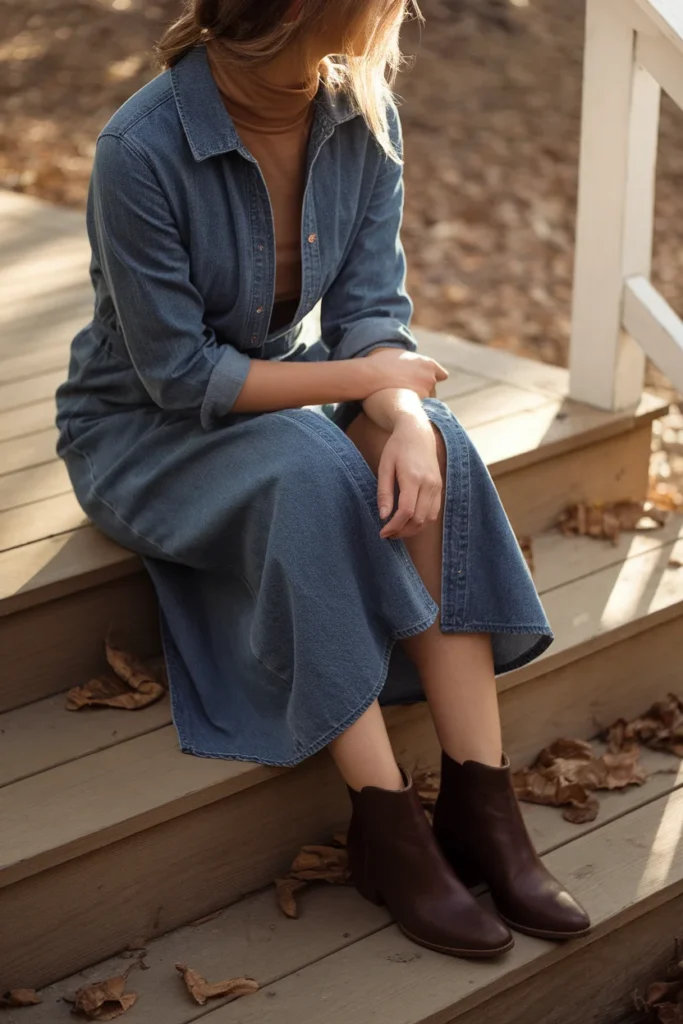
This is the formula that unlocks fall, and the reason Spec 1 above matters so much. A thin merino or cotton turtleneck in cream, camel, black, or oat goes underneath the dress, sleeves and neck showing.
Gauge is everything. A fine-gauge knit slips under a denim dress without fighting the armholes. A chunky cable knit will not, and forcing it creates bunched shoulders and a strained silhouette. If you can see the ribbing texture from across a room, it is too thick to go under.
Color logic: a cream or oat turtleneck reads soft and warm against indigo. Black reads sharper and more urban. Camel reads richest and is the one that most often gets a compliment.
Ankle boots finish it. A clean almond or square toe in black, espresso, or cognac keeps the line long. Avoid a boot with a pronounced ankle cuff or heavy buckle, since the shaft is going to sit right where the dress hem falls on a midi and the visual clutter shows. If you’re still building this part of the closet, the best ankle boots for a capsule wardrobe are worth getting right once, because they carry roughly a third of your fall outfits.
Season range: fall, and winter in mild climates.
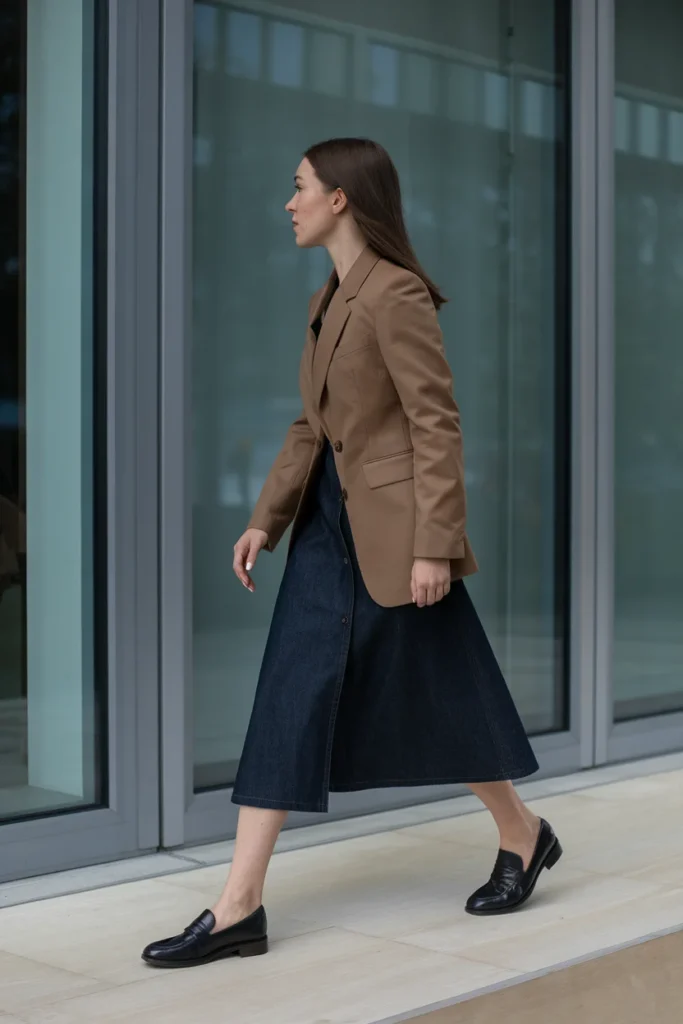
Outfit 4: Camel Blazer Over the Top
The fastest route from casual to business casual. A structured camel or oat blazer over a dark or mid-wash denim dress, with loafers or a low block heel.
Structure is the operative word. A soft unlined blazer collapses over denim and the whole thing goes shapeless. You want defined shoulders and a bit of body in the fabric, because the blazer’s job here is to impose a clean line on top of a casual base. A wool or wool-blend blazer does this better than a linen one.
Length rule that saves a lot of trial and error: the blazer hem should land above the widest point of the dress. A cropped or hip-length blazer over a midi works. A long-line blazer that hits mid-thigh over a midi creates two competing hemlines and reads heavy.
Camel over indigo is the pairing that does the most work, since the warm neutral softens denim’s coolness. If you want the full logic behind why some neutral combinations look intentional and others look accidental, how to pair neutral colors so nothing fights covers the undertone rules that apply here directly.
Office caveat, because it varies: a dark-wash or black denim dress under a blazer passes at most business-casual workplaces. A light-wash or distressed one generally does not, whatever the blazer is doing.
Season range: fall and spring, plus year-round in an air-conditioned office.
Outfit 5: Opaque Tights, Tall Boots, Wool Coat
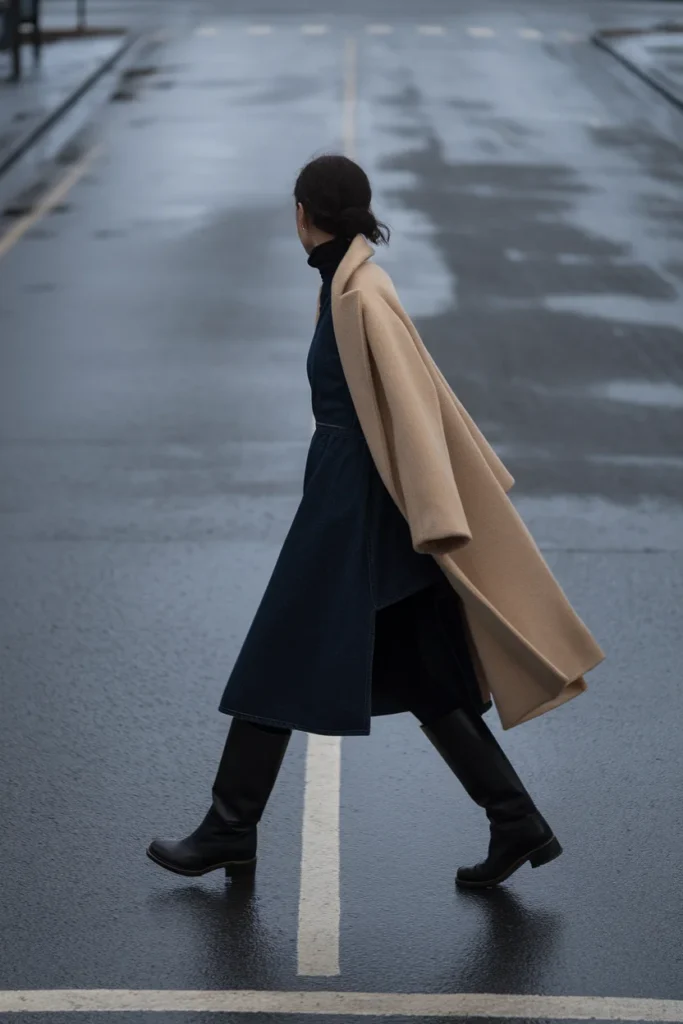
Winter denim works, but only if you commit to the full stack. Half measures here are what make people decide a denim dress is a three-season piece.
The stack: long-sleeve thermal or thin turtleneck underneath, opaque tights (60 to 80 denier, not sheer), knee-high or tall boots, wool coat over everything. Add a wool scarf if it’s genuinely cold.
Tights color is the decision that makes or breaks it. Black opaque tights with black boots create an unbroken column from hem to floor, which is the leanest and easiest option. Espresso or charcoal tights with matching boots do the same thing in a softer register. Cream or patterned tights break the line at the ankle and read costume-y with denim, so save those for wool dresses.
Coat length should clear the dress hem by two inches or more, or fall well short of it. A coat that ends within an inch of the dress hem looks like a mistake even when it isn’t.
Practical note that nobody mentions: denim gets genuinely cold. The fabric holds no warmth on its own, so the thermal layer underneath is doing all the work. Skip it and you will be miserable by noon regardless of how good the coat is.
Season range: winter, down to roughly 25 degrees with the full stack.
Outfit 6: Denim on Denim, Two Shades Apart
Denim on denim is not risky. Denim on denim in the same wash is risky, and that is the distinction that gets lost.
The rule: put at least two clear shades between the dress and the jacket. Light-wash jacket over a dark-wash dress works. Ecru or white denim jacket over mid-wash indigo works beautifully. A mid-wash jacket over a mid-wash dress just looks like you accidentally matched, and the eye reads it as a jumpsuit that went wrong.
Break the pairing with a non-denim element somewhere in the middle. A cream tee at the neckline, a cognac belt at the waist, or a leather crossbody strap across the chest all give the eye somewhere to land. Without that break, the outfit reads as a single denim block from shoulder to hem.
Fit contrast helps too. A cropped or boxy jacket over a fitted dress creates shape. A long relaxed jacket over a relaxed dress creates a rectangle. It is the same shade-gap rule that makes a denim jacket work over almost anything else in the closet, applied to a harder case.
Season range: spring and fall, the transitional weeks specifically.

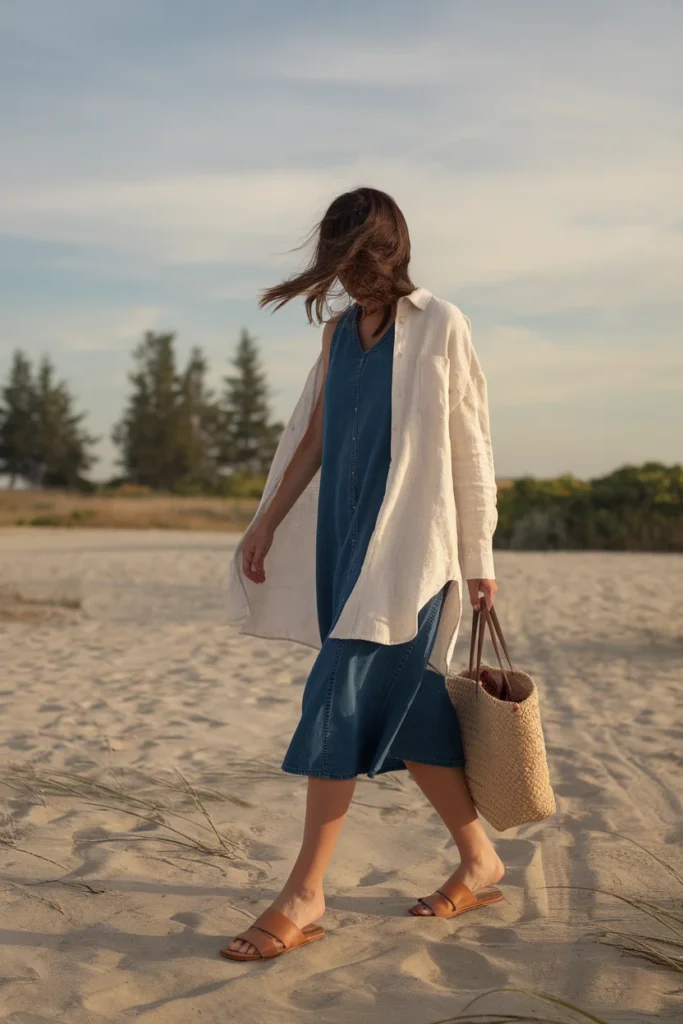
Outfit 7: Linen Button-Down Worn Open Over It
Summer’s answer, and the one that solves the sleeveless-denim-dress-is-too-plain problem without adding heat.
An oversized linen or cotton-gauze button-down in white, ivory, or a soft stripe, worn completely open over a sleeveless denim dress, sleeves pushed to the elbow. Flat leather sandals underneath. Straw or woven tote.
The open shirt does something specific: it creates two long vertical lines down either side of the body, which lengthens the whole silhouette and covers the shoulders and upper arms without a single extra degree of warmth. Linen’s breathability is the entire point, so a cotton poplin shirt will not do the same job in August.
Fit: the shirt should be at least one size up from your usual, and its hem should land above the dress hem. Same competing-hemline problem as the blazer.
Sandal note: flat leather slides, thong sandals, or simple woven flats in tan, cognac, or bone. Anything with a chunky sport sole drags this straight into a different outfit.
A rolled linen sleeve, a straw bag, and a mid-wash dress is also the exact combination Pinterest saves hardest between May and July, so shoot this one first if you’re photographing your own outfits.
Season range: summer, and spring in warm climates.
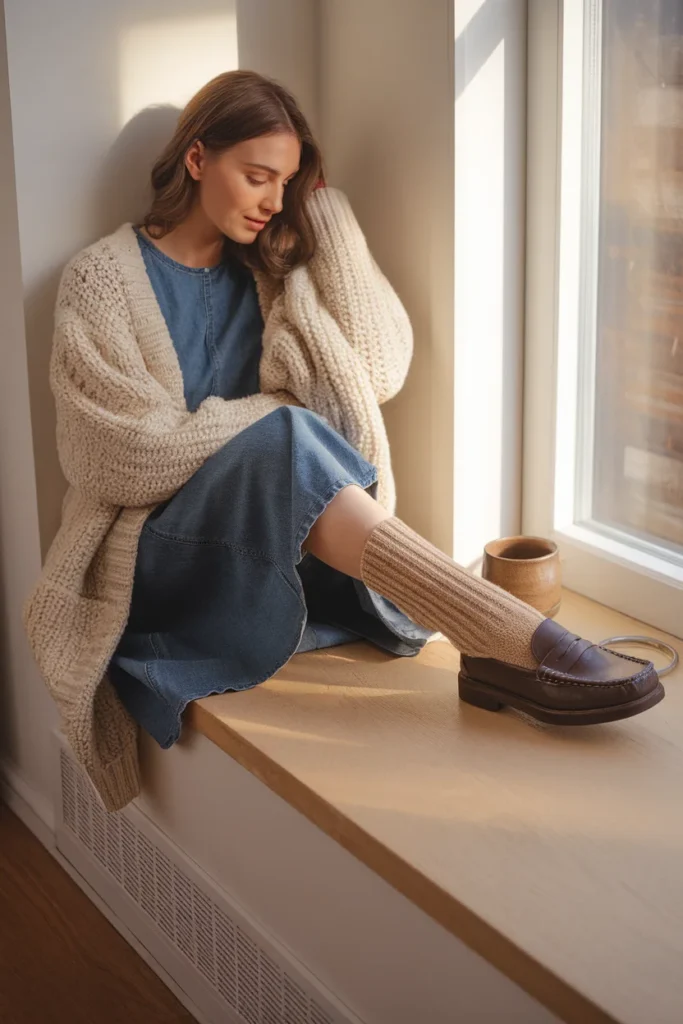
Outfit 8: Cream Cardigan, Loafers, Slouchy Socks
The transitional formula for the awkward weeks when it’s 50 degrees at 8am and 72 by lunch.
A cream or oat cardigan (buttoned, half-buttoned, or open depending on the hour), loafers, and a slouchy ribbed sock in cream or oatmeal peeking over the top. That sock detail is small and it is doing a lot: it softens the hard line of the loafer, adds texture, and makes the outfit look styled rather than assembled.
Cardigan weight should match the dress weight. A fine-gauge cardigan over a lightweight chambray dress. A chunkier one over a heavier denim. Mismatched weights are the most common reason a cardigan outfit looks slightly off without an obvious reason.
Loafers do the polishing here. A penny or lug-sole loafer in black, espresso, or cognac holds the outfit together, and unlike ankle boots they read the same in April and October, which is exactly what a transitional outfit needs. The loafers worth the hanger space in a small closet are the ones with a leather upper and a resoleable construction, since these get worn hard across two seasons.
Add a crossbody and you have a full errands-to-lunch outfit that takes ninety seconds.
Season range: fall and spring shoulder weeks, plus mild winters.
The Denim Dress Outfit Math
Here is the part that makes the purchase make sense. Screenshot this one.
| # | Layer | Shoes | Accessory | Season covered |
|---|---|---|---|---|
| 1 | White crewneck tee underneath | White leather sneakers | Woven tote | Spring, Summer |
| 2 | None, belted at the waist | Cream ballet flats | Gold hoops | Spring, Summer |
| 3 | Fine-gauge camel turtleneck under | Espresso ankle boots | Leather crossbody | Fall |
| 4 | Camel blazer over | Black loafers | Structured tote | Fall, Spring |
| 5 | Thermal under, opaque tights, wool coat | Tall black boots | Wool scarf | Winter |
| 6 | Ecru denim jacket over | White sneakers | Cognac belt | Spring, Fall |
| 7 | Ivory linen button-down open over | Flat leather sandals | Straw tote | Summer |
| 8 | Cream cardigan over | Penny loafers + slouchy socks | Crossbody | Fall, Winter, Spring |
Count the additions. White tee, turtleneck, blazer, cardigan, denim jacket, linen shirt, and a belt. Seven pieces, and if you have been building a capsule at all, you already own most of them. One purchase, eight outfits, four seasons.
Run the cost per wear. A $120 denim dress worn once a week across three of the four seasons lands around 39 wears in a year, which is roughly $3 per wear in year one and under $1.50 by year two. Compare that to a $60 trend dress worn four times. Cost per wear is $15, and it is still going down only because it is sitting in the closet.
The same arithmetic is why building a dresses-only capsule wardrobe works so well for people who hate getting dressed. One decision replaces two.
Three Styling Mistakes That Age the Whole Outfit
Matching your denim to your denim. Covered above, and it’s the most common one. Two shades apart, minimum.
Going full western when you only meant to go casual. Denim dress, cowboy boots, brown belt, and a suede jacket is a costume. Pick one western element and let the rest stay neutral. The dress plus tall brown boots is enough. Adding the fringe and the buckle is where it tips.
Sizing up for comfort. A denim dress one size too large does not read relaxed, it reads borrowed, because denim holds its shape and shows the excess instead of draping over it. Size to your shoulders and bust and let a belt handle the waist. This is the single most common reason a denim dress ends up unworn, and it’s a fit problem people usually misdiagnose as a styling problem.
How to Care for a Denim Dress So It Lasts
Denim rewards neglect, which is convenient.
Wash it rarely. Levi Strauss & Co’s own denim care guide recommends washing denim once every ten wears at most, in cold water to protect against fading and shrinking, and spot cleaning with a damp cloth or an old toothbrush and mild soap between washes. Everything in that guidance applies to a denim dress exactly as written.
Skip the dryer. Levi’s calls dryers “the natural enemy of jeans,” and line drying preserves the fit and avoids shrinkage or fabric warping. Hang the dress by the shoulders on a wide wooden hanger, not folded over a bar, since a fold line across the skirt is difficult to press out of heavy cotton.
Turn it inside out before washing. That one habit does more for wash retention than any detergent claim, because the abrasion happens on the inside instead of the face of the fabric.
Store it hanging, with a little air on both sides. Denim compressed tightly between other garments picks up permanent creases at the shoulder seam.
How to Style a Denim Dress Frequently Asked Questions
What shoes should I wear with a denim dress? Ballet flats, white leather sneakers, loafers, ankle boots, tall boots, and flat leather sandals all work, and between them they cover the full calendar. The one consistent rule is to keep the sole profile low. Chunky athletic soles and platform sneakers add visual weight at the bottom of an already-substantial fabric, which shortens the whole line.
What do you wear under a denim dress? For sleeveless or pinafore styles: a fitted white or cream crewneck tee in warm weather, a fine-gauge turtleneck in cold. For button-front shirt dresses, usually nothing underneath, or a thin camisole if the buttons gap. In winter, add opaque tights at 60 to 80 denier plus a thermal layer, since denim itself holds almost no warmth.
Are denim dresses still in style in 2026? Yes, and they are one of the more stable pieces in the category rather than a cyclical one. Live Pinterest data shows dedicated, actively-indexed idea pages for denim dress outfits across all four seasons, plus separate ones for boots, sneakers, layering, and plus-size styling. That breadth of sustained search demand is not what a fading trend looks like.
Does a denim dress work if you’re petite or tall? Yes, with a hem adjustment. If you’re 5’4″ and under, a midi that ends at mid-calf keeps the leg line intact, and belting slightly above your natural waist helps proportions read balanced. If you’re 5’9″ and over, a longer midi or maxi length avoids the dress riding up into an accidental mini, and a lower belt placement keeps the torso from looking cropped. Curvy, midsize, and plus-size proportions do best with a shirt-dress or A-line cut with a real waist seam rather than a straight shift.
Can I wear a denim dress to the office? Depends on the wash and the workplace. A dark-wash or washed-black denim dress under a structured blazer, with loafers and no distressing, passes at most business-casual offices. Light washes, raw hems, and any distressing generally do not, and no amount of blazer fixes that. Check what the most conservatively dressed person at your level wears before you commit.
How often should I wash a denim dress? Rarely. Levi Strauss & Co recommends once every ten wears at most, cold water, no dryer. Spot clean between washes and air it out overnight instead of laundering. Over-washing is the primary cause of fading, seat bagging, and hem fraying, and it is entirely avoidable.
Is a denim dress worth the money? If you’ll wear it across at least three seasons, the math is strongly in favor. As of August 2026, mass-tier options at Old Navy list around $49.99, Quince runs about $69.90, and Madewell sits roughly between $89.50 on sale and $168. A mid-tier dress worn weekly for three seasons lands near $3 per wear in the first year and keeps dropping. The sub-$50 versions save money up front and typically trade away fabric weight and seam finishing, so factor in a shorter life.
Start With Two
Do not try all eight this week. Pick the two that match the weather outside your window right now, and wear those until they feel automatic. Outfit 1 and Outfit 2 if it’s warm. Outfit 3 and Outfit 8 if it’s cooling off.
That’s the actual point of a capsule wardrobe. Fewer decisions, better ones, made once instead of every morning at 7:15. A denim dress just happens to be one of the pieces that pays that off fastest.
Screenshot the outfit math table, keep it in your camera roll, and check it the next time you’re standing in front of a full closet with nothing to wear.
Keep reading

How to Style a Jacket for Plus-Size Women: 10 Outfits That Work
A lot of jacket advice for bigger bodies is still written around hiding. Hide the hips, hide the arms, hide under something...

How to Style a Jacket for Women Over 50: 12 Outfits That Work
Your closet probably holds more jackets than you wear. There’s the blazer from an old job, the denim jacket you’re unsure about...

How to Style a Jacket: 10 Cozy Jacket Outfits for Fall and Winter
Your jacket is the first thing people see between October and March. It’s also the piece most of us grab last and...