
Cool Summer Outfits That Actually Keep You Cool
You’re wearing your most summery outfit in 85-degree heat and somehow still sweating through it. Cool summer outfits for hot weather sound obvious right up until you realize most of what gets marketed as “summer clothing” is still making your body work overtime to regulate temperature.
The issue isn’t your closet. It’s that nobody explained the actual fabric science behind staying cool, so you keep grabbing whatever looks light and breezy on a rack, not knowing whether it’ll actually perform. A cotton-blend blouse and a pure linen one look nearly identical on the hanger. On a 90°F afternoon with 70% humidity, they feel completely different.
This guide gives you both: the fabric truth you need to shop smarter going forward, and real outfit formulas built around pieces that earn their hanger space across a full summer. Casual days, work, travel, humid weekends. All of it.
I rotated a 10-piece summer capsule for 90 days through a July-to-September stretch in Atlanta (88°F average, 72% humidity most mornings) and tracked every combination against comfort, appearance, and whether I actually needed to change before a meeting. Here’s what worked, and why.
Why Your Summer Outfit Is Actually Making You Sweat
The polyester in your favorite summer top isn’t trying to make you miserable. It just can’t help it.
Synthetic fibers have smooth, tightly packed filaments that block airflow between the fabric and your skin. When you add body heat to that equation, the space between you and your shirt becomes a small, very personal oven. Your sweat has nowhere to go, so it stays on your skin, your body temperature climbs, and by noon you feel worse than you did at 7 a.m.
Natural fibers work differently at the structural level. Linen, for example, is made from flax plant cells that are naturally hollow and porous. That irregular, open structure allows air to circulate and, critically, allows your sweat to evaporate. Evaporation is your body’s built-in cooling system. Clothes that block evaporation are fighting against your own biology.
Humidity makes the problem sharper. Researchers at Georgia Tech found that in high-humidity conditions, the fabric’s ability to release moisture outward matters even more than raw breathability, because when the air is already saturated with water, evaporation slows down and the fabric’s moisture-release speed becomes the bottleneck. A “breathable” polyester shell can still leave you soaked because it keeps moisture pressed against your skin with nowhere to go. The full breakdown is worth reading: Georgia Tech’s 2024 research on fabrics for summer heat lays out exactly which properties matter most in high-temperature conditions.
Silhouette matters just as much as fiber content. A skin-tight shirt in linen still performs worse than a slightly relaxed one in the same fabric. You need a small air gap between the fabric and your skin. That gap is where the actual cooling happens.
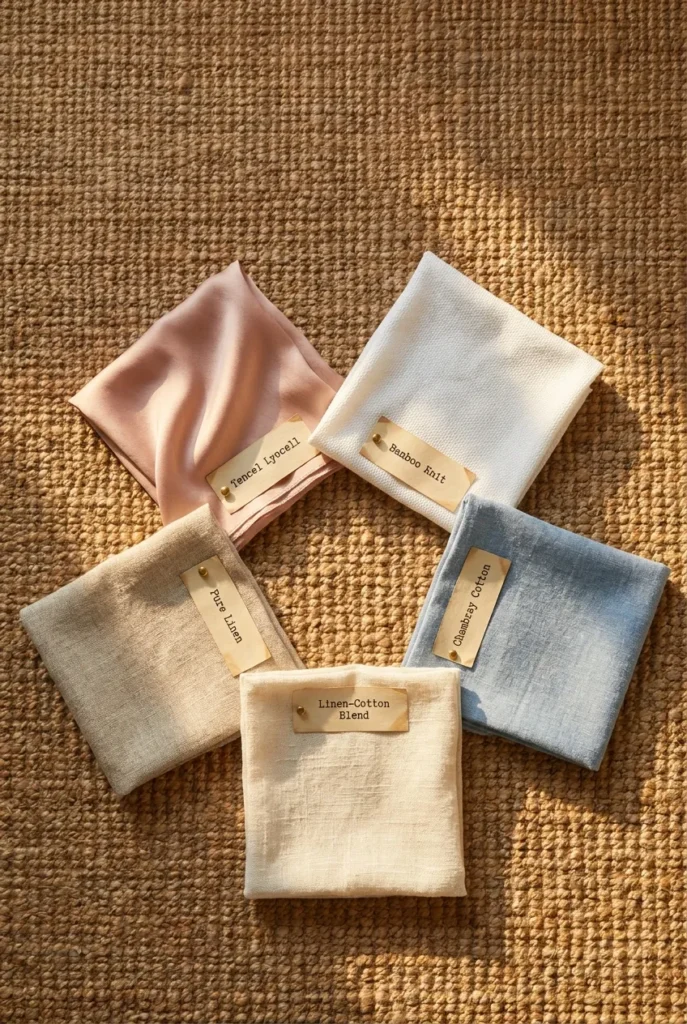
The 5 Fabrics That Earn Their Hanger Space in Summer
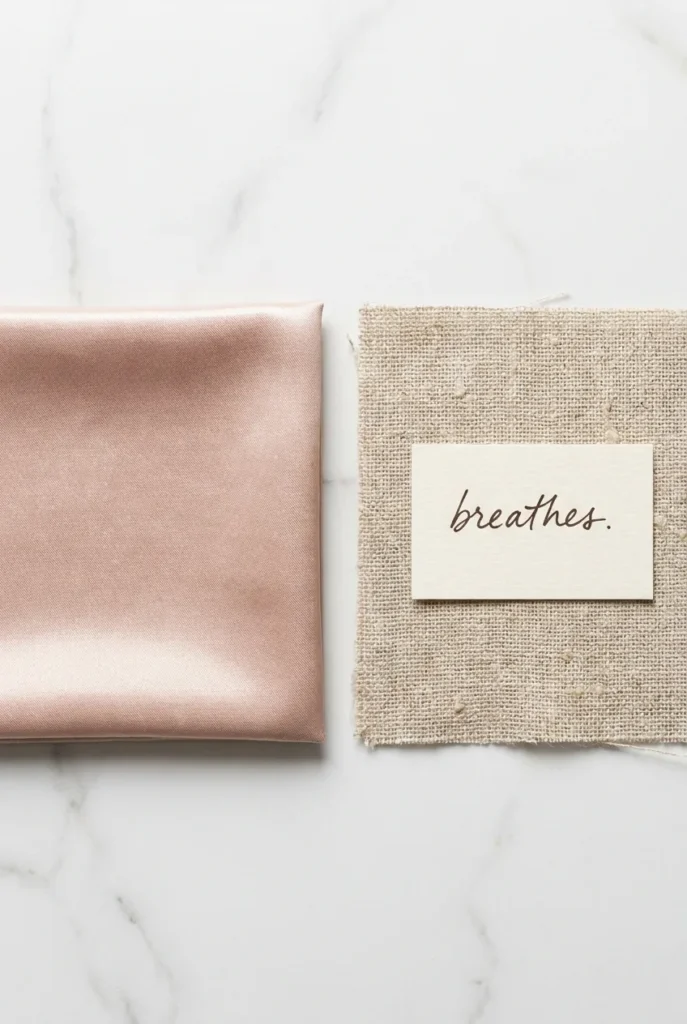
These five belong in every summer capsule. Each one has a specific reason, not just a vibe.
1. Linen
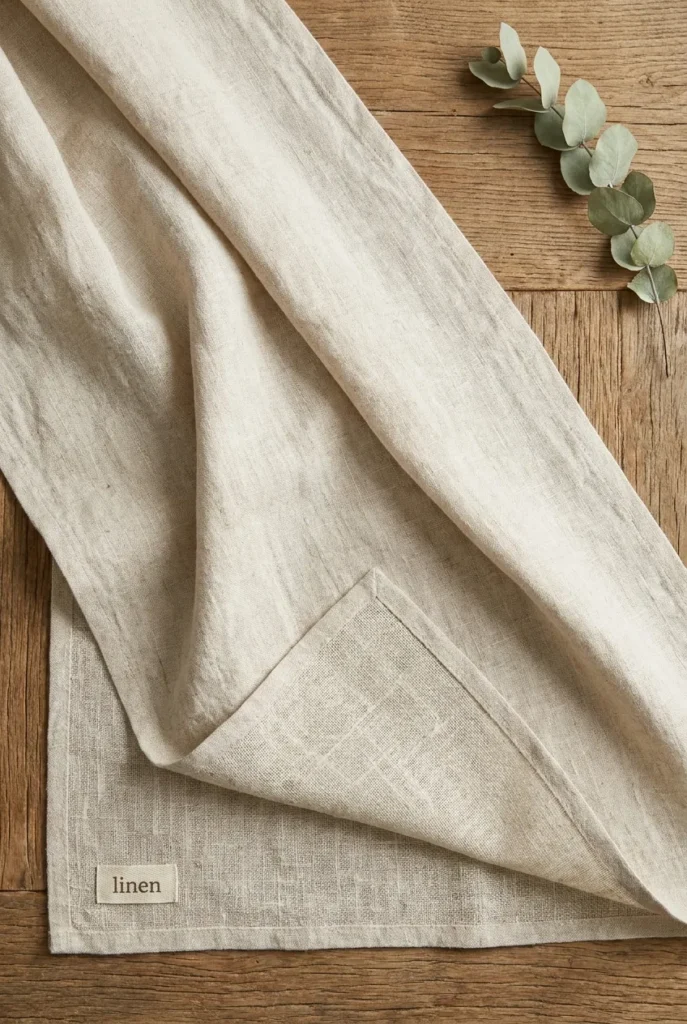
Linen is made from flax plant fibers and has a naturally hollow, porous structure that makes it one of the best-ventilating fabrics available at any price point. It absorbs up to 20% of its weight in moisture before it even feels damp on your skin, then releases that moisture into the air quickly. Your sweat evaporates instead of sitting against you.
The objection everyone raises: it wrinkles. Yes. The trade-off is worth it above 80°F. Look for linen in the 130 to 180 GSM weight range for summer pieces. Anything heavier than 200 GSM starts to hold heat rather than release it. Uniqlo linen typically falls in the 130 to 150 GSM range at $30 to $45. Quince Belgian linen runs around 155 to 160 GSM at $50 to $80. Both perform well in real heat. If you want a head-to-head comparison across four brands, the guide to the best linen shirts that actually breathe in summer heat tested Madewell, Quince, J.Crew, and Everlane side by side, and the winner wasn’t the most expensive one.
2. Tencel (Lyocell)
Tencel is made from wood pulp cellulose and is the underrated overachiever of summer dressing. Its fibers are smoother and more uniform than linen, which means it drapes beautifully, holds color well, and doesn’t wrinkle as aggressively. More importantly, it absorbs moisture 50% faster than standard cotton and releases it outward almost immediately.
In humid conditions specifically, Tencel edges ahead of linen because it doesn’t stiffen as it dries. If you spend summers in Charleston, Houston, Miami, or anywhere the air feels like a wet towel by 9 a.m., Tencel is worth prioritizing for shells, wide-leg pants, and dresses. Everlane, Quince, and COS all carry Tencel basics in the $45 to $120 range.
3. Lightweight Cotton (Voile, Lawn, and Chambray Only)
Standard cotton is tricky in heat. It absorbs sweat beautifully but dries slowly, so in humidity it can feel heavy and damp by mid-afternoon. The fix is the weave. Cotton voile, cotton lawn, and chambray are thin, open-weave cotton constructions that allow air through and dry noticeably faster than standard poplin, jersey, or twill.
A cotton voile blouse over wide-leg linen trousers is still one of the most functional hot-weather outfit combinations in any capsule. Target’s A New Day line and H&M both carry cotton voile options at $18 to $35. Worth knowing: voile can be sheer in direct sunlight, so a thin bamboo tank underneath is often a smart move.
4. Bamboo
Bamboo fabric (labeled bamboo viscose or bamboo rayon on most tags) has natural thermoregulating properties that make it feel cool against skin even when the ambient temperature is high. It wicks moisture and has a silky-smooth hand that feels noticeably lighter than cotton at the same weight.
Its limitation: bamboo drapes against the body rather than away from it, so it doesn’t create the air-gap effect that linen and chambray do. It works best as a foundational layer in a hot-weather outfit: tanks, shells, lightweight tees. Layer a bamboo tee under a linen overshirt for maximum performance. The bamboo pulls sweat away from your skin, the linen allows it to evaporate outward.
5. Linen-Cotton Blend (The Practical Compromise)
A 55/45 or 60/40 linen-cotton blend gives you roughly 80% of linen’s ventilation with significantly less wrinkling. The cotton slightly slows moisture release, so in very high humidity it doesn’t perform quite as well as pure linen. In typical summer heat, the difference is small enough that most people prefer the blend for blazers and trousers where a sharp drape matters. J.Crew and Banana Republic both carry linen-cotton blend trousers and blazers that typically run $79 to $165.
The Cool Outfit Equation: A Framework for Actually Staying Cool
Every cool summer outfit for hot weather that actually works follows this three-part equation. Any one element alone isn’t enough.
Fabric Tier + Silhouette Rule + Color Science = An Outfit That Keeps You Cool
Fabric tier: choose from the five above. Avoid anything where the fiber content lists polyester, nylon, acrylic, or a synthetic “performance” blend without a natural fiber backing it up.
Silhouette rule: go one step looser than your instinct tells you. Wide-leg instead of slim. A-line instead of pencil. Relaxed instead of fitted. The air gap between fabric and skin is not aesthetic. It’s mechanical. That gap is where evaporation happens.
Color science: light colors reflect UV radiation and absorb significantly less solar heat than dark ones. White, ivory, oat, cream, blush, and soft sage are your strongest performers in full sun. One dark anchor piece (an espresso belt, a navy bag) won’t overheat you. An all-dark outfit in direct August sun will.
The Fabric Performance Table for Your Summer Capsule:
| Fabric | Breathability | Humidity Performance | Wrinkle Level | Best Capsule Use |
|---|---|---|---|---|
| Linen (130-180 GSM) | A+ | A | High | Trousers, skirts, shirts, dresses |
| Tencel / Lyocell | A | A+ | Low | Shells, dresses, wide-leg pants |
| Cotton voile / lawn | B+ | B | Low-Med | Blouses, lightweight tops |
| Bamboo | B | A- | Low | Tanks, shells, foundational layers |
| Linen-cotton blend | A- | B+ | Medium | Blazers, trousers, overshirts |
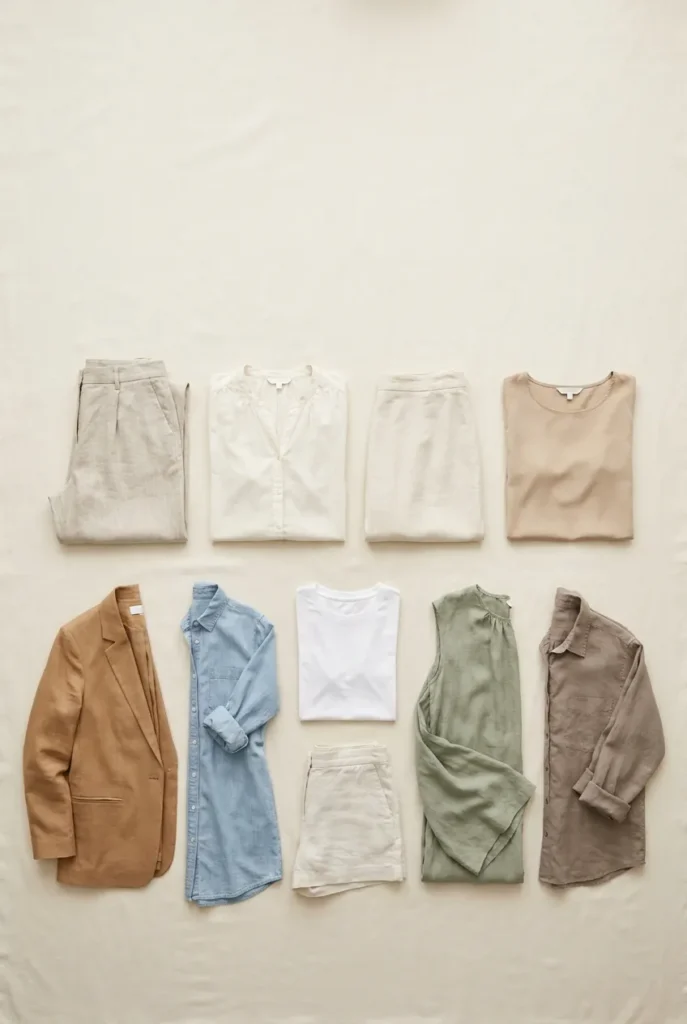
5 Cool Summer Outfit Formulas for Casual Hot Days
These are the formulas I reach for most on days when the temperature crosses 85°F and I still need to look like a person who has her life together. Each one follows the equation above. Each one uses pieces from the 10-piece capsule.
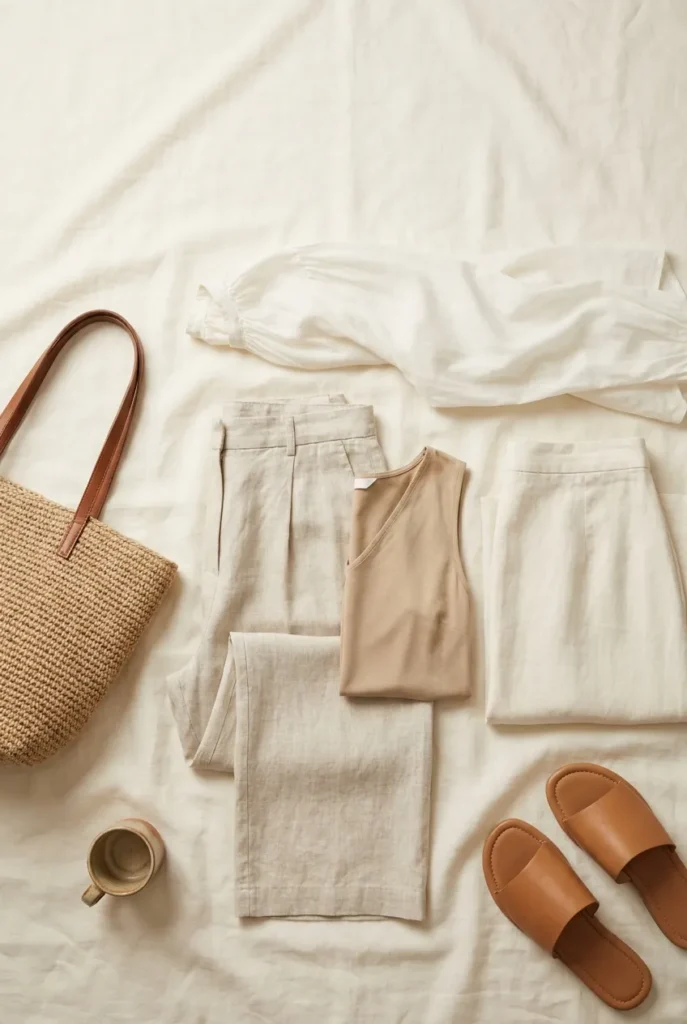
Formula 1: The Effortless Weekend Oat wide-leg linen trousers + white bamboo tee + tan woven tote + leather slides
The linen trousers ventilate from the hem up. The bamboo tee wicks close to the body. The loose trouser silhouette creates constant air movement as you walk. Total cost: $55 to $155 depending on where you shop. This is the combination I wore three times a week in Atlanta and it never let me down past 9 a.m.
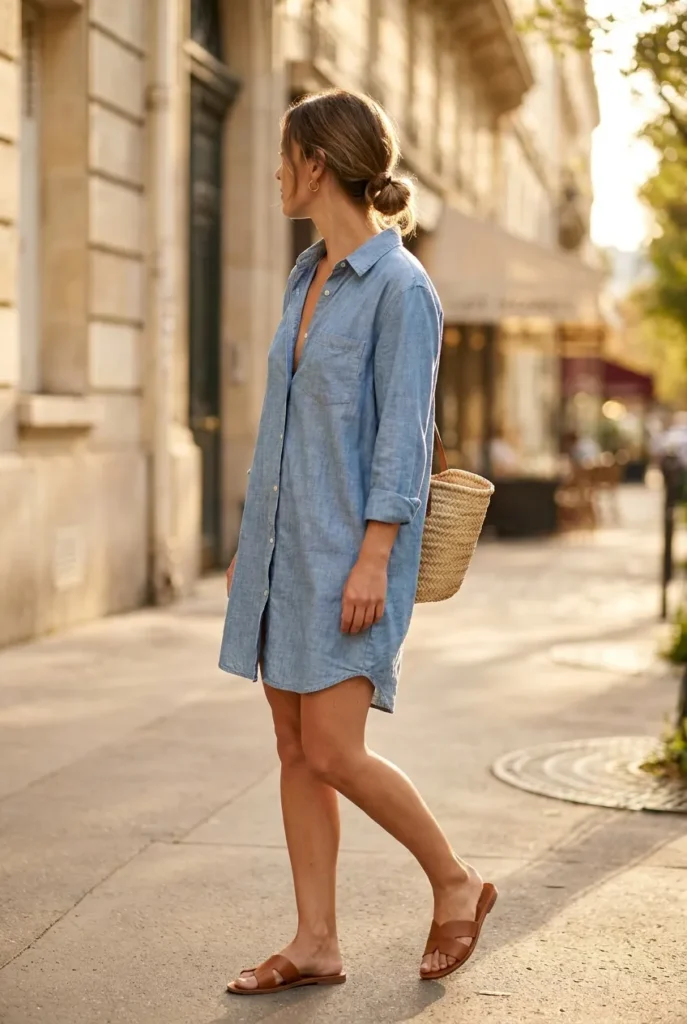
Formula 2: The Chic Errand-Running Look Light blue chambray shirtdress (worn open to mid-chest) + leather slides in cognac + gold hoop earrings
A shirtdress is one garment doing the work of two pieces, with the bonus of maximum air circulation around your legs. Chambray dries faster than denim or poplin in the same weight class, which matters on humid days when even a quick walk to your car leaves you damp.
Formula 3: The Quiet Luxury Summer Neutral Cream linen midi skirt + sand Tencel shell + camel leather crossbody + ballet flats
All three pieces are natural or semi-natural fibers. The A-line silhouette of the midi skirt creates consistent airflow and the neutral palette keeps the fabric cooler in direct sun. This is the combination I packed for 10 days in Lisbon and wore in four distinct configurations without repeating myself once. For more ways to stretch this skirt across your summer closet, eight capsule-friendly ways to style a maxi skirt this summer has combinations that work with most of what’s already in your capsule.
Formula 4: The Quiet Luxury Work-to-Weekend Camel linen-cotton blazer (worn open) + sand Tencel shell + ecru linen shorts + loafers
This one surprises people. A blazer in summer heat sounds wrong. A linen-cotton blend blazer worn open acts as a sun shield for your arms rather than a layer that traps heat. You’ll be noticeably more comfortable than the person next to you in a fitted synthetic tee.
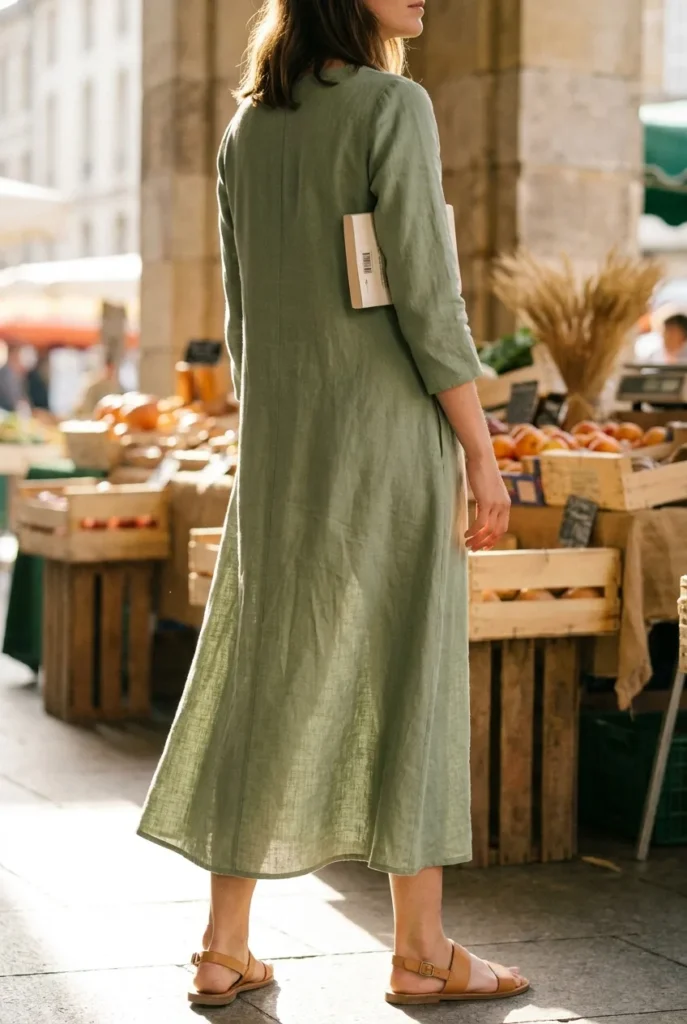
Formula 5: The Maxi-and-Done Day Sage linen maxi dress + flat tan sandals + woven tote
One garment, zero decisions, maximum breathability. A linen maxi that fits through the hip and flares from the knee circulates air with every step. It’s also one of the most Pinterest-performant silhouettes in the summer outfit category right now.
Cool Summer Outfit Formulas for Work and Office
Pinterest’s guided search tiles for this keyword were dominated by Office, Business casual, and Professional. That tracks: the summer work dilemma is specific. You need to look polished enough for a client meeting inside a 68°F building, then survive a 92°F walk from the parking garage without arriving soaked.
The approach is building your outfit from the inside out. Start with the base you’d wear in the heat. Add the professional layer (blazer, structured shirt) as the indoor piece. The outfit should function in both environments without you having to change.
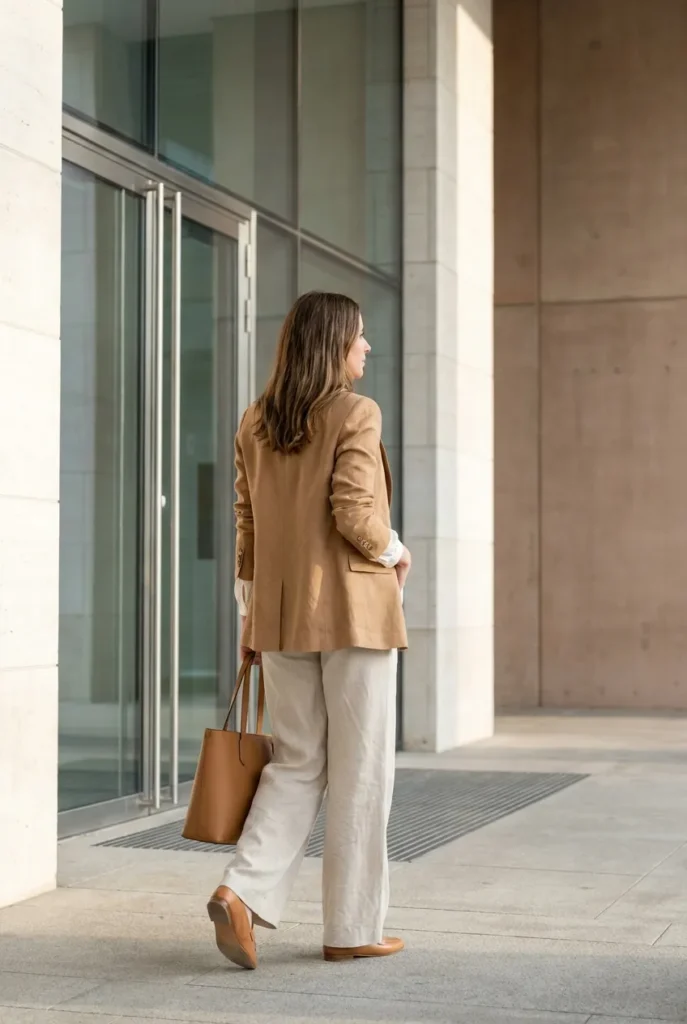
Work Formula 1: The Business Casual Breathable Oat linen-cotton wide-leg trousers + Tencel ivory shell + camel linen-cotton blazer (worn open) + pointed-toe loafers in tan
The blazer does double duty: it reads professional indoors and acts as a sun shield outdoors. The Tencel shell keeps you comfortable between the car and the door. This is the combination that makes the “85°F outside, 68°F inside” reality actually wearable across a full workday.
Work Formula 2: The Classy Summer Dress Option Chambray shirtdress belted at the waist + pointed ballet flats + gold hoop earrings + structured oat tote
Chambray belted reads as fully professional (it’s structured enough to signal intentionality) while performing in summer heat because of its open weave. According to REI’s expert guide on dressing for heat and humidity, woven fabrics with an open hand (like chambray) outperform tight weaves in heat and humidity even when the fiber content is the same. A belted shirtdress in chambray is one of the most cost-effective professional summer pieces you can buy. Old Navy and H&M both carry versions at $35 to $55. Banana Republic and J.Crew run $79 to $120 with slightly better drape.
Work Formula 3: The Teacher or Client-Facing Casual Ivory cotton voile blouse + oat wide-leg linen trousers + tan leather crossbody + white bamboo tank underneath
The voile blouse is genuinely airy, but it can be sheer in bright light. A white bamboo tank underneath solves the transparency problem without adding meaningful heat. The combination reads polished, breathes well, and works across a full day on your feet.
Weekend and Travel Outfit Formulas for Hot Weather
If you’re packing for anywhere warm (the American South, Italy, a beach town, a city long weekend), the capsule approach matters more, not less. Every piece needs to combine with at least four others, because you’re not bringing your full closet.
These three formulas assume a carry-on and five days. They use the same 10-piece capsule framework from earlier, so there’s no new shopping required if you’ve already built the base.
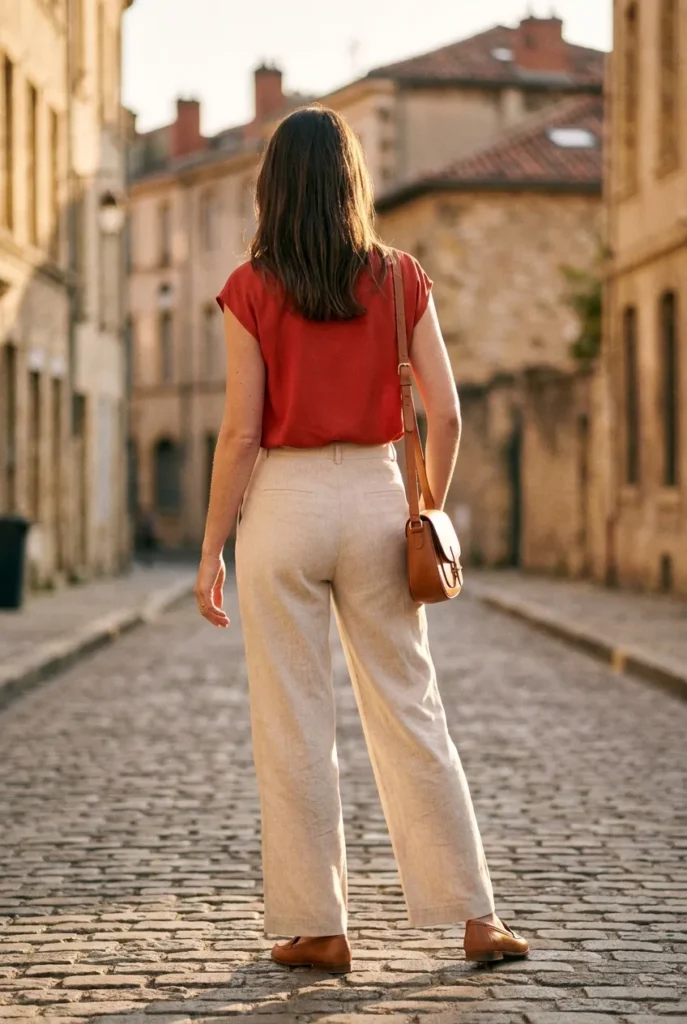
Travel Formula 1: The City Tourist Who Doesn’t Look Like One Oat wide-leg linen trousers + tomato red Tencel shell + tan loafers + camel leather crossbody
The tomato red shell (hex #C8392B) is your one accent piece. Everything else is neutral, so the whole bag still plays together in different combinations across five days. The Tencel shell handles humidity well. The linen trousers look intentional even after a 10-hour travel day.
Travel Formula 2: The Beach Town Look That Still Looks Intentional Cream linen midi skirt + white bamboo tee + woven tote + flat tan sandals + gold hoop earrings
This combination packs completely flat, weighs almost nothing, and dries overnight if you rinse it. A cream linen skirt is one of those pieces that gets noticeably better with wear as the linen softens. By day three of your trip it looks more expensive than it did on day one.
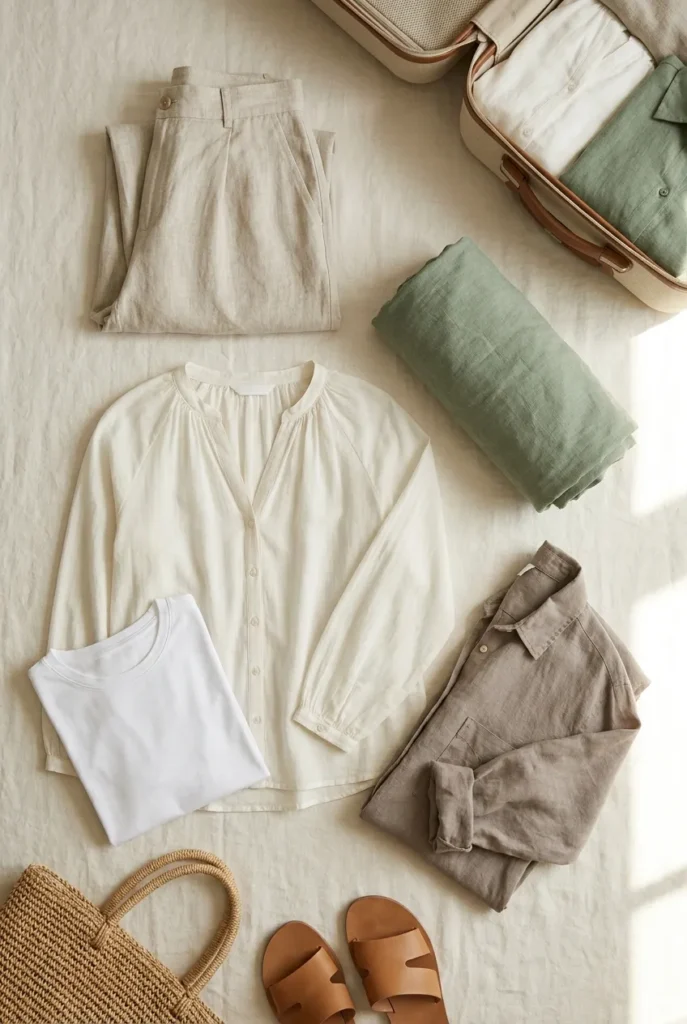
Travel Formula 3: The One-Bag Five-Piece Capsule These five pieces alone produce at least 14 distinct hot-weather outfits for a summer trip:
- Oat wide-leg linen trousers
- Sage linen maxi dress
- Ivory cotton voile blouse
- White bamboo tee
- Taupe linen overshirt
Outfit math: trousers plus bamboo tee = casual day one. Trousers plus voile blouse = polished day two. Maxi dress alone = day three. Overshirt over bamboo tee with trousers = different silhouette, same pieces. Overshirt open over maxi dress = evening look. And for any night when a breeze drops the temperature by 15 degrees, how to layer lightly when evenings cool down has six formulas that work directly over this capsule without adding bulk to your bag. For a deeper look at building this exact framework for a European trip, what to pack for hot-weather travel when you only have a carry-on shows how 10 pieces cover 10 days across three cities in summer heat.
The Fabric Traps That Keep People Hot (And How to Skip Them)
A few patterns come up again and again when readers tell me their summer outfits aren’t working.
The “breathable” polyester trap. Fast fashion brands label stretchy woven polyester as breathable. The fabric might have a mesh-like texture or a lightweight feel in the store, but it’s still synthetic. Your body heat has nowhere to go. If the fiber content reads 100% polyester or polyester blend with no natural fiber listed, it won’t perform above 80°F regardless of how it’s marketed.
The dark linen mistake. Linen in deep navy or black still ventilates well at the fiber level. But in direct summer sun, dark colors absorb significantly more solar radiation and warm the fabric from the outside in, which cancels out much of linen’s cooling benefit. Save dark linen for evening or shaded indoor settings. In full sun, go light.
The too-tight silhouette mistake. A slim-fit linen shirt removes the air gap that makes linen functional. It still looks polished, but it doesn’t actually keep you cooler than the synthetic next to it because the evaporation mechanism is blocked. Go one step looser than your usual fit, especially in trousers and tops.
The heavy natural fiber trap. A 280 GSM cotton poplin shirt is 100% natural fiber and will still overheat you in summer because the weight and density of the weave block airflow. Weight and weave matter just as much as fiber content. Lightweight open-weave cotton (voile, lawn, chambray): yes. Heavy cotton (canvas, poplin, French terry, thick jersey): no, not in heat above 80°F.
Frequently Asked Questions
What fabric keeps you coolest in summer?
Linen and Tencel are the strongest consistent performers in pure heat. In humidity specifically, Tencel edges ahead because it releases moisture faster and doesn’t stiffen when damp. A linen-cotton blend is the practical middle ground: slightly less breathable than pure linen but significantly easier to care for and less prone to heavy wrinkling. For most women building a summer capsule, a mix of all three covers every occasion from weekend to office.
What material stays cool in summer?
Any natural or semi-natural fiber in a lightweight, open weave. Linen (130 to 180 GSM), Tencel lyocell, cotton voile, cotton lawn, chambray, and bamboo all outperform synthetics in heat. The weave structure matters as much as the fiber: a tightly woven natural fabric can still trap heat, while an open-weave version of the same fiber breathes significantly better.
What is the 3-3-3 rule for clothes?
The 3-3-3 rule is a wardrobe minimalism challenge where you wear only 3 pieces for 3 months, rotating among 3 outfits. It’s more useful as a clarity exercise than as a practical daily system. The real value is what it reveals: which three pieces you’d actually reach for tells you exactly which items earn their hanger space in your real life. The 10-piece hot-weather capsule in this article is a more livable version of the same idea, with enough mix-and-match range to avoid repetition fatigue.
What clothes keep you cool in the summer?
Loose-fitting pieces in lightweight natural or semi-natural fibers, in light colors. The combination that outperforms everything else: wide-leg linen trousers or an A-line linen skirt (air circulation from the hem), a bamboo or Tencel shell (moisture-wicking against the skin), and light neutrals (ivory, oat, cream, sage) to reflect UV instead of absorbing it. Any single piece from that list helps. All three together is where the real difference shows up.
Does this approach work for petite women?
Yes, with a few proportional adjustments. If you’re 5’4″ or under, wide-leg linen trousers work best with a tucked or cropped top, otherwise the volume can read boxy rather than relaxed. A linen midi skirt in a petite-specific cut hits at a better proportion than a standard-length one (many brands including Banana Republic and J.Crew offer petite lengths). Linen shorts are often a stronger summer choice for petite frames than full-length trousers in peak heat.
Is linen worth the investment for summer?
Yes, firmly yes, on a cost-per-wear basis. I tracked cost-per-wear on every piece in my summer capsule for 6 months and the oat linen wide-leg trousers came in under $2 per wear by month three. Buy the right weight (130 to 180 GSM for summer), wash cold on a gentle cycle, and pull from the washer while still slightly damp to hang-dry. Linen gets softer and better-looking with every wash. Pre-washed linen from Quince or Everlane shrinks minimally on first wash and starts softer from day one.
Can I machine wash linen and Tencel?
Most linen and Tencel pieces can be machine washed on a gentle cold cycle. The risk with linen is shrinkage on the first wash (size up slightly if this concerns you) and wrinkling after tumble drying (pull it damp and hang-dry to avoid this). Tencel is more forgiving and handles the gentle cycle well without significant shrinkage. Both will outlast polyester pieces by years when cared for correctly, which is the whole argument for cost-per-wear.
The Only Summer Closet Principle You Need
Cool summer outfits for hot weather are not a style compromise. The woman who builds her summer closet around linen, Tencel, and lightweight cotton weaves looks more polished than the woman who grabs whatever synthetic looks summery on a sale rack. The fabric science backs it up. The outfit math works.
Start with two or three of the fabrics above, pick the formulas that match your actual life (casual, work, travel, or all three), and stop dreading hot days. A summer capsule that works in real heat, on real humid mornings, at real temperatures above 85°F: that’s the whole point of owning fewer pieces that actually earn their hanger space.
Save this post the next time you’re standing in front of your closet at 8 a.m. in July wondering what to wear.
Keep reading

Dresses Only Capsule Wardrobe: 10 Dresses, a Whole Summer of Outfits
A dresses only capsule wardrobe is the closest thing summer style has to a cheat code: ten dresses, zero coordinating, and a...
How to Style Knee-High and Tall Boots for Winter
You own the boots. You love the boots. And somehow they still live in the back of the closet while you reach...

Winter Capsule Wardrobe 2026: 20 Pieces That Mix Into 30+ Outfits
You know the feeling. The closet is full, the floor has three rejected sweaters on it, and you are still cold and...